One Microlitre Across Sixty Pivots: The Engineering of Watch Lubrication
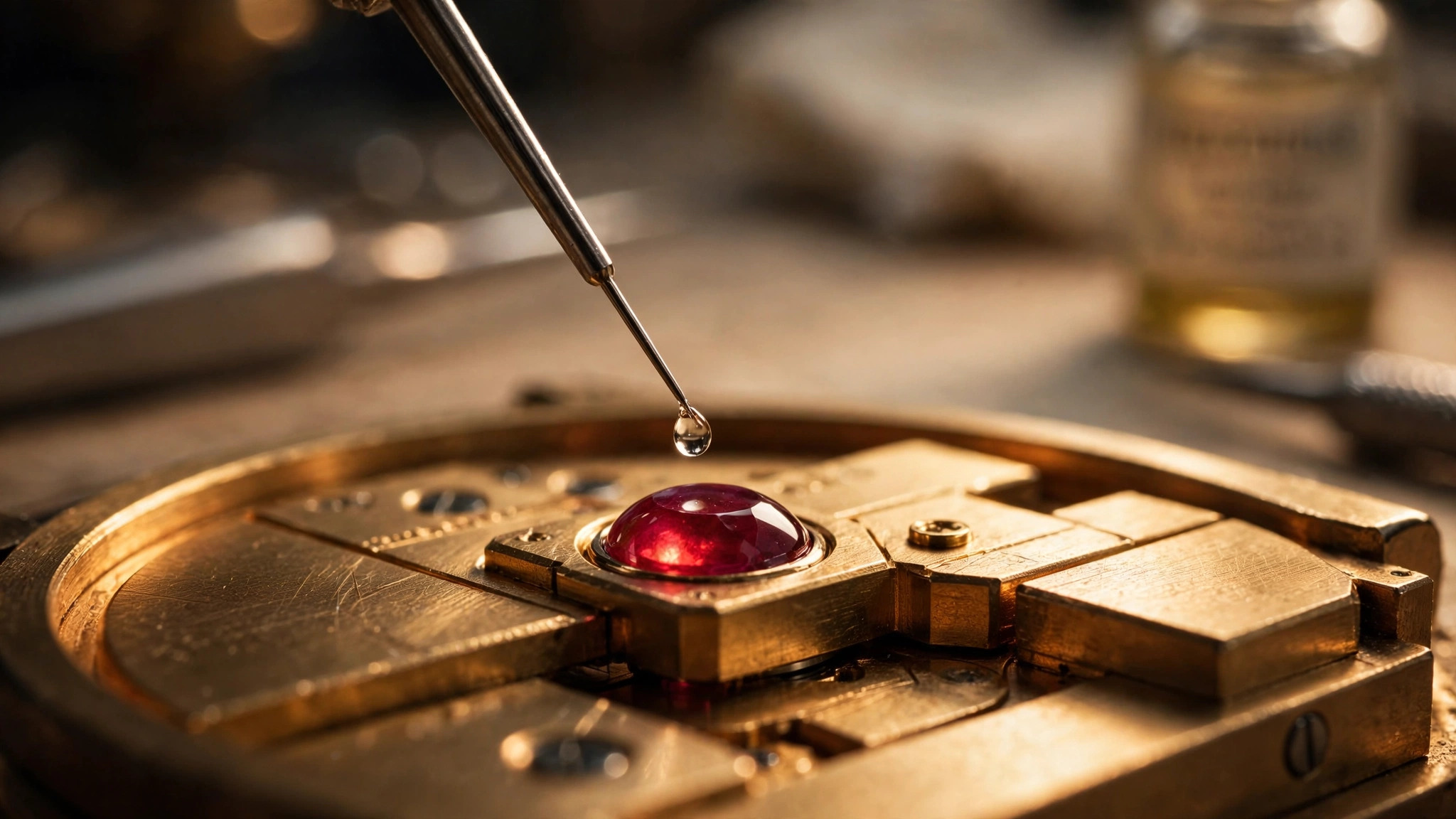
A mechanical watch movement needs roughly one microlitre of oil, distributed across sixty or more friction points. Each point requires a specific viscosity, a precise volume, and a surface treatment to keep the lubricant in place. When the oil degrades, the watch does not stop immediately. It drifts, then stutters, then wears itself to ruin.
Why a Mechanical Watch Needs Oil
Every rotating component in a mechanical watch rides on pivots, typically hardened steel arbors turning inside synthetic ruby or sapphire jewel bearings. Without lubrication, steel against corundum generates enough friction to drain the mainspring’s limited energy reserve before it can reach the escapement. A standard ETA 2824 caliber stores roughly 38 hours of energy in its mainspring barrel. If the friction at its approximately 21 jewel bearings were to double, the power reserve would collapse to hours rather than days, and the amplitude of the balance wheel would drop below the threshold required for accurate timekeeping.
Friction in a watch movement is not uniform. At the barrel arbor, a steel shaft turns slowly under high torque, grinding against the barrel wall. At the escape wheel pivots, tiny arbors spin at 21,600 vibrations per hour (in a 3 Hz movement) under almost no load. At the pallet fork, two synthetic ruby stones make and break contact with the escape wheel teeth 21,600 times per hour, experiencing impact forces that would fling a low-viscosity oil off the surface within days. Each of these interfaces presents a different tribological profile: different speeds, different pressures, different geometries, and therefore different lubrication requirements.
This is why a single oil cannot serve an entire movement. A watchmaker uses between five and eight different lubricants during assembly, each selected for its viscosity, film strength, and spreading behavior. Getting one wrong at one point is enough to compromise the whole mechanism.
From Cattle Fat to Synthetic Ester
For most of horological history, watchmakers used animal-derived oils. The most valued was porpoise jaw oil, prized for its low viscosity and resistance to thickening in cold temperatures. Others used neatsfoot oil, rendered from the shin bones and feet of cattle, or olive oil refined to remove acids. Abraham-Louis Breguet, perhaps the most accomplished watchmaker in history, reportedly lamented that if only someone could give him the perfect oil, he could give them the perfect watch.
Breguet’s frustration was well founded. Animal and vegetable oils are chemically unstable. They oxidize on contact with air, producing varnish-like residues that increase friction rather than reduce it. They evaporate, especially in the minuscule volumes used in watch movements. They attract dust, which mixes with degraded oil to form an abrasive paste. In warm climates, they thin and migrate away from the friction point. In cold climates, they thicken and resist the movement of pivots already operating under minimal torque. A watch oiled with natural lubricants needed servicing every one to two years.
Synthetic watch oils arrived in the 1970s, primarily from a single source: Moebius, founded in Hanover in 1855 by watchmaker Hermann Moebius and now part of the Swatch Group’s research and development division. Moebius’s synthetics are based on modified ester chemistry, synthetic hydrocarbon chains engineered for specific viscosity curves, oxidation resistance, and surface adhesion. They do not break down as rapidly as natural oils. They do not attract dust as aggressively. They maintain their viscosity across a wider temperature range. Their introduction extended recommended service intervals from one or two years to five, and later to seven or even ten years, depending on the movement and manufacturer.
But synthetic oils still degrade. Exposure to microscopic metal particles shed from pivots, to the faint atmospheric moisture that penetrates even the best gasket seals, and to the simple passage of time gradually alters their chemistry. After a decade, even the best synthetic lubricant in a well-sealed movement has lost enough of its original properties to warrant replacement. This is why your five-thousand-dollar mechanical watch requires periodic servicing at a cost of several hundred dollars. The service is not primarily about worn gears or broken springs. It is about exhausted oil.
The Moebius Menu
Walk into any professional watchmaker’s workshop and you will find a row of small glass vials, each containing two millilitres of clear or faintly amber liquid. These are the Moebius oils and greases that constitute the standard lubrication kit for modern Swiss movements. Each formulation is designed for a specific class of friction point.
Moebius 9010 is the lightest oil in common use: a thin synthetic with extremely low viscosity, designed for high-speed, low-load applications. It goes on the pivot jewels of the balance staff and the escape wheel, where arbors turn rapidly under minimal pressure. Its thinness allows it to form a film only a few molecules thick, just enough to separate metal from stone without creating drag that would reduce the balance wheel’s amplitude.
Moebius HP-1300 (also designated 9104) is a step heavier. It serves medium-load pivots: the center wheel, third wheel, and barrel arbor. These components turn more slowly than the escapement but carry more force from the mainspring. HP-1300’s higher viscosity gives it better film strength, meaning it resists being squeezed out from between the pivot and jewel under load.
Moebius 9415 is reserved for one of the most demanding surfaces in the movement: the impulse faces of the pallet stones. These two synthetic rubies, set into the pallet fork, make intermittent contact with the teeth of the escape wheel. Each contact transmits a tiny impulse of energy to the balance wheel. The oil on these surfaces must cling to polished corundum under repeated impact without spreading to the pallet fork’s pivots, where its presence would add unwanted friction. Applying 9415 correctly is considered one of the most delicate tasks in watch assembly. A fraction too much, and it creeps onto the pivot. A fraction too little, and the dry stone-on-steel contact accelerates wear on the escape wheel teeth.
Moebius 8200 is a natural grease (one of the few non-synthetic formulations still in regular use) applied to mainsprings. The inner coil of a mainspring slides against the barrel arbor, and the outer coil slides against the barrel wall. These are large, slow, high-pressure surfaces. Grease, not oil, is required because a liquid lubricant would be squeezed out under the mainspring’s stored tension. Some manufacturers have switched to Teflon-coated mainsprings that require no additional lubrication.
Moebius 9501 handles the keyless works, the system of levers and springs beneath the crown that switch between winding and time-setting modes. These parts slide laterally rather than rotating, and they move infrequently. The grease needs to stay put for years between actuations.
Epilame: The Invisible Fence
Oil on a jewel bearing does not stay put on its own. Left to physics, a droplet of Moebius 9010 deposited onto a ruby cup jewel would spread outward along the polished surface, climb the walls of the jewel setting, and migrate onto surrounding bridges and plates where it serves no purpose and may actively harm the movement by creating unwanted drag on dry surfaces.
Epilame is the solution. It is a fluorocarbon surface treatment, applied as a dip or spray to selected components before assembly. The treatment leaves a monomolecular film of hydrophobic and oleophobic molecules on the surface. This film dramatically increases the contact angle of any oil deposited on it, causing the lubricant to bead up and stay confined to the specific friction surface rather than spreading across the broader component.
Think of it as an invisible fence. The oil sits in the jewel cup, held in place not by gravity or surface tension alone, but by the chemical hostility of the surrounding epilamed surface. If the oil tries to spread beyond the bearing, it encounters a zone where the surface energy is so low that the lubricant simply cannot wet it.
Not every component receives epilame treatment. Balance wheels and hairsprings are left untreated because they should carry no oil at all. Even the microscopic thickness of an epilame coating could alter the hairspring’s stiffness or change the balance wheel’s moment of inertia by a measurable fraction. Pallet stones are epilamed individually by dipping just the impulse face, leaving the pivots dry. The precision required is remarkable: a coating intended to confine oil to a surface smaller than a grain of sand, applied to a component that itself weighs a fraction of a gram.
Modern high-volume production epilames components by bathing entire racks in a fluorocarbon solution and then selectively removing the coating from surfaces that need to accept oil. The result is a binary landscape across every bridge, plate, and jewel: regions that welcome lubricant and regions that repel it, all invisible to the naked eye.
Robotic Oiling and Nanolitre Precision
In the era of hand assembly, oiling was the watchmaker’s most anxiety-inducing task. A steel oiler, essentially a polished wire with a rounded tip, was dipped into a reservoir of oil and touched to the jewel bearing. Volume control depended on the watchmaker’s skill and the diameter of the oiler tip. Too much oil was the more common error, because the consequences of too little oil were invisible at first but catastrophic later.
Contemporary Swiss manufactures have largely automated this step. Robotic oiling stations use inkjet-style piezoelectric dispensers to deposit oil in volumes measured in nanolitres. Each oiling point in the movement is programmed with a specific lubricant type, a specific volume, and a specific position. A camera system verifies the oil deposit after application, checking that the droplet is centered on the jewel and that no satellite droplets have landed on surrounding surfaces.
Swatch Group’s ETA division, which produces more mechanical movements than any other manufacturer, runs assembly lines where a single movement passes through multiple oiling stations. Each station handles a different lubricant: one for the escapement, one for the gear train, one for the barrel. The entire oiling sequence for a movement containing 21 jewels takes less than two minutes. By hand, the same process takes a skilled watchmaker fifteen to twenty minutes and introduces significantly more variation in deposit volume.
The Degradation Curve
Fresh synthetic oil in a watch movement has a viscosity optimized for its operating temperature, typically between 5°C and 40°C. At room temperature, Moebius 9010 has a kinematic viscosity of approximately 3 centistokes, thin enough to form a boundary film without creating drag, thick enough to prevent metal-on-stone contact.
Over time, several mechanisms degrade this performance. Oxidation, accelerated by trace metals from the pivots acting as catalysts, increases viscosity and produces acidic byproducts that can etch jewel surfaces. Evaporation reduces the volume of oil at each point, eventually thinning the film below its functional threshold. Contamination from microscopic particles of metal, dust, and gasket material creates an abrasive suspension. Migration, despite epilame treatment, slowly redistributes oil from high-need surfaces to low-need ones.
The degradation is not sudden. A well-assembled movement with fresh synthetic lubricants will run within specification for five to seven years with minimal change in performance. Between years seven and ten, amplitude begins to drop as friction increases at the escapement. Rate stability degrades as the thickening oil at the pallet stones alters the impulse geometry. By year twelve or fifteen, unserviced, the movement may still run, but accuracy has deteriorated to minutes per day, and the pivots are beginning to score the jewel surfaces in ways that fresh oil alone cannot repair.
This is the practical case for regular servicing. A five-hundred-dollar service at year eight replaces degraded lubricant before it causes mechanical damage. A fifteen-hundred-dollar overhaul at year fifteen replaces scored jewels, re-pivots worn arbors, and addresses damage that accumulated because the oil was spent. The cheapest maintenance strategy is almost always the early one.
Silicon and the Dry Friction Frontier
Silicon components have reshaped the lubrication equation. Silicon is lighter than steel, harder than most conventional escapement alloys, perfectly paramagnetic (immune to magnetic interference), and critically, it can operate in a tribological regime where conventional lubrication is unnecessary.
When two silicon surfaces interact, or when a silicon surface contacts a corundum jewel, the friction coefficient is low enough that the energy budget of a mainspring can sustain operation without oil at the escapement. Omega, Rolex, Patek Philippe, and Swatch Group’s various brands all now produce escapement components from silicon, typically the hairspring, the escape wheel, and the pallet fork. These three components account for the majority of friction-related energy loss in a conventional movement. Eliminating oil at these points does not make the movement oil-free. It reduces the total number of oiling points from approximately sixty to approximately forty, and it removes oil from the locations most sensitive to degradation.
Jaeger-LeCoultre pushed further with the Master Compressor Extreme LAB in 2007. This movement used silicon for its escapement, ceramic ball bearings for its rotor (eliminating oil at the automatic winding mechanism), diamond-like carbon coatings on sliding surfaces, and a magnesium-alloy tourbillon carriage. Black diamond replaced conventional ruby pallet stones. Easium, a proprietary carbonitride coating, covered high-friction interfaces. The result was a movement that Jaeger-LeCoultre claimed required no lubrication over its lifetime.
The Extreme LAB was a proof of concept rather than a volume production piece. Fewer than a hundred were made. Its successor, the Extreme LAB 2, refined the approach with a 569-component caliber incorporating a column-wheel chronograph, ceramic rotor bearings, and the same oil-free silicon escapement. Both watches sold for six-figure prices, reflecting the cost of materials and manufacturing processes far beyond conventional watchmaking.
A fully oil-free production movement for mainstream watches remains elusive. Silicon eliminates lubrication at the escapement, but the gear train still depends on oil. Barrel arbors still need grease. The keyless works still require lubrication. Each of these interfaces presents material challenges distinct from the escapement: higher loads, different motion profiles, surfaces that silicon alone cannot address. Industry sources estimate that eliminating oil from an entire movement would require replacing every bearing surface with either ceramic or diamond-like carbon, at a cost that would push even a basic three-hand watch into five-figure territory.
What the Oil Tells You About the Watch
Experienced watchmakers can read a movement’s history from its lubrication. Oil that has turned from clear to dark amber indicates oxidation, often from a failed gasket admitting atmospheric moisture. Oil that has migrated from its jewel cups to surrounding bridges suggests either inadequate epilame treatment or a shock event that flung the lubricant out of position. Dry jewels with visible scoring on the pivot holes indicate that the movement ran for years after its oil was spent. A movement with fresh-looking oil on the gear train but degraded oil on the pallet stones was probably oiled by someone who used a single lubricant for all points rather than the correct viscosity for each.
The presence or absence of epilame treatment itself tells a story. Budget movements from the 1970s and 1980s often received no epilame at all, relying on the natural surface tension of oil on polished jewels. These movements required more frequent servicing because the oil migrated freely. High-end manufactures epilame every relevant surface, confining each oil deposit with chemical precision.
A watch that runs ten years without service is not a testament to overengineering. It is a testament to the quality of its lubricant and the precision of its application. When it finally loses accuracy, the oil is almost always the reason. Not the mainspring. Not the hairspring. Not the balance wheel. Oil.
Specifications
| Parameter | Typical Value |
|---|---|
| Total oil volume per movement | ∼1 µL (1/1,000th of a millilitre) |
| Oiling points (standard 3-hand movement) | 50–65 |
| Oiling points (chronograph movement) | 80–120 |
| Moebius 9010 kinematic viscosity (20°C) | ∼3 cSt |
| Moebius HP-1300 kinematic viscosity (20°C) | ∼30 cSt |
| Epilame coating thickness | 1–3 nm (monomolecular) |
| Robotic oiling deposit accuracy | ±0.5 nL |
| Service interval (natural oils, pre-1970s) | 1–2 years |
| Service interval (synthetic oils, modern) | 5–10 years |
| Temperature operating range | 5°C to 40°C |
| Silicon escapement oil requirement | None (dry friction coefficient < 0.1) |