Two Heartbeats, Seventy Days
How the Vacheron Constantin Twin Beat solves the perpetual calendar’s oldest problem
A perpetual calendar that stops is worse than a watch with no calendar at all. With a simple three-hander, you wind it and go. With a stopped perpetual, you sit with a corrector tool and press tiny buttons forty or fifty times, advancing each display one increment at a time until the day, date, month, and moon phase all agree with reality. Get one wrong and everything downstream shifts. Miss the leap year indicator and you won’t know until February 2028.
That is the central irony of the complication: perpetual calendars exist to eliminate the need for manual date correction, yet they demand a power reserve that never lapses, and most mechanical movements offer 48 to 72 hours before the mainspring gives out and every indication freezes. A collector who rotates through five watches will let the perpetual sit for a week, maybe two, and then the whole corrector-tool ritual begins again.
Vacheron Constantin’s answer, first introduced in 2019 and quietly improved for 2026, is the Traditionnelle Twin Beat Perpetual Calendar, a watch carrying two balance wheels inside the same movement: one beating at 5 Hz for daily wear, and a second that takes over when the watch comes off the wrist. Press a button at 8 o’clock and the movement switches to 1.2 Hz. Seventy days of reserve on standby, two and a third months without winding, without the calendar losing a single day.
Nobody else builds anything like it.
The Energy Arithmetic
Power reserve in a mechanical watch is governed by three variables: how much energy the mainspring stores, how much the escapement consumes per oscillation, and how many oscillations occur per unit of time, with frequency controlling the third variable directly and appearing as a multiplier in the energy budget so that halving the frequency roughly doubles the reserve from the same barrel. Drop from 5 Hz to 1.2 Hz and the math becomes dramatic.
At 5 Hz, the balance wheel completes 36,000 vibrations per hour, depleting the mainspring’s stored energy in approximately four days. At 1.2 Hz, that rate falls to 8,640 vibrations per hour, roughly one quarter the consumption. From the same co-axial double barrel, the Caliber 3610 QP stretches its reserve from four days to seventy, a factor of seventeen and a half that exceeds the simple frequency proportion because the 1.2 Hz gear train uses a physically larger balance wheel with a thinner, purpose-built hairspring, both optimized for low-energy oscillation rather than high-frequency accuracy. Every component in the standby train was designed to sip rather than gulp.
Accuracy at 1.2 Hz is lower than at 5 Hz, and Vacheron acknowledges this openly: five hertz delivers the precision expected of a Geneva Seal movement during daily wear, while standby mode prioritizes something else entirely, keeping the calendar alive. If the watch drifts a few seconds per day while sitting in a drawer, nobody cares, because what matters is that the perpetual calendar mechanism receives its nightly kick, the date advances, and the month and leap year registers stay synchronized. Recognizing that a perpetual calendar has two distinct operating conditions, each with different accuracy requirements, and building a movement that serves both from a single energy source is where the intellectual contribution lives.
Three Differentials and One Barrel
Running two independent gear trains from one mainspring barrel creates a distribution problem, and a differential, in horology as in automotive engineering, splits torque between two outputs that may rotate at different speeds. Vacheron’s caliber uses three of them.
When the wearer presses the mode selector, a V-shaped spring on the movement acts as a hacking mechanism, stopping one balance wheel and releasing the other, but because the gear trains connected to these balance wheels draw power from the same barrel at different rates, the instantaneous load change during switchover would damage the wheels or cause the mainspring to lurch without something to absorb the speed mismatch. That something is the first differential, and its sole purpose is smoothing the handoff.
Differential number two sits between the mainspring and the 1.2 Hz gear train, handling energy distribution. A mainspring delivers less torque as it unwinds, and the standby train’s larger balance wheel requires a different torque profile than the 5 Hz train, so the second differential ensures that energy from the barrel reaches the low-frequency balance at a consistent rate regardless of the barrel’s current wind state. That hairspring, thinner than a human hair, demands stable driving force throughout the entire 70-day reserve; fluctuations that a 5 Hz balance could absorb through its higher momentum would cause the 1.2 Hz wheel to stutter and eventually halt.
The third is the cleverest. Both operating modes need a power reserve indication, but they have wildly different scales: four days versus seventy. Rather than fitting two separate power reserve displays, Vacheron routes both through a single hand on a single counter with two concentric scales, and differential number three translates the barrel’s remaining energy into two parallel outputs calibrated to their respective depletion curves, driving the display hand accordingly depending on which mode is active. One hand, one counter, two scales, zero wasted dial space.
Where the Extra Five Days Came From
The original 2019 Twin Beat managed 65 days in standby, and seven years later, the 2026 version reaches 70. Five additional days may sound marginal, but finding them inside an already optimized movement required Vacheron’s engineers to rethink how the perpetual calendar mechanism itself consumes energy, because that mechanism, not the timekeeping train, had become the dominant parasitic load on the barrel.
Perpetual calendars with instantaneous date changes are energy hogs by design. At midnight, a spring-loaded lever releases and the date disc snaps forward one position in a fraction of a second, demanding a burst of torque far exceeding normal timekeeping consumption; in a conventional perpetual, the date-change mechanism might consume as much energy in that single second as the balance wheel does in several minutes of continuous oscillation. Multiply that across 70 nights and the cumulative draw becomes impossible to ignore.
Vacheron’s solution was a patented double-gear spring-winding system for the calendar drive, replacing the traditional arrangement where the mainspring directly powers the instantaneous jump with a staged approach: a smaller intermediate spring gradually charges over the course of the day, storing just enough energy to drive the date change at midnight, so the peak torque requirement drops by a factor of four because the charging occurs over hours rather than demanding a sudden burst from the barrel.
Multiply that savings across 65 nights and the accumulated energy that the original mechanism would have consumed on date changes now remains available in the barrel. Five extra days, liberated by redesigning the calendar’s appetite rather than enlarging the pantry.
Inside the 480 Components
Those dimensions deserve a moment. A standard perpetual calendar movement without the dual-frequency system typically runs 28 to 33 millimeters wide and 5 to 7 millimeters thick, and Vacheron fit an entire second gear train, a second balance wheel, three differentials, the V-shaped hacking spring, the new double-gear calendar drive, and 64 jewels into a package that occupies essentially the same volume. Four hundred eighty components, Geneva Seal certification, manual winding only.
Manual winding is deliberate, not a concession. An automatic rotor would add 3 to 4 millimeters of thickness and introduce a complication that runs counter to the watch’s purpose: if the Twin Beat spends most of its time in standby mode sitting in a safe, the rotor would never spin, making its weight and mechanism nothing but dead mass that pushes the case beyond 15 millimeters. Manual winding also gives the wearer tactile feedback on remaining reserve, the kind of information a rotor-wound barrel obscures behind automation.
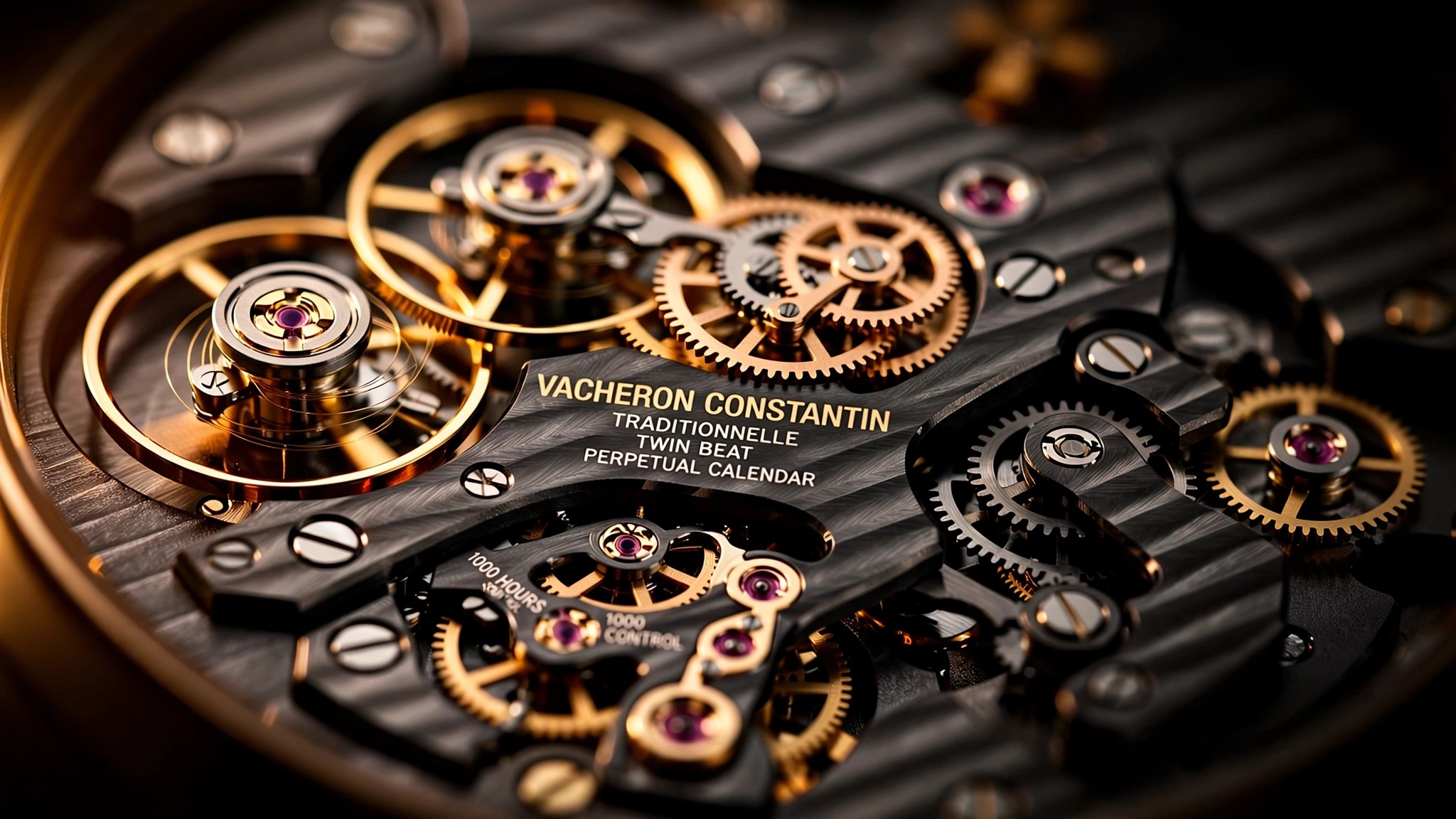
Geneva Seal certification means every component meets the Hallmark’s requirements for finishing, functional testing, and accuracy, with bridges hand-beveled and decorated with Côtes de Genève, while the mainplate receives a sandblasted finish followed by NAC galvanic coating, a dark surface treatment offering better corrosion resistance and visual depth than traditional rhodium plating. Through the sapphire caseback, the contrast between anthracite fixed components and golden moving parts makes the movement’s architecture legible at a glance.
Platinum Case, Sapphire Dial
Vacheron houses the 3610 QP in a 42-millimeter, 12.3-millimeter-thick case machined from 950 platinum, a metal roughly 60 percent denser than 18-karat gold, which gives the case a weight and wrist presence disproportionate to its modest dimensions. Water resistance is rated at 30 meters, adequate for handwashing but obviously not swimming, which is standard for a watch whose caseback is an exhibition sapphire crystal and whose crown drives a manual-wind caliber without screw-down sealing.
The dial is where things get unusual. An upper section in 18-karat gold receives a ruthenium coating in slate grey with a radiating hand-guilloché pattern, each line cut individually on a rose engine lathe, while below and around this gold section, a sapphire crystal panel exposes the movement’s mainplate, treated with the same dark NAC coating visible through the caseback. Calendar displays for day, date, and month occupy transparent sapphire discs that are laser-etched with a frosted finish providing contrast and legibility against the dark movement beneath, so the perpetual calendar’s information is readable not because it sits on top of an opaque dial, but because the frosted text catches light differently than the polished and sandblasted surfaces underneath.
Applied hands in 18-karat white gold indicate hours and minutes, with a large arrow at 9 o’clock pointing to the current frequency mode on a sector showing both “5 Hz” and “1.2 Hz,” and at 12 o’clock, the dual-scale power reserve indicator tracking remaining energy for whichever mode is active. Red stitching on the black calfskin strap and a platinum pin buckle round out the details.
Who This Watch Is Actually For
At 282,000 Swiss francs, the Twin Beat is not competing with the Patek Philippe 5236P or the Lange Datograph Perpetual on dial aesthetics or thin-dress-watch elegance. Its case is thick by perpetual calendar standards, and its dial is frankly busy, with visible movement architecture, two frequency indicators, and five calendar apertures occupying nearly every available surface, so do not expect it to vanish under a shirt cuff.
What it does is solve a problem that collectors with rotation habits know intimately: a watch that can sit in a safe for ten weeks and still show the correct date when you pick it up eliminates the single most maddening aspect of perpetual calendar ownership. Every other maker addresses this by offering a quick-set mechanism or a longer conventional power reserve, with Jaeger-LeCoultre’s Master Ultra Thin Perpetual Calendar providing correctors that can advance or retract every indication, and IWC’s Portugieser Perpetual Calendar storing about seven days of reserve, but neither approach comes within an order of magnitude of what the Twin Beat offers.
The 2026 version’s five extra days of reserve might seem like a footnote on a 70-day total, but the engineering behind those five days, specifically the double-gear spring-winding mechanism that cuts calendar-drive torque by 75 percent, represents the kind of iterative refinement that separates a proof of concept from a mature caliber. Vacheron didn’t just bring the Twin Beat back; they identified the single largest remaining energy sink in the movement and redesigned it from the ground up, which is exactly the kind of unglamorous mechanical problem-solving that separates real manufacture watchmaking from assemblage.
Seven years between versions. Five days gained. Four hundred eighty components in thirty-two millimeters. One problem solved in a way nobody else has attempted, and for good reason: the engineering cost of a second complete timing system, three differentials, and a purpose-built calendar drive is staggering, and only a house with Vacheron’s depth of movement design talent and patience for low-volume production would pursue it.
Sources
- Hodinkee, “Introducing: The Vacheron Constantin Traditionelle Twin Beat Perpetual Calendar Is Back,” June 2026. hodinkee.com
- Teddy Baldassarre, “Vacheron Constantin Traditionnelle Twin Beat Perpetual Calendar,” June 2026. teddybaldassarre.com
- Watchonista, “Vacheron Constantin's Traditionnelle Twin Beat Perpetual Calendar Extends the Meaning of Perpetual,” June 2026. watchonista.com
- SJX Watches, “Vacheron Constantin's Twin Beat Returns with 70-Day Power Reserve,” June 2026. watchesbysjx.com
- GMT Post, “SIHH 2019: Vacheron Constantin Traditionnelle Twin Beat Perpetual Calendar,” January 2019. gmtpost.com