The Speedster Finally Fits: Union Glashütte's 2026 Belisar in 40mm
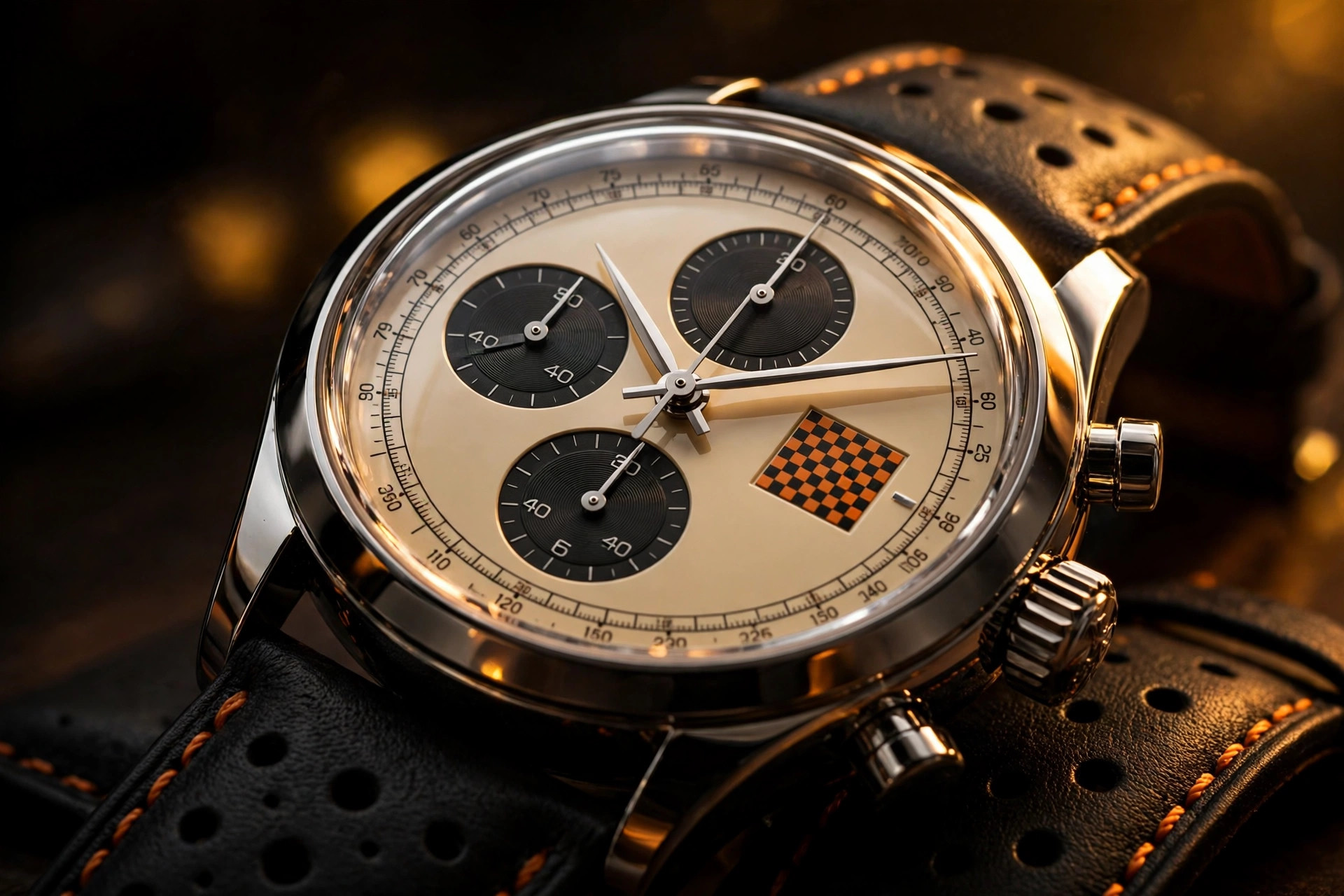
For five years Union Glashütte built the Belisar Chronograph Speedster into one of the most characterful racing chronographs nobody was talking about, and every single one of them arrived at 44 millimeters with a 52.9-millimeter lug-to-lug that wore like a hockey puck on any wrist that was not a pilot's.
No flaw in the series mattered more than the case size, and the 2026 edition fixes it: forty millimeters across, 14.65 thick, 48 lug-to-lug. Same series, same obsession with cars, a case you can actually wear under a cuff.
It also changes the muse, because past Speedsters nodded to model lines and rallies while this one copies a specific car: a 1968 Porsche 911 owned by Mainz-based automotive artist Marcus Haub, painted beige with bright orange detailing in a checkerboard pattern across the trunk, a car Haub has painted many times. Union Glashütte just painted it on a dial.
Not a rendering of a 911, not a badge, not a wheel design. A livery. That distinction matters, and it is the whole reason this watch works.
A Livery Is a Legibility Device
Racing liveries exist to be read at speed from a distance, which makes them one of the few art forms with a functional requirement, and a chronograph dial is the same problem at a different scale: information that must resolve instantly, at a glance, in bad conditions. Borrowing a livery for a dial is not decoration. It is stealing someone's solution to your problem.
Union Glashütte committed to the theft. The dial is glossy beige with orange chequered details concentrated on the right quarter, echoing Haub's trunk, while three matte black snailed sub-dials carry the 30-minute and 12-hour elapsed-time counters plus running seconds. A peripheral tachymeter scale in black frames everything. Black nickel-plated hands and white lacquered hands carry Super-LumiNova on the hour and minute, so the legibility the livery promises survives the dark.
Date sits inside the 12-hour counter at six, adjusted by a recessed corrector at ten, which keeps the dial balanced instead of punching an asymmetric hole in it, and running seconds live at nine. Everything a racing chrono needs, nothing it does not.
Mushroom-shaped pushers complete the vintage register, the kind of profile that went out of fashion when cases shrank in the 1990s and came back the moment anyone admitted 44-millimeter sport watches looked silly on normal people. They belong here more than they belonged on the old case.
The Movement Is Honest Work
UNG-27.S1 is an automatic calibre on the Valjoux 7750 architecture, and Union Glashütte does not pretend otherwise. Twenty-nine jewels, 28,800 beats per hour, hacking seconds, cam-actuated chronograph with 60-second, 30-minute, and 12-hour counters. One upgrade Union does claim, and it counts: a silicon balance spring.
Silicon buys two things a 7750-based movement actually needs. Antimagnetism, which matters because modern life is a magnetic minefield of laptop speakers, phone mounts, and magnetic clasps that can send a traditional Nivarox spring seconds off in a day. And thermal stability, since silicon barely moves with temperature the way metal springs do, leaving a minimum 65-hour power reserve with chronometry that behaves.
Union then does something the bigger Swatch Group brands cannot be bothered with at this price: the calibre is decorated, assembled, and regulated by hand in Glashütte, visible through the screw-down sapphire caseback. Hand regulation on a workhorse base is a better proposition than an unfinished "manufacture" movement at the same money, and it shows the brand knows exactly where it sits in the hierarchy.
Screwed-on case flanks, a screw-down crown, a domed sapphire crystal with anti-reflective treatment on both sides, and 100 meters of water resistance round out a case that takes its engineering seriously even when the dial is having fun. At 14.65 millimeters thick it is not svelte, which is the price of a 7750 with a display back, but it is a full half millimeter thinner than the 44-millimeter carcass it replaces.
Five Years of Speedsters, One Recurring Mistake
The Speedster series has run as annual limited editions since 2021, and the lineage tells you everything about the brand's priorities: a striking yellow-and-black 2022 edition, a 2023 tribute to a legendary 1970s car, a Porsche-themed 2024 model, and a 2025 edition that took its cues from the Lancia Delta Integrale, of all things, which was the first time the series looked at an Italian icon instead of a German one, and a bold move that delighted collectors precisely because it broke the pattern.
All of them were 44 millimeters, and nobody complained about the dials, though everyone quietly wished they wore smaller. That 2025 Integrale edition came in at 15.01 thick with a 52.99-millimeter lug-to-lug, and Monochrome's hands-on coverage of the 2024 electric-blue model had the same dimensions.
Union fixed it by porting the Speedster onto the compact Belisar Chronograph platform it introduced last year, the 40-millimeter case family that already proved the brand could do restraint. The 2026 Speedster is limited to 288 individually numbered pieces at EUR 3,450 including VAT, roughly EUR 350 to 500 over the standard 40-millimeter Belisar Chronograph, for the livery work, the scarcity, and the box it ships in.
Both strap options come in the box: a perforated rally-style black calfskin strap with orange stitching that leans into the motif, and a stainless steel bracelet that does the everyday work, with a quick-change system to swap between them and double-folding clasps with twin push-buttons on both. Two hundred eighty-eight owners will spend an unreasonable amount of time flipping between them, which is the point of quick-change.
Why This One Works
Most car-inspired watches fail in one of two ways: they either slap a badge on a dial that has nothing to do with the car, or they render the car so literally that the dial becomes a poster, and copying the livery dodges both failures. The checkerboard is graphic, abstract enough to work as dial furniture, and specific enough that the story checks out the moment you see Haub's paintings of the car.
Forty millimeters is not just a comfort story; it is a positioning story. At 44 the Speedster was a novelty for enthusiasts with big wrists. At 40 it is a legitimate alternative to the Longines Spirit, the Tissot PRS 516, and the lower end of the Omega Speedmaster Reduced conversation, except none of those wear a 1968 911's paint on their face. The beige dial alone would have made it stand out in a sea of black and blue chronos, and the orange checkerboard makes it memorable.
Union Glashütte is, as Gear Patrol put it this week, perhaps the least-known member of the Swatch Group, living in the shadow of Omega and Longines and sharing its hometown with Lange, Glashütte Original, Nomos, and Mühle. Being the sleeper has an advantage nobody talks about: you can do a beige-and-orange Porsche livery dial without a product committee killing it. No big brand would let that past a focus group, and no small brand could afford the silicon spring or the hand regulation behind it. This is the exact overlap where Union lives.
Limitations, Honestly
I have not handled this watch, and everything here comes from published coverage and Union Glashütte's own specifications, so take the wearability claims as geometry rather than testimony. Forty millimeters with 48-millimeter lug-to-lug should wear well on most wrists, but 14.65 millimeters of height is still a lot of dial standing proud, and the glossy beige finish may glare under direct light in ways a matte dial would not.
At heart it is a 7750 with a silicon spring, which means it is still cam-switched rather than column-wheel, and it still winds with the famous 7750 rotor wobble. None of that matters functionally, but if you wanted an haute chronograph architecture, look elsewhere. This is a workhorse with a materials-science upgrade, which is exactly what the price asks for and no more.
Two hundred eighty-eight pieces at EUR 3,450, or $3,700 in the US, means the Speedster premium over the standard Belisar 40 is real, and limited editions this small can vanish through dealer waitlists before most buyers hear about them. If you want one, the time to call a dealer is now, not after the reviews land.
For a series that spent five years getting the dial right and the case wrong, the 2026 Speedster finally gets both, because a livery is legibility and a 40-millimeter case is respect for the wearer. Put them together and you get the best argument yet that the Swatch Group's German sleeper brand understands something the famous ones forgot: a racing watch should be built like it expects to be worn at speed, not displayed in a vault.
Sources
- Gear Patrol, October 20, 2026, "Swatch Group's German Sleeper Brand Drops a Fun Racing Chronograph," confirming the 2026 Speedster is based on Marcus Haub's 1968 Porsche 911 with beige paint and orange checkerboard trunk livery, beige dial with orange checkerboard detail on the right quarter, black subdial highlights and inner tachymeter scale, orange stitching on perforated black leather strap, UNG-27.S1 automatic chronograph with silicon balance spring and 65-hour power reserve, 40mm steel case (down from 44mm), limited to 288 individually numbered pieces, $3,700, and the series' history of car-based editions including the 2025 Lancia Delta Integrale model.
- Monochrome Watches, October 19, 2026, "Union Glashütte brings the More Compact Belisar Chronograph Speedster 2026," confirming reference D009.227.16.282.09, 40mm x 14.65mm x 48mm lug-to-lug case in 316L stainless steel with screwed flanks, domed sapphire with AR treatment, screw-down crown and caseback, 100m water resistance, glossy beige dial with orange chequered details, matte black snailed sub-dials, tachymeter scale, date aperture inside the 12-hour counter at 6, recessed date corrector at 10 o'clock, stop-seconds, black nickel-plated and white lacquered hands with Super-LumiNova, UNG-27.S1 based on Valjoux 7750 architecture with silicon balance spring, 65-hour reserve, decorated/assembled/regulated by hand in Glashütte, perforated rally calfskin strap plus steel bracelet with quick-change system and double-folding clasps with twin push buttons, EUR 3,450 incl. VAT, 288 pieces, and the Speedster series running since 2021 with 2022 yellow-black, 2023 1970s tribute, 2024 Porsche-themed, and 2025 Lancia Delta Integrale editions.
- Luxe Digital, October 2026, "Union Glashütte shrinks the Belisar Speedster to 40mm for 2026," confirming the UNG-27.S1 as built on Valjoux 7750 architecture with silicon balance spring, 65-hour power reserve, hand decoration/assembly/regulation in Glashütte, visible through the screw-down sapphire caseback, and the series' tradition of celebrating individual cars, rallies, and the people around them.
- Monochrome Watches hands-on, February 2024, "Union Glashütte Belisar Chronograph Speedster Limited Edition" (2024 electric-blue edition), confirming the prior-generation 44mm x 15.1mm case with 52.9mm lug-to-lug, UNG-27.S1 at 30mm x 7.90mm, 28,800 vph, 29 jewels, silicon balance spring, 388-piece limitation, and the sub-dial layout (30-min and 12-hour counters, running seconds) carried into the 2026 model.
- Timekeepers Club and Le Nouveau Reveil coverage of the 2025 Speedster edition (October 2025), confirming 44mm x 15.01mm dimensions, 52.99mm lug-to-lug, 388 pieces, EUR 3,300, Lancia Delta Integrale inspiration, and the UNG-27.S1 movement with silicon balance spring and 65-hour reserve.