109 Kilograms of Conviction — How Toyota Built the World's Most Power-Dense Production Three-Cylinder
300 horsepower from 1,618 cc. A dry weight of 240 pounds. And a rally pedigree that explains every engineering decision inside the G16E-GTS.
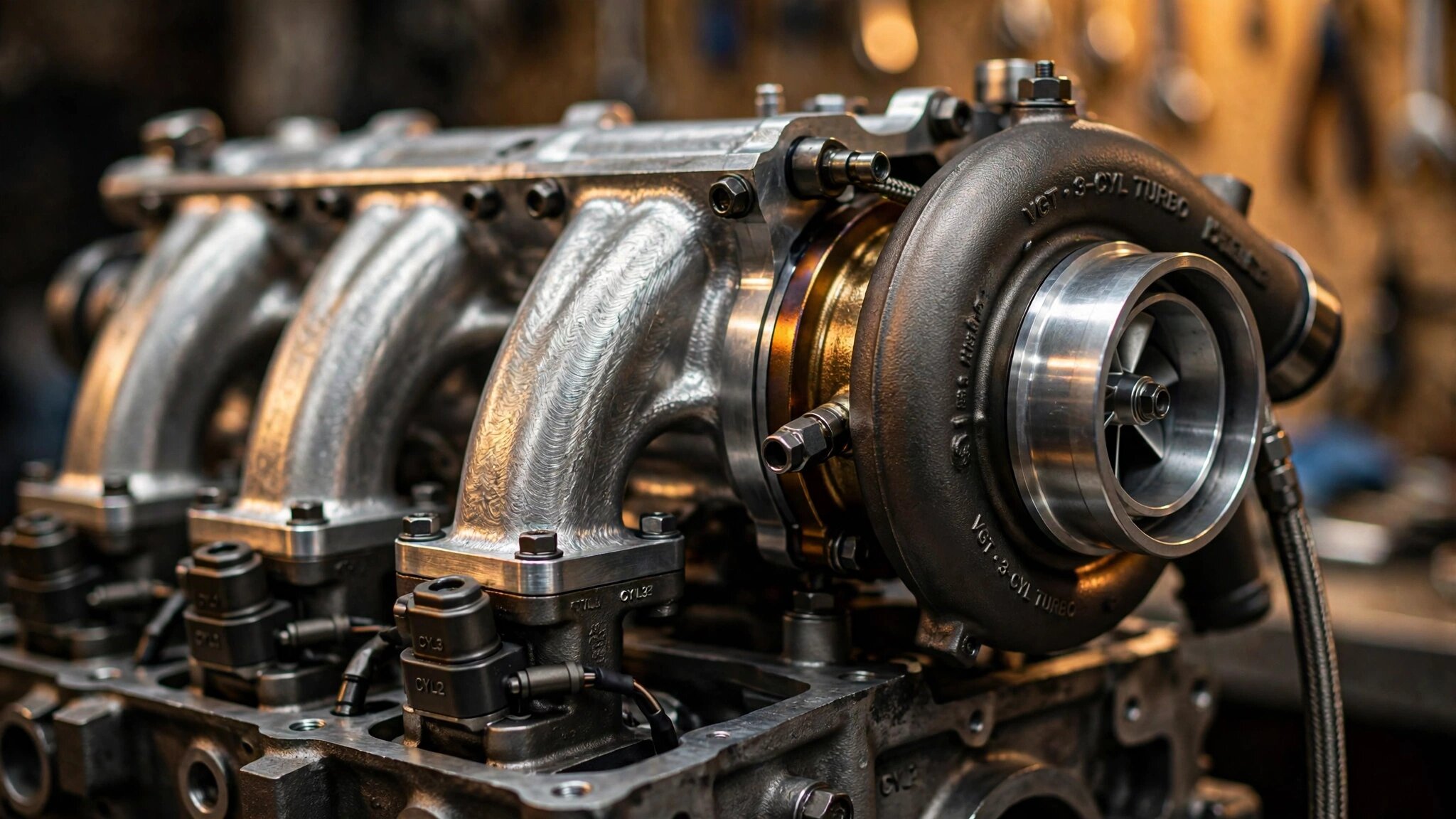
Most three-cylinder engines exist to save fuel and reduce costs. Toyota's G16E-GTS exists to produce 185 horsepower per liter from an engine that weighs less than a large adult. At 109 kilograms dry, without headers, clutch, or ancillaries, the 1,618 cc inline-three generates 300 horsepower at 6,500 rpm and 295 pound-feet of torque from 3,000 to 5,500 rpm. No other production three-cylinder engine has matched that specific output. Only Koenigsegg's 2.0-liter three-cylinder, a limited-production unit designed for the Gemera hypercar, surpassed it in absolute terms.
What makes this engine unusual is not just the headline numbers. Every major design decision traces back to a specific constraint, and understanding those constraints reveals why this engine exists in this form and no other.
Rally Rules and Japanese Tax Code
Toyota's Gazoo Racing division did not start with a displacement target. It started with two regulatory frameworks that converged on the same number. World Rally Championship regulations for the Rally1 class imposed displacement limits tied to engine configuration, making a 1.6-liter turbocharged unit competitive. Simultaneously, Japan's automobile tax structure penalizes vehicles by engine displacement in progressive brackets, with a significant cost jump at 2.0 liters. A 1.6-liter engine falls into a favorable tax bracket, keeping the GR Yaris affordable in its home market.
From these constraints came the bore and stroke dimensions: 87.5 mm bore by 89.7 mm stroke, yielding exactly 1,618 cc. Note the slightly long stroke. In a turbocharged performance engine, a bore-dominant design typically improves breathing and high-rpm power. But Toyota's engineers chose a marginally undersquare configuration. A longer stroke increases rod ratio and mechanical advantage at the crankpin, improving mid-range torque delivery, which matters more in rally stages where the driver needs immediate response exiting corners at varying speeds. That 2.2 mm stroke advantage over bore is not an accident. It is a rally calibration embedded in the iron.
A Block Built for Siege
Producing 185 hp/liter from a turbocharged engine demands cylinder pressures that would destroy a conventional aluminum casting. Toyota addressed this with a three-piece aluminum alloy block architecture that separates the cylinder walls from the main bearing structure. A large, one-piece bedplate supports all three main bearings as a rigid ladder frame, bolted to the lower half of the block. This arrangement distributes combustion loads across the entire lower structure rather than concentrating stress at individual bearing caps.
Inside, a forged steel crankshaft carries the cyclic loads from three firing events per two revolutions. Forged connecting rods transfer piston forces to the crank journals. Lightweight forged pistons sit in aluminum-lined bores, designed to tolerate the 26.2 psi of boost pressure that the Morizo Edition of the GR Corolla demanded. At 10.5:1 compression ratio, the pistons face extraordinary thermal and mechanical stress. A lower ratio would have reduced knock risk but would also have sacrificed low-end response and thermal efficiency. Toyota held the line at 10.5:1 and engineered around it.
Balance shafts manage the inherent vibration problem of a three-cylinder layout. With firing intervals of 240 degrees rather than the even 180 degrees of a four-cylinder, the G16E-GTS produces a primary imbalance that would fatigue mountings and irritate occupants without intervention. Counter-rotating balance shafts, geared to the crankshaft, generate an opposing vibration that cancels the primary harmonic. These shafts cost weight and parasitic friction, but Toyota accepted both penalties rather than let the vibration reach the chassis.
Dual Injection and the Knock Boundary
At 26.2 psi of boost, knock is not a risk. It is a certainty, unless the combustion strategy prevents it. Toyota's D-4ST system combines port fuel injection and direct injection simultaneously, firing both injectors in coordinated sequence. Port injection provides a well-mixed, homogeneous charge that enters the cylinder at relatively low velocity, promoting complete combustion and stable flame propagation at partial loads. Direct injection sprays fuel at high pressure directly into the combustion chamber, where the charge cooling effect of fuel vaporization reduces in-cylinder temperatures at the moment they would otherwise trigger detonation.
Running both systems together allows the engine management to shift the ratio between port and direct injection dynamically. At low rpm and light load, port injection dominates, reducing particulate emissions and carbon buildup on intake valves. Under full boost at high rpm, direct injection takes the larger share, maximizing charge cooling where knock risk peaks. Toyota does not publish the exact split ratios, but the system's effectiveness is measurable in the result: 10.5:1 compression with 26.2 psi of boost in a production engine, running on standard premium fuel.
Turbocharger Integration
An IHI single-scroll, ball-bearing turbocharger handles all boost duties. Rather than mounting it outboard on a conventional exhaust manifold, Toyota integrated the turbine housing directly into the exhaust casting. Eliminating the manifold-to-turbo flange reduces volume between the exhaust valves and the turbine wheel, accelerating spool-up and cutting turbo lag. It also reduces weight and allows faster catalyst light-off, since exhaust gases reach the catalytic converter at higher temperatures during cold start.
Ball bearings in the turbo's center housing reduce friction compared to journal bearings, allowing the compressor wheel to accelerate more rapidly from low exhaust energy conditions. An electronic wastegate provides precise boost control across the entire rpm range, managed by the engine's Denso ECU.
Hollow camshafts, driven by the VVT-i variable valve timing system, reduce reciprocating mass in the valvetrain. Each of the twelve valves (four per cylinder) operates on a timing map that adjusts intake and exhaust phasing based on rpm, load, and temperature. A cross-flow intercooler sits between the compressor outlet and the intake plenum, using ambient airflow to reduce charge temperatures before the mixture enters the combustion chambers.
Dry Sump: Solving the Oil Problem at 1.1g
Rally cars experience sustained lateral forces that a conventional wet-sump oil system cannot handle. Oil sloshes away from the pickup tube during prolonged cornering, and the crankshaft can windage through the standing oil in the pan, creating drag and aeration. Toyota specified a dry-sump lubrication system from the outset. Multiple scavenge pumps draw oil from the crankcase cavities and return it to an external reservoir, where it is de-aerated before being fed back to the engine under pressure.
Dry-sump design also allows the engine to sit lower in the chassis, because there is no deep oil pan to accommodate. In the GR Corolla's front-mounted, longitudinally oriented installation, this lowers the center of gravity measurably. Oil supply remains constant regardless of g-forces during hard cornering, braking, or acceleration, and the crankshaft spins in a scavenged, near-dry environment that eliminates windage losses.
2024 Revision: 268 to 300 Without Touching the Block
When Toyota updated the GR Yaris and GR Corolla for the 2024 model year, engineers raised output from 268 to 300 horsepower without redesigning the block, crankshaft, or connecting rods. Instead, they targeted three areas. Valvetrain components were strengthened with revised materials to tolerate higher spring pressures and faster cam profiles. Exhaust valve metallurgy was upgraded to a more heat-resistant alloy, allowing higher sustained exhaust gas temperatures before valve seat recession became a concern. Direct injection pressure increased, delivering finer fuel atomization and more aggressive charge cooling at high loads.
Combined with recalibrated boost targets and revised ignition timing maps, these changes extracted 32 additional horsepower from an architecture that was already producing nearly 166 hp/liter in its initial form. No bore increase. No stroke change. No additional displacement. Just material science, metallurgy, and calibration, applied to an engine whose original design had headroom built in from the start.
HKS, the Japanese aftermarket specialist, has since released a closed-deck conversion kit that machines the block's open-deck water jackets into a closed configuration, suppressing cylinder bore distortion under high combustion pressure. Their Step 3 short block kit replaces the crankshaft with a chrome steel full-counter unit, installs machined I-beam connecting rods 25% stronger than stock, and uses triple-tumble high-compression pistons designed to generate in-cylinder airflow patterns that resist knock. With a bore increase to 88.0 mm and stroke to 95.7 mm, displacement climbs to 1,750 cc. These kits exist because the G16E-GTS has become one of the most actively developed engines in global motorsport and tuning, with documented builds exceeding 650 horsepower on modified internals.
Context: What 185 HP/Liter Means
For perspective, the Corvette ZR1's LT7 twin-turbo flat-plane V8 produces 1,064 horsepower from 5,500 cc, yielding 193.5 hp/liter. Mercedes-AMG's M139 2.0-liter turbo four, the previous record holder for production four-cylinder engines, reaches 208 hp/liter in the A 45 S. Ferrari's F154 twin-turbo V8 in the 488 Pista achieved 182 hp/liter. Among three-cylinder engines specifically, nothing production comes close to the G16E-GTS. Ford's 1.0-liter EcoBoost three-cylinder in its most powerful form produces around 140 hp/liter. BMW's B38 1.5-liter three-cylinder turbo peaks at roughly 150 hp/liter in the i8.
Toyota's engine achieves its specific output through a combination that no other three-cylinder manufacturer has matched: forged rotating assembly, dry-sump lubrication, dual injection, integrated turbo, bedplate block construction, and motorsport-derived calibration. Each feature adds cost and complexity. Together, they produce an engine that defies the three-cylinder's traditional role as a cost-reduction exercise.
Why Three Cylinders, Not Four
A four-cylinder engine at 1.6 liters would have better inherent balance, smaller displacement per cylinder, lower thermal stress per bore, and no need for balance shafts. So why did Toyota choose three? Packaging and character. A three-cylinder engine is physically shorter by one cylinder's worth of bore spacing, reducing the powertrain's longitudinal footprint. In the GR Yaris, where engineers installed the engine longitudinally in a car originally designed for a transverse layout, every millimeter of length mattered.
Firing order also plays a role. A three-cylinder's uneven firing impulse produces a distinctive exhaust note with more character than a smooth four-cylinder. Rally engineers and Akio Toyoda, competing under the Morizo pseudonym, specifically valued this auditory signature. It sounds different because it is different, and that difference signals the engine's motorsport intent more effectively than any badge.
At 109 kilograms, the G16E-GTS weighs roughly 25% less than a comparable four-cylinder turbo of similar output. That weight saving is not theoretical. It sits over the front axle of a 1,475-kilogram car with an electronically controlled GR-FOUR all-wheel-drive system, where mass distribution directly affects understeer behavior, turn-in response, and traction allocation.
From Gravel Stages to Mass Production
Rally-derived engines rarely survive contact with production requirements. Emissions certification, noise regulations, cold-start behavior, 100,000-mile durability targets, variable fuel quality across global markets, and warranty obligations all impose constraints that motorsport ignores entirely. Toyota built the G16E-GTS to satisfy both worlds. Its dual injection system handles variable fuel quality. Its integrated turbo and catalyst proximity support cold-start emissions compliance. Its bedplate construction and forged internals provide the durability margin needed for warranty coverage at output levels that many race engines cannot sustain.
Gazoo Racing's testing program for the engine included extended endurance runs at the Nürburgring Nordschleife, 24-hour race entries with GR Yaris and GR Corolla variants, and continued development through the Super Taikyu series in Japan. Each competition exposed failure modes, material degradation patterns, and thermal management shortcomings that engineers corrected before production. WRC homologation required a minimum production volume, ensuring the engine was never a low-volume exotic but a genuinely mass-produced unit built on Toyota's Motomachi plant line.
Akio Toyoda once described the GR cars as vehicles that were "born and raised at the racetrack." For the G16E-GTS, that description is engineering fact, not marketing language. Every forged rod, every balance shaft revolution, every gram of the 109-kilogram dry weight reflects a development process that started on gravel and ended on a production line, with nothing lost in translation.
| Designation | Toyota G16E-GTS |
|---|---|
| Configuration | Inline-3, DOHC, 4 valves per cylinder |
| Displacement | 1,618 cc (1.6L) |
| Bore × Stroke | 87.5 mm × 89.7 mm |
| Compression Ratio | 10.5:1 |
| Power | 300 hp @ 6,500 rpm (GR Corolla 2024+) |
| Torque | 295 lb-ft (400 Nm) @ 3,000–5,500 rpm |
| Specific Output | 185 hp/liter |
| Dry Weight | 109 kg (240 lb) |
| Turbocharger | IHI single-scroll ball-bearing, integrated exhaust manifold |
| Fuel System | D-4ST combined port + direct injection |
| Lubrication | Dry sump |
| Block | Aluminum alloy, three-piece with bedplate |
| Rotating Assembly | Forged steel crankshaft, forged connecting rods, forged pistons |
| Valve Timing | VVT-i (variable valve timing, intake) |
| Redline | 7,200 rpm |
| Peak Boost (Morizo) | 26.2 psi (1.81 bar) |
| Applications | GR Yaris (2020+), GR Corolla (2023+) |
| Heritage | WRC Rally1 regulations, Gazoo Racing / Morizo development |