Every Gram at the Big End: The Metallurgy of Titanium Connecting Rods
At 8,000 RPM, a connecting rod's big end reverses direction roughly 267 times per second. Every gram of reciprocating mass at that bearing journal translates directly into centripetal force that the crankshaft, main bearings, and engine block must absorb. Titanium cuts that mass by 44 percent. Getting it to survive the job took three decades of metallurgical refinement.
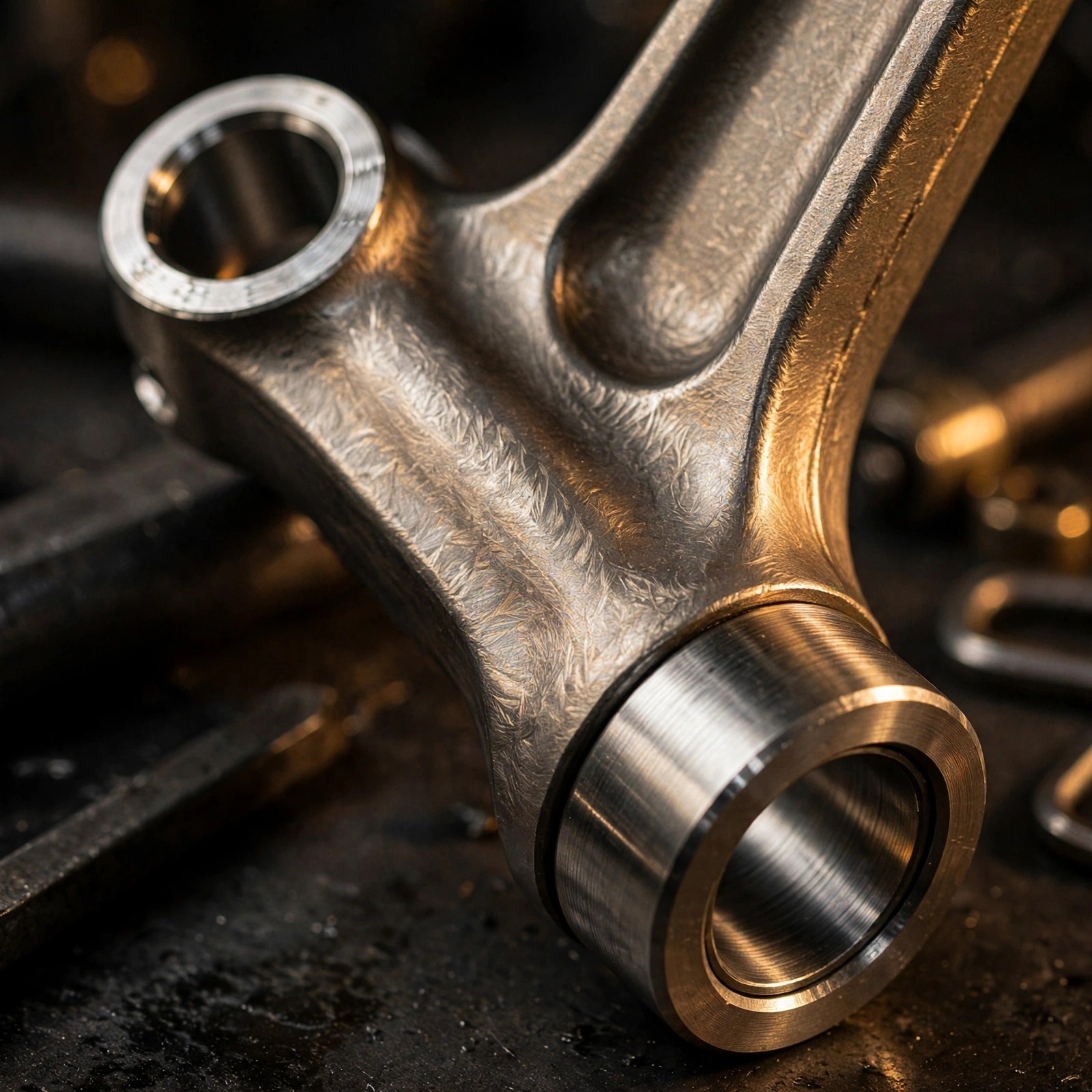
Cast Iron to Fracture-Split Steel
For most of automotive history, connecting rods were not engineered so much as overbuilt. Cast iron worked in low-revving flathead engines, and nobody questioned it. Ductile iron replaced it in the 1960s when higher compression ratios demanded better fatigue resistance, but neither material was light, and neither needed to be. Redline sat at 4,500 RPM, and the forces involved scaled with the square of engine speed. Nobody cared.
Forged steel changed the conversation in the 1970s. Alloys like 4340, a nickel-chromium-molybdenum steel with tensile strengths above 1,000 MPa, and the European equivalent 42CrMo4 allowed lighter cross-sections than cast iron while aligning the grain structure along the load path through the forging process, dramatically improving fatigue life compared to anything casting could achieve. But the real production breakthrough arrived in the 1990s with C70S6 fracture-split steel.
Fracture splitting sounds violent. It is. A forged steel rod blank is machined as a single piece, with the big end bore cut to final tolerance. Notches are laser-etched inside the bore. Then comes the brutal part: hydraulic pressure deliberately cracks the cap away from the rod body along those stress risers, producing two halves whose irregular fracture surfaces interlock perfectly when bolted back together, self-aligning with a precision that no machined mating surface could replicate. No offset drilling, no dowel pins, no careful cap alignment during assembly. C70S6 was designed to crack cleanly, its controlled carbon and sulfur content producing a brittle fracture exactly where the engineer wants it.
Almost every mass-market connecting rod produced today uses this process. Cheap, fast, and self-locating during assembly. But C70S6 is steel, and steel is dense: 7.85 g/cm³. A typical forged steel rod for a V8 weighs between 550 and 700 grams. In an engine that never exceeds 6,500 RPM, that weight is irrelevant. Past 8,000 RPM, it becomes the limiting factor.
Why Reciprocating Mass Matters Exponentially
Centripetal acceleration scales with the square of angular velocity. Double the RPM and the inertial load on every reciprocating component quadruples. A connecting rod is not purely reciprocating (the big end follows a circular path while the small end approximates linear motion), but the combined effect is the same: higher revs punish heavier parts disproportionately.
Consider the math at 8,000 RPM. A piston and rod assembly in the Corvette ZR1's LT7 flat-plane V8 changes direction 267 times every second, and peak deceleration at top dead center on the exhaust stroke exceeds 4,000 g: four thousand times the weight of the piston, wrist pin, and connecting rod small end, all concentrated in a reversal that lasts a few milliseconds. Cut 250 grams. Every bearing in the assembly thanks you. Lighter rods mean lighter counterweights on the crank, a lighter crank means less rotating inertia, and the savings cascade through the entire rotating assembly.
Flat-plane crankshaft engines benefit disproportionately. Unlike cross-plane cranks, flat-plane designs have inherent second-order vibrations that no arrangement of counterweights can fully cancel without adding mass. Lighter reciprocating components reduce those vibrations directly. Ferrari understood this early. Porsche understood it when developing the 9A2 Evo flat-six for the GT3 RS. GM understood it when the LT7 program demanded titanium rods to reach 8,000 RPM without shaking the C8 Corvette ZR1 apart.
Ti-6Al-4V: The Alloy That Won
Grade 5 titanium, formally designated Ti-6Al-4V, dominates high-performance connecting rod applications for reasons that have as much to do with metallurgical convenience as raw performance. Six percent aluminum and four percent vanadium stabilize the two-phase alpha-beta microstructure that gives this alloy its unusual combination of properties.
Alpha phase is hexagonal close-packed, hard and creep-resistant but brittle. Beta phase is body-centered cubic, ductile and tough but softer. In Ti-6Al-4V, aluminum stabilizes the alpha phase while vanadium stabilizes the beta, and by controlling the ratio and distribution of these two phases through forging temperature and heat treatment, metallurgists can tune the alloy across a wide range of strength-to-ductility trade-offs without changing the composition at all.
Numbers tell part of the story. Density: 4.43 g/cm³ versus 7.85 for 4340 steel, a 44 percent weight reduction for equivalent volume. Tensile strength: 950 to 1,100 MPa depending on processing, comparable to the best forged steels. Fatigue endurance limit: roughly 500 MPa at 10^7 cycles, adequate for the high-cycle regime connecting rods inhabit. Elastic modulus: approximately 110 GPa, about half of steel's 200 GPa.
That last number matters more than it seems. A lower elastic modulus means more deflection under load. But it also means a titanium rod stores and returns elastic energy differently than a steel rod, and under the alternating tension-compression loading of a four-stroke cycle, a degree of controlled flex can actually distribute stress more evenly across the rod's cross-section, reducing peak stress at the critical concentration points around the big end bore and bolt holes. Whether that is a net benefit depends entirely on geometry and operating regime. In practice, titanium rods are designed with slightly different cross-sections than their steel equivalents, optimized for the alloy's specific stiffness rather than simply copied at lower density.
| Property | Ti-6Al-4V (Grade 5) | 4340 Steel (forged) | C70S6 (fracture-split) |
|---|---|---|---|
| Density (g/cm³) | 4.43 | 7.85 | 7.85 |
| Tensile strength (MPa) | 950–1,100 | 1,000–1,200 | 800–950 |
| Fatigue limit (MPa, 107 cycles) | ~500 | ~550 | ~400 |
| Elastic modulus (GPa) | 110 | 200 | 200 |
| Specific strength (MPa·cm³/g) | ~225 | ~140 | ~110 |
| Fracture splittable? | No | No | Yes |
Specific strength is the metric that matters. Divide tensile strength by density and Ti-6Al-4V outperforms 4340 steel by 60 percent. A rod made from this alloy can be thinner in cross-section than a steel rod, lighter overall, and still carry the same loads with comparable fatigue life. Or it can match the steel rod's cross-section and carry higher loads at lower weight. Most engine designers choose a blend of both approaches.
Forging at 900 Degrees
Titanium connecting rods are never cast. Casting Ti-6Al-4V produces a coarse, columnar microstructure with poor fatigue resistance, and porosity from dissolved gases (titanium is famously reactive with oxygen, nitrogen, and hydrogen at elevated temperatures) creates internal stress risers that nucleate fatigue cracks. Investment casting works for aerospace brackets and non-structural components, but for a part that must survive billions of stress cycles at 4,000-g peak loads, only forging produces an acceptable microstructure.
Closed-die forging of titanium connecting rods happens in the alpha-beta temperature range, typically 900 to 950°C. Below the beta transus (approximately 995°C for Ti-6Al-4V), both alpha and beta phases coexist. Forging in this range deforms the alpha grains into a fine, equiaxed microstructure while the beta phase flows between them. After forging, controlled cooling preserves this two-phase structure. Quenching too fast produces martensite-like phases that are brittle and crack-prone. Cooling too slowly allows grain coarsening that reduces fatigue strength below acceptable thresholds for a component that must survive at 4,000-g peak deceleration on every combustion stroke.
Die design for titanium is considerably more demanding than for steel. Titanium's high strength at forging temperature means the dies must withstand enormous loads, its low thermal conductivity means heat concentrates at the die-workpiece interface accelerating die wear, and its tendency to gall (adhesively bonding to the die surface under pressure) requires specialized lubricants and die coatings that would be unnecessary for steel. Die life for titanium forging is a fraction of what steel forging achieves, and cost per unit reflects this directly.
After forging comes stress-relief heat treatment, then five-axis CNC machining: big end bore, small end bore, bolt holes, and I-beam cross-section, all to final tolerance. Surface finish is critical because machining marks act as stress risers, and in titanium's high-cycle fatigue regime, a single deep scratch at the wrong location can nucleate a crack that propagates to failure within thousands of cycles. Shot peening introduces compressive residual stress at the surface, effectively raising the fatigue limit by forcing any nascent crack to fight against that compression before it can open and grow.
Galling and the Bearing Problem
Titanium galls. When two titanium surfaces slide against each other under load, oxide films break down and the exposed metal adhesively transfers from one surface to the other, welding itself in place, seizing bolts and freezing nuts without warning. In connecting rods, the risk concentrates at the big end bearing interface.
Steel rods run against tri-metal bearing shells (steel backing, copper-lead intermediate layer, tin or bismuth overlay) with decades of tribological data supporting the design. Titanium rods use the same bearing shell architecture, but everything changes at the interface: thermal expansion coefficients differ, surface chemistry differs, and bearing crush (the interference fit that keeps the shell seated in the bore) must be recalibrated because titanium's lower modulus allows more bore distortion under bolt preload than steel would.
Rod bolt design itself changes for titanium. Titanium-to-titanium threaded interfaces are prone to galling under the high preloads that connecting rod bolts demand. Most titanium rod manufacturers use proprietary coatings or steel inserts at the bolt interface. ARP, the dominant supplier of performance fastener hardware, produces custom titanium rod bolts with dry-film lubricant coatings specifically designed to prevent galling during the torque-plus-angle tightening procedure used in precision engine assembly.
Nippon Steel's Cost Gamble
Ti-6Al-4V is expensive, painfully so. Vanadium alone trades above $30 per kilogram, sponge titanium production via the Kroll process is energy-intensive and batch-limited, and a pair of forged Ti-6Al-4V connecting rods for an aftermarket Corvette build costs $2,000 to $4,000 depending on the supplier. Multiply by eight for a V8 and the bill reaches $16,000 to $32,000 before machining the block to accept them.
Nippon Steel attacked this from the alloy side. Their Super-TIX 51AF replaces expensive vanadium, chromium, and nickel with iron, copper, and silicon as beta-stabilizing elements. Iron costs almost nothing compared to vanadium. Copper provides precipitation hardening that vanadium does not. Silicon improves high-temperature creep resistance, a property that matters for intake valves even more than for connecting rods. According to Nippon Steel's published data, Super-TIX 51AF achieves roughly 50 percent higher specific strength than the SCM430 chromium-molybdenum steel it targets as a replacement, at a material cost substantially below Ti-6Al-4V.
Yamaha adopted Super-TIX 51AF for connecting rods in the YZF-R1 superbike, making it one of the few production motorcycles whose engine trusts titanium rods to survive the stress of track-day redline sessions and the corrosive vibration of daily commuting on imperfect roads. Nippon Steel also developed Super-TIX 523AFM specifically for intake valves, claiming fatigue strength that exceeds Ti-6Al-4V in the relevant temperature range. Neither alloy has crossed into automotive production at scale, but they represent a credible path toward making titanium reciprocating components affordable enough for series-production engines beyond the supercar tier.
Where Titanium Rods Live Today
Ferrari has used titanium connecting rods since the 458 Italia's naturally aspirated 4.5-liter V8, and every subsequent mid-engine V8 and V6 from the F8 Tributo through the 296 GTB and SF90 Stradale has followed suit because Maranello's engine designers refuse to accept the reciprocating mass penalty that steel imposes at their target rev limits. Porsche specifies them in the 4.0-liter flat-six of the 911 GT3 RS and the competition-derived 9A2 Evo engine. Lamborghini uses them in the Huracan's 5.2-liter V10, and Ducati fits them in the Panigale V4, whose Desmosedici Stradale engine revs to 13,500 RPM in Superleggera trim.
GM's LT7 flat-plane V8 in the Corvette ZR1 is the most accessible application of titanium rods in a production car, though "accessible" is relative at the ZR1's price point. Each LT7 is hand-assembled at GM's Performance Build Center in Bowling Green, Kentucky, where shorter connecting rods (relative to the LT6 in the naturally aspirated Z06) paired with dished pistons allow the flat-plane crank's 8,000 RPM ceiling while keeping cylinder pressure within the block's structural limits. Every gram saved by the titanium rods directly enables that redline. Swap them for steel? Either the engine revs lower or it vibrates itself to pieces.
Motorcycle applications pushed the boundary earlier because MotoGP teams have run titanium rods since the early 2000s, when engine speeds routinely exceeded 16,000 RPM and even Ti-6Al-4V approached its fatigue limits under the kind of alternating loads that no steel rod could survive at those rotational velocities. Factory race teams employ aggressive inspection intervals, replacing rods after fixed mileage regardless of visible condition, and what works in MotoGP filters into production bikes years later, which is exactly the path that brought titanium rods to the Yamaha R1 and Ducati Panigale.
Powder Forging and the Next Frontier
Conventional forging starts with a solid billet, but powder forging starts with dust. Compact metal powder into a near-net-shape preform in a die, sinter it at high temperature to bond the particles metallurgically, then forge the sintered preform in a closed die to final density, squeezing out residual porosity and producing a fully dense part with a fine-grained microstructure.
Powder forging has been applied successfully to steel connecting rods in mass production. GKN and Sumitomo Electric produce millions of powder-forged C70S6 rods annually for automotive OEMs. Extending the same process to titanium is more challenging. Titanium powder is reactive and expensive to produce (gas atomization in inert atmosphere is the standard method). Sintering must occur under vacuum or inert gas to prevent oxygen pickup that would embrittle the material. Die wear during the forging step is even more severe with powder preforms than with conventional billets because the porous preform has higher surface area in contact with the die.
But the payoff is real, and it is substantial. Powder forging produces near-net-shape parts that require less CNC machining than billet-forged components, and for titanium, where machining is slow, tool wear is severe, and every millimeter of reduced machining envelope translates directly into lower cost per rod, this matters enormously. Academic research has demonstrated that powder-forged Ti-6Al-4V achieves mechanical properties competitive with billet-forged material when process parameters are optimized. A 2025 study in Nature explored titanium metal-matrix composites (Ti-6Al-4V reinforced with silicon carbide particles) produced via powder metallurgy routes, showing superior stiffness and fatigue performance compared to monolithic titanium in finite element analysis of connecting rod geometry, though the work remains academic and has not yet reached production validation.
Whether powder-forged titanium rods reach series production within this decade depends less on metallurgy than on economics, specifically on whether material and process costs can fall far enough below the current threshold to justify the switch in engines that currently rely on forged steel at a fraction of the price and with tooling amortized across millions of units. Nippon Steel's alternative alloys and powder metallurgy routes are converging on that crossover point. When they arrive, titanium connecting rods will migrate from supercars and race bikes into the kind of high-performance production engines that sell in tens of thousands rather than hundreds.
267 Reversals Per Second
A connecting rod is a study in contradictions. It must be stiff enough to transmit combustion forces without buckling, yet compliant enough to flex without cracking. Strong enough to survive billions of stress cycles, yet light enough not to destroy the bearings it rides on. Resistant to fatigue crack propagation at stress concentration points that no amount of design can fully eliminate.
Steel satisfied all of these requirements for decades, at a cost no other material could match. It still does for 99 percent of production engines. But in the one percent where engine speed pushes past 8,000 RPM, where flat-plane cranks amplify every gram of reciprocating imbalance, and where the difference between 550 grams and 310 grams at the big end determines whether the crankshaft survives or the bearings fail? Titanium is not a luxury but a structural necessity.
Thirty years of metallurgical refinement produced everything those rods require. Alpha-beta phase control. Closed-die forging in a narrow temperature window. Anti-galling coatings on every threaded interface, and bearing shells redesigned from scratch for an alloy that flexes twice as much as steel under the same load. None of it is simple, none of it is cheap, and all of it is necessary because physics does not negotiate: centripetal force scales with the square of angular velocity, and at 267 reversals per second, every gram at the big end is either your ally or your failure mode.