Five Thousand Pounds at 6:55: How the Manthey Kit Rewired the Taycan Turbo GT
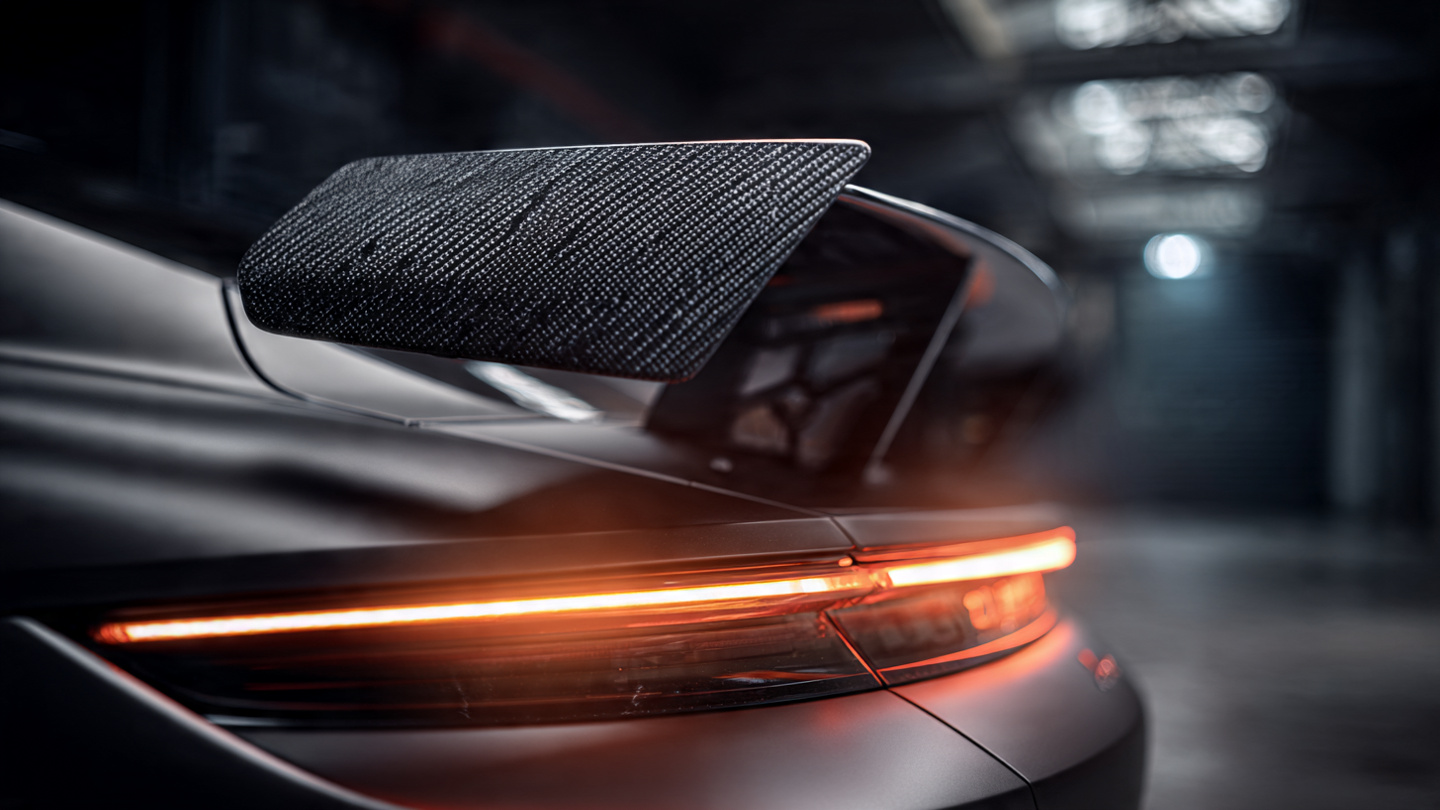
On April 15, Porsche development driver Lars Kern took a Taycan Turbo GT fitted with the Weissach Package and a new Manthey Kit around the Nürburgring Nordschleife in 6 minutes, 55.553 seconds, a time certified by a notary present at the circuit and announced publicly three weeks later on May 7. Those 12.94 miles through the Eifel mountains represent the fastest lap ever recorded by a production electric vehicle on what remains the most demanding automotive proving ground in the world, beating Kern's own 2023 record in the standard Taycan Turbo GT by a full twelve seconds.
Twelve seconds at the Nürburgring is enormous, the kind of gap that engineers spend entire development cycles chasing in tenths. Manthey Racing, the Meuspath-based outfit that has been extracting lap time from Porsches since the 1990s, found all twelve of those seconds in a car that already held the record by touching every system simultaneously: aerodynamics, powertrain calibration, wheels, tires, brakes, and suspension tuning. No single modification delivered the gap on its own, because every subsystem contributed fractions that compounded into something dramatic once the whole car worked as a coordinated system rather than a collection of individually optimized parts.
Tripling Downforce on a Four-Door Sedan
Aerodynamics did the heaviest lifting. At 200 km/h, the standard Taycan Turbo GT with Weissach Package generates 95 kilograms of downforce, a number that sounds adequate until you consider it is pressing a car weighing over 2,300 kilograms into the road through corners where centrifugal force wants to push it off. With the Manthey Kit installed, that figure rises to 310 kilograms at the same speed, and at the car's new maximum velocity of 309 km/h the total reaches 740 kilograms, meaning 1,631 pounds of aerodynamic force is pushing a sedan into the asphalt at nearly 200 miles per hour.
Manthey achieved this through a distributed aerodynamic strategy rather than a single dominant element. A new rear wing with enlarged end plates provides the most visible contribution, but the front receives an adjustable diffuser with distinct low-downforce and high-downforce configurations that let drivers optimize front-axle load for specific circuit layouts. Beneath the car, a redesigned high-performance rear diffuser adds extended fins to improve airflow extraction from the underbody. Larger air dams seal the floor more effectively against crosswind intrusion, carbon aerodiscs cover the rear wheels to smooth turbulent airflow around the wheel wells, and dive planes on the front bumper generate additional load on the front axle to maintain aerodynamic balance as rear downforce increases.
Crucially, every piece is adjustable or removable. Owners who take the car to a tight, technical circuit can prioritize front-axle grip; those running high-speed tracks can configure for reduced drag. Downforce is never free, because it always brings drag, and drag costs top speed and straight-line acceleration. Manthey's engineers balanced the package well enough that top speed actually increased by 5 km/h despite the massive downforce gain, which suggests careful drag management through the underbody venturi and rear diffuser exit geometry rather than simply bolting on bigger wings and accepting the penalty.
1,300 Amps: Manthey Rewrites the Battery
In every previous Manthey Kit for any Porsche model, whether 911 GT3, GT2 RS, or Cayman GT4, the powertrain remained completely untouched. Manthey modified chassis hardware, aerodynamics, brakes, and suspension calibrations, but the engine or motor was always left to Porsche's original specification. For the Taycan Turbo GT, Manthey broke that tradition for the first time in the company's history, and the changes center on the high-voltage battery's discharge capability rather than the electric motors themselves.
Optimizations to the battery management system, control unit, and pulse inverters raised the maximum discharge current while driving from 1,100 to 1,300 amps, an 18 percent increase in current flow that translates to a modest but meaningful power gain across every driving mode. Standard system output climbs from 580 kW (777 hp) to 600 kW (804 hp) for continuous use. Attack Mode, Porsche's ten-second overboost function activated by a steering-wheel button, now delivers 730 kW (978 hp) instead of 700 kW (938 hp). Launch control output stays unchanged at 760 kW (1,019 hp), but maximum torque rises by 30 Nm to reach 1,270 Nm, or 936 lb-ft in American units.
In combustion terms, what Manthey did is analogous to improving fuel pump flow rate and injector calibration rather than boring out cylinders or adding forced induction. Finding 27 sustained horsepower and 40 overboost horsepower by optimizing how quickly the battery delivers energy to the inverters sounds incremental on paper, but at 280 km/h on the Döttinger Höhe straight, where aero drag rises with the square of velocity, every additional kilowatt extends the moment before drag overwhelms available thrust by a measurable distance. Small power gains at high speed produce disproportionate lap time improvements because the car spends meaningful percentages of each lap above 250 km/h on the Nordschleife's long straights.
Six Pounds That Earned Their Place
Weight matters everywhere on a car, but unsprung weight matters disproportionately because every kilogram the suspension must accelerate over bumps and curbs is a kilogram the dampers must control at the expense of tire contact patch stability. Manthey's new 21-inch forged aluminum wheels, paired with titanium wheel bolts, cut approximately 2.7 kilograms of unsprung mass from the car despite being physically larger than the standard Weissach wheels, a reduction achieved through more aggressive material removal in the forging process and the switch from steel to titanium fasteners.
Wider Pirelli P Zero RM tires wrap those wheels, with fronts gaining four centimeters of contact width and rears growing by three centimeters. For the record attempt, Kern ran optional Pirelli P Zero Trofeo RS rubber, a semi-slick compound with track-specific chemistry that offers dramatically more grip than road-legal all-season alternatives at the cost of reduced wet-weather performance and faster wear rates. Wider contact patches combined with reduced unsprung mass allow Porsche's Active Ride suspension to maintain tire contact more effectively through the Nordschleife's aggressive surface transitions, where a heavier wheel-and-tire package would bounce and skip across mid-corner compressions that arrive without warning at 200 km/h.
Bigger Brakes and Smarter Software
Front brake discs grew from 420 mm to 440 mm in diameter, and performance brake pads replaced the standard compound on all four corners, while rear discs remain at 410 mm because Manthey judged the existing diameter sufficient given the Taycan's regenerative braking bias toward the rear axle. In a car that recovers significant kinetic energy through its electric motors during deceleration, the front brakes do a larger share of the friction work than in a conventional vehicle, which is why the front discs received the size increase while the rears did not.
Beyond the hardware changes, Manthey retuned every software-configurable system on the car in a joint development effort between Porsche's Weissach engineers and Manthey's team at Meuspath. Porsche Active Ride suspension received new spring and damper calibrations optimized for the Nordschleife's violent surface transitions. All-wheel-drive torque distribution algorithms were revised for faster power shuffling between axles during corner entry and exit. Four-wheel steering response curves and the rear axle differential mapping were both adjusted for circuit use, prioritizing rotation and stability over the comfort-oriented calibrations of the standard car. None of these changes required new hardware, since software defines the behavior of every one of these systems, and Manthey simply rewrote the definitions for a car intended to run on a closed circuit rather than a public road.
What It Beat, and What Still Went Faster
Kern's 6:55.553 beat BYD's Yangwang U9 Xtreme, a hypercar limited to 30 units worldwide that produces over 3,000 horsepower and was designed from the ground up as a performance showcase, by nearly four seconds. Porsche beat it with a sedan that seats four people and has a trunk. Xiaomi's production-spec SU7 Ultra, which held the previous production EV record at 7:04.957, lost its title by more than nine seconds.
However, Xiaomi also ran a stripped-down SU7 Ultra prototype that lapped in 6:22.091 in June 2025, a time no production car of any kind has matched. That car was not available for purchase and would not qualify under any reasonable production-vehicle definition, but the time demonstrates conclusively that raw lap speed from a lightweight, purpose-built Chinese EV exceeds what Porsche's production sedan can achieve by more than thirty seconds. Porsche wins on rules and legitimacy, while Xiaomi wins on absolute pace if you accept a car that nobody can buy as a relevant comparison.
Honesty about the "production" question matters here. Porsche's Manthey Kit will be available from the factory starting June 2026, making it a factory-backed production option rather than an aftermarket modification. But the car ran on semi-slick Trofeo RS tires, carried extensive carbon fiber aerodynamic modifications, received powertrain software recalibrations, and was driven by a professional development driver who has lapped the Nordschleife thousands of times over his career. Every manufacturer chasing Nürburgring records plays the same definitional game with varying degrees of transparency, and Porsche plays it more honestly than most, but nobody should confuse a 6:55 lap on semi-slicks with what happens when you drive a Taycan to get coffee on a Saturday morning.
Why Downforce Won This Particular Arms Race
Kern himself pointed to a single statistic that reveals where most of the twelve seconds came from. Through the "Lauda-Lefthander" section before Bergwerk, he carried 14 km/h more speed than his 2023 record run, not because the car had meaningfully more power but because it had dramatically more downforce pressing the tires into the pavement through a corner that punishes any car lacking confidence in its front axle.
High-speed cornering grip is governed by tire load, and at circuit speeds above 150 km/h, aerodynamic downforce becomes the dominant source of additional vertical load beyond the car's static weight. Adding 215 kilograms of aerodynamic force at 200 km/h transforms every high-speed corner into a fundamentally different proposition, allowing 14 km/h more speed through a single section and compounding that advantage across dozens of similar corners over a 12.94-mile lap.
Porsche and Manthey understood this relationship and built their strategy around it. Rather than chasing headline horsepower numbers to match Xiaomi's 1,526 hp or BYD's 3,000-plus hp, they built a car that converts modest power gains into cornering speed through aerodynamic load, accepting that a 5,000-pound sedan will never out-accelerate a purpose-built hypercar on a straight but can out-corner one if it sticks harder through every bend. Engineering discipline over brute force. Zuffenhausen over Shenzhen, this time, by four seconds and a commitment to the physics of vertical load over the marketing of peak power.
What We Don't Know Yet
Nobody outside Porsche and Manthey knows the price of this kit, and the company has not announced whether it will be available as a retrofit for existing Taycan Turbo GT owners or only as a factory-build option. If pricing follows Manthey's 911 GT3 kit precedent, expect an additional $30,000 to $50,000 layered on top of a Taycan Turbo GT with Weissach Package that already costs over $230,000, which would place the total vehicle cost near $280,000 in supercar territory for a car that still seats four and has a liftback.
Long-term reliability of the modified battery discharge parameters represents a genuine unknown. Raising peak current from 1,100 to 1,300 amps during sustained high-speed driving increases thermal stress on battery cells, bus bars, and inverter switching components in ways that Porsche's standard validation testing may or may not have captured at the extremes. Manthey's engineers presumably validated the calibration for durability, but production track record for these specific parameters does not yet exist, and early adopters will function as the extended test fleet whether they realize it or not.
Weight remains the Taycan's permanent structural disadvantage. At over 5,000 pounds, it is fundamentally heavier than any combustion-powered competitor producing similar lap times, and Manthey compensated for that mass through downforce and grip rather than addressing the root cause. Mass imposes its own compounding tax on tire wear rates, brake disc temperatures across consecutive laps, and battery energy consumption per lap. How many consecutive hot laps the Manthey Kit car can sustain before thermal derating reduces power output is a number Porsche has not published and probably should, because a 6:55 single-lap time means less if the car can only achieve it once before needing a twenty-minute cooldown.
Sources
- Electrek, Fred Lambert, "Porsche Taycan Turbo GT with Manthey Kit sets 6:55 Nürburgring EV record," May 7, 2026, detailing aero specifications, powertrain discharge current changes, wheel and tire dimensions, and brake upgrades.
- Carscoops, Thanos Pappas, "Xiaomi's SU7 Ultra Held The EV Nürburgring Crown, Until Porsche Wanted It Back," May 7, 2026, providing competitive context against Xiaomi SU7 Ultra and BYD Yangwang U9 Xtreme lap times.
- Autocar India, "Porsche Taycan Turbo GT with Manthey Kit sets new Nürburgring EV record," May 8, 2026, reporting system output increases, Attack Mode specifications, and Lars Kern's driver commentary on improved high-speed stability.
- CarBuzz, Brett T. Evans, "It's Official: Porsche And Manthey Are Addicted To Setting Lap Records," May 7, 2026, providing Manthey Kit historical context and comparison of power outputs across driving modes.
- Porsche Newsroom, official press release, "New Nordschleife record for production electric vehicles: Porsche Taycan leads the way again," May 7, 2026, original source for certified lap time, notary confirmation, and technical specifications.