Grown, Not Cut: How TAG Heuer Builds a Hairspring from Carbon Nanotubes
Inside a vacuum chamber at 850°C, carbon nanotubes sprout in the shape of a watch spring. After a decade of setbacks, surface chemistry breakthroughs, and four patents, TAG Heuer's TH-Carbonspring is finally ready for production.
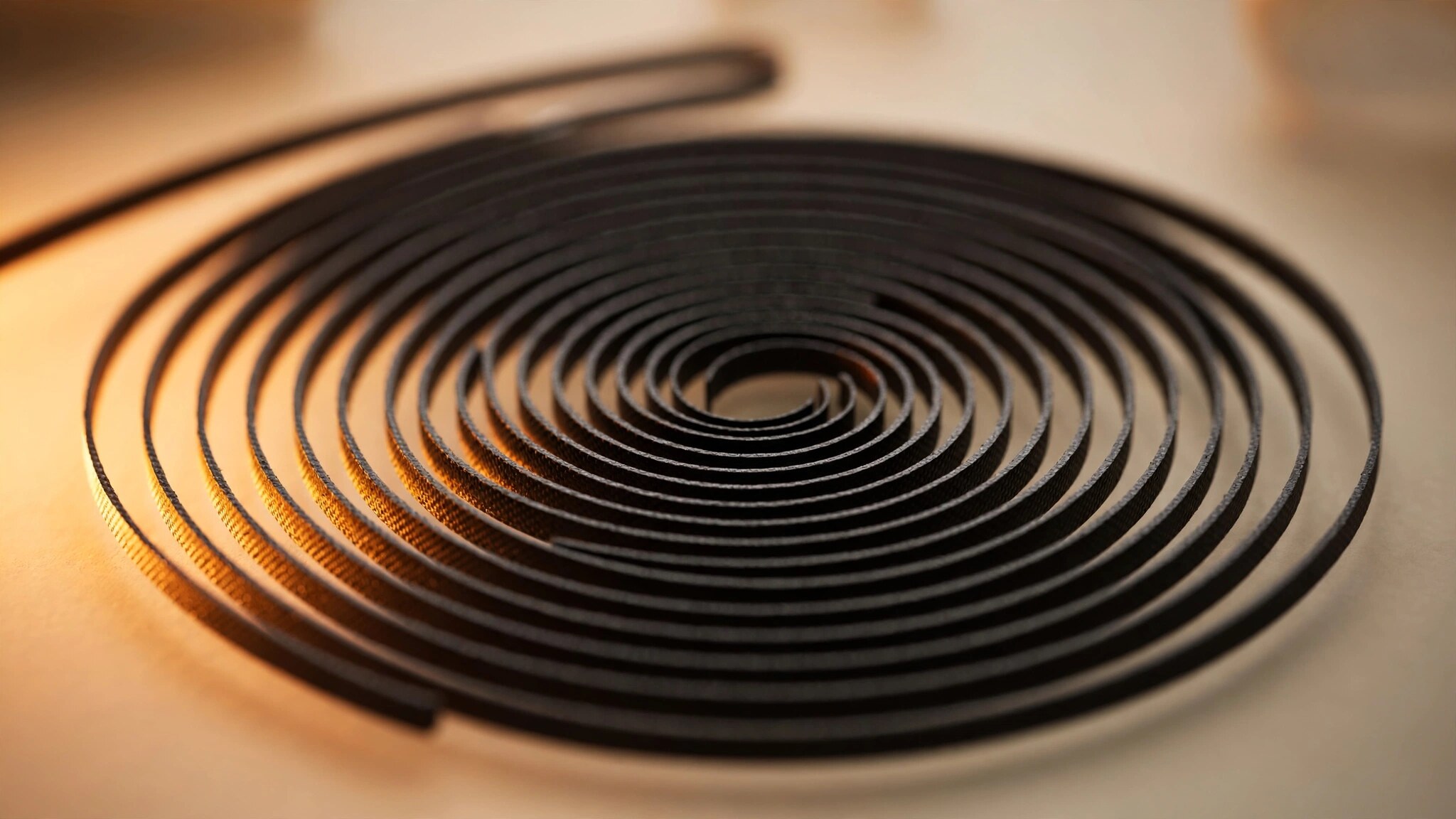
A Coil of Wire That Decides Everything
Every mechanical watch keeps time because of a single coiled spring, roughly the thickness of a human hair, oscillating back and forth several times per second. This hairspring, also called the balance spring, is the closest thing a mechanical watch has to a central processor. Its material, geometry, and mass determine how accurately the watch runs, how it responds to shock, whether it drifts near a magnet, and how consistently it performs as the mainspring winds down. Change the hairspring and you change the watch.
For most of the 20th century, that spring was made from Nivarox, a nickel-iron alloy developed to resist temperature-induced length changes. Nivarox hairsprings are rolled from wire, formed into spirals, heat-treated, and adjusted by hand. They work well enough, but they are susceptible to magnetism, and their elastic properties shift under extreme temperature swings. By the early 2000s, silicon emerged as a replacement that solved both problems. Etched from monocrystalline wafers in precisely computed geometries, silicon hairsprings are immune to magnetic fields, thermally stable, and reproducible to tolerances no metalworker could match by hand.
Silicon also introduced a new weakness: brittleness. A silicon hairspring can snap from a sharp shock or break during assembly if a watchmaker's tweezer slips. And access to the technology is restricted. A patent consortium led by the Swatch Group, Rolex, and Patek Philippe controls the key intellectual property around silicon hairsprings, leaving competitors to either license the technology or find another way forward.
TAG Heuer chose to find another way.
Carbon Nanotubes as Raw Material
Carbon nanotubes are cylindrical structures made of carbon atoms arranged in a hexagonal lattice, each tube only three to seven nanometers in diameter. A nanotube is roughly 50,000 times thinner than a human hair. Despite this vanishing scale, carbon nanotubes possess extraordinary mechanical properties: tensile strength exceeding 100 gigapascals (roughly 100 times that of high-strength steel at comparable cross-sections), near-zero thermal expansion, complete diamagnetism, and an elastic modulus that allows them to flex without permanent deformation.
None of these properties are new. Carbon nanotubes have been studied since the early 1990s and manufactured in industrial quantities for composite reinforcement, electronics, and filtration. What TAG Heuer's engineers recognized was that a dense array of aligned nanotubes, bonded together with a carbon matrix, could behave like a macro-scale spring while retaining the material advantages of nanoscale carbon. If they could grow nanotubes in the precise spiral geometry of a hairspring, they might skip the cutting, rolling, and forming steps entirely. Instead of shaping a spring from a bulk material, they would grow the spring directly into its final shape.
Growing a Spiral in a Vacuum Chamber
Production begins with a silicon wafer, the same kind used in semiconductor fabrication. A thin metallic catalyst layer, typically iron or cobalt, is deposited on the wafer surface in a pattern that defines the hairspring's exact spiral geometry, including its terminal curves and inner collet. Each wafer holds around 330 individual hairspring patterns.
This prepared wafer enters a chemical vapor deposition (CVD) chamber, where it is heated to between 600 and 850 degrees Celsius in a controlled atmosphere of hydrocarbon gases. At these temperatures, the gas molecules decompose on contact with the catalyst, freeing individual carbon atoms that nucleate and extend into vertical nanotubes. Millions of tubes sprout simultaneously, each one growing perpendicular to the wafer surface and parallel to what will become the balance staff axis. The process takes approximately three hours per batch.
What emerges is a "forest" of aligned nanotubes, standing upright in the precise spiral pattern of a hairspring. At this stage, the structure is delicate. Individual nanotubes are strong along their axis but weakly bonded to their neighbors. To consolidate the forest into a functional spring, TAG Heuer infiltrates it with amorphous carbon through a secondary CVD step. This carbon matrix fills the interstitial spaces between tubes, cementing them into a rigid composite. Critically, the collet (the small attachment point that connects the hairspring to the balance staff) is grown as part of this same process, formed directly by the catalyst pattern rather than bonded on separately. In silicon and metal hairsprings, the collet is a separate component, and attaching it introduces a stress concentration point. Growing it in situ eliminates that failure mode entirely.
After infiltration, the completed hairsprings are released from the wafer and individually inspected. Each batch of 330 springs requires refinement of layer thickness, geometry tolerances, and heat treatment parameters to ensure concentric breathing: the spring must expand and contract symmetrically around its geometric center during oscillation, without wobble or asymmetric displacement.
A Problem Nobody Anticipated
TAG Heuer debuted its first carbon nanotube hairsprings in 2019, installed in the Carrera Nanograph tourbillon. On paper, everything worked. Lab tests confirmed magnetic immunity, shock resistance up to 5,000 g, and favorable isochronism. A few watches shipped. Sister brand Zenith tried the technology in limited runs. Then, quietly, both brands pulled back.
Interviews and patent filings from 2025 reveal what went wrong. The nanotube composite, for all its mechanical virtues, was porous. Between the vertical tubes, nanoscale gaps remained open to the surrounding environment. In a watch movement, that environment contains lubricating oils (applied to jewel bearings and gear trains), volatile organic compounds from adhesives and gaskets, and ambient humidity. Over time, these substances wicked into the hairspring's open pore structure through capillary action, gradually changing its mass and altering its natural resonant frequency.
A hairspring that slowly gains mass is a hairspring that slowly changes its rate. For a movement regulated to chronometer standards (a maximum daily deviation of -4 to +6 seconds), even a fractional mass increase is enough to push the watch out of specification. Traditional metal and silicon hairsprings are dense, non-porous solids. Porosity had simply never been a design consideration in balance spring engineering, and TAG Heuer's development team did not detect the effect during prototyping. Patent WO2025114588A1, filed late in 2024 and published in June 2025, states the problem was only noticed in serial-production springs under real-world conditions.
Sealing Carbon at the Molecular Level
Solving the porosity problem required surface chemistry rather than mechanical engineering. TAG Heuer's team developed a two-part passivation process that renders the finished hairspring both hydrophobic and oleophobic, meaning it actively repels both water and oil at the molecular level.
First, a controlled CVD carbon overcoat is deposited onto the completed spring. This secondary carbon layer partially closes the pore entrances on the surface without filling the entire internal structure, preserving the composite's low mass and elastic properties while reducing its surface accessibility to liquids.
Second, and more unusually for watchmaking, the spring undergoes covalent diazonium-based functionalization. In this electrochemical process, diazonium salts react with the carbon surface, grafting short fluorinated molecular chains directly onto it through stable carbon-carbon covalent bonds. These fluorinated chains create a low-energy surface monolayer that aggressively repels both polar molecules (water) and non-polar molecules (oils). It is conceptually similar to the chemistry behind non-stick coatings, but executed at the scale of individual carbon nanotubes through a process that TAG Heuer developed and patented specifically for this application.
After passivation, the hairsprings undergo environmental testing to confirm that no measurable mass change occurs under accelerated aging conditions simulating years of in-case exposure to humidity and lubricant vapor. With this final manufacturing step validated, TAG Heuer declared the technology ready for industrialization in September 2025.
What Carbon Gets Right That Silicon Cannot
Both carbon and silicon hairsprings are non-magnetic, thermally stable, and manufacturable to precise geometric specifications. But carbon holds three advantages that silicon cannot match.
First, shock resistance. Silicon is a crystalline material that fractures along cleavage planes under impact. Lab tests demonstrate that a silicon hairspring fails catastrophically at shock loads around 5,000 g. A metal Nivarox spring deforms permanently at similar loads, losing its geometry and its regulating ability. TAG Heuer's carbon composite survives 5,000 g intact, flexing and returning to its original shape. For a watch worn during sports, construction work, or military operations, this difference matters. It also matters during servicing: a watchmaker can handle a carbon spring with conventional tweezers without the fear of fracture that makes silicon springs difficult to work with.
Second, mass. Carbon nanotubes have a density roughly one-sixth that of steel and lower than monocrystalline silicon. A lighter hairspring contributes less parasitic inertia to the oscillating system, bringing the real-world balance closer to the theoretical ideal of a massless spring. Less inertia means better isochronism, which means the watch runs at a more consistent rate regardless of its position on the wrist or the remaining tension in its mainspring.
Third, independence. TAG Heuer produces its carbon hairsprings entirely in-house at its laboratory in La Chaux-de-Fonds, Switzerland. No external consortium controls the underlying patents. No supplier can restrict allocation. All four TH-Carbonspring patents belong to TAG Heuer (and by extension, LVMH), giving the group a proprietary oscillator technology that could eventually be deployed across its entire portfolio of mechanical watch brands, including Zenith, Hublot, and Bvlgari.
Inside the Debut Movements
TAG Heuer launched the TH-Carbonspring in two limited-edition chronographs at Geneva Watch Days in September 2025. Each is limited to 50 pieces.
| Specification | Monaco Flyback TH-Carbonspring | Carrera Tourbillon TH-Carbonspring |
|---|---|---|
| Reference | CBL5190.FT6313 | CBS5190.FN6314 |
| Case | 39 mm, forged carbon | 44 mm, forged carbon |
| Caliber | TH20-60 | TH20-61 |
| Functions | Flyback chronograph | Flyback chronograph + flying tourbillon |
| Frequency | 4 Hz (28,800 vph) | 4 Hz (28,800 vph) |
| Power reserve | 80 hours | 65 hours |
| Certification | COSC chronometer | COSC chronometer |
| Price | CHF 17,000 | CHF 40,000 |
Both calibers are derivatives of TAG Heuer's Heuer 02 architecture, developed under the direction of Carole Forestier-Kasapi, who previously built movements at Renaud & Papis and Cartier before joining TAG Heuer to overhaul its in-house capability. Each movement uses column-wheel actuation and a vertical clutch for the chronograph, and the TH-Carbonspring replaces what would otherwise be a standard silicon or Nivarox oscillator. Interestingly, TAG Heuer retained a traditional raquette index regulator rather than a free-sprung balance, a conservative choice that keeps assembly and adjustment simple during initial production rollout.
Both watches are dressed entirely in forged carbon composite, with dials featuring a machined spiral motif that references the hairspring's coiled geometry. Production constraints on the cases, not the hairsprings, are what limit each run to 50 pieces. TAG Heuer's stated production capacity for TH-Carbonspring hairsprings is over 100,000 units per year at full wafer throughput.
From Lab to Assembly Line
Most watchmaking innovations arrive as finished products. TAG Heuer's carbon hairspring arrived as a materials science problem that took a decade to solve, failed publicly in 2019, and required a detour through electrochemistry before it worked. Patent WO2017220672A1 described the original growth process. Patent WO2025114588A1 described the surface treatment that made the original process viable. Between those two filings lies eight years of refinement that included building custom CVD reactors, developing wafer-scale quality control protocols, and learning that the laws of capillary action apply to hairsprings too.
Whether carbon ultimately displaces silicon across the industry depends on how reliably TAG Heuer can scale the process, and whether competing groups develop their own non-silicon oscillators. But the engineering record is now clear: a hairspring can be grown from nanotubes in a vacuum chamber, sealed against its environment through molecular-level surface chemistry, and installed in a COSC-certified chronograph that carries a five-year warranty. For a component whose basic design had not changed in 350 years, that counts as new.