One Press, Zero Dead Time: TAG Heuer's Monza Flyback Turns 50 in Forged Carbon
Fifty years after Heuer built a black chronograph for Niki Lauda, TAG Heuer marks the Monza's anniversary with a 500-piece Flyback in forged carbon, timed to the Italian Grand Prix. Its black is structural now, not cosmetic, and the movement answers a question most chronographs never asked: why should stopping the timer and starting it again take three presses?
Timing two consecutive intervals with a normal chronograph is a small bureaucratic procedure. Stop the running seconds hand. Press again to reset, and wait while the hands fly home. Press a third time to start the next measurement. Each of those presses is a mechanical negotiation, and the gap between "stopped" and "restarted" is dead time nobody can measure because the instrument itself is busy resetting. For a driver timing pit stops or a physician counting pulse rates, that gap is the instrument getting in its own way. Flyback chronographs exist to delete it, and TAG Heuer's new Monza, released September 1 ahead of the Formula 1 race at the circuit the watch is named for, is the complication's most legitimate anniversary vehicle in years.
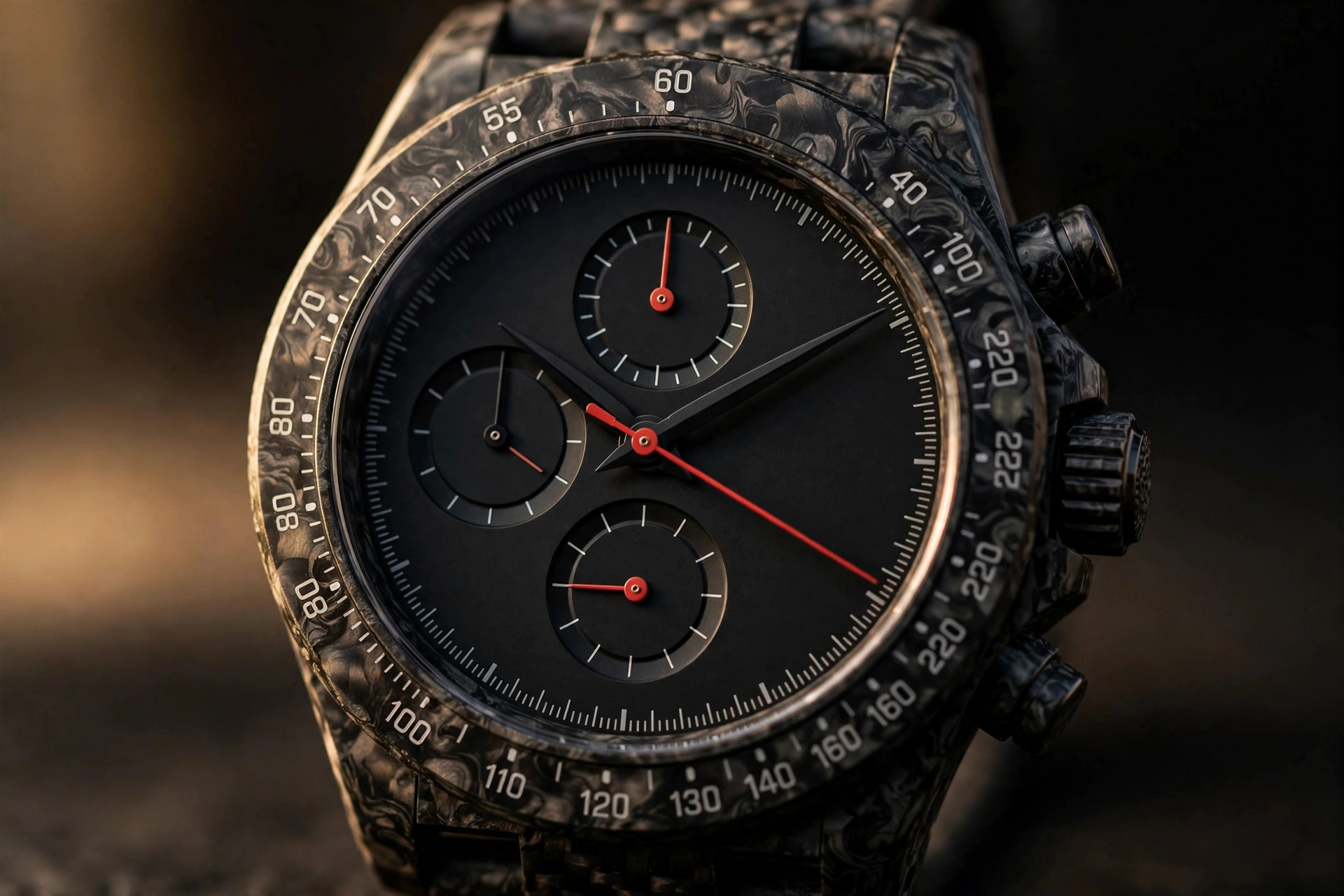
Legitimate because the Monza was born from timing races. Heuer became Ferrari's official timekeeper in 1971, Niki Lauda won the world championship with the team in 1975, and the Monza arrived in 1976 to celebrate it, quickly recognizable by its black-coated case, a genuinely unusual thing at the time. Reference CR5092.FC8372, limited to 500 numbered pieces, returns to the black theme with a 42mm case in forged carbon, a matte black dial with red accents, and the COSC-certified calibre TH20-12, an in-house automatic flyback chronograph running at 28,800 beats per hour. Price is $13,400 in the US, £11,300 in the UK, and EUR 13,350 in Europe.
Three presses, one problem
A conventional chronograph resets through a reset hammer. When you press the reset pusher, a spring-loaded hammer swings down onto heart-shaped cams attached to the chronograph seconds and minute wheels, and the cams' geometry forces every hand back to zero. It is elegant and violent: metal striking metal every time you zero the watch, thousands of times over the watch's life, each impact landing on the same cam flanks. Do that three times per interval and you have both the dead time and the wear pattern of a chronograph that works hard.
Flyback replaces the procedure with a single gesture. Press the pusher at 4 o'clock, and the movement performs in one mechanical sequence what would be three separate presses on a conventional chronograph: the clutch disengages the chronograph from the gear train, the reset hammer strikes the heart cams to zero the hands, and the clutch re-engages so the hands are running again the instant they reach zero. One press, no gap. In pit-lane terms, the instrument never looks away.
Two pieces of architecture make the sequence feel the way it should. Think of the column wheel as the chronograph's gearbox: a toothed pillar that raises and lowers levers in the correct order as you work the pushers, and its machined ramps give flyback actuation a smooth, deliberate click instead of the mushy stacking of a cam-actuated movement. Engagement comes from the vertical clutch: a friction coupling that slides into mesh with the running seconds wheel when engaged, without the tooth clash of a horizontal clutch, which is why a vertical-clutch chronograph seconds hand starts moving without the tiny initial jump that horizontal-clutch movements show. In a flyback, that matters twice over, because the hand restarts from zero under full torque dozens of times a session, and every restart is a small mechanical promise the movement has to keep.
An 80-hour budget at 4 hertz
The TH20-12 is a member of TAG Heuer's TH20 family, the in-house successor to the Heuer 02 that debuted with the 2023 Carrera glassbox, and it is an integrated chronograph, meaning the chronograph works are built into the mainplate's layout rather than bolted on as a module. That distinction is the difference between a movement designed around timing and a time-only movement with timing glued to it: the wheel train, barrel, and chronograph share torque paths planned from the start. TAG Heuer certifies the calibre as a chronometer with COSC, which is unusual for a flyback chronograph at this price and means each movement passed the fifteen-day rate test in five positions before casing.
Its headline figure is 80 hours of power reserve at 4 hertz, and that figure deserves scrutiny the way every reserve claim does. Eighty hours is the barrel's energy budget for the time train alone, and running the chronograph continuously draws extra torque through the vertical clutch and the chronograph wheelwork, which shortens effective reserve while timing. TAG Heuer did not publish a full technical sheet for the anniversary model, though past Monza references with this movement carried the same 80-hour rating, so read it as the calibre's stated budget, not a while-timing guarantee. Honestly, an 80-hour barrel gives the flyback's repeated restarts room to breathe: the chronograph's torque demands sit further from the barrel's exhausted tail, where amplitude falls off and rate wanders. A short barrel makes a busy chronograph an inaccurate one by Sunday. This one should still be honest on Monday.
Visible through the grade 2 titanium caseback, the movement wears its function on its finishing. Through the grade 2 titanium caseback, the openworked rotor shows blackening and red-ink engraving of the movement details, and the column wheel itself is finished in red, a choice that is either decoration or information depending on your generosity. I will be generous: the column wheel is the single component that makes a flyback feel expensive, and painting it red makes sure every owner who flips the watch over finds it. Finishing that teaches the anatomy is finishing with a purpose.
Black all the way through
The original Monza's black was a coating. In 1976 a black case meant a layer of black chrome over steel, which looked menacing and wore at the edges the way coatings do, revealing the metal underneath exactly where the wrist brushed the world. On the anniversary model, the black is the material itself. Forged carbon is chopped carbon fiber pressed with thermoset resin in a heated mold, and the resulting composite is black through its full thickness: scratch it and you expose more black, not a steel apology. Each case's marbled pattern is unique because the fiber chips land randomly in the mold, which gives every one of the 500 pieces a dial-up-grade individuality for free.
There is real engineering behind the romance. A carbon composite case trades the directional strength of woven prepreg for near-isotropic behavior, which suits a cushion-shaped case that takes knocks from unpredictable angles, and the specific stiffness of the composite is high enough that a 42mm case does not need the wall thickness steel would demand. That said, the anniversary Monza is 15.22mm thick, which is not a thin watch by any measure, and the honest reading is that forged carbon bought the weight and the blackness, not the slimness. All that thickness went to the automatic chronograph with an 80-hour barrel, the domed sapphire crystal, and the caseback assembly; carbon cannot shrink a calibre.
Here is where my curiosity turns technical: the caseback assembly. That back is screwed-down grade 2 titanium with black DLC coating, which means threaded metal has to bite into something inside the composite midcase, and chopped-fiber resin is a poor thread material: threads cut directly into it relax, strip, and fatigue with repeated servicing. Industry's standard answer is threaded metal inserts molded into the composite at the caseback seat, but TAG Heuer has not said. It is the kind of unglamorous detail that decides whether a composite watch services gracefully in 2036 or becomes a case-replacement story, and anniversary coverage so far has asked about the marble pattern instead. Somebody with a press pass to Geneva Watch Days should have asked about the inserts.
Two instruments on one flange
The dial's outer flange carries both a tachymeter and a pulsometer scale, which looks like a decorative flourish until you remember what the original Monza was for. A tachymeter converts elapsed seconds over a known distance into speed: a racing instrument. A pulsometer converts counted heartbeats over a fixed number of beats into beats per minute: a physician's instrument. Heuer sold the Monza to people who timed things, and putting both scales on the flange was the 1976 way of saying the watch did not care what you were timing. This edition keeps both, which is either fidelity to the original or a refusal to choose a customer. I read it as the former, and I approve of instruments that admit they serve two masters.
Beyond the flange, the rest of the dial is a study in keeping the original's visual codes while fixing its ergonomics. Two sub-counters at 3 and 6 o'clock, an angled date window at 9, running seconds at 6, printed indices, white Super-LumiNova on the hands and markers, and red reserved for the chronograph seconds hand, the minute-counter hand, and the flyback marker. This layout family debuted with the 2023 contemporary Monza Flyback; the anniversary model desaturates the skeletonized dial of the 2023 edition into matte black, which reads as the more faithful tribute. Perforated black calfskin with red stitching and a DLC titanium folding clasp finishes the motorsport costume, and the costume is earned: this is one of the few anniversary watches whose celebration is a mechanism rather than a paint job.
What we don't know yet
Honesty requires the caveats, and the first is the usual one. I have not handled this watch, and neither has anyone outside TAG Heuer and the press corps; every figure here traces to the launch reporting from Geneva Watch Days week, and the manufacturer's full technical sheet for the anniversary reference was not published at launch. That 80-hour figure is the calibre's rating from prior references with the TH20-12, not a measured value from this case.
Second caveat: the price context, stated once and then set aside. At $13,400 the anniversary Monza costs a few hundred dollars less than the skeletonized 2023 carbon Monza and sits well above Tudor's carbon chronograph at $8,625, though the Tudor lacks the flyback function. Price is a fact, not an argument; the engineering is the argument, and on engineering terms the flyback complication at this level of finish is doing real work.
Third: the servicing question from the carbon section, which remains open. Forged carbon cases have a short service history compared with steel, and the caseback insert question is the canary. TAG Heuer's composite experience runs deep, from the 2016 Carrera Heuer-01 carbon case onward, which is reassuring, but each new case geometry is its own fatigue experiment, and 500 owners will be the test population. In fifty years the original Monza's black chrome wore at the edges. Its black will not wear that way. Whether it wears better or differently is a decade-long experiment that starts now.
None of which changes the read. Fifty years on, this could have been a dial reprint; instead it is a materially honest watch built around a complication with a genuine function, and the flyback is the right complication for a watch named after a racetrack. Timing intervals is what chronographs are for. Doing it in one press, with no dead time and a red column wheel doing the choreography, is what this one is about.
| Spec | Monza Flyback Chronograph 50th Anniversary |
|---|---|
| Reference | CR5092.FC8372 |
| Case | 42mm x 15.22mm, forged carbon cushion case, fixed carbon bezel, carbon crown |
| Crystal | Domed sapphire, double anti-reflective treatment |
| Caseback | Grade 2 titanium with black DLC, screwed down, numbered (500 pieces) |
| Pushers | Black DLC stainless steel |
| Dial | Matte black, red accents, printed indices, white Super-LumiNova |
| Layout | Sub-counters at 3 and 6, angled date at 9, running seconds at 6, tachymeter + pulsometer flange |
| Movement | Calibre TH20-12, in-house automatic flyback chronograph, COSC-certified |
| Chronograph works | Column wheel, vertical clutch, red-finished column wheel, blackened openworked rotor |
| Frequency / reserve | 28,800 vph (4 Hz), 80h power reserve (calibre rating) |
| Water resistance | 100m |
| Strap | Black perforated calfskin, red stitching, DLC grade 2 titanium folding clasp |
| Availability | September 2026, limited to 500 numbered pieces |
| Price | $13,400 USD / £11,300 / EUR 13,350 |
| Heritage | Monza introduced 1976 for Niki Lauda's championship; Heuer Ferrari timekeeper from 1971 |
Sources
- WatchTime, "TAG Heuer Celebrates 50 Years of the Monza with a New Flyback Chronograph," September 1, 2026. Anniversary context, forged carbon case, COSC-certified TH20-12.
- Hodinkee, "Introducing: TAG Heuer Monza Flyback Chronograph Carbon Limited Edition," September 1, 2026. Reference CR5092.FC8372, case dimensions 42 x 15.22mm, caseback/crown/pusher materials, $13,400 price, 2023 comparison.
- Monochrome Watches, "First Look: The New TAG Heuer Monza Flyback Chronograph Carbon," September 1, 2026. TH20-12 architecture (column wheel, vertical clutch), 80h reserve, red column wheel, EUR 13,350.
- Hypebeast, "TAG Heuer Monza Flyback Chronograph Release Info," September 2026. Dial layout, flange scales, titanium caseback, strap details.
- Time+Tide Watches, "TAG Heuer Monza Flyback Chronograph 50th Anniversary Limited Edition," September 1, 2026. Availability September 2026, 500 pieces, £11,300.
- TAG Heuer official, Calibre TH20-01 technical specifications. Column wheel and vertical clutch, bi-directional winding, 4 Hz, 80h reserve (platform data shared with TH20-12).