708 Hours per Revolution: How the TAG Heuer Seafarer Tracks the Tide with Gears
A disc inside the TAG Heuer Carrera Seafarer completes one full rotation every 29.53125 days. That fraction is the synodic lunar month, approximated as a ratio of gear teeth. It was first calculated by a Swiss physics teacher in 1949, for a 15-year-old boy who would grow up to run the company.
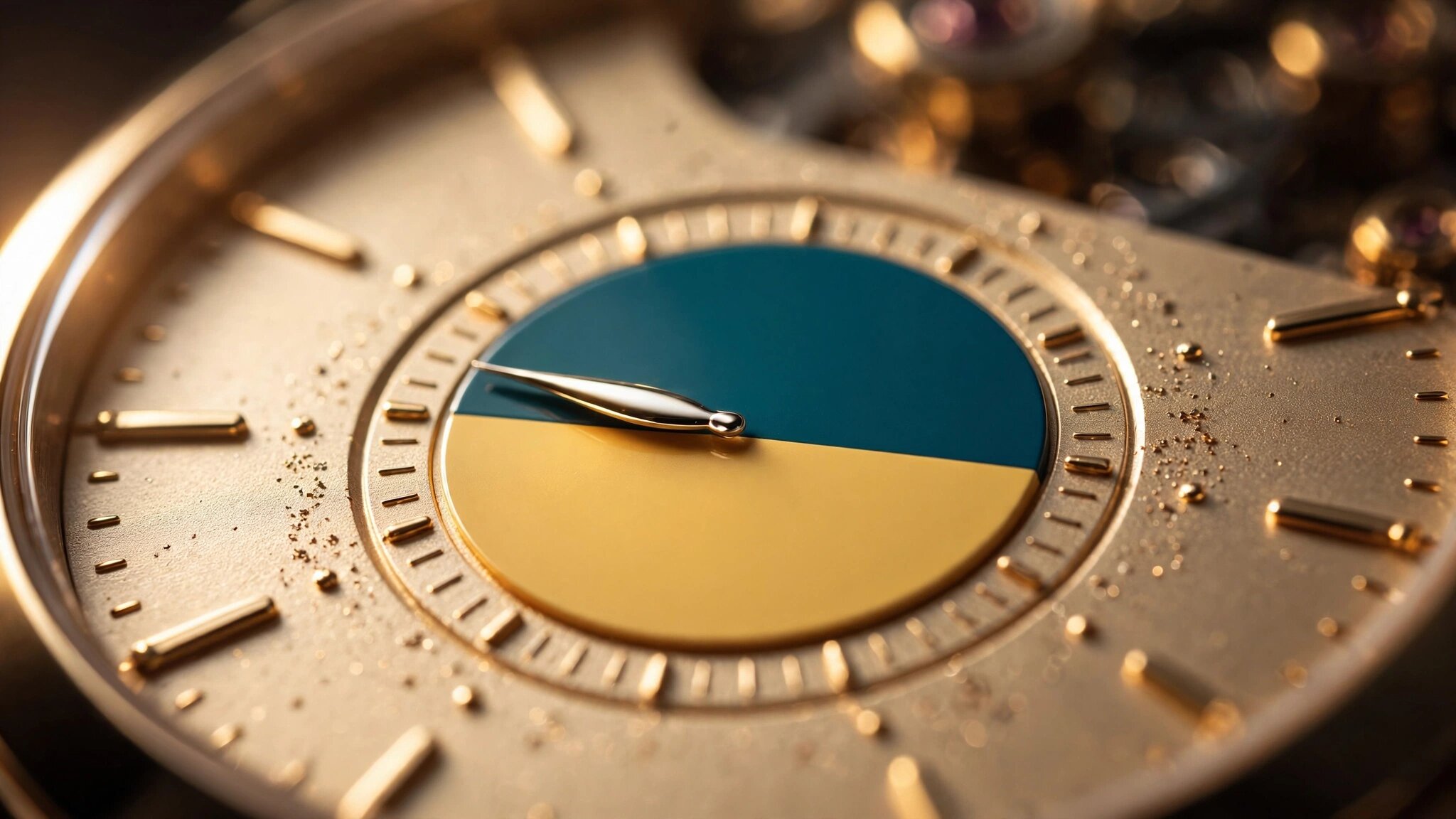
The Moon’s Inconvenient Period
Tides are driven by gravity. As the moon orbits Earth, its gravitational pull raises a bulge of water on the side of the planet facing it and, somewhat counterintuitively, a second bulge on the far side. The result, in most coastal locations, is two high tides and two low tides per day. But the cycle does not repeat every 24 hours. Because the moon advances roughly 12.2 degrees along its orbit each day, the tidal cycle runs approximately 50 minutes longer than a solar day. Over the course of a full lunar month, the pattern resets.
That full cycle is called the synodic month: the interval from one new moon to the next. Its length is 29 days, 12 hours, 44 minutes, and 2.88 seconds. Expressed as a decimal, 29.53059 days. For a watchmaker, this number presents a specific mechanical problem. You need a disc to rotate exactly once in that interval, and you have nothing to work with except metal wheels with integer numbers of teeth.
A Teenager and a Physics Teacher
In the late 1940s, Walter Haynes, then president of Abercrombie & Fitch, asked Charles-Edouard Heuer to build a wristwatch that could display tidal information. Hunters, fishermen, and sailors had embraced the solunar theory, first proposed by outdoor writer John Alden Knight in 1926, which held that the gravitational positions of the sun and moon influence the feeding patterns of fish and wildlife through predictable daily and monthly cycles. Knight had analyzed over 200 record catches and found that 90 percent occurred during the new moon at specific lunar times. Haynes wanted those rhythms on a dial.
Charles-Edouard was stumped. His 15-year-old son Jack recalled the moment in his autobiography:
“He scratched his head and admitted he had no idea how to do it. I told my father that my physics teacher at school, Dr. Heinz Schilt, was a genius and I was sure he would be able to find a solution. Indeed he could and he performed all the calculations for the wheels and cogs needed for a watch to predict high tides at a given location.”
Schilt’s calculation was essentially a problem in number theory. Given a going train that advances one wheel by a fixed increment each day, he needed to select gear teeth counts whose ratio would produce a rotational period of approximately 29.53 days. In 1949, the result was the Heuer Solunar: a time-and-tide wristwatch with a colorful rotating subdial at 6 o’clock.
The Fraction 945/32
A synodic month is 29.53059 days. No gear train with integer tooth counts can reproduce this number exactly. Watchmakers must choose a rational approximation close enough that the accumulated error stays invisible to the user.
Most moon phase watches use the crudest workable fraction: 59/2. A 59-tooth wheel advanced by one tooth every 12 hours completes a half-cycle every 29.5 days. It works, but 29.5 is not 29.53059. The error is 0.03059 days per month, or about 44 minutes. After 2 years and 7 months, the display drifts a full day from the actual lunar cycle. That is fine for a decorative moon phase disc, where the display is a circle divided into light and dark halves and nobody expects sub-day precision.
A tide indicator demands more. If the disc is divided into quadrants marking high and low tide windows, a 44-minute monthly drift means the indicated high tide slides away from reality by almost an hour within two years. For a sailor reading tide states at a glance, that gap is the difference between information and fiction.
A better fraction is 945/32. As a decimal, 945 divided by 32 equals 29.53125. The error against the true synodic month drops from 44 minutes per month to roughly 57 seconds. At that rate, the mechanism would need 3.7 years to accumulate a single day of drift. In practical terms, any sailor who resets the disc when changing ports will never notice the error.
Why 945/32? Because both numbers factor cleanly into gear-friendly integers. 945 equals 3 cubed times 5 times 7, or equivalently 27 times 35, or 63 times 15, or 189 times 5. 32 equals 2 to the fifth power. These factors can be distributed across two or three gear stages, each with tooth counts that fit inside a wristwatch movement. A direct 945-tooth wheel is obviously impractical, but a two-stage compound reduction, say a 63-tooth wheel driving a 15-tooth intermediate paired with a 32-tooth output, achieves the same ratio in a package a few millimeters across.
TAG Heuer has not published the exact tooth counts in the Seafarer’s tide gear train. But the specification of 29.53125 days per rotation confirms that the mechanism operates on the 945/32 ratio or an algebraically equivalent factorization.
From Solunar to Seafarer
Schilt’s gear train found its first home in the 1949 Solunar, a 36mm hand-wound watch with a central seconds hand and a rotating tide subdial. Abercrombie & Fitch sold it alongside fishing rods and shotguns. Setting it required consulting a local tide table, noting the time of the next high tide, and pressing a button at 4 o’clock to advance the disc until the “high” marker aligned with the current position. From that point forward, the mechanism tracked the tidal rhythm automatically.
A year later, Heuer added the tide disc to a three-register chronograph. The resulting Mareographe (sold by Abercrombie & Fitch under the name Seafarer, and by Orvis as the Solunagraph) combined stopwatch functionality with tidal indication, producing what was arguably the most specialized tool watch of the 1950s. Various dial layouts, case sizes, and color schemes appeared over the next two decades. Production ceased in the mid-1970s as quartz watches and digital tide computers made the mechanical approach seem quaint.
For nearly 50 years, the complication sat dormant. TAG Heuer produced a limited-edition Seafarer in collaboration with Hodinkee in 2025, then followed with the current Carrera Chronograph Seafarer for the permanent collection, unveiled at LVMH Watch Week in Milan in January 2026.
The TH20-04 Caliber
Integrating a tide mechanism into a modern caliber is harder than it was in 1949. Schilt’s original gear train sat inside a simple three-hand movement with room to spare. Fitting the same train alongside a column-wheel chronograph with a vertical clutch, date mechanism, and automatic winding introduces competing demands for space, torque, and reliability.
TAG Heuer’s Calibre TH20-04 is a dedicated solution. It is not a module bolted onto an existing base movement; the tide mechanism is integrated into the architecture alongside the chronograph. A column wheel controls the start, stop, and reset functions of the central chronograph seconds hand and the 30-minute counter at 3 o’clock. A vertical clutch handles the coupling between the chronograph and the going train, preventing the seconds hand from stuttering at start. Running seconds and a date window share the subdial at 6 o’clock. And at 9 o’clock, the tide disc occupies its own subdial, driven by the dedicated gear train through a stepped daily advance that occurs shortly after midnight.
Operating frequency is 28,800 vibrations per hour, or 4 Hz. Power reserve is 80 hours, delivered by a single mainspring barrel. Winding is automatic via a rotor shaped like the TAG Heuer shield. Water resistance for the 42mm stainless steel case is 100 meters.
What the Disc Does Not Do
It is worth being precise about what a mechanical tide indicator actually provides. It does not compute tides. Actual tidal prediction requires accounting for the gravitational influence of the moon, the sun, the shape of the local coastline, the depth of the ocean floor, the Coriolis effect of Earth’s rotation, and dozens of harmonic constituents unique to each port. Lord Kelvin built the first tide-predicting machine in 1873 using an analog computer with ten gear-driven cranks, each representing a separate harmonic. Modern digital tide tables use 37 or more constituents to achieve sub-centimeter accuracy.
A single rotating disc does none of this. It tracks one cycle: the average synodic month. Once manually set to a known high tide at a specific location, it indicates when the next high and low tides should approximately fall, assuming semi-diurnal tides (two highs and two lows per lunar day) and no disruption from weather, barometric pressure, or unusual bathymetry. Move to a different port and you must reset it. Hit a period of diurnal tides (one high and one low per day, common along parts of the Gulf of Mexico and Southeast Asia) and the quadrant display becomes misleading.
None of this diminishes the engineering. It simply clarifies that the Seafarer belongs to a tradition of indicating complications, not computing ones. A moon phase disc does not predict eclipses. A date wheel does not account for leap years without human correction. And a tide disc does not replace a nautical almanac. Each provides a mechanical approximation of a natural cycle, made useful by its immediacy and made beautiful by the gears that drive it.
A Problem Worth Solving Twice
Seventy-seven years separate the Solunar from the Carrera Seafarer. In that interval, the synodic month has not changed. The gravitational mechanics governing ocean tides have not changed. The gear ratio problem Dr. Schilt solved at a Swiss school desk in the late 1940s remains identical. What changed is everything around it.
Integrating that same ratio into a 42mm case alongside a column-wheel vertical-clutch chronograph, 80-hour power reserve, and 100-meter water resistance required engineering at a different scale. It is one thing to calculate the wheels. It is another to fit them next to a chronograph clutch and still have room for a mainspring that runs three days.
Jack Heuer, now in his nineties, lived to see his first contribution to the family business return in a form Dr. Schilt probably never imagined. The gears still turn at the same rate.
| TAG Heuer Carrera Chronograph Seafarer | |
|---|---|
| Reference | CBS2016.EB0430 |
| Case | 42mm stainless steel, brushed and polished, 14.4mm thick, 48.6mm lug-to-lug |
| Crystal | Domed sapphire (Glassbox), double anti-reflective coating |
| Water resistance | 100 meters |
| Movement | Calibre TH20-04, automatic, column-wheel chronograph, vertical clutch |
| Frequency | 28,800 vph (4 Hz) |
| Power reserve | 80 hours |
| Functions | Hours, minutes, running seconds, date, chronograph (central seconds, 30-minute counter), lunar tide indicator |
| Tide cycle | 29.53125 days per revolution |
| Dial | Champagne opaline, 18K gold-plated hands and indices, Intrepid Teal accents |
| Bracelet | 7-row stainless steel “beads of rice,” folding clasp; additional beige sports strap included |
| Price | CHF 8,300 / €8,800 |