The 42mm Fix: TAG Heuer Rebuilds the Carrera Chronograph Sport Around Its Case
For six years, the best in-house chronograph TAG Heuer made at this price was trapped inside the worst case they would put on it. The 2026 Carrera Chronograph Sport finally fixes that with a 42mm diameter, a 14.17mm profile, and a bezel built like an instrument panel instead of a trophy.
The 2020 Generation Was a Movement in Search of a Case
Rewind to 2020. TAG Heuer launches the Carrera Sport as a 44mm slab of steel capped with a solid ceramic bezel, thickness 15.48mm, lug-to-lug 49.8mm, wrist coverage that rivaled a hockey puck. Under that bulk sat genuinely good machinery, the Heuer 02 evolution that would become the TH20-00: column wheel, vertical clutch, 80 hours of reserve, in-house chronograph architecture for a fraction of what Geneva charges.
Nobody argued with the movement; everybody argued with the case. A racing chronograph is supposed to be an instrument, something you glance at and read in a tenth of a second. Instruments do not need 44 millimeters of diameter to display three sub-dials. They need legibility, and the old Sport's faceted baton markers and solid ceramic bezel were mass and shininess in the service of nothing mechanical.
At the Formula 1 Gran Premio de Espana 2026 in Madrid, a race TAG Heuer now title-sponsors, the brand finally admitted the case was the problem. Five new references arrived with the same in-house Calibre TH20-00 and an entirely reworked exterior. This is the first real overhaul of the Chronograph Sport since 2020, and the telling detail is what stayed identical.
Geometry First: What 2mm, 1.31mm, and 1.2mm Actually Buy
Diameter drops from 44mm to 42mm, thickness falls from 15.48mm to 14.17mm, and lug-to-lug contracts from 49.8mm to 48.6mm. Each number sounds like rounding error, but together they change the watch.
Case volume scales roughly with the square of the diameter, so the move to 42mm removes on the order of 9 percent of the case's planar footprint, and the 1.31mm thickness reduction cuts another slice off the top. More importantly, a 42mm case with 48.6mm lugs now fits the way a 42mm chronograph should fit: inside the boundaries of a normal wrist, where the lugs no longer cantilever past the edges for anyone under a seven-and-a-half-inch wrist.
Context matters. The Omega Speedmaster Professional sits at 42mm with a 13.2mm profile, and nobody calls it slim, while Rolex holds the Daytona to 40mm and 11.9mm. At 14.17mm the new Carrera Sport remains thicker than both, and that is the honest number to keep in view. Column-wheel chronographs with vertical clutches and 80-hour mainspring barrels are inherently tall movements, and 14.17mm is what that architecture costs once you stop adding bezel bulk on top of it, which is the honest accounting: TAG Heuer did not repeal physics, they just stopped making it worse.
The Bezel Is the Engineering Story
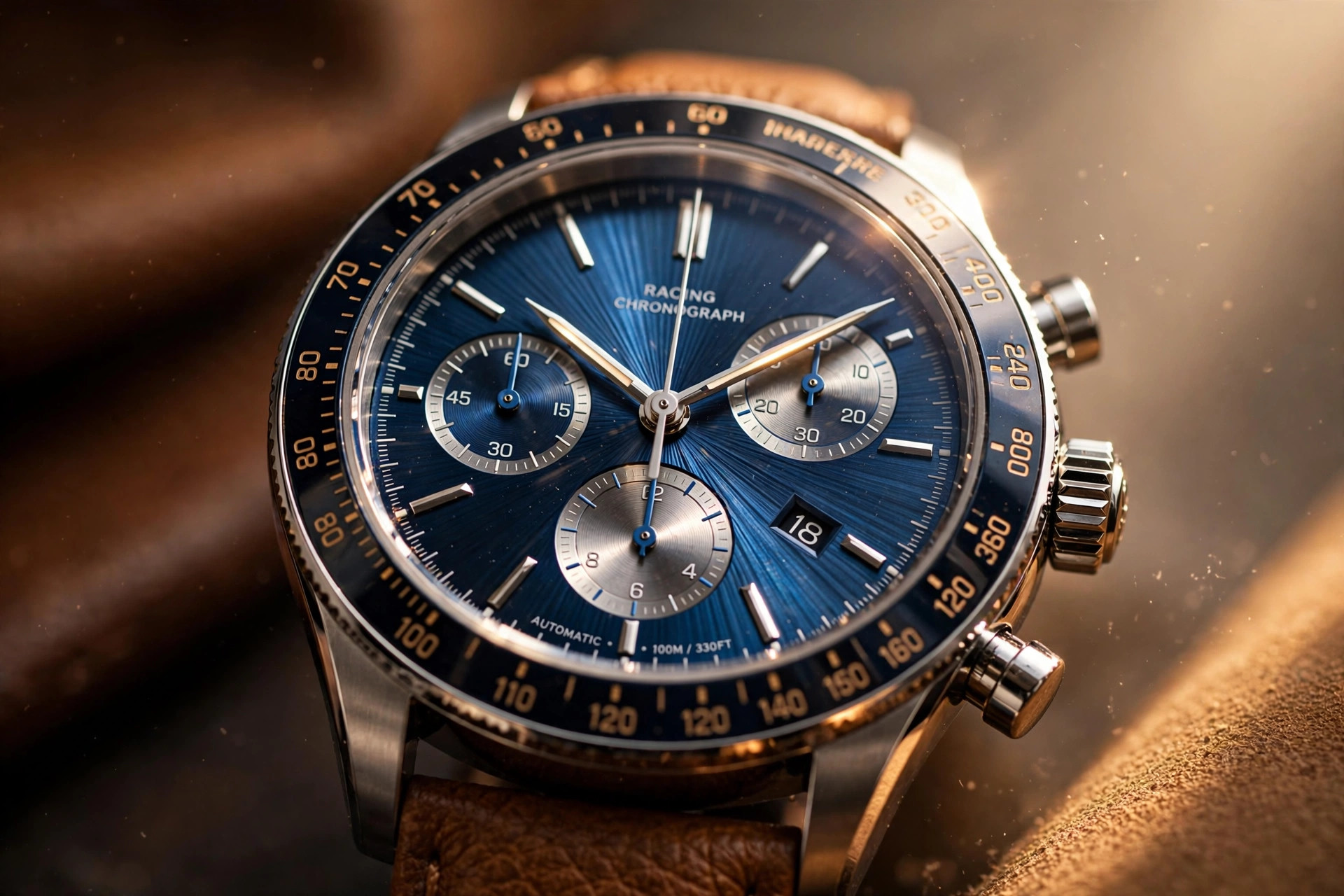
Here is the change that matters most and the one launch coverage mostly glossed over, and it matters because a solid ceramic bezel is a terrible piece of engineering for a tool watch, whatever it looks like in press photos. In its place sits a fixed steel frame holding a polished ceramic tachymeter insert.
Sintered zirconia ceramic is extraordinarily hard, around 1,200 HV on the Vickers scale against roughly 200 HV for 316L steel, which makes it nearly scratch-proof. It is also brittle, expensive to CNC-machine with diamond tooling, and essentially unrepairable: chip a solid ceramic bezel and you replace the whole ring at factory cost. A bezel that cannot be refinished and shatters instead of denting is jewelry, not instrumentation.
The steel-cradle construction reverses the logic: steel takes the structural job, absorbing impact energy through plastic deformation exactly the way 316L is supposed to, and ceramic keeps the job it is actually good at: a polished, hard-wearing surface that carries the tachymeter scale without fading. If the insert ever chips, you swap a smaller, cheaper component instead of a full bezel. Omega has run exactly this playbook on the Planet Ocean and Seamaster lines for years, a fixed metal bezel with a ceramic insert, and nobody accuses those watches of cutting corners.
A solid ceramic ring needs minimum wall thickness to survive machining and everyday knocks, but an insert seated in a steel cradle can be thinner because the steel behind it carries the load, which is the thickness angle. Part of that 1.31mm reduction in profile comes from the bezel no longer needing to be self-supporting. This is the kind of invisible engineering that never appears in marketing copy and is exactly why the redesign reads as serious rather than cosmetic.
Legibility at Speed: The Glassbox Dial Language
TAG Heuer borrowed the large printed 60-second track from its Glassbox Carrera, the model that has carried the line's design credibility since 2023, and dropped the previous generation's faceted applied batons. In their place: prominent Arabic numerals marking even-minute intervals, a redesigned flange, and the tricompax layout intact at 3, 6, and 9, a 30-minute counter, small seconds, and 12-hour counter respectively, with the date tucked into the 6 o'clock sub-dial.
Opinions will split on this, and I will take a side. Printed numerals on a tool watch are not a downgrade from applied batons; they are the correct choice for a tachymeter-reading instrument. Faceted indices catch light beautifully and read inconsistently depending on wrist angle. High-contrast printed numerals on a continuous 60-second scale read the same under a pit-lane floodlight as they do in shade. Jack Heuer's original 1963 Carrera understood this: legibility is the whole design brief.
The five dial executions run black opalin with red chronograph accents, a silver panda with black counters, teal green with silver sub-dials, and two blue sunray versions, one on the bracelet and one on perforated brown calfskin. On the black-dial reference, the ceramic bezel carries a red and white timing scale, the strongest racing signal of the bunch. None of this is subtle, and a racing chronograph should not be.
What They Kept, and Why Keeping It Is the Point
Inside, nothing changed. The Calibre TH20-00 carries over: an in-house automatic integrated chronograph with column wheel and vertical clutch, 28,800 vibrations per hour, 33 jewels, 80 hours of power reserve, and bidirectional winding, viewable through a sapphire caseback where the shield-shaped rotor does its work. (WatchBase traces the TH20-00 directly to the Heuer 02 base architecture, revised and re-designated when the Glassbox generation arrived in 2023.)
A manufacturer that redesigned the case, bezel, dial, and bracelet but left the movement alone is telling you where the strength was. The TH20-00 was never the weak link: column-wheel actuation gives crisp pusher feel, the vertical clutch eliminates the seconds-hand jump that friction-based horizontal clutches inflict when the chronograph engages, and 80 hours of reserve means you can leave it Friday and pick it up Monday. TAG Heuer spent its engineering budget where the 2020 watch was losing sales, which is what rational product management looks like.
The engraved Victory Wreath motif, echoing Jack Heuer's tradition of gifting gold watches to victorious drivers as lucky charms, is the one indulgence, and I will allow it: every racing chronograph gets exactly one superstition.
The Bracelet Grew Up Too
Tapered H-shaped steel bracelet, 22mm at the lugs, with a toolless easy-link adjustment system and butterfly clasp. The easy-link mechanism is the quiet quality-of-life upgrade of this redesign: wrists swell and shrink through the day, and a bracelet that lets you add or remove a link without tools is the difference between a watch that fits at breakfast and a watch that fits at dinner.
Perforated brown calfskin on a folding clasp covers the second blue-dial reference, in the classic racing-strap register. Leather or bracelet, water resistance holds at 100 meters with screw-in caseback, which is honest tool-watch spec and nothing more.
Limitations Worth Stating
I have not handled the watch. Everything here rests on launch reporting from Hypebeast, The Manual, Fratello, Monochrome, and Revolution, plus TAG Heuer's own published specifications, cross-checked where sources agree. Hands-on assessment of the bezel machining, the easy-link mechanism's tolerances, and whether the printed dial reads as crisp in person as it does in press photography will have to wait.
At 14.17mm the watch is still thick, because the TH20-00's vertical-clutch architecture sets a floor on that, and buyers cross-shopping an 11.9mm Daytona will notice. Lug-to-lug at 48.6mm is improved but still long; small wrists should try before committing. And the steel-cradle bezel, for all its engineering sense, trades away some of the old solid-ceramic bezel's jewel-like presence, which a certain buyer will mourn. Fine. That buyer was never reading a tachymeter anyway.
Retail starts at $6,650 on leather and $6,850 on the bracelet, per U.S. pricing, and I will say no more about that: this site covers engineering, not dealer margins.
Specification
| References | CDB2110.BA0054 (black), CDB2111.BA0054 (blue, bracelet), CDB2111.FC8378 (blue, leather), CDB2112.BA0054 (teal green), CDB2113.BA0054 (silver) |
|---|---|
| Case | Stainless steel, 42mm diameter x 48.6mm lug-to-lug x 14.17mm thick; fixed steel bezel cradle with polished ceramic tachymeter insert |
| Crystal | Sapphire (domed, double anti-reflective per launch coverage) |
| Caseback | Sapphire, screw-in; engraved Victory Wreath |
| Dial | Black opalin / silver panda / teal green sunray / blue sunray; printed 60-second track, Arabic numerals, tricompax sub-dials (30-min at 3, small seconds at 6 with date, 12-hr at 9) |
| Movement | Calibre TH20-00, in-house automatic integrated chronograph; column wheel + vertical clutch; 28,800 vph (4Hz); 33 jewels; 80-hour power reserve; bidirectional winding; shield-shaped rotor |
| Water resistance | 100m / 10 ATM |
| Bracelet / strap | Tapered H-shaped steel bracelet, 22mm, toolless easy-link adjustment, butterfly clasp; perforated brown calfskin option |
| Launched | Formula 1 Gran Premio de Espana 2026, Madrid |
What It Costs, and Why the Case Was the Whole Story
Strip away the launch noise and the 2026 Carrera Chronograph Sport is a single thesis executed in steel: the TH20-00 deserved a case engineered like the movement. TAG Heuer shrank the envelope by meaningful margins, rebuilt the bezel as a steel structure with a ceramic working surface instead of a monolithic ring, and gave the dial the legibility language the Glassbox proved out. Nothing inside changed because nothing inside needed to.
Six years is a long time to wear a bad case on a good movement, and the wait is over.