Bend, Don't Pivot: How TAG Heuer's Calibre TH80-00 Eliminated Every Pivot in the Chronograph
Press the top pusher on any premium chronograph. Inside the case, a cascade begins. A lever swings on its pivot to release a column wheel. As that wheel rotates, its pillars rise to lift an operating lever off its seat, which pivots to release a clutch. Once engaged, the clutch connects the chronograph train to the movement's gear train. Every one of those interactions involves a pin turning inside a hole, metal sliding against metal, lubrication slowly migrating away from the contact zone. Hit the bottom pusher to reset and a separate chain of levers fires in reverse. A watchmaker assembling this mechanism by hand will set as many as eight individual pivots for the chronograph function alone, each demanding precise endshake, side-shake, and lubrication. Multiply those pivot points by millions of actuations over a four-to-five-year service interval, and friction becomes the defining constraint of chronograph design.
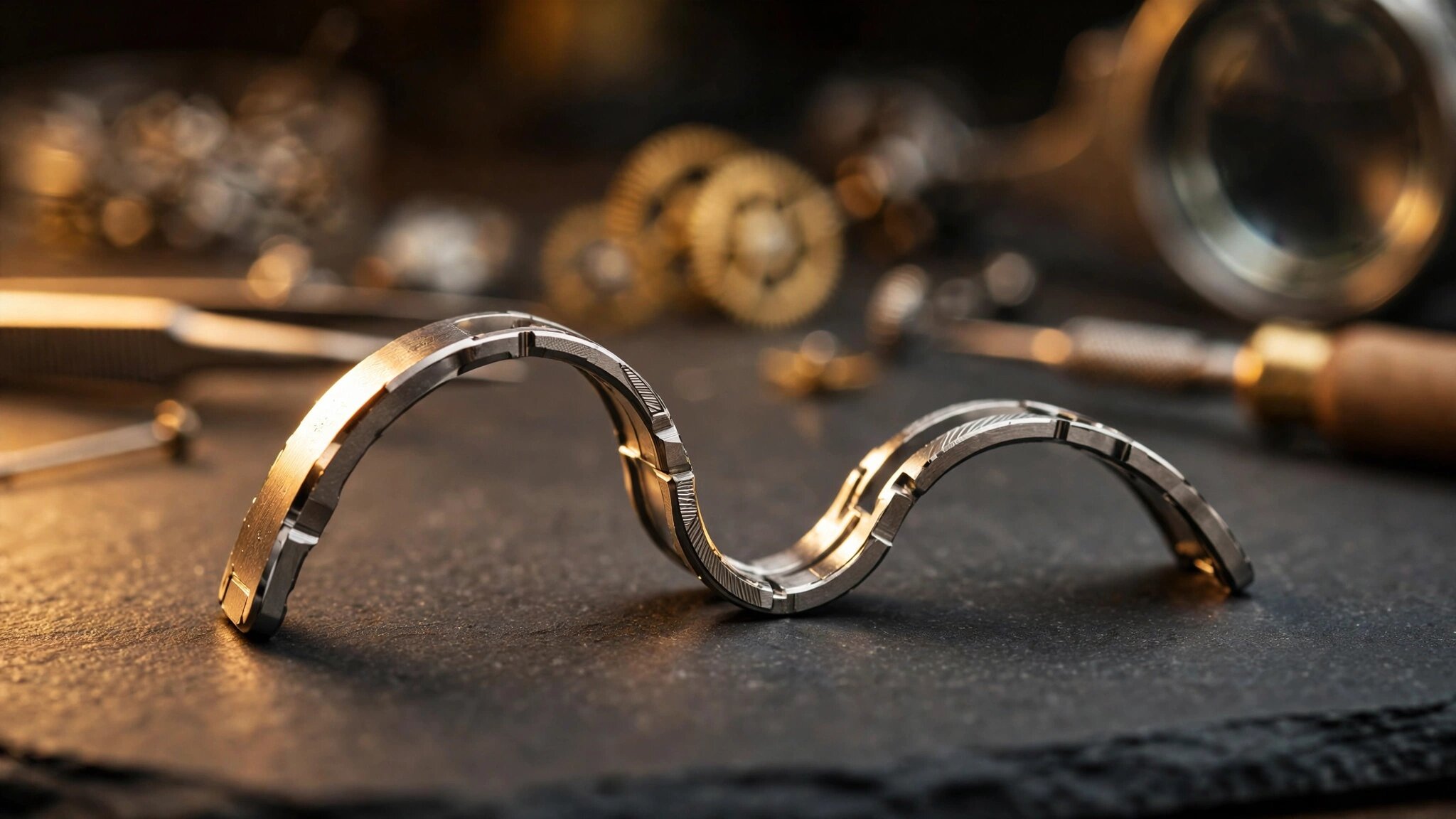
TAG Heuer's Calibre TH80-00, launched at Watches and Wonders 2026 inside the Monaco Evergraph, eliminates the entire pivot-based chronograph actuation system. No column wheel. No articulated levers. No operating springs. In their place sit two flexible components, fabricated by high-precision LIGA, that deform elastically to perform the start, stop, and reset functions. One component governs start and stop. A second handles reset. Both are bistable, meaning they hold two discrete positions without continuous force, snapping between states the way a light switch flips rather than drifting like a dimmer.
Growing Metal in a Mold
LIGA stands for Lithographie, Galvanoformung, Abformung: lithography, electroplating, molding. It is a micro-fabrication process borrowed from the semiconductor industry and adapted for mechanical components. A precise mask, functioning as a stencil, is laid over a thin resin layer on a disc and exposed to ultraviolet light. UV penetrates the unmasked portions and hardens the exposed resin through polymerization. A solvent dissolves the remaining soft resin, leaving a miniature mold of the desired component geometry. Immersion in a galvanic bath follows, where a nickel alloy is deposited into the mold cavities layer by layer, building the component from the bottom up. Once the metal reaches the target thickness, the disc is lapped flat, the resin mold is dissolved, and the finished components emerge with tolerances measured in single-digit micrometers. No hand finishing. No adjustment. Component geometry is locked in entirely by the mask.
UV-LIGA is not new to high horology. Rolex introduced LIGA-fabricated components in the Calibre 4130 powering the Cosmograph Daytona. Its chronograph seconds wheel features individual teeth built from cantilevered springs that flex inward during meshing, eliminating backlash between gears and removing the need for a tensioner spring. It is an elegant refinement of one specific component within a conventional architecture. Column wheel, operating levers, every other pivot in the Daytona's chronograph mechanism: all remain traditional pin-in-hole joints requiring lubrication and periodic service.
Replacing the Architecture
What TAG Heuer has done with the TH80-00 is categorically different. Rather than refining a single component within the existing framework, the calibre replaces the framework itself. A traditional chronograph might use seven to twelve individual components to coordinate its three functions: column wheel, coupling levers, operating levers, brake springs, return springs. Where convention uses a dozen rigid parts pivoting on pins, the TH80-00 uses two monolithic flexures. Fewer components. Fewer assembly steps. Zero sliding-contact joints in the chronograph train.
Five years of co-development between TAG Heuer LAB and Vaucher Manufacture Fleurier produced this architecture. TAG Heuer LAB, the brand's think tank of scientists and engineers established in 2016, designed the compliant mechanism. Vaucher, the same manufacture that co-developed the split-seconds Calibre TH81-00, handled production engineering. Neither party has published the precise alloy composition or detailed geometry of the bistable components, but the manufacturing process (LIGA) and operating principle (elastic deformation between two stable equilibrium positions) are confirmed.
Why Flexures Work
Compliant mechanisms are well understood outside horology. Satellite instruments have relied on flexure-based pointing systems for decades, prized in environments where a technician cannot arrive to re-lubricate a joint. EPFL's Instant-Lab, led by associate professor Simon Henein, has published extensively on flexure applications in both space hardware and timekeeping. "Compliant mechanisms do not need lubricant and have no wear," notes Gilles Feusier, head of technology at EPFL's Space Center. Henein adds that below their elastic limit, flexures do not suffer from material fatigue, preserving their internal crystal structure across what is theoretically an infinite number of cycles. His research places that elastic limit at roughly 40 degrees of angular travel for typical watchmaking flexures.
Bistability is the property that makes this practical for a chronograph. A simple flexure, like a diving board, returns to its neutral position once the load is removed. A bistable flexure holds two distinct equilibrium positions, requiring energy input to snap from one to the other but remaining stable in either state without external force. In the TH80-00's start/stop component, pushing the top chronograph pusher snaps the flexure from its disengaged position to its engaged position. It stays engaged with no continuous spring pressure. Pushing again snaps it back. Reset works identically: one snap from armed to released returns the chronograph counter to zero.
Compounding Eliminations
Every eliminated pivot is a compounding improvement. No pivot means no friction at that joint. No friction means no lubricant required at that point. No lubricant means no lubricant migration, which is the primary degradation mechanism in mechanical watch movements. Oils creep away from contact surfaces over years, leaving dry metal-on-metal interfaces that accelerate wear exponentially. Reducing lubrication points in the chronograph mechanism directly extends the interval between required service visits. TAG Heuer backs this engineering with a five-year warranty, more than double the two-year standard for comparable COSC-certified chronograph movements.
What Else Lives Inside
Beyond the compliant chronograph, the Calibre TH80-00 carries a TH-Carbonspring oscillator, a carbon-composite hairspring developed at TAG Heuer LAB that is antimagnetic, lighter than its metallic equivalent, and more shock-resistant. Operating at 5 Hz (36,000 vibrations per hour), the movement resolves elapsed time to one-tenth of a second. Power reserve is 70 hours. COSC certification confirms chronometer-grade daily accuracy.
Construction is inverted: barrel, gear train, balance, and escapement are mounted on the dial side, visible through transparent acrylic glass. Two fine-brushed, sandblasted bridges anchor the barrel at 12 o'clock and the escapement at 6 o'clock, framing the movement in visual symmetry with the 30-minute chronograph counter at 3 o'clock and small seconds at 9 o'clock. Through the sapphire caseback, the rotor is sculpted in the shape of the TAG Heuer shield, alongside a checkered-flag motif on the oscillating weight.
Monaco as Laboratory
TAG Heuer has form with radical chronograph experiments in the Monaco case. In 2004, the V4 Concept replaced gear trains with belt drives and swapped synthetic rubies for ceramic ball bearings. By 2011, the Mikrograph measured to one-hundredth of a second with dual escapements running at 360,000 vibrations per hour. In 2024, the Split-Seconds Chronograph used Selective Laser Melting to build an exoskeletal titanium case weighing just 85 grams. Each generation used the Monaco's square case as a testbed for technologies that eventually filtered into broader production.
Whether the compliant chronograph follows the same path remains to be seen. LIGA costs decrease as production scales, and the TH80-00's reduced component count should simplify assembly. But the engineering argument is hard to dismiss even at CHF 23,000: fewer parts, no lubrication in the chronograph actuation, theoretically infinite fatigue life below the elastic limit, and a warranty that says TAG Heuer believes its own math.
Two Strips of Metal
Available in natural Grade 5 titanium with blue opaline counters (ref. CEW5181.FT8123) or black DLC-coated titanium with red accents (ref. CEW5180.FT8122), both 40mm Monaco Evergraph models retain the left-hand crown that traces back to the 1969 Ref. 1133 and its Calibre 11. Elongated pushers and tapered lugs update the ergonomics. Water resistance is rated to 100 meters. Rubber straps with textile embossing and titanium folding clasps complete both references.
For anyone who has watched a watchmaker spend an afternoon adjusting the endshake on eight chronograph pivots, the appeal of the TH80-00 is immediate. Three centuries of accumulated lever-and-pivot wisdom, distilled into two strips of carefully shaped metal that flex instead of rotate. Fewer things to go wrong means fewer things that will.
Sources
- TAG Heuer Official Magazine, "Everything you need to know about the Calibre TH80-00," April 15, 2026.
- Revolution Watch, "On to the Next Lap with the TAG Heuer Monaco" and "The TAG Heuer Monaco Evergraph," 2026.
- WatchTime, "TAG Heuer Introduces Monaco Evergraph with New Calibre TH80-00," April 15, 2026.
- Tatler Asia, "Tag Heuer Monaco Evergraph Debuts Revolutionary Compliant Chronograph at Watches and Wonders 2026."
- SJX Watches, "Insight: High-Tech LIGA Within the Rolex Daytona Cal. 4130," November 2020.
- EPFL, "Friction-free precision, from space to watchmaking," September 2024.
- Escapement Magazine, "TAG Heuer Monaco Evergraph Watch Review, Specification & Price," 2026.
- Boss Hunting, "TAG Heuer's New Monaco Evergraph Is Proper 21st Century Watchmaking," April 2026.