Woven, Not Chopped: How Surface Transforms Rebuilt the Carbon Ceramic Brake Disc From the Fiber Up
Every major carbon ceramic brake disc on the market uses chopped short carbon fibers pressed into resin. Surface Transforms, a company in Knowsley, England, weaves continuous fibers into a three-dimensional matrix instead. The difference sounds incremental. It changes everything about how the disc conducts heat, wears, and dies.
Chopped Fiber and Its Limits
Brembo's carbon ceramic manufacturing process, which supplies Ferrari, Porsche, McLaren, Lamborghini, Aston Martin, and Mercedes-AMG from the factory, starts with carbon fibers cut to lengths of roughly 3 to 50 millimeters. These chopped fibers are mixed with phenolic resin and pressed into a steel mold that reproduces the disc geometry. Carbonization at around 900°C converts the resin binder into a porous carbon matrix. Then comes siliconization: the porous carbon preform is infiltrated with molten silicon at approximately 1,700°C in a high vacuum, and the silicon reacts with the carbon to form silicon carbide (SiC) throughout the disc. Total process time runs about five days. What emerges is a C/SiC composite disc that weighs roughly half as much as cast iron, operates at sustained temperatures up to 750°C without fade, and lasts around 150,000 kilometers on the road.
Impressive numbers. But the chopped-fiber architecture has structural consequences that only become apparent under sustained track abuse. Short fibers distributed randomly through the matrix create a material that is approximately isotropic, meaning its properties are roughly the same in every direction, but the fibers terminate at random points throughout the volume. Each fiber end is a stress concentration. Under repeated thermal cycling, microcracks nucleate at these termination points and propagate through the SiC matrix between fibers. Because no fiber is long enough to bridge a developing crack across a significant distance, crack propagation is essentially unopposed once it begins.
On the road, this does not matter. Street driving rarely pushes brake temperatures above 300°C, the thermal cycles are gentle, and the 150,000-kilometer service life is generous. On a track, the failure mode is specific and familiar to anyone who has run Porsche PCCB or Ferrari CCM3 discs hard: the surface develops a condition called "chunking," where sections of the friction face delaminate in irregular patches, sometimes during a single aggressive track session. Once chunking begins, the disc is finished. It cannot be resurfaced because the short fibers that provided structural integrity in the missing material are gone, and grinding deeper only exposes more fiber ends at more random angles. A chunked carbon ceramic disc is scrap. Replacement cost for a set of Porsche 991 Turbo PCCB rotors runs approximately $16,000 to $20,000.
Continuous Fiber Changes the Failure Mode
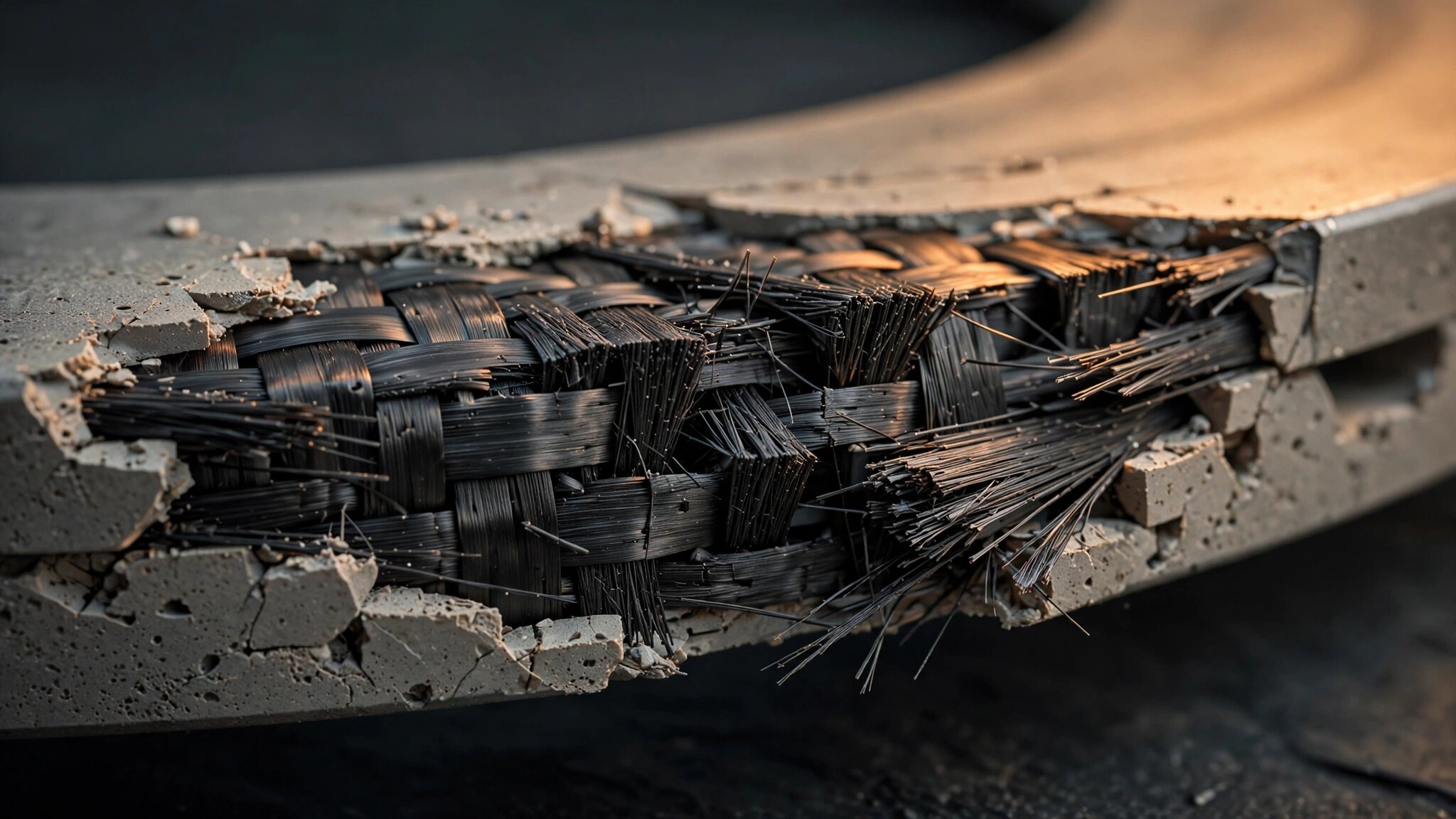
Surface Transforms, founded in 1992 and listed on the AIM market of the London Stock Exchange, takes a fundamentally different approach. Instead of chopping carbon fibers to short lengths and distributing them randomly, ST interweaves continuous carbon fibers into a three-dimensional multi-directional matrix. Sheets of long fibers are laid perpendicular to each other, creating a structure where fibers run unbroken through the full thickness and diameter of the preform. After weaving, the preform undergoes carbonization and then liquid silicon infiltration, the same basic chemistry as the Brembo process, but the resulting C/SiC composite has radically different internal architecture.
Three properties change immediately.
First, thermal conductivity. Carbon fiber is an excellent thermal conductor along its length but a poor conductor across its diameter. In a chopped-fiber disc, heat must jump between fiber ends and through the SiC matrix, because no single fiber spans a significant fraction of the disc. In a continuous-fiber disc, heat travels along unbroken fiber paths that run from the friction surface deep into the disc body and outward toward the ventilation channels. ST claims three times the thermal conductivity of competitor carbon ceramic discs, and independent testing from multiple aftermarket retailers selling ST discs for Porsche, McLaren, and Ferrari applications reports operating temperatures approximately 100 to 200°C lower than OEM chopped-fiber discs under identical track conditions. Lower operating temperature means less thermal stress on the pad, the caliper seals, the brake fluid, and the disc itself.
Second, crack propagation resistance. A continuous fiber that encounters a developing crack does not terminate. It bridges the crack, carrying load across the fracture plane and preventing the crack from propagating further without breaking the fiber itself. This is the same principle that makes woven carbon fiber composites in aerospace structures damage-tolerant: a crack in the resin matrix hits a fiber and stops, or at least slows dramatically, because breaking a continuous fiber requires significantly more energy than propagating a crack through brittle SiC matrix between fiber ends. In practical terms, ST discs do not chunk. They wear gradually and uniformly, because the continuous fiber skeleton holds the friction surface together even as the SiC matrix between fibers wears away.
Third, and this is the property that makes the economics completely different: continuous-fiber discs can be resurfaced. Because the fiber architecture remains structurally intact even after thousands of miles of track use, the worn friction surface can be machined back to fresh material, re-infiltrated, and returned to service. ST specifies up to three resurfacing cycles per disc, at a cost of approximately $600 per rotor plus shipping, with a ten-business-day turnaround. Refurbishment involves full disassembly of the two-piece disc and hat assembly, inspection of all components, resurfacing of the rotor ring, and reassembly with new hardware. After three refurbishments, a single set of ST rotors provides 12,000 to 15,000 track miles of service life. For comparison, a set of Porsche PCCB discs that chunks after 2,000 to 3,000 track miles provides zero resurfacing opportunities and costs three to four times as much per replacement set.
Manufacturing the Weave
ST's manufacturing facility in Knowsley, Merseyside, is the only carbon ceramic brake disc factory in the United Kingdom. Production begins with the fiber architecture: continuous carbon fiber tow is woven into sheets and then layered in perpendicular orientations to create the three-dimensional preform. This step is conceptually similar to how aerospace-grade carbon fiber reinforced polymers (CFRP) are produced, but with a critical difference in what happens next. Aerospace CFRP uses an epoxy or thermoplastic matrix that cures at relatively low temperatures and remains a carbon-polymer composite. ST's process carbonizes the preform to burn out organic binders, leaving a porous carbon-carbon skeleton, and then infiltrates it with liquid silicon to convert the matrix to silicon carbide.
Liquid silicon infiltration, or LSI, is a reactive process. Molten silicon at around 1,500 to 1,700°C wicks into the porous carbon preform through capillary action, and the silicon reacts with the carbon matrix to form SiC in situ. The continuous fibers survive this process because their crystallographic structure is stable at siliconization temperatures, and the SiC matrix forms around them rather than consuming them. Control of porosity in the preform stage determines how evenly the silicon infiltrates and how uniform the resulting C/SiC matrix is. Non-uniform infiltration creates hot spots and inconsistent friction behavior, so preform density and pore distribution are tightly controlled.
After siliconization, final machining brings the disc to dimensional tolerance. C/SiC is extraordinarily hard, approaching 2,500 HV in some formulations, so machining requires diamond tooling and generates substantial tool wear. Surface finish of the friction face is critical: too rough and initial pad bedding is inconsistent, too smooth and the transfer layer that stabilizes friction behavior takes longer to develop. ST machines to a specific surface roughness that balances these requirements, and every disc undergoes dynamometer validation to confirm that friction remains stable across repeated high-energy stops before it ships.
From Koenigsegg to Corvette
Surface Transforms' first hypercar contract was with Koenigsegg. ST supplies carbon ceramic discs for the Koenigsegg CCR, and in 2020 won a £5 million contract as sole brake disc supplier for the Koenigsegg Gemera, a 1,700-horsepower hybrid four-seater hypercar manufactured by NEVS in Trollhättan, Sweden. Koenigsegg's selection was not surprising: the Gemera's combination of extreme power, all-wheel drive, and a 4,600-pound curb weight generates massive braking energy, and the continuous-fiber architecture's superior thermal management and durability align with Koenigsegg's engineering philosophy of building cars that are genuinely usable on track, not just fast in a straight line.
Aston Martin followed with the Valkyrie, a collaboration with Red Bull Advanced Technologies that produces over 1,100 horsepower from a Cosworth-built V12 and runs at Le Mans Hypercar-level downforce with road tires. The Valkyrie's braking requirements are closer to a race car than a road car, and the decision to specify ST's continuous-fiber discs over conventional CCM suggests that Aston Martin's engineering team, which includes former Red Bull Racing aerodynamicist Adrian Newey, prioritized the thermal conductivity and crack resistance advantages that matter most under sustained high-energy braking.
Then came General Motors. The 2026 Corvette ZR1X uses the J59 brake package as standard equipment, with 16.5-inch carbon ceramic rotors front and rear clamped by Alcon 10-piston front and 6-piston rear monobloc calipers. During development, the Savage Geese YouTube channel's technical review revealed that Jon Washington, Lead Brake System Engineer for Corvette, identified the rotors as Surface Transforms units. GM's press materials describe them as "constructed with continuously woven carbon fiber threads." The ZR1X's 1,250 combined horsepower, sub-two-second 0-60 time, and quarter-mile trap speed above 150 mph mean that the interval between braking events on track is drastically compressed compared to lesser Corvettes. Less time between stops means less cooling time, which makes the 3x thermal conductivity advantage of continuous-fiber architecture operationally significant rather than merely academic.
GM also specified the J59 package as optional on the 2025 ZR1 when equipped with the ZTK Performance Package (RPO code J59, $1,500 on top of the $8,495 Carbon Aero Package). Testing produced 1.9G of deceleration from 180 to 120 mph, and engineers logged 2,500 track miles across four test cars without a brake change. That endurance number, if accurate, represents a dramatic improvement over the chunking failures that Corvette C8 owners have reported with the standard Brembo-sourced carbon ceramic brakes at track days.
| Surface Transforms CCST vs. Traditional CCM | |
|---|---|
| Fiber Architecture | Continuous 3D woven matrix vs. random short-fiber distribution |
| Thermal Conductivity | ~3x higher (continuous fiber thermal pathways) |
| Operating Temperature | 100-200°C lower under equivalent braking load |
| Wear Pattern | Gradual, uniform vs. chunking/delamination |
| Refurbishment | Up to 3x resurfacing ($600/rotor) vs. not possible |
| Track Life per Set | 4,000-5,000 miles vs. 2,000-3,000 miles typical |
| Total Service Life | 12,000-15,000 track miles (with refurbishments) |
| Replacement Cost | ~50% of OEM CCB rotor pricing |
| Weight vs. Cast Iron | Up to 70% lighter (typically 40 lbs unsprung mass savings) |
| OEM Applications | Koenigsegg Gemera/CCR, Aston Martin Valkyrie, Corvette ZR1X/ZR1 ZTK |
| Manufacturer | Surface Transforms PLC, Knowsley, UK (LON:SCE) |
Aftermarket Adoption and the Cost Argument
ST's aftermarket business may actually matter more than its OEM contracts, because it exposes the continuous-fiber technology to a customer base that already owns cars with conventional carbon ceramic brakes and can make a direct comparison. Hinz Motorsport, the primary North American distributor, sells ST disc sets for the Porsche 991 and 992 GT3, GT3 RS, GT2 RS, and Turbo, as well as McLaren 675LT, 720S, and 765LT applications. These are bolt-on replacements for existing PCCB or CCM rotors, requiring no caliper changes, which means the customer can keep the original discs to reinstall before selling the car.
Pricing tells an interesting story. A set of OEM PCCB replacement rotors for a Porsche 992 GT3 RS costs in the range of $16,000 to $20,000, and those rotors are disposable once they wear or chunk. A comparable set of ST CCST rotors costs approximately $8,600 for the fronts alone on a 991 Turbo application. Expensive, certainly, but not when amortized across 12,000 to 15,000 track miles including three refurbishment cycles. At $600 per rotor for each refurbishment, the total cost of ownership for a set of ST rotors across their full service life is roughly equivalent to one and a half sets of OEM PCCB rotors, while delivering four to five times the total track mileage. For anyone who actually tracks a Porsche GT car regularly, the arithmetic is not close.
Performance differences reinforce the cost argument. Retailers and track-day users consistently report better brake modulation with ST discs, meaning the relationship between pedal pressure and deceleration is more linear and predictable, which improves trail-braking accuracy. This is likely a direct consequence of the lower operating temperature: brake pad compounds behave more consistently when the rotor surface is 100 to 200 degrees cooler, because the pad is operating in a more stable region of its friction-versus-temperature curve. Cooler rotors also extend caliper seal life, reduce brake fluid degradation, and decrease the frequency of fluid boiling events that produce a spongy pedal under sustained track use.
Limitations and Open Questions
Surface Transforms is a small company. Its Knowsley factory has finite capacity, and scaling production to meet OEM demand from Koenigsegg, Aston Martin, and General Motors simultaneously has been a persistent challenge. ST's annual reports and investor communications have repeatedly flagged production ramp delays, and the company has invested in expanding manufacturing capacity to meet current and anticipated future contracts. Whether they can reliably deliver the volume that a program like the Corvette ZR1/ZR1X requires, which involves production numbers orders of magnitude larger than the Gemera or Valkyrie, remains an open question. The J59 package being optional on the ZR1 (versus standard only on the ZR1X) may reflect supply constraints as much as market segmentation.
Longevity data is also still maturing. ST's 4,000-to-5,000 track-mile-per-set claims and 12,000-to-15,000 total-life-with-refurbishment figures come from the company and its distribution partners. Independent long-term validation from large user populations does not yet exist in the way it does for Brembo's CCM technology, which has been in OEM service since the early 2000s. Early adopters on Porsche and McLaren platforms report excellent results, but "early adopters running track-prepared supercars" is a self-selecting sample. Whether the continuous-fiber architecture's advantages hold up across a broader range of use cases, climates, and driver behaviors will only become clear as the ZR1X puts ST discs into the hands of thousands of Corvette buyers who are not necessarily seasoned track veterans.
Cold-bite performance, the initial friction when braking from cold, is an area where carbon ceramic discs have historically been criticized compared to cast iron. ST claims "outstanding performance, even from cold" in its marketing materials, and the higher thermal conductivity could theoretically help by more rapidly distributing the initial frictional heat across a larger volume of rotor material. Whether this translates to a measurable improvement in real-world cold-stop distances is something that published third-party test data has not yet conclusively established.
What a Fiber Does
Strip away the brand names and the hypercar associations, and the Surface Transforms story reduces to a straightforward materials science insight. When a carbon fiber runs continuously through a composite structure, it does three things that a short fiber cannot: it conducts heat along its full length instead of forcing heat to jump between fiber endpoints, it bridges cracks instead of allowing them to propagate between fiber terminations, and it maintains structural continuity under material removal, which is what makes resurfacing possible. Brembo's process chops fibers because it is simpler, faster, and more scalable. ST's process preserves fiber continuity because doing so transforms the disc from a consumable into something closer to a durable good. Both approaches produce a functional carbon ceramic brake disc. One of them produces a brake disc you can rebuild.
That distinction did not matter much when carbon ceramic brakes were luxury options on cars that rarely saw a track. It matters a great deal when GM puts them as standard equipment on a 1,250-horsepower Corvette that costs less than a Porsche GT3, and whose buyers will inevitably take it to track days expecting the brakes to survive. The Corvette ZR1X's J59 package is not just a spec-sheet exercise in caliper piston count and rotor diameter. It is a bet that a different fiber architecture, from a small company in northwest England, solves a problem that the entire carbon ceramic brake industry has been working around for two decades.