Cutting the Column: How Steer-by-Wire Replaced a Century of Mechanical Steering
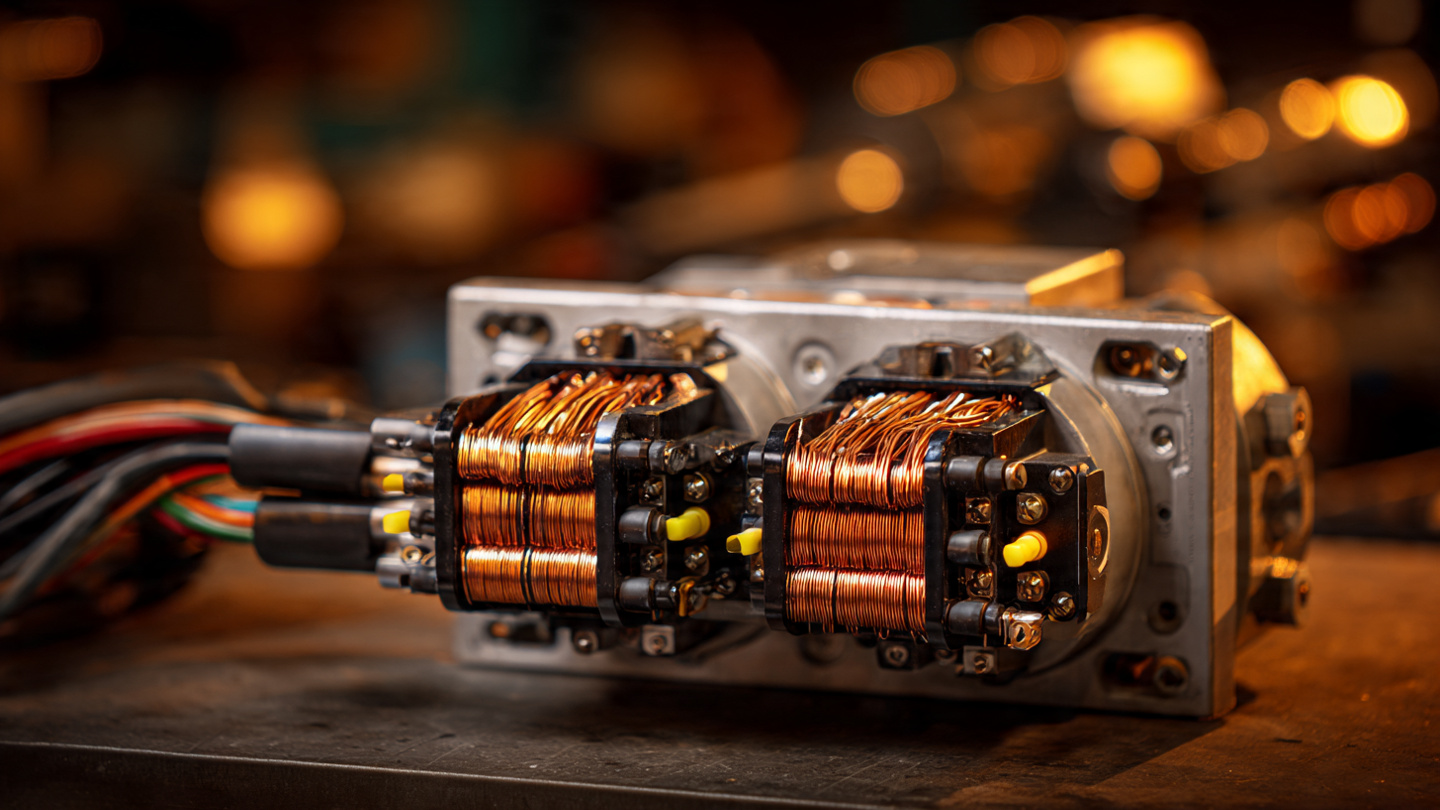
Every car sold since the invention of the automobile has connected the steering wheel to the front wheels through a mechanical column. A steel shaft, usually with one or two universal joints and an intermediate coupling, runs from the driver's hands to a rack-and-pinion or recirculating-ball gearbox. Turn the wheel, and that rotation transmits mechanically to the tie rods. Simple. Reliable. Unchanged in fundamental principle since the 1890s.
Steer-by-wire eliminates that shaft entirely. Sensors read the angle and torque the driver applies to the steering wheel. Electronic controllers process that input. Electric motors at the steering rack turn the front wheels. A separate haptic motor at the steering wheel simulates road feel. No physical connection exists between the steering wheel and the wheels on the road. If you cut the car in half at the firewall, the steering wheel would spin freely, and the front wheels would still respond to electronic commands.
Aviation figured this out decades ago. Fly-by-wire replaced mechanical flight controls on the General Dynamics F-16 in 1978 and on the Airbus A320 in 1988. Both removed the cables and pushrods connecting cockpit controls to control surfaces, replacing them with electronic signal paths and hydraulic actuators. Fighter jets and commercial airliners have operated without mechanical control linkages for nearly half a century. Automotive steering took twenty years longer to reach the same conclusion, for reasons that have everything to do with safety certification, cost, and the peculiar expectations drivers place on what their hands should feel.
Why Mechanical Steering Persisted
A mechanical steering column is its own safety backup. If the power steering pump fails or the electrical system dies, the driver can still turn the wheels. Effort increases dramatically, but control remains. Regulators and consumers have relied on this inherent redundancy since power steering became standard in the 1950s. Removing the column means removing that fallback. Every failure mode that a mechanical shaft handles passively, such as power loss, controller malfunction, and sensor corruption, must now be handled actively by electronics.
Aviation solved this problem through redundancy mandated by strict certification standards. Commercial aircraft carry triple- or quadruple-redundant flight computers, each running different software on different hardware, with independent power supplies and independent sensor inputs. Failure of any single component, or even two simultaneous components, cannot cause loss of control. That level of redundancy costs thousands of dollars per channel and requires significant volume and weight. In a $35,000 sedan, the economics are different.
Consumer expectations created another barrier. Drivers have developed an intuitive understanding of what steering should feel like. Road texture, tire grip, alignment pull, crosswind loading, and pothole impacts all transmit through the column as vibrations, torque variations, and resistance changes. Experienced drivers use these signals constantly, often subconsciously, to gauge traction and adjust their inputs. Replacing those signals with motor-generated approximations required years of development in haptic feedback algorithms. Early prototypes felt numb, artificial, or laggy. Convincing engineers that simulated feel could match mechanical feel was harder than building the actuators themselves.
ASIL D: What Safety Certification Actually Requires
ISO 26262 defines Automotive Safety Integrity Levels from A (lowest) to D (highest). ASIL D applies to systems whose failure could directly cause death or serious injury with high probability and no warning. Steering qualifies. A sudden loss of steering at highway speed is a worst-case scenario: the driver has no alternative control input and minimal time to react.
ASIL D certification demands a single-point fault metric of at least 99%. For every 100 possible single-component failures, 99 must be either detected by diagnostics within the fault-tolerant time interval or physically incapable of causing a hazardous output. Latent fault coverage must reach 90%, meaning faults that hide in the system without immediate effect must be caught by periodic self-tests before they compound with a second fault.
In practice, meeting these numbers requires hardware redundancy at every level. Dual processors running independent software stacks. Dual power supplies from separate bus segments. Triple-redundant angle sensors on both the steering wheel and the rack. Dual communication links between the steering-wheel module and the rack module, typically CAN and Ethernet, with each link on its own physical wiring harness. And dual actuation paths at the rack: two electric motors, either of which can steer the vehicle alone if the other fails.
Achieving ASIL D certification for a steer-by-wire system took Nexteer Automotive years of analysis, testing, and validation. In April 2026, Nexteer announced that its system had become the first SbW to receive full ASIL D certification and enter mass production, installed in a Chinese new energy vehicle. Every other production SbW system operates at lower safety integrity levels or retains some form of mechanical backup.
Architecture: Two Motors, Two Brains, Three Sensors
A typical steer-by-wire architecture splits into two modules. On the driver side, a steering-wheel module contains the haptic feedback motor, an angle sensor, a torque sensor, and a microcontroller. On the rack side, a road-wheel actuator module contains one or two electric motors driving the steering rack, position sensors, and its own microcontroller. Wiring harnesses connect the two modules with redundant communication links.
Tesla's Cybertruck implementation illustrates the redundancy strategy. Two steering motors sit at the rack. One draws power from the high-voltage battery (the same pack that drives the electric drivetrain). A second motor draws from a separate 48-volt bus with its own battery. If the high-voltage system fails completely, the 48V motor can steer the vehicle independently. Triple-redundant angle sensors measure rack position, with the controller cross-checking all three readings and flagging any disagreement within milliseconds.
Nexteer's ASIL D system takes this further. Dual controllers run independent software, comparing outputs against each other in real time. If one controller produces a command that disagrees with the other by more than a calibrated threshold, the system enters a degraded mode where the verified controller takes sole authority. Dual actuation paths ensure that steering force remains available even with one motor offline. Failover happens within milliseconds, fast enough that the driver perceives no interruption in steering response.
Lexus uses a different strategy for its One Motion Grip on the RZ 450e. Rather than dual rack motors, Lexus pairs a single rack actuator with aggressive torque monitoring and a limited-authority backup mode. If the primary actuator fails, the system can still guide the vehicle to a controlled stop but cannot provide full steering authority for continued driving. Lexus considers this acceptable because the probability of the specific failure mode is extremely low and the system detects it fast enough to alert the driver before a dangerous situation develops.
Road Feel: How a Motor Fakes a Pothole
Removing the mechanical column eliminates the primary channel through which road feel reaches the driver. In a conventional system, tire forces transmit through the tie rods, through the rack, up the intermediate shaft, through the universal joints, and into the steering wheel as torque, vibration, and resistance. Drivers feel the difference between dry asphalt and wet gravel, between a crowned road and a flat one, between understeering through a corner and tracking cleanly through it.
In a steer-by-wire system, a haptic feedback motor mounted in the steering column housing generates all of these sensations artificially. Sensors at the rack measure the forces acting on the tie rods. Algorithms translate those forces into motor commands that reproduce the expected torque and vibration at the steering wheel. When the front tires hit a pothole, rack-side accelerometers detect the impact. Within 5 to 10 milliseconds, the haptic motor applies a pulse to the steering wheel that mimics the jolt a mechanical column would have transmitted.
Variable resistance is the easier half. When the car enters a corner, lateral tire forces increase. Algorithms translate measured rack forces into proportional resistance at the steering wheel, so the wheel becomes harder to turn as cornering loads build. This matches the behavior of a mechanical system, where increased tire scrub naturally requires more steering effort. At highway speeds, baseline resistance increases to provide a sense of stability. At parking speeds, resistance drops to nearly zero.
Vibration fidelity is the harder half. Road texture produces high-frequency vibrations in the 10 to 200 Hz range. Reproducing these through a haptic motor requires low-latency sensor data, fast controller update rates (typically 1 kHz or higher), and a motor with sufficient bandwidth to follow rapid torque variations. Early SbW prototypes filtered out high-frequency content to avoid noise, which made the steering feel dead. Modern systems preserve road texture by passing high-frequency rack force data through a shaped filter that attenuates only frequencies associated with rack mechanism noise while retaining frequencies associated with road surface information.
Tuning these filters is subjective engineering. Porsche's chassis engineers would demand a different frequency weighting than Lexus's, because their customers expect different things from steering feel. A Cayenne buyer wants to sense individual expansion joints. A UX buyer wants smoothness. Steer-by-wire makes both possible on the same hardware by changing software calibrations, which is simultaneously its greatest advantage and its most difficult development challenge.
Variable Steering Ratios: 5:1 to 12:1 Without a Gear Change
In a mechanical steering system, the ratio between steering-wheel rotation and front-wheel angle is fixed by the rack's geometry. A 16:1 ratio means 16 degrees of steering-wheel rotation produces 1 degree of front-wheel angle. Faster ratios (lower numbers) make the car respond more aggressively to small inputs. Slower ratios (higher numbers) provide stability and precision at highway speeds. Mechanical variable-ratio racks exist, using non-linear tooth profiles cut into the rack bar, but they offer limited range and cannot adapt to vehicle speed or driving conditions.
Steer-by-wire decouples the relationship entirely. Because no mechanical linkage connects the steering wheel to the rack, software can apply any ratio it wants, and change that ratio continuously based on speed, driving mode, or situational need.
Tesla's Cybertruck demonstrates the extremes. At parking speeds, the system runs approximately 5:1, meaning a small rotation of the steering wheel produces a large front-wheel angle. This enables tight maneuvering despite the Cybertruck's 6,800-pound curb weight and 143.1-inch wheelbase. At highway speeds, the ratio shifts to roughly 12:1, requiring more steering input for the same front-wheel deflection. This stabilizes the vehicle and prevents overcorrection at speed. Transition between ratios is continuous and transparent to the driver.
Combined with rear-wheel steering (the Cybertruck can deflect its rear wheels up to 10 degrees), variable ratios at the front create a turning circle far tighter than the wheelbase would suggest. At low speeds, front and rear wheels steer in opposite directions, shrinking the turning radius. At high speeds, rear wheels steer in the same direction as the front, improving stability during lane changes.
Total steering-wheel rotation on the Cybertruck is 340 degrees, roughly one full turn lock-to-lock. A conventional truck with similar dimensions would require 3.5 to 4 full turns. Lexus's One Motion Grip on the RZ 450e is even more aggressive: 150 degrees of total rotation, less than half a turn. For drivers accustomed to conventional steering, these reduced rotations feel alien at first. Within minutes, most adapt, because the variable ratio ensures the car's response rate matches expectations regardless of absolute wheel angle.
From Infiniti to Nexteer: A Production Timeline
Nissan's Infiniti Q50, launched in 2014, was the first mass-produced car to offer steer-by-wire. Infiniti called it Direct Adaptive Steering. Sensors on the steering wheel transmitted commands electronically to actuators at the rack. A haptic motor simulated road feel. In normal operation, no mechanical connection existed between wheel and road.
But Infiniti hedged. A mechanical steering column remained in place, connected to the rack through a clutch. Under normal driving, the clutch stayed disengaged and the system operated in full by-wire mode. If the electronics failed, the clutch engaged automatically, restoring direct mechanical control within fractions of a second. This was a pragmatic engineering decision. Without ASIL D-level redundancy in the electronics, the mechanical backup was the safety net. Critics noted that the system added weight and complexity: you had a full electronic steering system plus a full mechanical steering system, with a clutch between them.
Reviews were mixed. Some praised the isolation from road imperfections and the ability to adjust steering feel through drive modes. Others found the haptic feedback unconvincing, with an artificial quality that experienced drivers noticed immediately. Infiniti refined the system through successive model years but never fully silenced the criticism that simulated feel fell short of the mechanical benchmark.
Tesla's Cybertruck, delivered starting in late 2023, was the first US-market production vehicle to ship with full steer-by-wire and no mechanical backup column. Tesla relied on dual-motor redundancy and triple-redundant sensing to meet safety requirements without a fallback linkage. Removing the mechanical column entirely saved weight, freed packaging space in the dashboard, and allowed the yoke-style steering controller (or optional round wheel) to sit on a stub shaft with no joints, no intermediate coupling, and no collapse mechanism. MotorTrend awarded the Cybertruck its 2025 Best Tech award specifically for the chassis systems, including the SbW implementation.
Lexus introduced its One Motion Grip system on the RZ 450e in 2023, initially available only in select markets. Like Tesla, Lexus eliminated the mechanical column entirely. Unlike Tesla, Lexus limited total steering rotation to 150 degrees per side, creating an almost kart-like directness that polarized reviewers. Some found it revelatory for parking and low-speed maneuvers. Others missed the familiar hand-over-hand rotation of a conventional wheel. Toyota expanded availability of One Motion Grip through 2024 and 2025, refining the feedback algorithms with each software update.
Nexteer Automotive's April 2026 announcement marks the most significant milestone since the Cybertruck's launch. By achieving ASIL D certification for its SbW system, Nexteer proved that steer-by-wire can meet the highest automotive safety standard without any mechanical backup. Multi-layered redundancy covers every potential failure: dual controllers, dual power supplies, multiple communication links, and dual actuation paths at the rack. Software-defined road feel allows automakers to calibrate steering character for their brand identity without hardware changes. Variable steering ratios come standard. And the entire system is validated to the same integrity level as the braking system.
What Steer-by-Wire Enables Beyond Steering
Removing the steering column opens design possibilities that extend well beyond the steering function itself. A mechanical column defines the location of the steering wheel relative to the rack. Move the driver's seat, and the column angle changes, requiring adjustable joints and telescoping sections. In a steer-by-wire car, the steering wheel can mount anywhere. It can be a yoke, a joystick, a traditional wheel, or a game-controller-style input. Its position is constrained only by ergonomics, not by the geometry of a steel shaft running through the firewall.
For autonomous driving development, SbW provides a clean interface between human and machine control. In a mechanical system, the autonomous driving computer must either backdrive the steering column against the driver's hands (creating a tug-of-war if the driver and computer disagree) or add a secondary actuator to the existing steering chain. With SbW, the computer sends commands directly to the rack motors, and the haptic motor can either follow those commands (letting the wheel rotate in the driver's hands as a visual indicator) or hold a fixed position (disconnecting the wheel from autonomous steering entirely). Mode transitions between human and autonomous control become software operations with no mechanical engagement or disengagement.
Crash safety improves as well. Conventional steering columns include a collapsible section designed to crumple during a frontal impact, preventing the column from spearing the driver. Collapse mechanisms add cost, weight, and design constraints to the column and instrument panel. Without a column, there is nothing to collapse and nothing to intrude into the driver's survival space. Knee airbag packaging becomes simpler. Instrument panel design gains freedom.
Vehicle platforms benefit from the flexibility. A single SbW rack module can serve left-hand-drive and right-hand-drive markets by rerouting wiring harnesses instead of re-engineering column geometry, firewall penetrations, and intermediate shaft routings. For an automaker selling in both the UK and continental Europe, that simplification translates into real manufacturing savings.
What Remains Unsolved
Cost is the first barrier. A SbW system requires two or more rack motors (versus one in a conventional electric power steering system), redundant controllers, redundant power feeds, a haptic feedback motor, and additional sensors. Nexteer has not disclosed pricing, but industry estimates place SbW system cost at two to three times that of conventional EPS. For premium vehicles, that incremental cost disappears into a six-figure sticker price. For mass-market vehicles at $30,000, it is harder to absorb.
Regulatory frameworks have not fully caught up. UNECE Regulation 79 governs steering systems internationally and historically required a "direct mechanical connection" between the steering control and the road wheels. Amendments adopted in 2018 and subsequent years opened a path for SbW systems that meet specific fault-tolerance requirements, but compliance still varies by market. Homologation in some countries requires demonstrating that the SbW system provides "equivalent safety" to a mechanical system, a standard that is technically met by ASIL D certification but procedurally complex to document.
Driver acceptance remains a variable. Enthusiast forums and automotive journalists have spent three years debating whether SbW steering feel can match a well-tuned hydraulic rack. For many drivers, the answer is already yes: the latest implementations from Tesla and Lexus receive broadly positive reviews for feel quality. For a vocal minority, particularly those who track their cars or have decades of muscle memory calibrated to mechanical feedback, simulated feel still lacks the transparency of a direct connection. Whether that gap closes entirely depends on continued advances in sensor fidelity, control algorithm sophistication, and haptic motor bandwidth.
Cybersecurity introduces a new threat surface. A mechanical steering column cannot be hacked. A steer-by-wire system, as an electronic control system on the vehicle's network, is theoretically vulnerable to the same classes of attack that affect any networked automotive ECU. Isolation architectures, encrypted communication protocols, and hardware security modules mitigate these risks, but they add another layer of validation to an already complex certification process.
Engineering Timeline
| 1978 | F-16 enters service with fly-by-wire flight controls, no mechanical backup |
| 1988 | Airbus A320 becomes first commercial airliner with full fly-by-wire |
| 2003 | Delphi (now Aptiv) demonstrates automotive SbW concept vehicle |
| 2014 | Infiniti Q50 launches with Direct Adaptive Steering, first production SbW (mechanical backup retained) |
| 2023 | Tesla Cybertruck ships with full SbW, no mechanical column, dual motor redundancy |
| 2023 | Lexus RZ 450e One Motion Grip enters select markets, 150-degree lock-to-lock |
| 2025 | Cybertruck SbW wins MotorTrend Best Tech (chassis category) |
| April 2026 | Nexteer achieves world's first ASIL D-certified SbW, enters mass production in Chinese NEV |
System Comparison
| System | Infiniti Q50 DAS | Tesla Cybertruck | Lexus One Motion Grip | Nexteer ASIL D |
| Mechanical Backup | Yes (clutch-engaged column) | No | No | No |
| Rack Motors | 1 + mech fallback | 2 (HV + 48V) | 1 | 2 (dual path) |
| Angle Sensors | Dual | Triple-redundant | Dual | Multiple (undisclosed count) |
| Safety Integrity | Lower than ASIL D (mech backup) | Not publicly rated | Not publicly rated | ASIL D certified |
| Total Rotation | ~540° | 340° | ~300° | Variable (OEM configurable) |
| Variable Ratio | Yes | Yes (5:1 to 12:1) | Yes | Yes (software-defined) |
| Rear-Wheel Steering | No | Yes (up to 10°) | No | OEM configurable |
From the F-16 to the Cybertruck, the engineering argument for removing mechanical control linkages has followed the same trajectory: redundancy makes the mechanical fallback unnecessary, and the absence of mechanical coupling enables capabilities that linkages physically prevent. Variable ratios, software-tunable feel, packaging freedom, platform flexibility, and clean autonomous-driving interfaces all require cutting the column. Aviation spent fifteen years proving the concept. Automotive spent twenty. Nexteer's ASIL D milestone in April 2026 closes the certification gap that kept mechanical backups in place. For the next generation of vehicles, whether electric, autonomous, or simply better-engineered, the steering column is optional equipment.
Sources
- Nexteer Automotive, "Nexteer Achieves World's First ASIL D-Certified Steer-by-Wire System in Mass Production," press release, April 26, 2026.
- MotorTrend, "2025 Best Tech: Tesla Cybertruck Chassis Systems," 2025.
- ISO 26262:2018, "Road vehicles – Functional safety," Parts 1–12, International Organization for Standardization.
- Tesla, Inc., Cybertruck Owner's Manual, Steering System section, 2024.
- Lexus Newsroom, "Lexus RZ 450e One Motion Grip: A New Dimension of Vehicle Control," 2023.
- Infiniti Newsroom, "Direct Adaptive Steering Technical Overview," 2013.
- SAE International, "Steer-by-Wire Systems: Architecture and Functional Safety Considerations," SAE Technical Paper 2022-01-0965.