Thirty-Five Hundred Times a Minute
How Sodium Shuttles Heat Inside a Nimonic Exhaust Valve
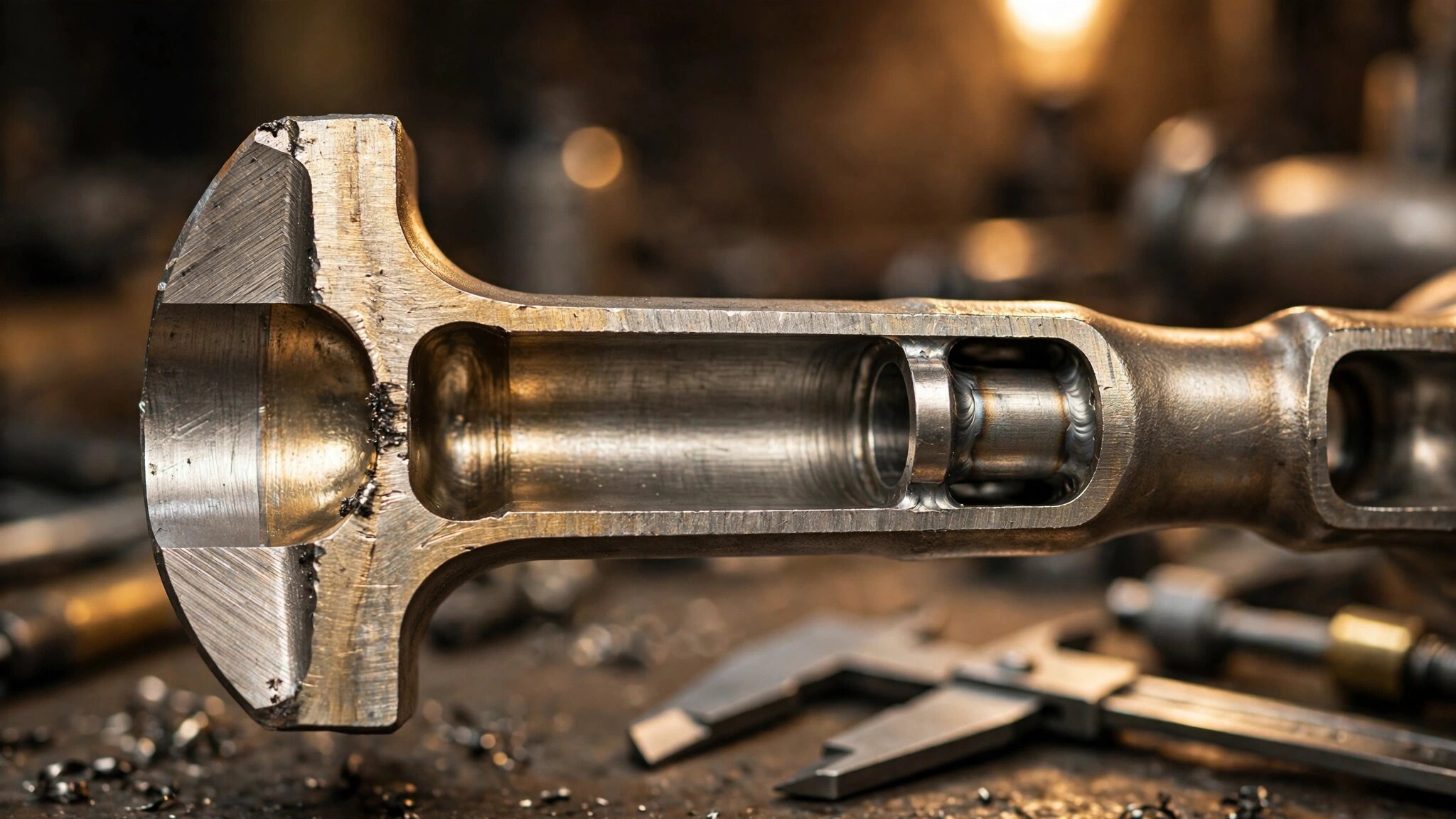
Sodium is element eleven. It catches fire in moist air. Drop a chunk into water and it explodes. On paper, sealing it inside an engine component that lives next to burning fuel seems like an act of sabotage.
In practice, it is one of the most elegant thermal engineering solutions in modern engine design. And it has been working since before the first jet engine flew.
What Goes Wrong Without It
An exhaust valve face reaches 750 to 850 degrees Celsius under sustained load. At those temperatures, a standard austenitic exhaust valve alloy like 21-4N is creeping. Its grain boundaries are sliding. Hot exhaust gas, thick with sulfur compounds and partially combusted fuel, erodes the sealing face with each closing event. Over thousands of hours, the valve head warps just enough to break its seal against the seat, allowing blow-by that further concentrates heat on the leak path. In a turbocharged engine, where exhaust back-pressure holds hot gas against the valve longer than in a naturally aspirated design, the thermal load is worse still.
When an exhaust valve finally fails at high RPM, the result is rarely gentle. A valve head can detach from its stem and drop into the cylinder, where the rising piston strikes it at velocities exceeding 25 meters per second. Piston crown, cylinder wall, connecting rod, sometimes the crankshaft counterweight beneath. Mechanics call it a "dropped valve," and it can convert a $30,000 engine into scrap metal in a quarter of a revolution.
Keeping the valve cool enough to prevent this cascade is the entire engineering challenge. Roughly 75 percent of an exhaust valve's heat exits through its seat contact area during the brief milliseconds it sits closed. Another 25 percent conducts down the stem to the valve guide. Without enhancement, that stem path is limited by the thermal conductivity of the valve alloy itself, typically 11 to 25 W/(m·K) for nickel-based superalloys. Liquid sodium conducts heat at roughly 140 W/(m·K), six to twelve times faster. Filling the stem cavity with sodium adds a high-speed thermal express lane parallel to the slow conduction path through the metal walls.
An Older Idea Than You Might Think
Sodium-filled valves did not originate in sports cars. Their first large-scale application was in the Wright R-1820 Cyclone, a nine-cylinder radial engine that powered the Boeing B-17 Flying Fortress. Air-cooled aircraft engines presented a thermal challenge that no automotive engine matched: exhaust valves had no water jacket nearby, relying entirely on seat contact and stem conduction to shed heat. During long bombing missions at sustained power, standard solid exhaust valves would overheat, warp, and lose their seal. Sodium filling cut valve head temperatures by 55 to 110 degrees Celsius, extending time between overhauls from hundreds of hours to thousands.
Pratt & Whitney's R-2800 Double Wasp, which powered the F6F Hellcat and P-47 Thunderbolt, used them as standard equipment. By 1945, virtually every high-performance air-cooled aircraft engine relied on sodium-filled exhaust valves. When piston aircraft faded from military frontlines and jets took over, the technology migrated first to racing and then, decades later, to production performance cars. Nimonic and Inconel superalloys, originally developed for jet turbine blades, became the preferred valve body materials. Aviation's thermal problem and its solution traveled together.
Nimonic: Born for Turbine Blades, Repurposed for Valves
Sodium handles the heat transfer. But the valve body must survive constant thermal cycling, spring seating forces of 500 to 800 newtons, and corrosive exhaust gases. Standard 21-4N stainless steel retains roughly 350 MPa of tensile strength at 750 degrees Celsius. For a valve face living at 800 degrees in a turbocharged engine, that margin evaporates.
Nimonic 80A was created in the early 1940s by Henry Wiggin & Co., the manufacturing arm of Mond Nickel Company, for Frank Whittle's jet engine program. Early British turbine blades were failing because no existing nickel alloy maintained its strength in a gas turbine's interior. Nimonic 80A answered with a specific chemistry: approximately 75 percent nickel, 19.5 percent chromium, 2.4 percent titanium, and 1.4 percent aluminum. When aged at 700 degrees Celsius, those titanium and aluminum atoms combine with nickel to form nanoscale precipitates called gamma-prime. These particles, each smaller than a virus, act as physical barriers inside the crystal structure. They block the slow, grain-by-grain deformation called creep that would otherwise pull the metal apart under sustained high-temperature stress.
At room temperature, Nimonic 80A has a tensile strength of 1,100 to 1,250 MPa. At 750 degrees Celsius, it holds roughly 700 MPa, double what 21-4N manages. Inconel 751, a close relative with slightly more iron for improved hot hardness, is used interchangeably. Aftermarket manufacturers like Supertech list their valves simply as "Inconel/Nimonic," since both alloys rely on the same gamma-prime strengthening mechanism and behave almost identically at exhaust valve operating temperatures.
How Sodium Actually Moves
Engineers call it the cocktail shaker effect, and the name is more literal than it sounds. A sodium-filled exhaust valve is typically 50 to 60 percent filled with metallic sodium by cavity volume. Sodium melts at 97.8 degrees Celsius. Within seconds of engine start, the plug of solid sodium inside the hollow stem liquefies completely.
What happens next depends on engine speed. At idle, liquid sodium sits mostly at the bottom of the stem cavity, transferring heat by natural convection as the warmer end drives a slow circulation pattern toward the cooler end. Heat transfer at this stage is modest, perhaps two to three times better than conduction through the valve walls alone.
As RPM climbs, the physics change dramatically. Each time a cam lobe lifts the valve off its seat, the valve accelerates from zero to peak velocity in roughly one to two milliseconds. At 7,000 RPM in the Corvette ZR1's LT7, each exhaust valve opens 3,500 times per minute, with peak accelerations during the opening and closing ramps exceeding 3,000 g. Liquid sodium, driven by these violent accelerations, sloshes forcefully from head to stem and back on every cycle. Experimental studies on sodium-filled valves have measured Nusselt numbers between 8 and 15 at representative engine speeds, confirming that forced sloshing dominates over simple conduction by a wide margin. Not coincidentally, sodium filling matters most at exactly the operating conditions where thermal load is highest.
Hyundai and Kia quantified the result in their Lambda II 3.3-liter twin-turbo V6, making an unusual choice: filling not just the stem but also the valve head with sodium. Published data showed valve head temperatures dropping from approximately 800 degrees Celsius to 650, a 150-degree reduction that moved the valve alloy firmly below its creep threshold and enabled more aggressive ignition timing without risking pre-ignition.
Manufacturing: Filling a Valve with a Reactive Metal
Building a sodium-filled Nimonic exhaust valve means solving a contradiction: sodium reacts violently with water and oxygen, yet it must remain sealed inside a component that will operate millimeters from combustion gases for tens of thousands of hours.
In the dominant manufacturing process, a Nimonic or Inconel billet is hot-forged into a rough valve shape with an oversized head. CNC machining bores the stem cavity to precise dimensions, leaving a wall thickness of 1.5 to 2.0 millimeters. Workers then insert a measured quantity of metallic sodium under an argon or nitrogen blanket. Even atmospheric humidity can oxidize sodium's surface and degrade thermal performance, so inert gas protection throughout this step is non-negotiable.
Once filled, the open end of the stem is sealed with a hardened steel tip cap using friction welding. In this process, the cap spins against the stem end at high speed while being pressed forward under load. Frictional heat at the interface reaches 1,000 to 1,200 degrees Celsius, plasticizing both surfaces without melting them. When rotation stops, the joint solidifies into a bond with no voids, porosity, or contamination paths that would allow sodium to leak. Supertech specifies a minimum hardness of 52 HRC for these tip caps, since the stem end absorbs thousands of impacts per minute from the rocker arm or finger follower.
After welding, stress-relief tempering is followed by hardfacing on the seating surface. Stellite 6, a cobalt-chromium-tungsten alloy at roughly 40 HRC, is applied by plasma-transferred arc welding to resist the micro-hammering and hot erosion of repeated seat-impact events. Finally, the stem receives a superfinish, polishing to roughly one-third the surface roughness of a standard valve.
Why Not Everyone Uses Them
If sodium-filled Nimonic valves solve thermal problems so effectively, why do most production engines still use solid stainless steel exhausts?
Cost is the blunt answer. A solid 21-4N exhaust valve costs a manufacturer $2 to $4 at volume. A sodium-filled Nimonic unit, with its superalloy billet, precision boring, inert-atmosphere sodium insertion, friction welding, Stellite hardfacing, and superfinish treatment, runs $40 to $80 each in aftermarket supply. OEM volumes bring that down, but the multiple remains substantial. For a V8 with four exhaust valves per cylinder, the cost difference at the engine level is measured in hundreds of dollars.
Weight tells a more nuanced story than the headline "10 percent lighter" suggests. Sodium (density 0.97 g/cm³) is far lighter than Nimonic (8.19 g/cm³), but the hollow valve body requires thicker walls to maintain rigidity, partially offsetting the savings. Titanium intake valves, roughly 40 percent lighter than steel equivalents, deliver a larger reciprocating-mass reduction per dollar. This is why the LT7 pairs titanium intakes (45 millimeters) with sodium-filled Nimonic exhausts (35 millimeters): each material is deployed where its specific advantage matters most.
Toyota's 2JZ-GTE, arguably the most celebrated turbocharged inline-six ever produced, used solid Inconel 751 exhaust valves without sodium filling. Its engineers relied instead on generous valve seat widths, efficient coolant routing around the exhaust ports, and conservative ignition timing to manage thermal load. For a road engine with moderate duty cycles and substantial margins elsewhere in the cooling system, solid superalloy valves were sufficient. Sodium filling becomes essential when those margins disappear: in engines pushed to extreme specific outputs, sustained track loads, or boost levels that send exhaust gas temperatures past 950 degrees Celsius.
Ninety-Eight Degrees
Electric drivetrains will eventually eliminate exhaust valves from many powertrains. Hydrogen internal combustion, which burns hotter than gasoline and produces water vapor that accelerates corrosion, may push sodium-filled valves harder than any previous application. Thermal barrier coatings sprayed directly onto valve faces have shown promise in laboratory settings but add manufacturing complexity without eliminating the fundamental heat-path bottleneck that sodium solves. For now, no alternative delivers the same combination of heat transfer rate, structural compatibility, weight savings, and proven reliability across billions of operating hours.
At full power in the LT7, each exhaust valve opens and closes fifty-eight times every second. Each cycle, liquid sodium accelerates from head to stem and back, driven by thousands of g of valve acceleration. Not diffusion. Not slow convection. A violent, high-frequency thermal pump, forcibly relocating heat from a region where it destroys metal to a region where the cooling system can absorb it.
Sodium melts almost exactly at the temperature of boiling water. Seventy-five years after the B-17, that low melting point remains the key to keeping exhaust valves alive at temperatures that would melt aluminum, soften steel, and oxidize titanium. It is not a weakness. It is the entire point.