Borrowed from a Submarine Hull: How Sinn Hardens German Military Steel to 1,200 Vickers
Sinn buys the exact steel alloy that ThyssenKrupp Marine Systems forges into the pressure hulls of Germany's Type 212A submarines, then adds five proprietary technologies on top of it. One watch. Five layers of defense. A surface harder than case-hardened industrial tooling.
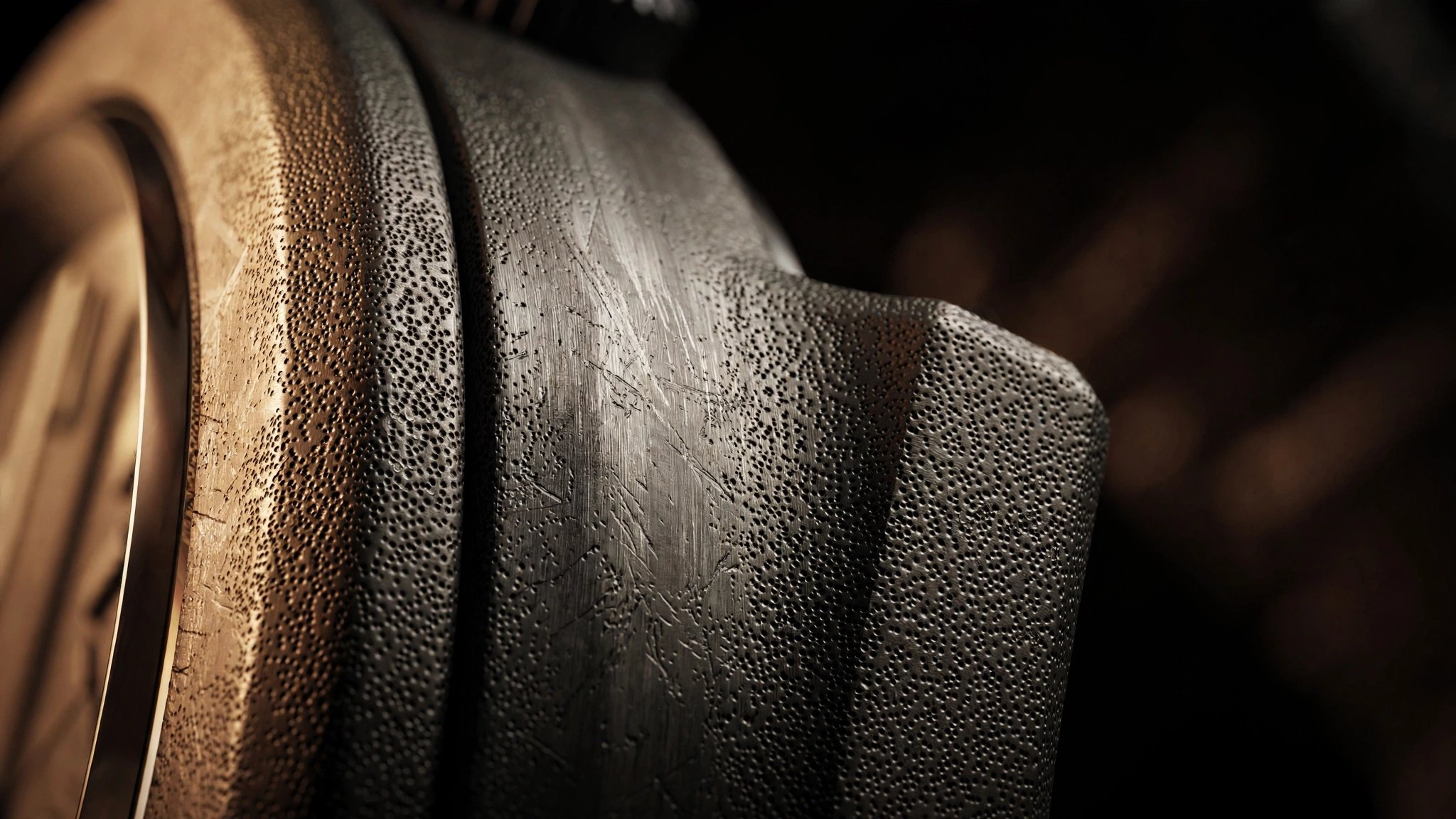
Why Most Watch Cases Scratch Easily
Standard watch cases are machined from 316L stainless steel, an austenitic alloy containing roughly 16 to 18 percent chromium and 10 to 14 percent nickel. It resists corrosion well, machines predictably, and accepts both brushed and polished finishes without complaint. What it does not do is resist abrasion. At approximately 200 Vickers on the hardness scale, 316L sits below ordinary window glass (around 500 Vickers), which means a grain of sand dragged across a steel watch case will leave a visible mark. Every polished case in every jewelry display is a scratch waiting to happen.
Most manufacturers accept this. Polishing services exist for a reason. But Sinn, a Frankfurt-based company founded in 1961 by pilot and flight instructor Helmut Sinn, decided the problem was worth solving at the material level rather than the aftermarket level. Beginning in the 1990s, Sinn developed a series of proprietary surface technologies aimed at making tool watches that could survive real-world abuse without looking like they had. Each technology addresses a different failure mode, and stacking them together produces a watch case that behaves less like jewelry and more like an industrial bearing.
Start with the Right Steel
In their search for a steel with superior corrosion resistance and mechanical properties, Sinn's engineers found what they needed at ThyssenKrupp Marine Systems, the manufacturer of Germany's current-generation military submarines. In small quantities, ThyssenKrupp supplies Sinn with the same alloy used to fabricate the external pressure hulls of the Type 212A, the most advanced non-nuclear submarine class in active service. Sinn refers to this material simply as "German Submarine Steel."
What distinguishes submarine steel from conventional 316L is a combination of higher yield strength, greater corrosion resistance in chloride environments, and near-zero residual magnetism. A submarine operating in saltwater for months at a time cannot afford pitting corrosion on its hull, and a submarine hunting for magnetic mines cannot afford to be magnetic itself. Both properties transfer directly to a dive watch: the case resists seawater attack that would pit ordinary steel, and it won't magnetize the movement or interfere with a compass during underwater navigation.
Sinn does not publish the precise alloy specification, but submarine hull steels in the German naval tradition typically belong to the high-yield quenched-and-tempered family, with yield strengths above 500 megapascals and carefully controlled sulfur and phosphorus content to minimize inclusion-driven corrosion initiation sites. For comparison, 316L stainless yields around 170 to 220 megapascals. Starting with a stronger, more corrosion-resistant base metal means every subsequent treatment is building on a better foundation.
Tegiment: Nitrogen Into the Surface
Tegiment is the technology that gives Sinn its hardness claim, and it works by altering the crystal structure of the steel's outermost layer through nitrogen diffusion. In broad terms, the process belongs to the family of thermochemical surface treatments that includes nitriding and nitrocarburizing, techniques used across the automotive and aerospace industries to harden gear teeth, cylinder bores, and crankshaft journals.
During tegiment processing, watch components are placed in a controlled atmosphere at elevated temperature, and nitrogen atoms diffuse into the steel's surface layer. As nitrogen enters the interstitial sites of the iron lattice, it forms hard nitride compounds and distorts the crystal structure, creating a hardened zone that extends to a controlled depth below the surface. Sinn reports the resulting surface hardness at approximately 1,200 Vickers.
At 1,200 Vickers, the tegimented surface is six times harder than untreated 316L and harder than the 1,000 Vickers achieved by many case-hardened industrial tool steels. It exceeds the hardness of tempered high-speed steel files and sits in the range of tungsten carbide cutting inserts. Scratching this surface with anything softer than a precision-ground ceramic or a diamond is essentially impossible.
Critically, tegiment is a surface treatment, not a through-hardening process. Only the outermost layer is transformed. Below that nitrogen-enriched shell, the core metal retains its original ductility and toughness, which means the case can absorb impacts without cracking. A watch case hardened all the way through would be brittle and liable to shatter on a hard impact, like a glass rod that cannot bend. By hardening only the surface, Sinn gets the best of both regimes: an exterior that resists abrasion and an interior that resists fracture.
Black Hard Coating: 2,000 Vickers and a Lesson in Layering
On selected models, Sinn applies a Black Hard Coating on top of the tegimented surface. It consists of titanium aluminium carbon nitride (TiAlCN) deposited through physical vapor deposition, and it adds a matte black finish while pushing surface hardness to approximately 2,000 Vickers.
PVD coatings on watches are nothing new. Dozens of manufacturers offer DLC (diamond-like carbon) or TiN (titanium nitride) coatings in various colors, and these coatings deliver genuine hardness improvements on a microscopic scale. What they do not always deliver is durability, because PVD is a thin film, and a thin film bonded to a soft substrate behaves like ice on a pond: press hard enough and the coating cracks, chips, or delaminates, not because the coating failed but because the soft metal underneath deformed and the rigid coating could not follow.
Sinn's approach solves this by requiring tegiment processing as a prerequisite for PVD. Black Hard Coating is never applied to untreated steel. By first hardening the substrate to 1,200 Vickers through nitrogen diffusion, Sinn creates a foundation rigid enough to support the 2,000-Vickers PVD film above it without the differential hardness that causes flaking. It is a deliberate engineering stack: ductile core absorbs impact, tegimented shell resists deformation, PVD layer resists abrasion. Each layer does exactly one job, and each depends on the layer beneath it.
| Layer | Hardness (Vickers) | Function |
|---|---|---|
| Core (submarine steel) | ~250–300 | Impact absorption, ductility |
| Tegiment (nitrogen diffusion) | ~1,200 | Scratch resistance, substrate rigidity |
| Black Hard Coating (TiAlCN PVD) | ~2,000 | Surface abrasion resistance, color |
Ar-Dehumidifying: Solving the Fog Problem
Surface hardness protects the outside of the case. Ar-Dehumidifying protects the inside. Water vapor trapped within a sealed watch case will condense on the crystal when the watch moves between temperature environments, and condensation on the inside of a crystal is more than an aesthetic annoyance: moisture accelerates lubricant degradation, promotes corrosion on movement components, and can eventually compromise timing accuracy.
Sinn's solution works in two stages. First, the case is filled with dry nitrogen gas (originally argon, hence the legacy "Ar" designation), displacing the humid ambient air that would otherwise be sealed inside during assembly. Second, a small copper sulphate desiccant capsule is embedded within the case, where it continuously absorbs any residual moisture that enters through gasket permeation over years of use. Together, the inert gas fill and the desiccant capsule keep internal humidity low enough to prevent fogging across an operating temperature range of minus 45 degrees Celsius to plus 80 degrees Celsius.
For a police diver entering cold water from a heated boat cabin, or a mountain rescue operative stepping from a warm helicopter into sub-zero alpine air, crystal fogging is not a minor inconvenience. It renders the watch unreadable at the exact moment when reading the elapsed time on a dive bezel or a countdown timer matters most. Sinn treats fog prevention as a reliability requirement, not a luxury feature.
HYDRO: Oil Instead of Air
For the most extreme dive applications, Sinn goes further than dehumidification. HYDRO technology fills the entire case interior with a clear silicone oil that is optically transparent, chemically inert, and essentially incompressible. An oil-filled case eliminates crystal fogging entirely, because there is no gas phase in which water vapor can condense. But the more significant benefit is underwater readability.
When light passes from water through air-backed glass, it refracts at the air-glass interface and creates reflections that wash out the dial at oblique viewing angles. An oil-filled case eliminates the air gap. Light passes from water through glass and into oil with minimal refractive index change at each boundary, which means the dial remains fully legible from any angle. Sinn's HYDRO watches are pressure-rated to 5,000 meters, though the practical ceiling for human diving is far lower. At any realistic depth, the dial looks the same as it does on land.
Oil filling introduces its own engineering constraints. Every seal must contain liquid under pressure, not just resist water ingress, and the oil must remain stable across temperature extremes without yellowing, outgassing, or changing viscosity enough to affect the hands. Sinn selected a medical-grade silicone oil that meets these requirements, but the consequence is that HYDRO watches use quartz movements rather than mechanical ones, because the viscous drag of the oil on a mechanical gear train would alter its rate. A Ronda 715 Li quartz caliber, with its low-torque stepper motor and lithium cell, operates normally in oil.
Captive Bezels and Crown Placement
Beyond materials and surface chemistry, Sinn addresses failure modes that other dive watch manufacturers treat as acceptable risks. A conventional rotating bezel is retained by a spring ring or click mechanism that allows it to be pulled off the case under sufficiently hard lateral impact. On a watch rated for real diving, losing the bezel underwater means losing the ability to track elapsed bottom time, which is a safety-critical failure.
Sinn's captive bezel design locks the rotating bezel into the case structure so that it cannot separate from the case under any impact within the watch's rated operating envelope. Combined with minute ratcheting, which indexes the bezel in one-minute increments rather than the coarser five-minute clicks used by most dive watches, the captive bezel transforms from a cosmetic ring into a precision timing instrument secured against the kind of hard knocks that divers and rescue professionals encounter routinely.
Crown placement is another deliberate choice. On all U-series models, the crown sits at four o'clock rather than the conventional three. Shifting it down by 30 degrees prevents the crown from digging into the back of the hand during wrist extension, a nuisance on a desk and a genuine discomfort under a drysuit glove. Small ergonomic decisions like this separate a tool watch designed by people who use tool watches from one designed by people who photograph them.
Titanium Damascus: Forging the Unforgivable
In 2024, Sinn introduced its most ambitious case material yet: Titanium Damascus. Inspired by the centuries-old technique of forge-welding alternating layers of different steels to produce a blade with a visible grain pattern, Sinn applies the same principle to titanium, layering commercially pure Grade 2 titanium with high-strength Grade 5 (Ti-6Al-4V) alloy.
Damascus steel is difficult. Damascus titanium is considerably harder. Under the forging press, pure titanium and Grade 5 titanium have vastly different flow characteristics and yield strengths. Grade 2 deforms easily while Grade 5 resists, and under sufficient pressure, the softer phase tries to squeeze out from between the harder layers like toothpaste from a tube. Controlling this differential flow requires precise temperature, pressure, and cycle management during every forging pass.
Etching presents a second challenge. Steel Damascus reveals its pattern through sulfuric acid, a well-understood and easily handled etchant. Titanium's exceptional chemical resistance defeats sulfuric acid entirely. Revealing the layered pattern on a Titanium Damascus case requires hydrofluoric acid (HF), one of the most dangerous chemicals used in any manufacturing process and a substance that demands specialized ventilation, protective equipment, and handling protocols far beyond what steel etching requires.
Finally, Sinn developed a dedicated tegiment process for titanium, hardening the surface to preserve the Damascus pattern against everyday scratching. On the 1800 model series, the case ring incorporates the dial as an integral surface, allowing the organic forging pattern to flow continuously from case to dial face without interruption. No two pieces look identical, because no two forging runs produce the same grain flow.
What Gets Stacked Where
Not every Sinn watch carries every technology. Sinn treats its innovations as a modular system, and specific combinations appear on specific models depending on the intended use case. A U1 SDR diver gets submarine steel, tegiment, Black Hard Coating on the bezel, captive bezel, and Ar-Dehumidifying. A U50 HYDRO gets submarine steel, tegiment, oil filling, and a quartz movement calibrated for viscous resistance. An 1800 gets Titanium Damascus with tegiment and no PVD, because coating would obscure the forging pattern.
Each model represents a different stack chosen for a different set of operating conditions. A desk-diving pilot watch does not need HYDRO. A 5,000-meter saturation dive watch does not need a mechanical movement. Sinn does not sell a single flagship with everything on it and dare you to find a reason for each feature. It sells the stack that matches the mission.
What Normal Steel Cannot Do
Most watchmakers accept 316L as a given. It works. It polishes nicely. It corrodes slowly enough for terrestrial use. And for most watch owners, whose primary environmental threat is a desk edge or a doorframe, 316L is perfectly adequate. Nobody needs submarine steel to survive a Monday at the office.
But "adequate" is a design choice, and Sinn makes a different one. Starting with a steel that was specified to survive years of immersion in saltwater at crush depth, then hardening its surface to a level that industrial toolmakers would recognize as competitive, then protecting the interior atmosphere against moisture that most sealed cases simply ignore. Layer by layer, each technology closes a failure mode that a watch made from off-the-shelf 316L leaves open.
A tegimented U1 with Black Hard Coating on the bezel will not look new forever. Enough years of hard use will produce wear marks, because 2,000 Vickers is not infinity and nothing except diamond sits at the top of the hardness scale permanently. But it will look newer, longer, than any comparable steel dive watch, and the engineering that produces that result is not marketing language layered onto a standard case. It is nitrogen atoms forced into a crystal lattice, titanium aluminium carbon nitride condensed from plasma, and silicone oil sealed under pressure in a case machined from the same alloy that keeps saltwater out of a submarine. Every layer earned its place.