Wound in Orbit: Sinn's 140 A S Anniversary and the Movement Built for Zero Gravity
Here is a physics question most watch marketing never dares to ask, because the honest answer could ruin the romance. Does an automatic watch need gravity? Instinct says yes: a rotor hangs off-centre and swings down, winding the mainspring, and in freefall nothing swings down. Sinn's position, backed by a German physicist who carried the experiment 331 kilometres up, is that the intuition confuses weight with inertia. A rotor winds because it swings on its bearing in response to the wearer's acceleration, and acceleration survives just fine in orbit. Your wrist moves. What matters is that the rotor moves relative to the watch. Gravity is merely the convenient trick that returns the rotor to its rest position on Earth, and a freely swinging rotor has no rest position to return to anyway.
Reinhard Furrer put that argument to the test whether he meant to or not. Shortly before the D1 Spacelab mission, he acquired a Sinn 140 S, equipped with the Lemania 5100 chronograph movement, and wore it on his wrist through the seven-day flight. Sinn's own account of the mission is direct: under real mission conditions, it demonstrated that a self-winding SINN timepiece continues to wind itself solely through the movements of its wearer, even in zero gravity. That was 1985, three years before the phrase space-qualified had been focus-grouped into a selling point. Nobody was trying to start a product category. A pilot bought a watch, went to space, and came back with a data point.
Sixty-five years after Helmut Sinn founded the company in 1961, the anniversary model keeps the flight lineage front and centre, but the interesting engineering is not the commemoration. It is the movement inside: the SZ01, a chronograph calibre that exists because a corporate takeover destroyed Sinn's supply chain, and that took nine years to build.
Nine years to replace a dead movement
Chronograph nerds revere the Lemania 5100, and not for its beauty. It was a workhorse with nylon parts and a central-minute chronograph display, built for military contracts where legibility beat prestige. Then the Swatch Group bought Lemania, converted the factory into Breguet's manufacture, and stopped selling 5100s to outsiders around 2002. Sinn's chronograph lines, the 142, the 156, the EZM 1, the 140 series itself, suddenly had no heart. There was no alternative movement that put elapsed minutes on the centre axis, which professional users considered non-negotiable, so Sinn did what stubborn engineering firms do: announced an in-house development programme based on the Valjoux 7750 and spent nine years getting it right.
Debuting in the EZM 10 in 2012, the SZ01's architecture tells the story of a company that refused to compromise on one specific trait. Start with the 7750, a proven cam-and-lever chronograph with a conventional 30-minute subdial at 12. Re-engineer the gear train and clutch system so the elapsed-minute counter moves to the centre axis, co-axial with the chronograph seconds hand, and advances in discrete jumps. Twenty-eight jewels, 28,800 semi-oscillations per hour, hacking seconds, antimagnetic to DIN 8309. It is a modified 7750 in the same way a race car is a modified road car: the base architecture survives, and almost nothing about the behaviour does.
Why does the jumping matter enough to rebuild a movement around? Because a conventional 30-minute subdial is a squint-and-guess exercise. You read a short hand against tiny graduations crammed into a circle the size of a thumbnail, and at minute 37 you are interpolating. Once per minute, crisply, the SZ01's minute hand jumps against a minute scale that runs around the full diameter of the dial. Either the hand is on a minute mark or it is between them, and when it jumps you see the event happen. For pilots, medics, and anyone timing under stress, that distinction is the difference between a measurement and an estimate. Legibility is a feature you engineer, not a font you choose.
One honest complication: the power reserve is listed inconsistently. Fratello and the Japanese press put the 140 A S at 46 hours; several secondary specs list 42, which is the figure Sinn has historically attached to SZ01-based models like the EZM 1.1 S. Same movement family, so the honest reading is that 42 hours is the floor and 46 the ceiling, and neither figure is the reason anyone buys this watch. Still, it is worth stating precisely, because a movement article that glosses over its own spec discrepancy is doing exactly what it accuses press releases of doing.
Reading it like an instrument
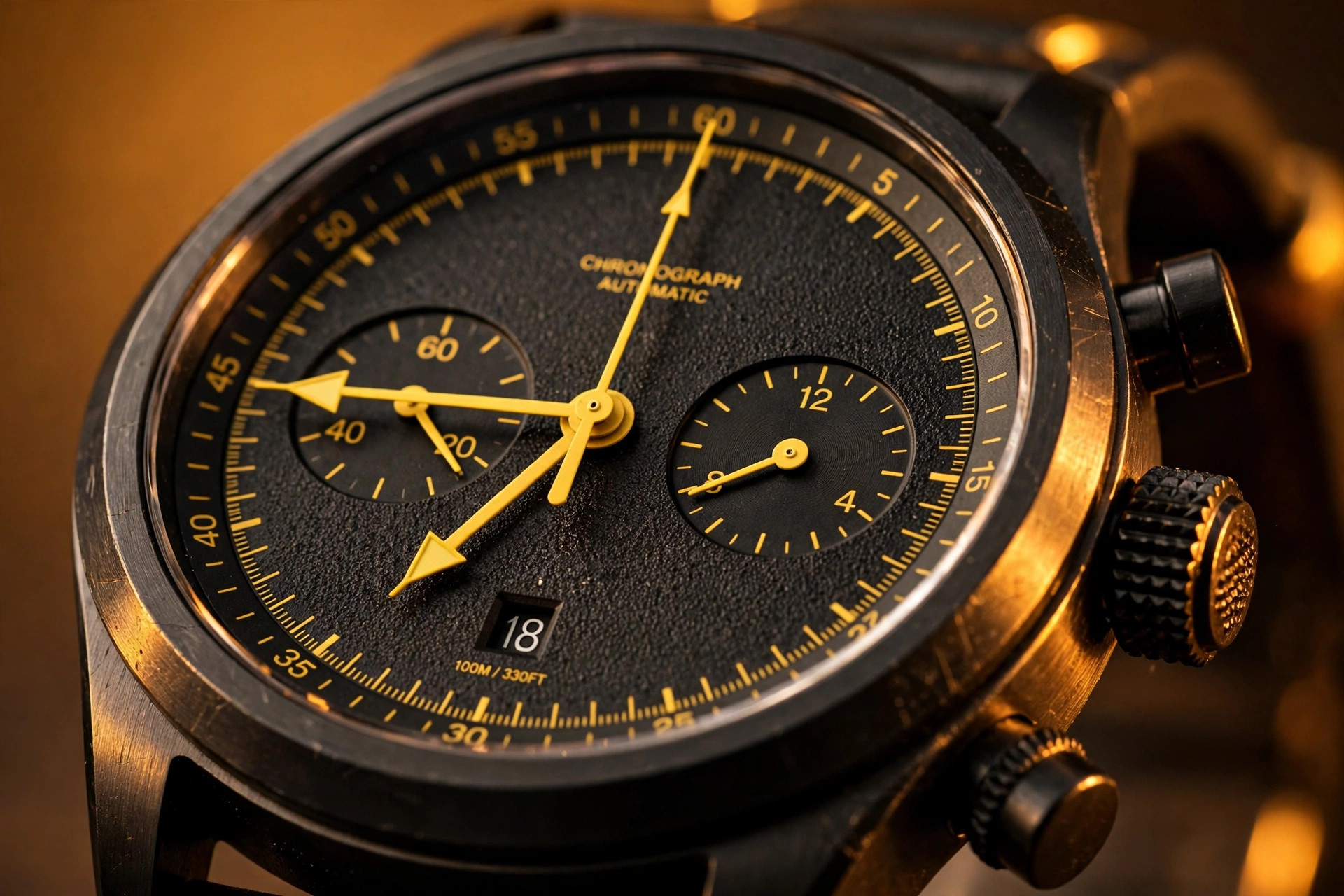
Look at the dial the way a pilot would, because that is the only way it makes sense. Matte black, painted luminous indices, hour and minute hands in lume. Its chronograph minute and seconds hands, the only elements in yellow, get the luminescent treatment too, so the timing function glows as its own layer above the time-of-day layer. Colour-coding by function rather than by brand is an old instrument-panel trick, and it works here precisely because the watch commits to it: yellow means stopwatch, everything else means time.
At three sits a date window. At six, a 12-hour counter. At nine, subsidiary seconds. Ringing the dial, a full-diameter minute scale serves the jumping centre-minute hand that is the SZ01's reason for existing. Previous 140-series models wore their chronograph hands in red; the anniversary edition goes yellow, a small change that reads clearly as a distinct reference rather than a refresh. Around the inside of the dial, a rotating pilot's bezel with a luminous key mark, operated by the crown at ten, handles timing that is too short or too casual for the chronograph. Two timing systems, one watch, and neither fights the other for attention.
Interior bezels deserve a moment of appreciation, because they are the tool-watch answer to a genuine problem. An external rotating bezel is precise, but it is also a gasket, a spring, and a click mechanism exposed to knocks, salt, and grit. An interior bezel lives under the crystal, driven by a crown through the case wall, immune to everything except the wearer's own crown discipline. You give up some tactile certainty. You gain a bezel that cannot be bumped off its setting. For a watch whose ancestors went to orbit, that is the correct trade.
Hardening the metal, not the marketing
Now the case, because Sinn's case technology is arguably more interesting than its chronograph. TEGIMENT is a thermal-chemical process that hardens the outer layer of the steel itself, taking the surface to about 1,200 Vickers against roughly 220 for untreated stainless. That figure comes from Sinn's own technology materials and the brand's US distributor, not an independent lab, but the distinction that matters is structural, not numerical. A coating is a foreign material laid on top of the metal, and coatings chip, flake, and delaminate. TEGIMENT is the metal, hardened, which means there is nothing to peel off. On top of the TEGIMENT base, the 140 A S Anniversary adds a black hard coating, and that ordering is deliberate: Sinn's own guidance is that PVD-style coatings should only go on TEGIMENT-hardened cases, because a hard layer over soft steel can flake when the substrate dents beneath it. Hard over harder is fine. Hard over soft is a promise waiting to be broken.
New for the anniversary is the case finish itself: a combination of polished and satinised surfaces on 44 by 15.5 millimetres of black-coated steel, 118 grams without strap, with 22-millimetre lugs. Fratello notes the mixed finish gives the watch a more deliberate, almost dressy register against the matte instrument dial, and that tension, instrument face, polished case, is exactly what separates an anniversary piece from a pure tool. Polished black coating scratches more visibly than the bead-blasted black of the standard 140 St S, which means the finish is a choice with a cost, and Sinn has made it openly: this one is meant to be looked at as well as used.
Inside, the case is filled with inert argon gas and carries a copper sulphate capsule that absorbs any moisture that finds its way in. Sinn calls it Ar-Dehumidifying Technology, and the pitch is mundane in the best way: moisture inside a watch degrades movement oils, fogs the crystal, and makes everything slightly less reliable, so remove the moisture and remove the problem. Dry-capsule elements sealing the crown and push-pieces: the D3 system adds another moisture barrier where most watches have a single gasket and a prayer. Sinn rates the watch water- and pressure-resistant to 10 bar and, critically for a descendant of a space-flown watch, resistant to low pressure. Low pressure matters because a watch that has been sealed at sea level and then taken to altitude, or higher, experiences the case trying to push itself apart from the inside, and Sinn rates the 140 A S to survive the reverse of a dive: not just keeping water out, but keeping the crystal on when the outside air thins.
Temperature gets the same unsentimental treatment across Sinn's technology programme. Across its technology programme, the brand has long specified special movement oils and inert-gas filling to keep its instrument watches running from minus 45 to plus 80 degrees Celsius, and while that range is a catalogue-level claim for the technology family rather than a per-reference guarantee for this edition, it explains the design philosophy: a chronograph descended from a watch that flew in an unpressurised-to-pressurised thermal environment does not get to have fragile moods about weather.
The space lineage, honestly told
Return to 1985, because the story deserves precision rather than myth. Payload name Deutschland 1: the D1 mission was a German-booked Spacelab flight, designated STS-61-A, flown aboard Challenger from October 30 to November 6, 1985. Eight people flew, still the largest crew ever carried by a single spacecraft from launch to landing, including payload specialists Reinhard Furrer and Ernst Messerschmid for Germany and Wubbo Ockels for ESA. Two shifts worked the Spacelab module around the clock running 76 experiments. Furrer's 140 S went along on his wrist, unplanned as a marketing exercise, and the watch's automatic winding behaved exactly as the physics said it should: the rotor responded to the wearer's motion, the mainspring charged, the chronograph ran.
Sinn has been careful, to its credit, not to overclaim this. Sinn's line is that the flight demonstrated a self-winding mechanical chronograph functions reliably in zero gravity, which is what happened, and the company does not pretend the watch was instrumented or that NASA signed off on anything. Seven years later, astronaut Klaus-Dietrich Flade carried a Sinn 142 S aboard the Mir-92 mission in 1992, giving the lineage a second data point. Two flights, two watches, zero drama: the least theatrical space-watch heritage in the industry, which may be why it is also one of the most believable.
There is a melancholy footnote that honest coverage should include. STS-61-A was the last successful flight of Challenger; the orbiter was lost with her crew on STS-51-L less than three months later, in January 1986. Furrer himself died in a light-aircraft crash in 1995. This anniversary watch commemorates an engineering lineage, not a tragedy, but the lineage passes through real flights with real crews, and a story that borrows the romance of 1985 owes its readers the full picture. Hardware did its job. People did theirs. Some of them did not come home from later missions, and saying so is not morbid; it is the difference between heritage and decoration.
What the anniversary edition actually changes
Strip away the commemoration and ask what is new here versus the regular-production 140 St S, because a limited edition has to justify its 300-piece run on hardware, not adjectives. Same SZ01 movement family, same chronograph layout. What changes: the yellow chronograph hands against the matte black dial, replacing the red of recent 140s; the polished-and-satinised case finish against the St S's bead-blasted black; the commemorative laser-engraved insignia on the screw-fastened case back; and the presentation box, which ships the watch on a black H-link bracelet with tool-free micro-adjustment in the clasp, plus a black leather strap with yellow accents, a band replacement tool, and spare spring bars. At 5,490 euros with both straps, the anniversary sits essentially at the top of the SZ01 range rather than at a collector's premium.
Whether 300 pieces will be enough is the usual limited-edition parlour game, and it is the wrong question. Wrong question, though. The right one is whether the 140 line needed an anniversary at all, and the answer is that Sinn's 65th gave the company an excuse to do what it plainly wanted to do anyway: keep the 140 series current while the bead-blasted regular models handle the purists. Anniversary editions that change nothing are cash grabs. This one changes the finish, the accent colour, and the presentation, and leaves the engineering alone, which is the correct priority order for a brand whose selling point has always been that the engineering is the luxury.
One genuine criticism: at 44 by 15.5 millimetres, this is a large watch carrying a movement developed when large was fashionable, and Sinn has made no attempt to slim it. A jumping-minute gear train stacked on a 7750 base that was never petite, 10-bar and low-pressure ratings demanding case depth, an interior bezel needing its own crown: none of that is negotiable without redesigning the watch, and redesigning the watch would mean abandoning the instrument character that justifies the lineage. Still, wrists under seven inches should know what they are signing up for, and the anniversary premium over the standard model buys finish and presentation, not wearability.
| Specification | Sinn 140 A S Anniversary |
|---|---|
| Reference and edition | 140.050, limited to 300 pieces worldwide; unveiled October 27, 2026 for Sinn's 65th anniversary |
| Movement | Sinn SZ01, self-winding chronograph; modified Valjoux 7750 architecture with central 60-minute jumping stopwatch hand; 28 jewels, 28,800 semi-oscillations per hour, hacking seconds, antimagnetic to DIN 8309 |
| Chronograph display | Centre-mounted 60-minute stopwatch hand with jumping minute indication read against a full-diameter minute scale; central chronograph seconds hand; 12-hour counter at 6, subsidiary seconds at 9, date at 3 |
| Bezel | Interior rotating pilot's bezel with luminous key mark, operated by the crown at 10 |
| Dial and hands | Matte black dial; indices, hour and minute hands in luminescent colour; chronograph minute and seconds hands in yellow with luminescent colour |
| Case | Stainless steel, 44 mm diameter, 15.5 mm thick, 22 mm lug width, 118 grams without strap; combination of polished and satinised surfaces; black hard coating on a TEGIMENT Technology base (surface hardened to approximately 1,200 Vickers) |
| Sealing | Ar-Dehumidifying Technology (argon-filled case, copper sulphate moisture capsule); D3 system on crown and push-pieces; sapphire crystal with anti-reflective coating on both sides; screw-fastened case back with laser-engraved commemorative insignia |
| Resistance | Water- and pressure-resistant to 10 bar; resistant to low pressure; functional reliability per DIN standards 8309 and 8310 |
| Strap and box | Black H-link stainless steel bracelet with TEGIMENT treatment and black coating, tool-free micro-adjustment in clasp; presentation box adds black leather strap with yellow accents, band replacement tool, and spare spring bars |
| Price | 5,490 euros with both straps |
| Lineage | Descends from the 140 S worn by Reinhard Furrer aboard Spacelab D1 (STS-61-A, Challenger, October 30 to November 6, 1985); the 142 S flew with Klaus-Dietrich Flade on Mir-92 in 1992 |
| Unresolved | Power reserve listed inconsistently across sources (42 to 46 hours); delivery timeline disputed, with some coverage pointing to January 2027; no independent hands-on review or long-term accuracy data yet |
Honesty block: This article is based on Sinn's official product page and 2026 technology catalogue (sinn.de), plus coverage from Fratello (October 27, 2026), WhoWatchWear (October 27, 2026), Define Watches, timekeepers.club, webChronos Japan, WatchRanker, and SJX Watches on the SZ01's development history. I have not handled this watch, and no independent review exists yet. The power reserve is listed as 46 hours by Fratello and the Japanese press and 42 hours by several secondary specs; both figures are carried above rather than resolved. The 1,200 Vickers TEGIMENT figure is Sinn's published specification via its distributor materials, not an independent laboratory measurement. STS-61-A mission details are from ESA and NASA records. The 65th anniversary dates the company's founding to 1961, per Sinn.
Most anniversary watches celebrate survival, which is to say they celebrate not dying. Sinn's 140 A S celebrates something narrower and more interesting: a specific functional trait, the central jumping minute hand, that survived the death of its original movement, a corporate takeover, and nine years of redevelopment. Space flight is the poetry. The movement, the engineering. And the case, hardened from the metal up to five times the surface hardness of ordinary steel, is the argument that none of it was done for show. A watch that went to orbit proved automatics work in weightlessness. Forty-one years later, its descendant is still built like it might have to go back.