Half Air, Half Water: Singer's DLS Turbo and the 9,000-rpm Flat-Six
The headline is 710 horsepower. The story is the cooling split that keeps it alive.
In January 2026, the first DLS Turbo customer car reached its owner, two years seven months after Singer announced the program in June 2023 and showed it at Goodwood that July. Its owner named it Sorcerer, and it wears graduated Fantasia Blue, track-focused aero, and a 3.8-litre twin-turbo flat-six rated at 710 horsepower SAE net with 750 Nm of torque. That works out to about 187 horsepower per litre, at a redline most turbo engines never approach.
One number moved in the time between. Hagerty reported 690 bhp in 2023, and Singer's figure for Sorcerer is 710 hp SAE net, with no other change published between the show car and the customer car. Whether the difference is a real gain or a different yardstick, Singer has not said.
Turbocharging and high revs have always pulled in opposite directions. Boost adds heat, heat limits revs, and the usual settlement is a fully water-cooled engine. Singer's DLS Turbo does something else. Water-cooled heads, air-cooled cylinders.
Where it came from
DLS stands for Dynamics and Lightweighting Study, and the name is the brief. Singer's first DLS, developed with Williams Advanced Engineering and the late Hans Mezger, was a 4.0-litre naturally aspirated flat-six making around 500 horsepower at 9,000 rpm. Extensive use of carbon fiber, magnesium, and titanium brought weight to 990 kilograms, with a run of 75 cars.
The reason is not published. One plausible reading is thermal headroom: if the cut came from bore, more metal sits between bores. If it came from stroke, bore spacing is unchanged, and the gain is piston speed instead, since a shorter stroke slows the pistons at the same revs. The bore reading carries the stronger mechanism, since the metal between bores is where a boosted air-cooled cylinder is most likely to fail first. A third possibility is that the 3.8 litres share nothing with the NA engine's dimensions at all. Bore and stroke are in the list below, so the guess cannot be checked. Either way, each litre carries a heavier load than before: output per litre rose by about half, so the smaller engine's advantage, if it has one, is the extra metal or the slower pistons.
A 992.1 Porsche 911 Turbo S makes 640 horsepower from a 3.745-litre twin-turbo flat-six, or about 171 horsepower per litre. That comes at a 7,200-rpm redline, through an eight-speed dual-clutch to all four wheels. This engine makes more power per litre, and the arithmetic is that its peak power arrives 2,250 rpm higher at lower mean cylinder pressure, as the numbers below show. At peak power the Turbo S runs about 22.7 bar of mean cylinder pressure against this engine's 18.6 (assuming peak power at 9,000 rpm), both derived from published figures. If it weighed the NA DLS's 990 kilograms it would be about 717 horsepower per tonne, against about 505 for the NA DLS and about 388 for the 1,649-kilogram Turbo S. Even 200 kilograms heavier it would still be about 597.
That is as far as the published figures go: 0-60 and top speed cannot be bracketed, because without gear ratios you cannot turn power-to-weight into acceleration, and without weight you cannot even start. Those numbers need gearing and weight, and both are in the unknowns list below. On the spec sheet alone, the Turbo S is the known quantity, with published performance figures where this car has none, so the comparison stops there.
Every DLS Turbo starts as a customer 964, a 1989 to 1994 car. As understood, the plan is 99 cars (unconfirmed). A 964 bay is the constraint: the split has to fit it.
The cooling split
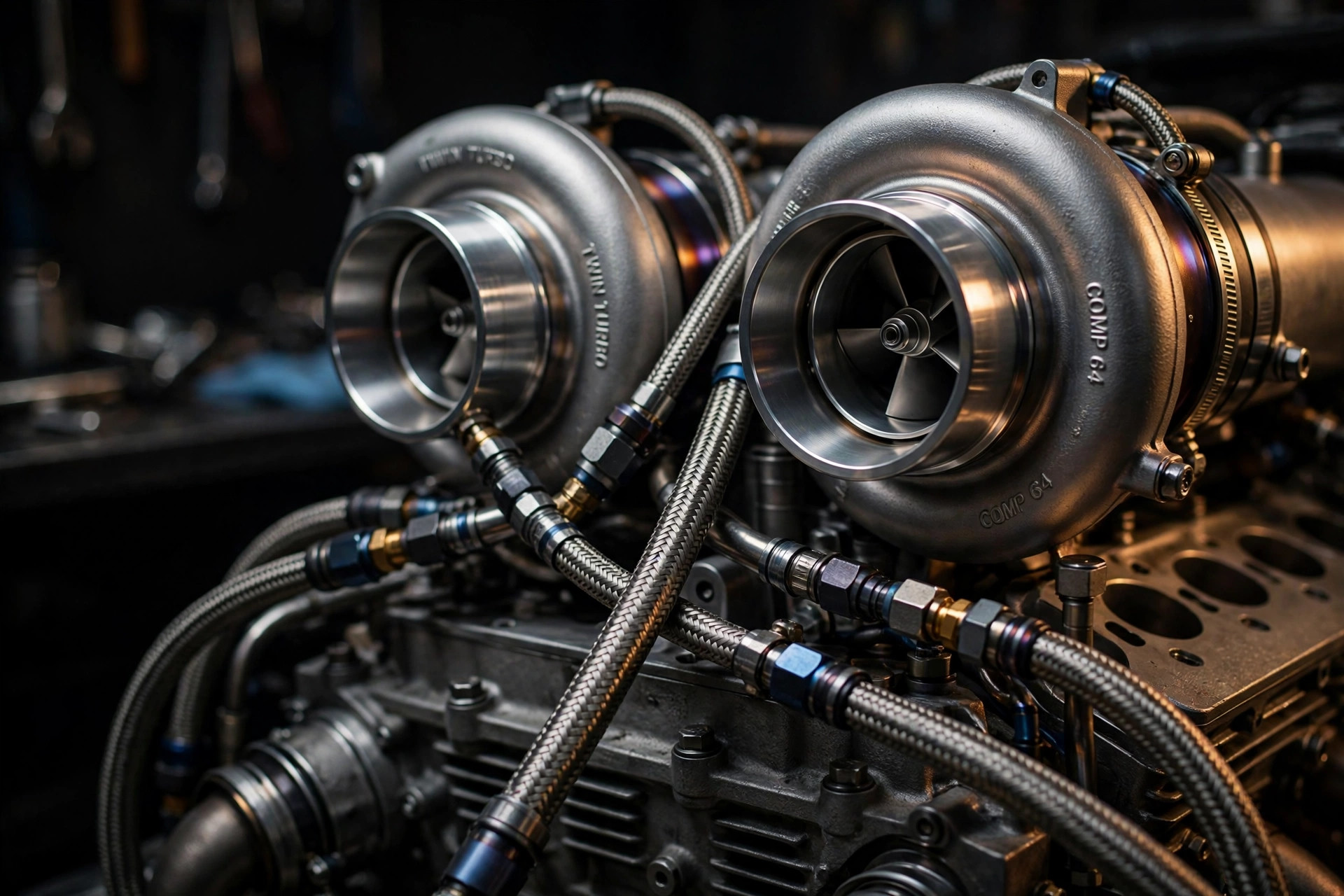
At the heart of the car is a 3.8-litre flat-six with four valves per cylinder, and around it, twin variable-geometry turbochargers, electric wastegates, air-to-water intercooling, and an electrically driven horizontal fan. Singer rates the result at 710 horsepower SAE net and 750 Nm, or 553 lb-ft, with a 9,000-rpm redline. Every figure there is for this car specifically, since every commission is built to its owner's specification.
Water-cooled heads, air-cooled cylinders. This is the first engine in any Singer restoration to split cooling that way. Combustion happens in the heads, the valves live there, and detonation starts there. Water jackets around the heads pull heat out of exactly the places that need it, which lets the engine run the boost a 9,000-rpm turbo motor demands, while the cylinders stay air-cooled. Whether the split saves weight, or why the cylinders stayed air-cooled at all, is not in the published figures.
In a road car, Porsche tried this once. In the 1980s, the 959 ran water-cooled heads on air-cooled cylinders, with sequential turbos, a small one spooling first and a larger one joining at higher revs, and it stopped at about 7,300 rpm. That split had already won Le Mans in the 956 and 962. Porsche never repeated the split in a production road car, not even on the 993 Turbo, and the 996 went fully water-cooled. At this output, about 187 horsepower per litre against the 959's 450 from 2.85 litres, about 158 per litre, the split is being asked to do considerably more, at higher revs, through the same kind of thermal compromise.
Three things changed since the 959: the fan is electrically driven, so its speed follows the ECU rather than the crankshaft, and it can keep moving air at idle or after shutdown, if the ECU is programmed that way. Variable-geometry turbos let boost be shaped across the rev range. Modern engine management can watch knock cylinder by cylinder and pull timing after the first knock events, before sustained detonation becomes damage. None of that is Singer-specific. Whether those three advances are enough for a 29-horsepower-per-litre jump over the 959, on the same split, is untested. The gap is quantified, and it cannot be closed without boost pressure and a heat budget, both in the list below.
It stayed a footnote. On a clean sheet, full water cooling is the obvious choice, because water jackets hold bore temperature uniform for emissions and oil control. A uniform bore stays round, so the rings seal and the mixture burns the same in every cylinder. Integrated jackets package tighter than a fan with fins and ducts, and a water jacket damps combustion noise that bare fins transmit. The split only earns its place inside an existing 964 bay.
Cylinders are the gamble, because under boost they absorb far more heat than the naturally aspirated DLS cylinders ever did, and air, fins, and a fan are a thinner margin than a water jacket. Water jackets help manage knock in the heads: cooler head and exhaust-valve surfaces lower end-gas temperature, which raises the knock limit. The cylinders' margins are unproven.
The head and the cylinder also grow by different amounts. The head sits near coolant temperature while the finned cylinder runs hotter and less uniformly. The two expand at different rates, and load the joint and studs that hold them together.
At roughly 35 percent brake thermal efficiency, a 530-kilowatt engine burns fuel at a rate near 1,500 kilowatts and rejects roughly a megawatt as heat, through the exhaust, the coolant, the oil, and the cylinder fins. At 30 percent, the rejected heat would be nearer 1.2 megawatts. Lower mean pressure still means more heat at 9,000 rpm: power per litre scales with mean pressure times revs, and 9,000 rpm means more combustion events per second, so the heat rate is what the fins and fan must reject. Mean pressure is 24.8 bar at peak torque, falling to 18.6 at peak power.
Oil is the other heat path. In an air-cooled flat-six, oil carries a large share of the heat out of the pistons and cylinders. How much it can carry turns on piston cooling jets, which spray oil under the piston crown, and oil-cooler capacity, both in the list below. What would settle the question is a heat budget, and the variables that would let it be drawn are listed below. Until that budget exists, the cooling question stays open.
Two turbos that behave
With a petrol turbo, the hard part is the exhaust. Petrol exhaust gas runs near 1,000 degrees Celsius at full boost, against roughly 750 to 850 in a diesel, and that gap is why petrol variable-geometry turbos were rare for so long. The vanes warp, seize, and creep at those temperatures, and surviving them takes nickel-grade superalloys and clearances that hold at temperature. Porsche has used variable-geometry turbos on the 911 Turbo since 2006. Singer's pair has to survive the same heat at the redline, in a 964 engine bay that was never drawn up for twin VGTs at 9,000 rpm.
Vanes are the mechanism. They replace the 959's sequential twins: one turbo per bank, no small turbo handing over to a large one, and no handover to calibrate in a 964 bay. Pivoting vanes change the nozzle area, and the angle sets turbine speed, which sets compressor boost: closed at low flow, the gas moves faster and spools the turbo early. Open at high flow, backpressure stays down and the turbo breathes. At 9,000 rpm the vanes' job flips: exhaust energy is plentiful, so keeping backpressure down matters more than spooling the turbo early, and the vanes have to do it in exhaust gas near 1,000 degrees Celsius. How early the spool arrives is still unknown.
Electric wastegates use an electric motor rather than a pneumatic capsule to move the gate, which positions the gate directly, independent of manifold pressure, where a pneumatic capsule works through pressure against a spring. Together, the wastegate and the VGT vanes are two actuators chasing one boost target, and the ECU has to coordinate them. Vanes primarily set turbine speed at low revs; the wastegate bleeds what the vanes cannot use at high revs. It also guards against turbo overspeed when the vanes are fully open, because even fully open, the vanes still pass all the exhaust through the turbine, so only a bypass can cut turbine power to zero. Two actuators, two jobs. The wastegate never touches the vanes. From the seat, shaped boost should feel like no lag and no surge, a linear pull to the redline.
Singer chose air-to-water intercooling, whose water volume absorbs the heat spikes of full-boost acceleration. Saturation is the catch: on sustained load the water heats up too, and then it needs its own radiator, pump, and airflow, a separate weight and complexity bill from the head-cooling question that arrives on top of it. How long saturation takes, a single pull or a full session, is exactly the unanswered question. A compressor can heat charge air past 150 degrees Celsius at full boost, and an intercooler typically brings it back toward 40 to 60 degrees, using a small water circuit and, in a typical air-to-water layout, a front heat exchanger. Air-to-water also keeps the charge runs short.
Three manufacturers have attacked the turbo problem from three different sides, and each answer has its price. Porsche electrified the turbocharger itself, with the T-Hybrid twin eTurbos in the 992.2 Turbo S: an electric motor in each spools its turbine before exhaust gas arrives, at the cost of electrical complexity and a 400-volt system to feed it. Ferrari has filed a patent application for Peltier coolers around the turbo inlet, a solid-state answer that draws power and has yet to prove itself at production scale. Singer attacked heat where combustion happens, in the heads, while fitting variable-geometry turbos with electric wastegates, and paid with the thermal margin of its air-cooled cylinders. The eTurbo is proven and expensive; the Peltier is elegant and unproven. The split needs no high-voltage system and no solid-state cooler, which is why it fits a 964 bay at all, and it is the least tested at this output.
Titanium and Inconel make the exhaust, with side exits. Both metals survive exhaust gas that attacks ordinary steel through oxidation, creep, and thermal fatigue, and both cost far more than the steel they replace. Side exits keep the exhaust path short, which dumps heat before it soaks the rear of the car, and puts the noise where everyone can hear it.
What the side exits sound like at 9,000 rpm is unanswered. No sound clip has been published, and the naturally aspirated DLS is no guide to a turbo motor's note. Turbos muffle exhaust pulses, so the note should be quieter than the NA car's at the same revs, and short side exits should preserve the high-frequency content and put it beside the driver rather than behind the car. A flat-six at 9,000 rpm through two turbos will carry less of the NA DLS's character; how much survives is untested.
Drivetrain and chassis
Singer chief executive Mazen Fawaz said in 2023 that the car in his mind was a Ferrari F40. At 201 mph, it was the fastest production car of its moment, the first past 200, and it earned that with a twin-turbo V8 in a carbon-kevlar body and almost nothing between the driver and the machine. Fawaz was invoking intent, the idea that sensation matters more than specification. This car makes the same argument in hardware: a manual where a dual-clutch would be quicker, rear-wheel drive where all-wheel drive would be easier. Those are its terms. The side-exit exhaust is this car's own: the Ferrari breathed through three central pipes in the rear apron.
And the parallel has a limit: the F40 had no driver aids at all, no anti-lock brakes, no power steering, and turbo lag the driver had to work around. VGT vanes and electric wastegates manage the lag the F40 left to its driver. This car carries a five-mode Bosch traction and stability system, a safety net the Ferrari never had. Whether Off fully defeats the system or only raises its thresholds is unpublished, and the answer decides whether the purity argument survives.
Output goes to the rear wheels through a six-speed manual, a new unit developed with Ricardo, the British transmission specialist, with no dual-clutch option and no all-wheel drive. Six ratios is a deliberate count. A dual-clutch would offer seven or eight, and the manual trades shift time for direct control and less weight and complexity. What six ratios must do is keep the rpm drop on each upshift small enough that the engine lands back above its boost threshold, and the spacing decides whether they do. Ricardo's brief was the torque and the revs: 750 Nm through a box that has to survive 9,000-rpm input speed.
Behind the gearbox sits the running gear. Double-wishbone front suspension replaces the 964's struts: a strut ties the wheel to the body, so camber follows body roll, while a wishbone pair can be shaped to hold the wheel upright under cornering load. That costs packaging space and complexity, and a track-focused option adds bespoke dampers with remote adjustment. Carbon-ceramic discs with monobloc calipers resist fade and cut unsprung weight against steel, at higher cost and with less bite when cold. Bosch developed the traction and stability system with Singer, and it offers five modes: Road, Sport, Track, Weather, Off. The five modes share hardware and differ only in intervention thresholds: Road and Weather intervene earliest, Sport next, Track latest.
Forged magnesium centre-lock wheels, 19 inches at the front and 20 at the rear, wear Michelin Pilot Sport Cup 2 or Cup 2R rubber. 345/30 at the back. Magnesium cuts unsprung weight against aluminium, and it is more fragile for it: a kerb strike that would bend an aluminium wheel can crack a magnesium one. Cup 2R is the track compound: more dry grip than Cup 2, less wet grip, faster wear, and a need for temperature before it works. That is a lot of tire for a 964, and it is why the body had to grow.
The 934/5 body
Founder Rob Dickinson traces the car to a Super 8 film he saw at twelve, of the 1977 Watkins Glen 6 Hours, where a 911 morphed into boxed hips, gaping intakes, and a giant double-planed rear wing. In the 1977 SCCA Trans-Am championship the 934/5 won six of eight rounds. Dickinson has said that since Singer began, he has wanted to return to that moment and celebrate that car, and the DLS Turbo is the return.
As a 934/5 tribute, the body's shape follows its job. Carbon-fiber panels, shaped with computational fluid dynamics, carry added intakes and NACA ducts that feed cooling air and turbocharger breathing. Boxed arches cover 345-section rear rubber, far wider than any standard 964 rear tyre, so the arches had to grow.
Two aerodynamic states are available: road, a ducktail spoiler and a lower-drag front fascia, and track, an adjustable high-downforce wing and a deep front splitter. Its owner chose track, and it sits on Champagne-finished double-seven-spoke magnesium centre-lock wheels. Owners can order both aero sets, with the spares arriving in flight cases so the car can be converted between them. It is a road car, and the track aero is the option, not the default.
Inside, the seats are trimmed in leather and Alcantara with Champagne contrast piping, and no other cabin detail has been published. What the cabin should reveal is whether a car built around a thermal gamble carries the instruments to watch it: an oil-temperature gauge, a boost gauge, anything that tells the driver what the cylinders are doing.
The numbers
Those instruments would read pressures and speeds. Brake mean effective pressure is the average pressure pushing the pistons, the fairest single measure of how hard an engine works. Published figures let you work it out. What follows is everything Singer has published, plus the figures those numbers imply. Torque density is about 197 Nm per litre, and brake mean effective pressure works out near 24.8 bar at peak torque. At peak power, torque falls to about 562 Nm and brake mean effective pressure to about 18.6 bar, assuming peak power arrives at the 9,000-rpm redline, which Singer has not confirmed.
On both counts, the 992.1 Turbo S runs higher mean cylinder pressure, about 214 Nm per litre and 26.8 bar at peak torque. At peak power it runs about 22.7 bar against this engine's 18.6, yet still makes less power per litre, about 171 against 187, because its peak power arrives at 6,750 rpm against 9,000. If peak power arrives at 8,500 rpm instead, the torque figure is nearer 595 Nm.
Mean piston speed is the other missing scale. At 9,000 rpm it would be 21.0 metres per second on a 70-millimetre stroke, 22.8 on 76, and 24.0 on 80, so the missing stroke figure spans the difference between ordinary and extreme. At 21 metres per second the pistons, rings, and bearings are inside familiar production territory; at 24, oil-film survival and bearing loading stop being routine. For scale, the Turbo S runs about 18.3 metres per second at 7,200 rpm on its 76.4-millimetre stroke, a typical production ceiling sits near 20 to 22, and Formula 1 engines of the V8 era ran near 25. Bore, stroke, boost pressure, weight, and gear ratios would let the analysis go further, and the full list is in the next section.
| Spec | DLS Turbo (Sorcerer, Jan 2026) |
|---|---|
| Donor | Porsche 911 Type 964, 1989-1994 |
| Engine | 3.8L twin-turbo flat-six, four valves per cylinder |
| Cooling | Water-cooled cylinder heads, air-cooled cylinders, electrically driven horizontal fan |
| Turbos | Twin variable-geometry, electric wastegates, air-to-water intercooling |
| Output | 710 hp SAE net, 750 Nm (553 lb-ft) |
| Power density | About 187 hp/L (NA DLS: 125 hp/L; 992.1 Turbo S: 171 hp/L) |
| Torque density | About 197 Nm/L (992.1 Turbo S: about 214 Nm/L; derived from published figures) |
| Peak BMEP | About 24.8 bar at peak torque; about 18.6 bar at peak power (assumes peak power at 9,000 rpm; unconfirmed). 992.1 Turbo S: about 26.8 bar at peak torque, about 22.7 bar at peak power; derived from published figures |
| Redline | 9,000 rpm |
| Transmission | Six-speed manual, developed with Ricardo, rear-wheel drive |
| Body | Carbon-fiber, CFD-shaped; road (ducktail) or track (wing and splitter) aero, swappable |
| Chassis | Double-wishbone front; Bosch five-mode traction and stability; bespoke dampers available |
| Brakes / tires | Carbon-ceramic discs, monobloc calipers; forged magnesium centre-lock wheels 19 in F / 20 in R; Michelin Pilot Sport Cup 2/2R, 345/30 R20 |
| Exhaust | Titanium and Inconel, side exits |
| Interior | Leather and Alcantara seats, Champagne contrast piping |
| Program | Announced June 2023; shown at Goodwood July 2023; first customer car January 2026; 99 planned (unconfirmed) |
What we do not know yet
No lap times, no weight, and no independent test exist yet. Everything in this article traces to Singer's own announcements and the press coverage of them, and the gaps are the story as much as the figures.
Heat soak decides it. How long does the split cooling last on a full summer track day before heat soak catches up with the air-cooled cylinders? Do the electric wastegates stay precise after thousands of heat cycles, and can anyone outside Singer service this engine, or does every issue mean a trip back to Oxfordshire?
What Singer has not published is a long list, and three of them would change the verdict: weight, boost pressure, and peak-power rpm. Weight decides the power-to-weight figures, boost pressure decides the thermal and knock load, and peak-power rpm decides whether the 18.6 bar and 562 Nm figures hold. Performance: weight, 0-60 mph, and top speed. Engine: boost pressure, compression ratio, bore and stroke, fuel octane, injection type, turbo shaft speed and bearing type, peak-power rpm, and boost-threshold rpm. Running gear: gear ratios and rear suspension layout. Cooling: oil system capacity and cooling, piston cooling jets, intercooler layout, differential thermal expansion between the water-cooled heads and the air-cooled cylinders, and fan airflow and power draw at peak heat rejection. Price and planned production total.
Verdict
Half air, half water. That is the gamble: a 1980s cooling compromise asked to carry 187 horsepower per litre through a manual to the rear wheels, built from a 1989-94 air-cooled 964. What comes next is more customer cars, and the first independent drive. No delivery count has been published. Until those arrive, the DLS Turbo is a claim about heat, waiting for a thermometer, a full summer track day, and a set of scales.
- Negoni Labs, "Singer DLS Turbo: 710 hp, 9,000 rpm and a first customer car three years after Goodwood," November 1, 2026. (Title as published; the interval from June 2023 to January 2026 is two years seven months.) https://negonilabs.com/articles/singer-dls-turbo
- Hagerty UK, "Singer turns on the Turbos," June 27, 2023, updated October 26, 2026. https://www.hagerty.co.uk/articles/singer-turns-on-the-turbos/
- The Drive, "The Singer Sorcerer Is a Reimagined 911 With Strong 934/5 Vibes," January 25, 2026. https://www.thedrive.com/news/the-singer-sorcerer-is-a-reimagined-911-with-strong-934-5-vibes
- THE SHOP, "Singer Presents First Porsche 911 Reimagined, DLS Turbo to Owner," January 2026. https://theshopmag.com/news/the-first-porsche-911-reimagined-by-singer-dls-turbo-presented-to-its-owner/
- Paul Tan, "Porsche 911 Singer Vehicle Design DLS Turbo Sorcerer," January 23, 2026. https://paultan.org/2026/01/23/porsche-911-singer-vehicle-design-dls-turbo-sorcerer-9000-rpm-3-8l-twin-turbo-710-hp-750-nm/
- AutoTrader NZ, "Singer unleashes 700hp DLS Turbo 911: Meet Sorcerer," November 2026. https://autotrader.co.nz/news/singer-unleashes-700hp-dls-turbo-911-meet-sorcerer
- BIDR Auctions, "Singer DLS and DLS Turbo: The Only Singers Coming to Auction in the US," August 26, 2026. https://www.bidrauctions.com/blog/singer-dls-dls-turbo-us-auction-preview
- Carcody, "How Singer Reimagines Porsche 964s: Process, Services and Specs," November 2026. https://carcody.com/how-singer-turns-a-porsche-964-into-a-bespoke-modern-classic/
- evo, "Singer DLS revealed at Goodwood Festival of Speed," July 12, 2018. https://www.evo.co.uk/singer/dls
- Porsche press data, Type 992 911 Turbo S specifications. https://press.porsche.com/download/prod/presse_pag/PressBasicData.nsf/Download?OpenAgent&attachmentid=2753626
- Porsche Newsroom, "Powertrain: Innovative performance hybrid system with twin turbocharging" (992.2 911 Turbo S T-Hybrid, two eTurbos, 400-volt system). https://newsroom.porsche.com/en/press-kits/pfv-porsche-911-turbo-s/Powertrain.html
- CarBuzz, "Ferrari Just Made Turbochargers Even More Complex Than Ever" (Ferrari patent filing, Peltier coolers around the turbo inlet), October 16, 2026. https://carbuzz.com/ferrari-peltier-cooler-patent-october-2026/