Three Hundred Percent: How Silicon-Carbon Composites Survive the Expansion That Destroys Pure Silicon Anodes
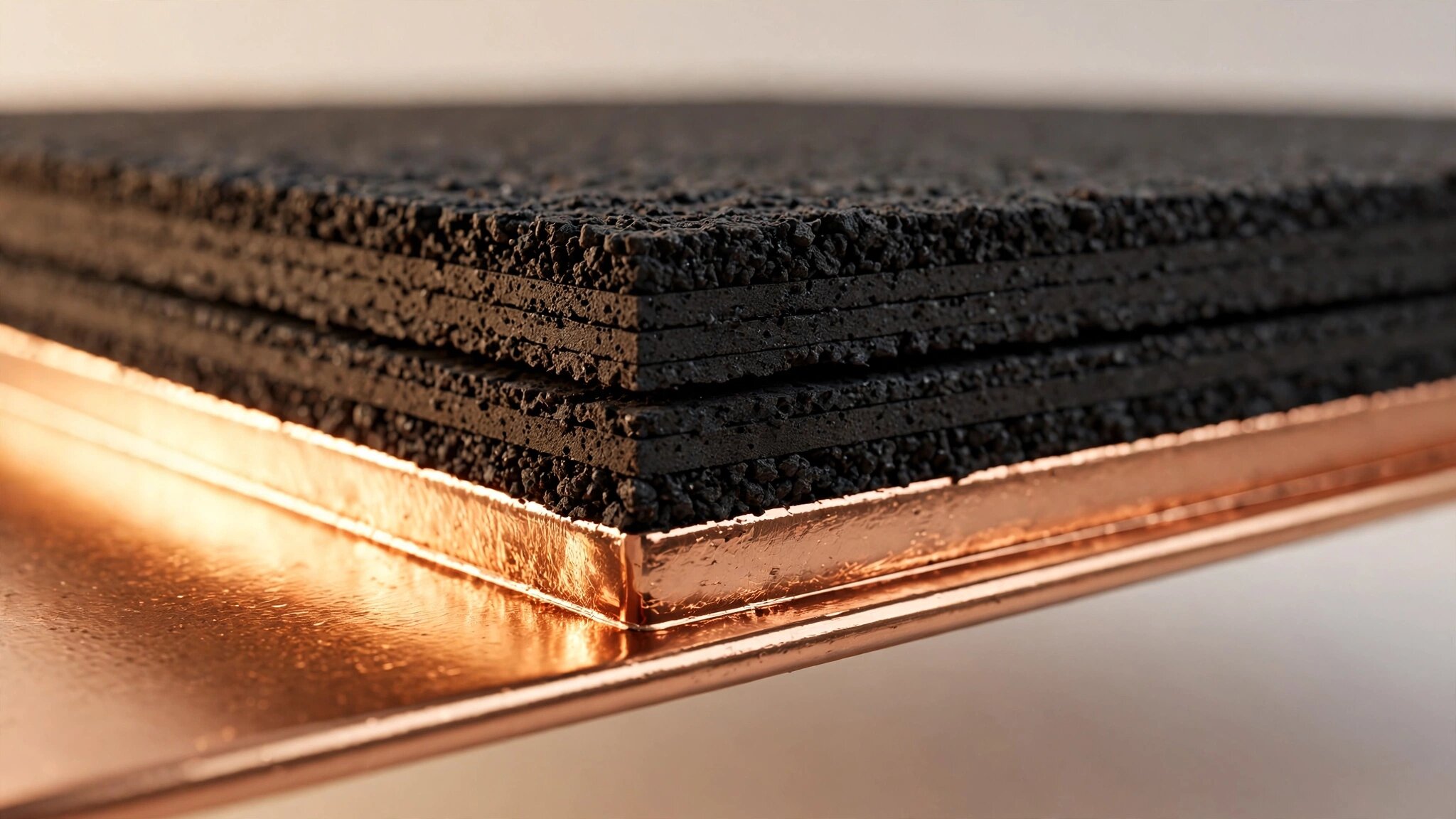
Every lithium-ion battery in every electric car on sale today stores charge in its anode the same way: lithium ions slide between layers of graphite during charging and slide back out during discharge. This arrangement is called intercalation, and graphite's theoretical limit is 372 milliamp-hours per gram. That number has not changed since Sony commercialized the lithium-ion cell in 1991. Cathode chemistry has evolved through half a dozen generations. Anode chemistry has been frozen for three decades.
Silicon could break the freeze. Each silicon atom bonds with up to four lithium ions, yielding a theoretical capacity of roughly 4,200 mAh/g. That is more than ten times what graphite offers. A battery pack built with silicon-dominant anodes could store the same energy in a smaller, lighter enclosure, or store dramatically more energy in the same footprint. Charging speed improves too, because silicon's higher conductivity moves ions faster under load.
But silicon has a problem that graphite does not. When lithium ions enter a silicon lattice, the crystal structure rearranges. The volume of the anode material expands by up to three hundred percent. Then, when the ions leave during discharge, it contracts. Repeat that cycle a few hundred times and the electrode disintegrates. Particles fracture. Electrical connections break. The solid electrolyte interphase, a thin passivation layer that forms on the anode surface during the first charge cycle, cracks open with every expansion and reforms with every contraction, consuming fresh electrolyte each time. Within months, the battery is dead.
The Solid Electrolyte Interphase Problem
Understanding why silicon anodes fail requires understanding the SEI layer. During a battery's first charge, electrolyte molecules decompose on the anode surface and form a thin film roughly ten to fifty nanometers thick. In a graphite anode, this film is stable. Graphite expands only about ten percent during lithiation, so the SEI stays intact and stops growing after the first few cycles. The irreversible capacity loss is small and predictable.
In a silicon anode, the three-hundred-percent expansion tears the SEI apart. Fresh silicon surface is exposed to the electrolyte, and new SEI forms on every cycle. Each reformation consumes lithium from the cathode and electrolyte from the cell. Coulombic efficiency drops. Internal resistance rises. Gas generation increases. The cell swells physically, which puts mechanical stress on the pack structure. After a few hundred cycles, cumulative lithium loss starves the cathode and the cell capacity collapses.
Every viable silicon anode architecture must solve two problems simultaneously: contain the mechanical expansion of silicon particles and stabilize the SEI layer so it does not perpetually regenerate.
Architecture One: The Porous Carbon Scaffold
Group14 Technologies, based in Woodinville, Washington, manufactures a material called SCC55. It is a silicon-carbon composite built on what the company calls Scaffold Prime, a porous hard-carbon framework with engineered void space inside each particle.
The manufacturing process starts with a carbon precursor that is pyrolyzed into a rigid, electrically conductive scaffold riddled with nanoscale pores. Amorphous nano-silicon is then deposited inside these pores through chemical vapor deposition. The silicon fills the pore volume partially, leaving empty space within each particle. When lithium ions enter during charging and the silicon expands, it swells into the void space rather than pushing outward against the particle boundary. Its outer carbon shell remains dimensionally stable, so the SEI layer on the particle surface does not crack.
What emerges is a drop-in anode material. SCC55 particles are roughly the same size and shape as conventional graphite particles, which means battery manufacturers can run them through existing electrode coating equipment, existing calendering presses, and existing cell assembly lines. No pre-lithiation step is required. No external compression system is needed. Group14 claims the material achieves over 1,500 charge-discharge cycles at eighty percent capacity retention with NMC cathodes, and cells built with one-hundred-percent SCC55 anodes deliver up to 400 Wh/kg at the cell level.
Group14 opened a manufacturing facility in Moses Lake, Washington, with annual capacity for 4,000 tonnes of SCC55, enough to supply roughly 20 gigawatt-hours of cells. The company has a joint venture with SK Group in South Korea for additional capacity and partnerships with Porsche and Mercedes-Benz parent Stellantis.
Architecture Two: Silicon Nanowires Grown on Copper
Amprius Technologies in Fremont, California, takes a fundamentally different approach. Instead of embedding silicon particles inside a carbon matrix, Amprius grows forests of pure silicon nanowires directly onto a copper current collector foil using a chemical vapor deposition process adapted from solar cell manufacturing.
Each nanowire is roughly fifty to one hundred nanometers in diameter and several micrometers tall. During lithiation, the wires swell radially but do not fracture because the strain distributes along the wire's length. Because the wires are anchored at one end to the copper foil and free at the other, they expand and contract without losing electrical contact. The geometry also provides natural spacing between wires, giving each one room to swell without crushing its neighbors.
Amprius ships cells commercially at 450 Wh/kg and 1,150 Wh/L, with third-party verification of 500 Wh/kg and 1,300 Wh/L in prototype form. Those are the highest verified energy densities for any lithium-ion cell, roughly double the gravimetric density of the best production cells using graphite anodes. The company's primary customers are in aviation: Airbus, AeroVironment, BAE Systems, and Teledyne FLIR use Amprius cells in drones, high-altitude pseudo-satellites, and defense platforms where weight is the dominant constraint.
Cycle life is the tradeoff. Nanowire anodes currently deliver fewer charge-discharge cycles than scaffold composites before reaching the eighty-percent retention threshold. For aviation applications where energy density matters more than longevity, that tradeoff is acceptable. For passenger EVs expected to last a decade and hundreds of thousands of miles, it narrows the use case to performance vehicles where weight savings justify more frequent pack replacement or careful thermal management to extend lifespan.
Architecture Three: Nano-Silicon in a Polymer Matrix
Sila Nanotechnologies, headquartered in Alameda, California, produces a nano-engineered silicon material called Titan Silicon. Rather than growing nanowires or filling a carbon scaffold, Sila synthesizes silicon nanoparticles with a proprietary surface treatment that manages expansion at the particle level. The particles are combined with conductive additives and advanced binders to form an electrode that accommodates volume change through controlled porosity and mechanical compliance in the binder network.
Sila claims a volumetric energy density above 800 Wh/L at the cell level, which is twenty to forty percent higher than conventional graphite-anode cells. Mercedes-Benz invested in Sila in 2019 and announced plans to use Titan Silicon in the electric G-Class, making it the first automaker to publicly commit a production vehicle to a silicon-dominant anode. Sila's manufacturing facility in Moses Lake, Washington, runs on renewable energy and is scaled for automotive volumes.
The company's approach prioritizes volumetric density over gravimetric density. For passenger vehicles, where battery packaging space is often the binding constraint rather than weight, fitting more energy into the same physical volume can matter more than reducing mass. A higher volumetric density means a thinner battery floor, which translates directly into cabin headroom or a lower center of gravity.
Why Automakers Are Moving Now
At the GM Empower conference in San Francisco in June 2026, Kurt Kelty, GM's vice president of battery and sustainability, stated plainly: "We believe silicon is the next anode technology." He added that silicon anodes would be deployed "in greater percentages" in the short to mid-term.
Timing favors silicon. Solid-state batteries, which replace the liquid electrolyte with a solid material and have been the subject of enormous investment and relentless hype, remain years from volume production. Toyota, the most aggressive solid-state proponent, targets 2027 or 2028 for limited production. Most independent analysts expect 2030 or later for meaningful commercial scale. Silicon anodes, by contrast, are being manufactured today in facilities designed for automotive volumes. They use the same liquid electrolyte, the same separator films, the same cell formats, and much of the same manufacturing equipment as conventional lithium-ion cells. The transition cost is a fraction of what solid-state would require.
Chinese smartphone manufacturers have already crossed the threshold. Honor, Xiaomi, and OnePlus ship handsets with silicon-rich anodes that deliver battery capacities inconceivable two years ago in the same form factor. Consumer electronics is serving as a proving ground, and the results are feeding directly into automotive qualification programs.
Geopolitics plays a role too. More than ninety percent of global graphite processing is concentrated in China. Silicon is the second most abundant element in the Earth's crust. Building silicon anode supply chains in the United States and Europe reduces dependence on a single country for a critical battery input. Both Group14 and Sila operate manufacturing facilities in Washington State. Amprius manufactures in Fremont, California. GM is developing silicon anode capabilities at its Battery Cell Development Center in Michigan.
What Changes in the Battery Pack
Replacing graphite with silicon does not simply drop more energy into the same cell. It changes the mechanical design of the pack. Silicon-dominant anodes swell more during charging than graphite, even with engineered void space. Cell-level expansion of five to fifteen percent is typical, compared to two to three percent for graphite. Pack designers must accommodate this with compliant cell-to-pack interfaces, compression foam layers, or structural elements that flex without fatiguing over thousands of cycles.
Thermal management changes too. Silicon's faster ion kinetics generate different heat profiles during fast charging. The peak heat generation shifts earlier in the charge cycle and concentrates more sharply at high states of charge. Cooling channels must be sized for the revised thermal map, and battery management software must adjust charge rate curves to avoid local hot spots that would accelerate SEI degradation in the silicon anode.
The payoff for solving these integration challenges is substantial. Group14 claims a twenty-percent reduction in pack weight at equivalent energy. At the vehicle level, for a typical 100 kWh EV battery pack weighing around 500 kilograms, that represents roughly 100 kilograms of mass savings. In a performance context, 100 kilograms affects acceleration, braking distances, tire wear, and suspension tuning. In a range context, it extends the distance a charge delivers. In a manufacturing context, it reduces the material cost per kilowatt-hour because you need fewer cells to reach the same total energy.
Charging speed is the improvement most visible to drivers. Silicon anodes accept lithium ions faster than graphite because silicon's electrochemical kinetics are inherently quicker and the shorter diffusion paths in nanostructured composites further reduce resistance. Multiple companies claim ten-minute charging from ten to eighty percent state of charge with silicon-dominant cells on 350 kW DC fast chargers. For context, the fastest graphite-anode EVs currently achieve that same charge window in eighteen to twenty-two minutes.
The Thirty-Year Anode Finally Moves
Graphite has been a remarkably successful anode material precisely because it is boring. It barely expands. It forms a stable SEI. It survives thousands of cycles. It is cheap to source and easy to process. For three decades, no alternative could match its combination of stability, longevity, and manufacturability.
Silicon-carbon composites have reached the point where they can. Not by eliminating silicon's expansion, but by engineering around it. Porous scaffolds give silicon room to breathe inside a rigid carbon shell. Nanowires channel strain along a single axis. Nano-silicon particles with engineered surfaces limit the damage that expansion inflicts on the interphase layer. Each architecture makes a different set of tradeoffs between energy density, cycle life, manufacturing complexity, and cost. None of them requires a new cell format, a new electrolyte system, or a new factory. They slot into the existing lithium-ion supply chain as a material substitution, which is exactly what makes them commercially viable now rather than in 2030.
Silicon cannot store four thousand milliamp-hours per gram in practice. Real-world composite anodes deliver eight hundred to fifteen hundred mAh/g depending on the silicon fraction and architecture, because void space, carbon binders, and conductive additives dilute the active material. But even at those diluted numbers, silicon-dominant anodes roughly triple the capacity of graphite on a per-gram basis. That is not an incremental improvement. It is the largest single-component upgrade available to a lithium-ion cell today, and the industry that ignored the anode for thirty years is finally paying attention.