1,000 Fractures, One Fix: Self-Healing Composites That Outlast the Cars They Build
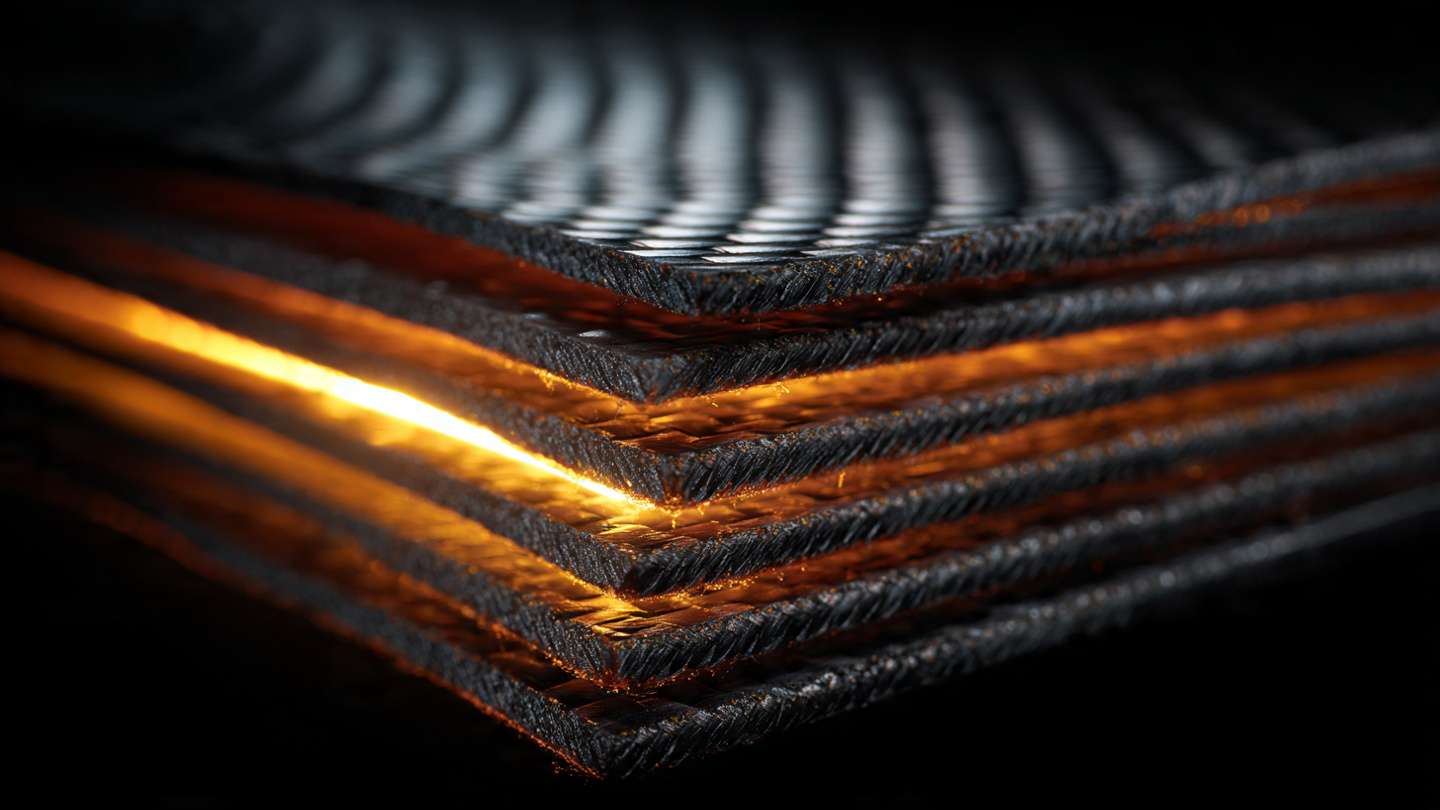
Carbon fiber composites have a dirty secret. They crack from the inside. Not the kind of crack you can see on a body panel or feel in a structural member, but invisible separations between laminate layers that grow silently under load until the part fails. This failure mode, interlaminar delamination, has haunted fiber-reinforced polymers since the 1930s. It killed composite structures on aircraft, chewed through wind turbine blades mid-rotation, and made every exotic carbon tub on a supercar a ticking clock with a 15-to-40-year fuse. Nobody could see it coming, and once it started, nobody could stop it. A team at North Carolina State University just published a material that resets the clock. A thousand times.
Delamination: The Invisible Failure
A fiber-reinforced polymer composite is a stack of thin plies, each consisting of continuous fibers (carbon, glass, or aramid) embedded in a thermoset or thermoplastic matrix. Strength runs along the fibers, which is where composites earn their extraordinary specific stiffness. Between the plies, only the resin matrix holds layers together, and resin is brittle by composite standards, with an interlaminar fracture toughness (GIC) typically between 100 and 300 J/m² for standard carbon-epoxy systems, a number that represents the energy required to propagate a crack between layers and is, by any structural measure, not much.
Impact damage is the classic trigger: a bird strike on an aircraft wing, a stone kicked up on a highway striking an underbody panel, hail on a turbine blade. The surface might show nothing more than a faint dimple. Beneath it, delaminations can extend tens of millimeters in every direction, invisible to visual inspection and often to ultrasonic scans performed at the wrong angle or frequency. Compressive loads then buckle the delaminated plies outward, propagating the crack further, and fatigue cycling drives it wider still. By the time the damage reaches a detectable size, the part may have lost a significant fraction of its design strength.
This is why composite-intensive cars like the McLaren Senna, Lamborghini Aventador, and Corvette ZR1 come with maintenance schedules that include periodic non-destructive evaluation of structural carbon components. It is also why repairing delamination damage in the field is brutally expensive: the affected section often must be cut out and replaced with a bonded patch, a process that requires autoclave-grade curing conditions and skilled technicians, and can cost thousands of dollars per repair even on components that appear externally intact.
The NC State Approach
Jason Patrick, an associate professor of civil, construction, and environmental engineering at NC State, has spent years attacking the delamination problem from a direction most composite engineers ignored. Instead of making the composite tougher so it resists cracking longer, his team made it capable of healing itself after it cracks. That distinction matters more than it might appear. Toughness improvements are linear: a composite that is twice as tough lasts roughly twice as long under similar loading. Self-healing is multiplicative: a composite that can repair itself 1,000 times extends its useful life by orders of magnitude beyond any achievable toughness improvement.
The material they built resembles a conventional fiber-reinforced polymer composite in most respects, with the same carbon or glass fiber reinforcement, the same epoxy matrix, the same layup geometry that any composite engineer would recognize from a decade of production experience. Two additions change everything.
First, the team 3D-printed a thermoplastic healing agent directly onto the fiber reinforcement before layup. The agent is ethylene-methacrylic acid copolymer, or EMAA, deposited in a controlled pattern that creates a polymer interlayer between plies, and this interlayer does double duty: before any damage occurs, it acts as an interlaminar toughener, making the composite two to four times more resistant to delamination than an unmodified laminate. A standard carbon-epoxy system with a GIC around 200 J/m² jumps to 400 to 800 J/m² with the EMAA interlayer in place. The composite starts its life tougher than the best conventional alternatives.
Second, the team embedded thin carbon-based heater layers into the laminate stack, and when an electrical current passes through these layers they generate heat uniformly across the interlaminar plane, which is where the healing happens. When the EMAA reaches its melt temperature, it flows into any delamination cracks and microfractures in the surrounding matrix, filling them from the inside. As the material cools, the EMAA resolidifies, rebonding the separated fiber layers and restoring the interlaminar fracture toughness to near its original value without an autoclave, without a vacuum bag, without a technician armed with a scalpel and a bonding fixture. Just current.
Forty Days of Destruction
The question Patrick’s team needed to answer was whether this healing process degrades over repetition, because self-healing polymers are not new and previous approaches using microencapsulated monomers or vascular networks showed promising first-cycle recovery but degraded rapidly across subsequent cycles because the healing agent was consumed and not replenished. EMAA is different because it is a thermoplastic that can be melted and resolidified repeatedly without significant chemical degradation, but the gap between “can be” and “does, a thousand times, under automated fracture loading” is precisely the kind of gap that separates a promising material from a proven one. So the team built a machine to find out.
Lead author Jack Turicek, a graduate student at NC State, designed an automated testing system that repeatedly applied tensile force to the composite specimen, opening a 50-millimeter-long delamination crack in the interlaminar plane during each cycle. After fracture, the system triggered the embedded heaters, melted the EMAA, allowed the material to cool and resolidify, then measured the interlaminar fracture toughness of the healed interface before fracturing it again. The rig ran continuously for 40 days, one thousand fracture-heal cycles, without human intervention after the start button was pressed.
“We found the fracture resistance of the self-healing material starts out well above unmodified composites,” Turicek reported. “Because our composite starts off significantly tougher than conventional composites, this self-healing material resists cracking better than the laminated composites currently out there for at least 500 cycles.” Toughness did decline after repeated healing, but slowly, tracing a gentle downward curve rather than falling off a cliff. Even at cycle 1,000, the material retained meaningful structural integrity, far above the threshold where conventional composites would have been scrapped and replaced.
Century-Scale Arithmetic
Patrick’s group ran the numbers on real-world service scenarios. In applications like aircraft wing skins, wind turbine blades, and automotive structural panels, delamination events do not occur every few minutes as in the test rig. They accumulate over months or years, driven by fatigue loading, thermal cycling, and occasional impact events. If the self-healing composite is triggered on a quarterly maintenance schedule, flowing current through the heater layers to melt and rebond any accumulated damage, 1,000 available healing cycles translates to roughly 250 years of service. Annual healing extends that to 1,000 years, though the researchers conservatively estimate 125 to 500 years depending on loading severity, a number they published in the Proceedings of the National Academy of Sciences.
For context: conventional FRP composites in aerospace applications are typically certified for 20 to 30 years, with extensions granted through expensive inspection and recertification programs. Wind turbine blades are designed for 20 to 25 years. Automotive carbon fiber components lack formal longevity standards, but practical service life is generally assumed at 15 to 25 years before delamination-related stiffness loss becomes a concern. A material that functions structurally for 125 years does not merely extend the life of a composite part. It outlives the entire technology cycle of whatever vehicle or structure it was built into. The carbon tub of a car built with this material would outlast not just the car, but probably the manufacturer that made it.
What Automotive Carbon Fiber Stands to Gain
Performance cars have embraced carbon fiber reinforced polymer in direct proportion to how much they cost. The McLaren 720S uses a carbon fiber MonoCell II tub weighing 82 kilograms that provides the structural core of the entire vehicle. Lamborghini developed forged carbon fiber (Forged Composites) for the Aventador and Huracán, using chopped carbon fiber in a compression-molded matrix that allows complex geometries but trades some fiber-direction strength for manufacturing flexibility. The Corvette ZR1 uses carbon fiber extensively in its body panels and aerodynamic package. Even the Porsche 911 GT3 RS relies on carbon-fiber-reinforced polymer for its fixed rear wing, front lid, and various structural brackets where weight savings directly improve lap times.
All of these applications share the same vulnerability. A track-day impact, a parking lot fender tap, a stone strike on the underbody: any of these can initiate delaminations that are invisible to the owner and ruinously expensive to repair once discovered, because carbon fiber body panel repair at a Porsche-certified facility routinely exceeds $5,000 for a single panel and McLaren tub damage can run into six figures, numbers that explain why insurance claims for composite damage on supercars rank among the highest per-incident costs in the entire automotive industry.
Self-healing interlayers would not prevent impact damage to the matrix or fiber breakage. They address a specific failure mode: interlaminar delamination, which is also the most common failure mode in thin-walled composite structures subjected to low-velocity impact. A self-healing composite body panel that receives a parking-lot-speed impact would still show the surface cosmetic damage, but the hidden interlaminar separations beneath the impact site, the ones that silently degrade stiffness and eventually require panel replacement, would be healed on the next maintenance cycle by passing current through the embedded heaters. The structural integrity of the panel would be restored without removing it from the car.
Manufacturing Realities
3D printing a thermoplastic interlayer onto fiber reinforcement before layup is not a radical departure from existing prepreg manufacturing workflows. Prepreg suppliers already apply resin systems, toughening particles, and interleaf films to dry fiber reinforcement as part of the material production process. Adding a 3D-printed EMAA pattern is an additional step, but it integrates into the same material supply chain that feeds autoclave and out-of-autoclave composite production lines.
The embedded heater layers present a more significant manufacturing consideration. They must be positioned at each interlaminar interface where healing capability is desired, connected to an electrical circuit that can deliver current on demand, and insulated from the structural fiber reinforcement to prevent short circuits through the conductive carbon fibers. Patrick’s published work uses thin carbon nanotube-based heater sheets, which add negligible thickness and weight to the laminate but require careful integration during layup. For automotive applications, this means the part design must incorporate electrical connectors and a control circuit capable of delivering the required current density across the heater layers during maintenance events.
That is not trivial. But it is not unprecedented either. Modern performance cars already embed sensors, heating elements, and conductive pathways in composite structures. Heated carbon fiber seats in the Porsche Taycan use resistive elements integrated into the composite shell. Anti-icing systems on aircraft composite leading edges use electrothermal heaters bonded to or embedded in the laminate. The electrical architecture for self-healing is conceptually similar, a resistive heating circuit with a power source and a controller, it is just applied at every interlaminar interface rather than on a single surface.
Limitations the Paper Acknowledges
The NC State research is honest about what it does not demonstrate. Fiber breakage is not addressed. If a carbon fiber tow fractures under impact, no amount of interlaminar healing will restore the tensile strength carried by those broken fibers. Delamination is a matrix-dominated failure mode; fiber failure is a fiber-dominated one. The two often co-occur under severe impact, which means self-healing addresses one component of impact damage but not all of it.
The automated test rig produced Mode I (opening) delamination exclusively. Real-world delamination often involves Mode II (sliding shear) and mixed-mode loading, and the healing efficiency under those conditions has not yet been characterized over 1,000 cycles. Early-cycle data from the NC State group shows EMAA healing works well under Mode II, but the long-duration automated endurance data is currently Mode I only.
Environmental aging is another open question. Composites in automotive service are exposed to UV radiation, moisture cycling, temperature extremes, road salt, fuel, and cleaning solvents. Whether the EMAA interlayer maintains its healing efficiency after years of environmental exposure is unknown, because the 40-day test was conducted under laboratory conditions. EMAA is a chemically robust polymer with good resistance to most solvents and moderate UV stability, but long-term aging data in an interlaminar environment has not been published.
These are genuine gaps, not footnotes. They are also exactly the kind of gaps that separate a laboratory demonstration from an engineering specification, the kind that require years of environmental aging studies, mixed-mode fracture characterization, and real-world field trials before any OEM will put the material into a production bill of materials, because qualifying a new composite system for structural automotive applications involves the same multi-year development cycle that every material system has undergone from initial publication to production deployment, and no one has ever shortened that timeline by wishing it were faster.
Five Centuries Is a Different Promise
Composite engineers have spent decades improving interlaminar toughness through particle toughening, thermoplastic veils, z-pinning, and stitching. Each approach pushes the fracture toughness curve higher, delaying the onset of delamination. None of them address what happens after the crack forms. Self-healing composites occupy a different design philosophy entirely: accept that cracks will form, because they always do in any structural material under cyclic loading, and build in the ability to fix them automatically.
The 40-day, 1,000-cycle endurance test published in PNAS is the first demonstration that this approach can deliver century-scale structural longevity in a fiber-reinforced polymer system. It does not solve every problem. It does not make composites impervious to damage. What it does is transform interlaminar delamination from a terminal condition, the failure mode that defines the service life of every composite structure currently in production, into a recoverable one. For an industry that measures component life in decades and replacement costs in thousands of dollars per panel, a material that measures its life in centuries and its repair cost in kilowatt-hours of electrical current is not an incremental improvement. It is a different category of promise.
Sources
- J. Turicek, Z. Phillips, K. Nakshatrala, J. Patrick, “Self-healing for the Long Haul: In situ Automation Delivers Century-scale Fracture Recovery in Structural Composites,” Proceedings of the National Academy of Sciences, 2026. DOI: 10.1073/pnas.2523447123.
- NC State University, “Engineered Materials Can Self-Heal and Last Centuries,” news.ncsu.edu, January 2026.
- CompositesWorld, “NC State, Houston University develops self-healing composite that repairs damage 1,000 times,” compositesworld.com, 2026.
- NC State Engineering, “New Tech Solves Longstanding Challenges for Self-Healing Materials,” engr.ncsu.edu.
- Eaton Corporation, “TVS Technology Overview,” eaton.com. (For prior ED article context on composite materials in performance vehicle supply chains.)
- McLaren Automotive, “MonoCell II Carbon Fibre Chassis,” mclaren.com.
- Lamborghini, “Forged Composites Technology,” lamborghini.com.