Two More Cylinders: RUF Builds the Flat-Eight Porsche Never Sold
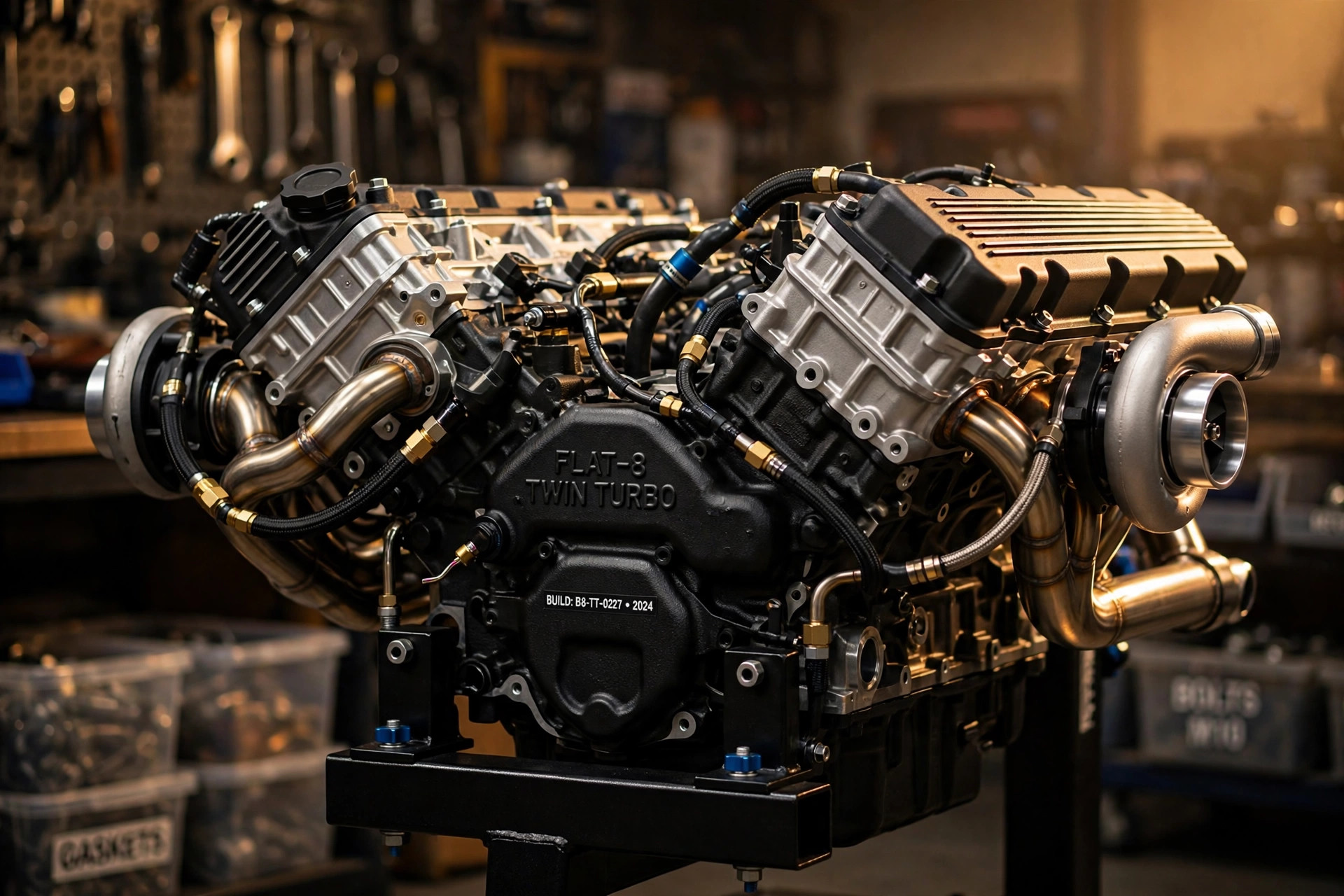
RUF's B8 Erprober is a clean-sheet 4.8-liter twin-turbo flat-eight making over 1,000 horsepower, and no production car has ever carried this layout. The interesting question is not the power figure. It is why RUF added cylinders instead of boost.
A Different Answer to Four Figures
Goodwood, July. RUF rolls a black-and-yellow CTR3 up the hill with Tanner Foust at the wheel, and the sound coming out of the back is the first anyone has heard from a new engine in a very long time: an eight-cylinder boxer. Internally called the Erprober, German for "tester," the B8 is a 4.8-liter twin-turbocharged flat-eight developing more than 1,000 horsepower and more than 1,000 Nm of torque, which converts to just under 738 lb-ft. It is RUF's first boxer-eight, designed and built in-house, and it currently lives in a CTR3 mule stretched 100 millimeters to accommodate the longer block. Rear-wheel drive, through a RUF-developed six-speed manual. Nobody else sells a manual at this torque.
CarBuzz asked the obvious question the week of the reveal: is adding cylinders smarter than adding boost? Put numbers on it and the question answers itself. One thousand horsepower from 4.8 liters is roughly 208 horsepower per liter. Getting the same four figures out of a 3.6-liter flat-six would demand close to 278 per liter, which is the territory where pistons, rods, crankshafts, and bearings all get nervous at once. Porsche's current Turbo S, at 701 horsepower from that same 3.6-liter hybrid flat-six, already runs strengthened cast pistons, an enlarged crankcase with bigger ventilation chambers, and motorsport-derived roller cam followers just to cope. Every unit of boost past that point raises cylinder pressure, combustion temperature, and the heat the cooling system must reject, in a cascade.
RUF sidestepped the cascade. Four extra cylinders mean each combustion chamber does roughly three-quarters of the work for the same total output. That is the whole trick. Lower peak pressure per cylinder buys wider knock margin, calmer ignition timing, and lower thermal load on every piston crown. Boost is a tax on the whole combustion system; displacement is a savings account. This is a remarkably traditional answer to a very modern power target, and it only works because RUF was willing to design a whole engine around it.
Why a Flat-Eight, Mechanically
A horizontally opposed eight is four mirror-image piston pairs boxing each other across the crank centerline. Mirror pairs cancel primary reciprocating forces by construction, which is the same trick that makes flat-fours and flat-sixes pleasant. Doubling it buys the second advantage: with the two four-cylinder crank sections phased against each other, much of the secondary shake cancels too. Porsche's 908 racers ran a 3.0-liter air-cooled flat-eight at more than 8,000 rpm in the late 1960s, which is the kind of evidence that does not need a theory section. The architecture is smooth by inheritance.
Then there is the firing order arithmetic. Eight cylinders across 720 degrees of crank rotation gives a power pulse every 90 degrees, and there is almost no gap for a flywheel to bridge. Power delivery goes glassy, which matters for two reasons RUF cares about: a manual gearbox behind 1,000 Nm gets gentler treatment from smooth torque input than from lumpy delivery, and the turbochargers see near-continuous exhaust energy instead of discrete slugs of it, which keeps them on boost across a wider band. Whether RUF tuned the exhaust manifolds to exploit that last effect is one of the many things they have not said.
Flat layouts keep the center of gravity low, the same advantage every 911 has banked since 1963, and adding cylinders does not change the width of the engine, only the length. A flat-eight block at the same bore spacing is roughly a third longer than a flat-six block. In a rear-engine car, length is the scarce dimension, which is exactly why the CTR3 mule grew 100 millimeters. The stretch is the packaging receipt, and it is honest: RUF paid for the two cylinders in wheelbase, not in body width.
The Long Crank Problem, and Why Nobody Else Did This
Here is the engineering bill, and it explains six decades of silence on the subject. An eight-cylinder flat crankshaft is a long crankshaft, and long crankshafts twist. Torsional vibration along that length is the classic failure mode of every long-crank layout, which is why inline-eights died and why inline-sixes need serious damper design. A flat-eight crank is effectively two flat-four cranks joined in series, and every firing pulse sends a torsional wave down the shaft that the next pulse can reinforce, a resonance that worsens as the crank grows longer because the shaft's natural frequency drops toward the firing frequency as rpm climbs, which is precisely the regime where a 1,000-horsepower engine wants to live. Get the phasing and the damper wrong and you do not get 1,000 horsepower; you get a very expensive tuning fork that shakes itself apart at high rpm.
Cooling is the second structural tax. Two turbochargers, eight cylinders, and rear-engine packaging mean intercoolers, charge plumbing, and exhaust routing all compete for the same airflow at the back of the car. The engine is not air-cooled nostalgia; a 208-hp-per-liter turbo engine rejects enormous heat, and every degree of intake temperature costs power and knock margin. RUF has disclosed nothing about bore, stroke, compression ratio, redline, turbo sizing, or engine weight, so the honest statement is that the thermal packaging of this engine is unknown, not that it is solved, and anyone who claims to know how RUF packaged the intercoolers and charge plumbing in the back of a rear-engine car at these boost levels is telling you more about their own confidence than about the engine.
Those two problems, torsional and thermal, are plausibly the reason Porsche never productionized a flat-eight road engine despite racing one for years and even sketching one for a 918 Spyder successor. Autocar's Goodwood reporting notes that Porsche drew up a 904 concept with a 5.0-liter flat-eight rated around 750 horsepower and 738 lb-ft, a project that never reached customers. CarBuzz's tally is sharper: no series-production car has ever carried a flat-eight, with the last sighting being the two Porsche 914/8 prototypes of the 1970s, one-off cars with the 908's racing engine shoehorned in. RUF decided to pay the engineering bill that everyone else kept deferring.
Six Gears and a Thousand Newton-Meters
Manual gearboxes at four-figure torque are becoming an endangered species for a reason: holding 1,000 Nm through a clutch and a gear set is a packaging and materials problem, not a romance problem. BMW and Ferrari have both walked away from manual transmissions in their highest-output cars, citing exactly this. RUF builds its own gearboxes, a capability most manufacturers, let alone tuners, do not have, and the six-speed in the B8 mule is RUF-developed.
There is a reading of the manual choice that goes beyond tradition. Smooth power delivery from 90-degree firing intervals reduces the peak torque spikes the gearbox has to absorb, which is the same balance-physics argument from the earlier section doing double duty. A flat-six pushed to 1,000 horsepower would deliver its torque in larger, lumpier 120-degree pulses with higher peak cylinder pressure behind each one. The flat-eight's lower specific load is kinder to the gearbox it was designed around. I will not claim RUF picked the manual because the flat-eight flatters it, but the architecture certainly does not hurt.
What We Know and What We Do Not
RUF has said the engine was designed and developed in-house, that it makes over 1,000 horsepower and over 1,000 Nm, and that the Goodwood car is a dedicated testbed for technologies that will shape a future RUF model, supported by lubricant partner MOTUL. RUF's own framing is worth quoting carefully: neither RUF nor any other company has deployed such an engine "in this form." The hedges in that sentence are doing real work. Nobody else has shipped a production flat-eight, but Porsche's racing department and its concept studio have both been here before, and RUF knows exactly whose shoulders it is standing on.
I have not heard this engine in person, seen it on a stand, or reviewed RUF's internal data. Everything about the torsional and thermal analysis above is first-principles reasoning from the layout and the disclosed figures, not reporting from RUF's engineering notebooks. The 908 comparison rests on established racing history, not on fresh measurement. And the B8 is a test mule, not a production car: stretch marks and all, it is a rolling laboratory, and laboratories sometimes produce results their builders did not expect.
What RUF has built, regardless, is the first clean-sheet flat-eight of the modern era, and the thesis behind it deserves respect. When the rest of the industry chases four-figure output by turning up the boost and engineering around the consequences, RUF asked whether the engine should simply be bigger. The answer cost them 100 millimeters of wheelbase, a long crankshaft to tame, and a manual gearbox to feed. On the hill at Goodwood, with Tanner Foust at the wheel and the flat-eight doing something no production car engine has ever done, the bill looks paid.
Specification
| Engine | RUF B8 "Erprober," 4.8-liter twin-turbocharged horizontally opposed eight-cylinder; designed and developed in-house |
|---|---|
| Output | Over 1,000 hp; over 1,000 Nm (approx. 738 lb-ft) per RUF |
| Specific output | Approximately 208 hp/L (computed from disclosed figures) |
| Drivetrain | Rear-wheel drive via RUF-developed six-speed manual |
| Test vehicle | Modified RUF CTR3, body extended 100 mm (3.9 in) to accommodate the engine |
| Debut | Goodwood Festival of Speed, July 10-12, 2026; hillclimb runs driven by Tanner Foust; MOTUL as lubricant development partner |
| Status | Development testbed; not a production model. RUF says technologies will shape a future RUF model |
| Historical note | No series-production car has ever used a flat-eight. Porsche raced the type in the 908 (1968-1970) and sketched a 5.0L flat-eight 904 concept for a 918 successor that never shipped (per Autocar) |
Displacement Is a Strategy, Not a Relic
Strip away the Goodwood theater and the B8 Erprober is a single argument in metal: when the power target is four figures, the cheapest component in the engine is another cylinder. RUF bought lower peak cylinder pressures, a wider knock margin, and 90-degree firing intervals for a gearbox that would otherwise be begging for mercy, and paid with wheelbase and a long crankshaft. That is engineering as resource allocation, which is the only kind that matters.
There is no pricing angle here and there never will be: this site covers engineering, not dealer margins, and RUF has not named a car for the engine anyway. What matters is that someone finally built the flat-eight the industry kept sketching and shelving. Porsche raced it. Porsche concepted it. RUF built it. In that order, eventually, the bill gets paid.