Haplos: The Annual Calendar Rolex Rebuilt Down to Two Parts
Rolex unveiled the Perpetual Padellone in mid-September 2026 with the usual fanfare: a collector nickname on the dial, a meteorite moonphase, Calibre 7190. Ignore the romance for a moment. Underneath sits the patented Haplos system, an annual calendar implemented as a carrier finger, an annual lever, and month-length data milled into the back of the month disc. Nothing else. That is the actual story.
What Was Actually Announced
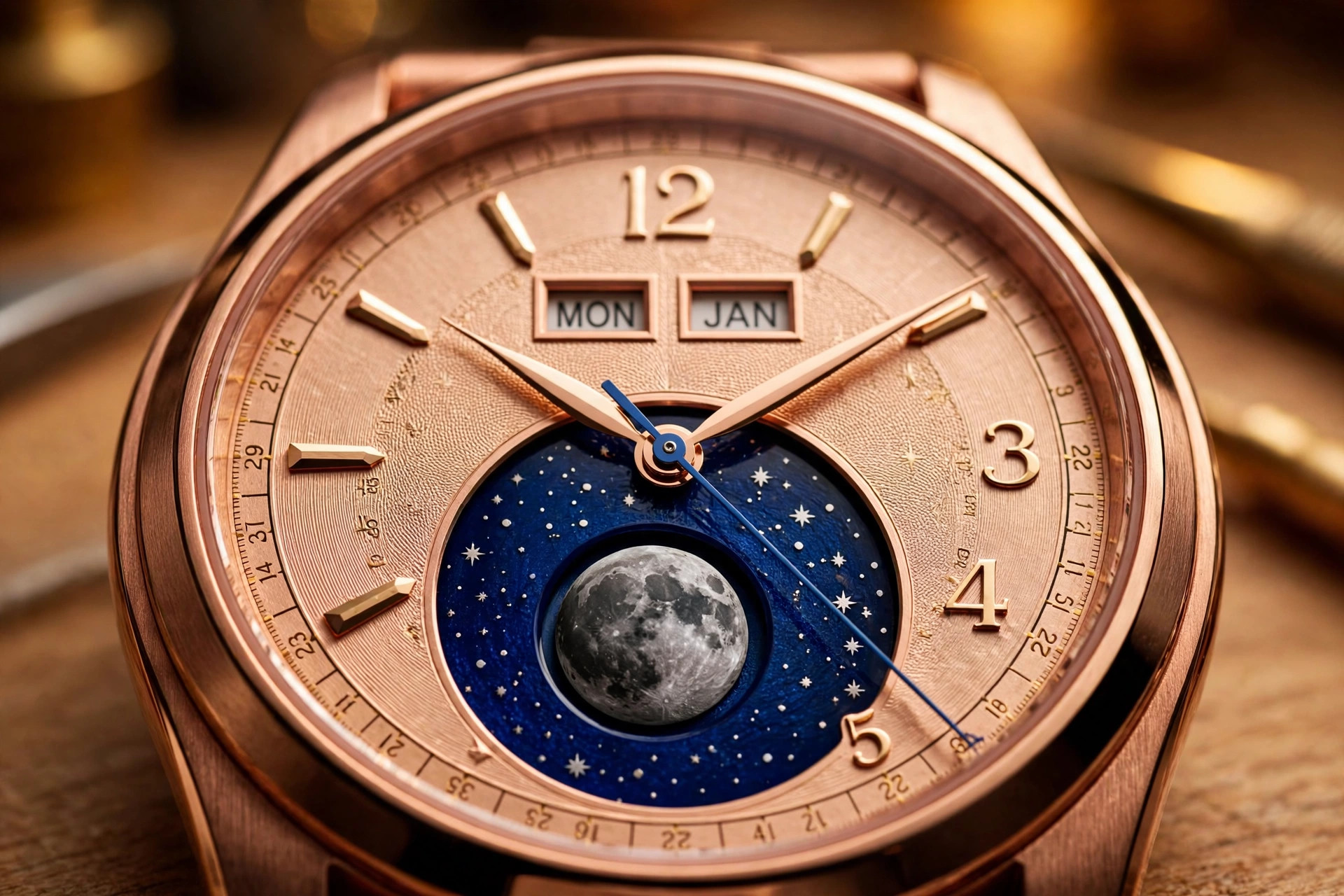
References 53505 and 53506, announced around September 15, 2026. Everose gold (M53505-0002 on brown alligator, M53505-0003 on the seven-link Settimo bracelet) or 950 platinum (M53506-0002 on black alligator), 39mm across and 12.20mm thick. Day and month sit in twin apertures at twelve o'clock. A blue date hand with a crescent-moon tip sweeps the date track around the dial's edge. Filling the six o'clock aperture, the moonphase is a blue enamel disc, the full moon and the new moon cut from meteorite, the new moon finished in dark blue PVD, pad-printed stars scattered across the disc.
Not a limited edition, though Rolex says production will ramp slowly. Pricing starts at $59,000 on leather, $72,800 on the Settimo bracelet, $66,200 for platinum. Sapphire caseback. Correctors in the case for day, date, month, and moonphase. Superlative Chronometer certification under the 2026 criteria, which Rolex strengthened to include magnetism, reliability, and sustainability testing alongside the existing −2/+2 seconds per day after casing.
And the headline complication combination, day, date, month, and moonphase in one watch, is something Rolex had not built in 73 years. The previous instance was reference 6062, discontinued in 1953. Since then the brand has shipped millions of day-dates and monthless calendars, and the day-date-month-plus-moonphase combination disappeared from the catalog entirely.
Why Annual Calendars Are Usually Component-Dense
An annual calendar's job sounds simple: handle the 30- and 31-day months by itself, and ask for one correction a year at the end of February. Implementing it is not simple, because the mechanism needs to know which month it is in. Conventional annual calendars solve this with a stepped month wheel or month cam, a 12-position program wheel with notches of different depths, plus a lever train that reads the notch and blocks or releases the date jump at 30 instead of 31. Patek Philippe's reference 5035, the first modern annual calendar, runs a module with roughly 90 components bolted onto the base movement. It is an elegant device and a sprawling one.
Haplos discards almost all of that. Two components added to the instantaneous date mechanism: an additional carrier finger and an annual lever. That programming, the month-length data, lives on the reverse of the month disc itself. As the disc rotates once per year, its back face presents a continuously changing mechanical code to the annual lever, which learns the current month's length and decides whether the date jumps at 30 or 31.
This is the packaging insight worth dwelling on. Somebody has to cut the month disc anyway; it carries the month display, and its position encodes the month with zero ambiguity. Rolex chose to write the program data onto the part that already knows the answer, instead of adding a separate program wheel that re-derives the month. Fewer parts, fewer mesh points, fewer ways to bind. Haplos comes from the Greek for simple, and for once the marketing etymology describes the mechanism.
Simultaneous Instantaneous Jumps Are the Hard Part
Here is the detail that separates this from a parts-count curiosity: at midnight, the date, the day, and the month all jump together, instantaneously, in a fraction of a second. Not staggered across hours. Not dragging. Simultaneous.
Calendar jumps are spring-loaded events. Energy builds up, then releases to slam a disc forward, and the shock has to be managed so it does not disturb the oscillator. Doing one instantaneous jump at midnight is a solved problem. Doing three at once, plus a moonphase disc indexing through its 29.53-day cycle, concentrates the entire night's mechanical work into one instant, and the torque demand spikes. Something has to pay for that spike.
Which is where the rest of Calibre 7190 earns its place. Calibre 7190 runs at 36,000 vibrations per hour, 5 Hz, with approximately 66 hours of power reserve. Behind those numbers sits the silicon Dynapulse escapement, Rolex's dual-wheel escapement introduced in the Land-Dweller's Calibre 7135 in 2025, which the brand claims delivers roughly 30 percent more energy to the oscillator than a conventional Swiss lever. A thick-coiled Syloxi silicon hairspring, a ceramic balance staff for magnetic resistance, and Paraflex shock absorbers complete the oscillator package.
Read the architecture as a single design decision and it starts to cohere: the efficiency gains from Dynapulse are what buy the torque budget for three simultaneous instantaneous jumps without sacrificing amplitude or the 66-hour reserve. Thirty patent applications cover the calibre, two of them exclusive to the 7190, and Rolex filed separate patents on Haplos and on the jump mechanism itself. Patent filings tell you where the company thinks the value is. It is not the dial.
One honest caveat on the Dynapulse claims: I covered the escapement's mechanics when the Land-Dweller launched, and the 30 percent figure is Rolex's stated number, not an independently measured one. Nobody outside Plan-les-Ouates has put a 7190 on a timing bench yet. That efficiency claim is plausible given the escapement geometry, but treat it as the brand's engineering story until third parties verify it.
The Moonphase Is Not a Compromise
Most moonphases are aperture affairs: a disc rotating beneath a crescent cutout, the lunar image sliding in and out of view. This one is fully exposed. Visible at six o'clock: the entire blue enamel disc, and the meteorite full and new moons travel continuously through the 29.53-day lunar cycle, aligning in turn with a triangular indicator above the disc. Both moons carry pad-printed faces, a wink at the whimsical moon displays of the vintage Padellone.
Materially this is honest luxury. Enamel over a moonphase disc is real grand feu work, not a printed substitute, and meteorite moons on both the full and new moon representations is a flex, since the new moon on most watches is just painted dark. Using a slice of actual asteroid iron for a moon that spends most of its life nearly invisible is exactly the kind of excess that dress-watch collectors pretend not to care about while paying for it.
Mechanically this is less exotic than the calendar. A 59-tooth drive wheel gives the standard approximation of the lunar cycle, 29.5 days, losing about a day every two and a half years. Rolex has not claimed astronomical precision, and the four case correctors include one for the moonphase, so correction is tool-based rather than crown-based. Fine. It is a display complication, and it is displayed beautifully.
Seventy-Three Years of Calendar Absence
The nickname deserves its paragraph. "Padellone" is Italian slang, roughly "big frying pan," and it was attached by collectors to the reference 8171 in the early 1950s because its roughly 38mm case looked absurdly broad in an era when 34mm was normal. Around 1,000 to 1,200 pieces were made between 1949 and 1953, running a triple calendar and moonphase that needed manual correction after short months.
Rolex almost never adopts collector nicknames officially. Rolex names almost nothing; the Datejust and Day-Date are the exceptions that prove the rule. Putting Padellone on the dial is a deliberate break with seventy years of practice, and it only makes sense if you read it as Rolex finally acknowledging the collector culture it spent decades pretending to ignore.
Worth noting precisely what the original was and was not. The original's calendar was a triple calendar, correctors for everything, manual intervention at every short month. This one is an annual calendar that intervenes once a year. Sharing the name is an act of marketing lineage, not technical descent. Nobody should confuse the two mechanisms, and the 12.20mm case thickness makes clear this is a modern device: thin it is not, not against a 1950s dress watch, and not against modern annual calendars that ship under 10mm. Thirty-nine millimeters sits a single millimeter above the original's already-oversized-for-its-era 38mm, which is either respectful or cowardly depending on your view of case size trends.
The Full Spec Sheet
| Detail | Specification |
|---|---|
| References | M53505-0002 (Everose on brown alligator), M53505-0003 (Everose on Settimo bracelet), M53506-0002 (platinum on black alligator) |
| Case | 18 ct Everose gold or 950 platinum; 39mm diameter, 12.20mm thick; sapphire caseback |
| Dial | Intense White (Everose) or Ice Blue (platinum), grained center, satin-finished outer ring; twin day/month apertures at 12 |
| Moonphase | Blue enamel disc at 6 o'clock; meteorite full and new moons (new moon in dark blue PVD); pad-printed faces and stars; 29.53-day cycle |
| Date display | Blue PVD central hand with crescent-moon tip, peripheral track |
| Movement | Calibre 7190, automatic; 36,000 vph (5 Hz); approx. 66-hour reserve; 35 jewels |
| Oscillator | Silicon Dynapulse escapement (~30% efficiency gain claimed); Syloxi hairspring; ceramic balance staff; Paraflex shocks |
| Calendar | Patented Haplos system: carrier finger + annual lever, month-length data on reverse of month disc; day, date, month jump simultaneously and instantaneously at midnight; correction once yearly (end of February) |
| Setting | Four case correctors (day, date, month, moonphase); stop seconds |
| Certification | Superlative Chronometer; −2/+2 s/day after casing (strengthened 2026 criteria) |
| Prices | $59,000 Everose on leather; $72,800 Everose on Settimo bracelet; $66,200 platinum on leather |
| Availability | Not limited; production ramping slowly, per Rolex |
| Announced | September 2026 (outside the Watches and Wonders cycle) |
Simple Is the Hardest Thing to Ship
Annual calendar design has a known failure mode: cleverness that does not survive service. Month program wheels with twelve stepped notches, spring-loaded feelers, stacked levers, every added part a future point of friction and a technician's future headache. Patek's module is a marvel, and watchmakers quietly dread it.
Haplos attacks the problem from the opposite end. Here the program is a surface treatment on an existing disc. Two components added to the date mechanism. Energy discipline from the escapement pays for the midnight jump. Whether it services gracefully over decades is unproven, and it will be decades before anyone knows, which is the honest position: every new calendar mechanism is a promise with a very long verification cycle.
But the instinct is right. In a complication category where everyone solved the problem by adding parts, Rolex solved it by removing the program wheel. Moonphase gets the photography. Padellone gets the auction houses. Two parts and a disc go to the annual calendar, and that is the whole point.
Sources
- Monochrome Watches, "In-Depth: The new Rolex Perpetual Padellone," September 2026. Haplos system components, reverse-of-disc programming, simultaneous instantaneous jumps, 30 patent applications, CHF pricing (52,500 / 64,800 / 59,000).
- WatchTime (via 5D Watches blog), "Rolex Perpetual Padellone 2026: Specs, Price, Details," September 2026. References 53505/53506, 39mm x 12.20mm, Calibre 7190 on Calibre 7135 base, 5 Hz, 66-hour reserve, Dynapulse silicon escapement.
- Crown Watch Blog, "INTRODUCING: Rolex Perpetual Padellone," September 2026. Haplos carrier finger and annual lever detail, Domed/fluted dual bezel, Settimo bracelet, correctors in case.
- Watch Collecting Lifestyle, "Introducing: Rolex Perpetual Padellone," September 2026. Syloxi thickened for 5 Hz, ceramic balance staff, optimized brass balance wheel, Superlative Chronometer −2/+2 s/day, strengthened 2026 criteria.
- Hourstriker, "Rolex Perpetual Padellone," September 2026. 35 jewels, moonphase construction (blue enamel disc, meteorite moons, pad-printed stars), four correctors, stop seconds.
- Fratello, "An In-Depth Look At The New Rolex Dynapulse Escapement," 2025. Dynapulse efficiency (~30% vs Swiss lever), nanoliter oil application, sequential-distribution architecture.
- Caliber Corner, "Rolex Dynapulse Escapement," 2025. Dynapulse 7 patents, silicon components, ceramic balance staff, 10-year development.
- Flawless Crowns, "Rolex Perpetual Padellone: Pricing And Details," September 2026. Ref 8171 heritage (1949-1953, ~38mm, ~1,000-1,200 pieces), 73-year gap since ref 6062 (discontinued 1953).