The Rolex Oyster Case: 100 Years of Hermetic Architecture
How a screw-down crown patent from 1926 became the structural DNA of every Rolex collection. Three sealing revolutions, one relentless engineering program.
A century is a long time to spend refining something everyone already takes for granted. Water resistance in a wristwatch feels as inevitable as antilock brakes in a car. It just comes standard. Nobody picks up a $200 Seiko and worries about whether rain will kill it. That baseline comfort traces directly to a single patent filed in 1926 by a man who ran a watch company from London and manufactured nothing himself.
Hans Wilsdorf's patent CH120851 described a case in which three separate components, the bezel, caseback, and winding crown, all screwed down against a central middle case. Not a wildly original concept. Screw-down casebacks already existed. But Wilsdorf solved the one problem nobody else could: the crown. Push-pull crowns couldn't seal. Earlier "hermetic" cases sealed completely but required you to pry them open just to wind the watch, a routine that defeated the purpose. Wilsdorf acquired an existing screw-down crown design, refined it, integrated it into a case architecture where every access point threaded shut, and called the result the Oyster.
It worked. And then it kept working for a hundred years.
The Original Shell
Inside, the 1926 Oyster was more complex than it appeared. Its movement didn't mount directly into the case body. Instead, it sat in a threaded metal ring, along with the dial and hands, forming a self-contained unit. Crown and stem connected through a threaded tube fixed to the case wall. Then the bezel screwed down from above and the caseback from below, compressing the whole assembly into a sealed chamber.
This was modular by necessity. Case manufacturing and movement assembly were done separately, often by different companies entirely, and then married together. This threaded-ring approach let the movement holder function as an interface between two manufacturing streams. Wilsdorf orchestrated both from his office in London. Aegler supplied the movements from Biel. Cases came from Geneva and La Chaux-de-Fonds suppliers.
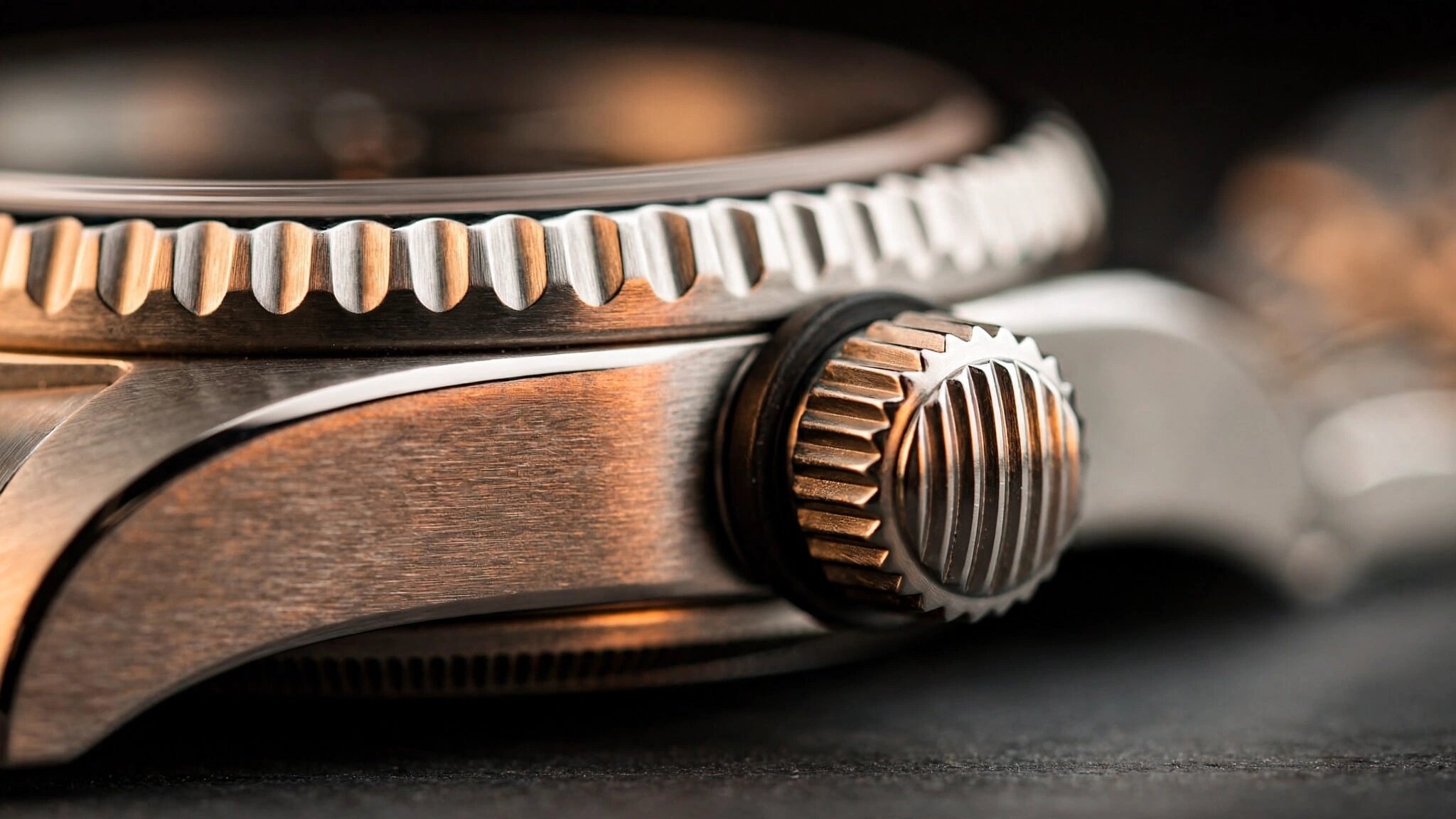
Today's fluted bezel, now an iconic decorative element, started as a purely functional detail. Rolex watchmakers needed a tool to grip and torque the bezel down against the case. Those ridged edges gave the proprietary wrench something to bite into. Over decades, as case construction evolved and the bezel attachment method changed, the fluting survived as an aesthetic signature. Function became identity.
One year after the patent, Wilsdorf found his proof-of-concept moment. Mercedes Gleitze, a young typist and distance swimmer, attempted to cross the English Channel wearing a Rolex Oyster on a chain around her neck. She spent over ten hours in the cold water, and the watch emerged in perfect working order. Wilsdorf took out a full-page advertisement in the Daily Mail declaring the Oyster "The wonder watch that defies the elements." He'd invented the modern concept of the celebrity sports ambassador before the phrase existed. That specific watch sold at Sotheby's in 2025 for $1.73 million.
Dealers started displaying Oyster watches inside fish tanks on their counters. Nothing complicated. Just a watch sitting in water, running fine, while customers watched. Sometimes the most persuasive engineering argument is the simplest demonstration.
Sealing the System Shut
But the Oyster case had a fundamental limitation that Wilsdorf understood immediately: every time you unscrewed the crown to wind the watch, you broke the seal. Manual winding required daily access. Daily access meant daily vulnerability.
In 1931, Rolex introduced the Perpetual rotor, a semicircular weight that swung freely on a central bearing, converting the natural motion of the wearer's wrist into winding energy. Self-winding watches weren't new. Abraham-Louis Perrelet built one in the 1770s. Harwood patented a bumper automatic in 1923. But Wilsdorf's rotor spun a full 360 degrees (no bumper stops), wound efficiently in both directions, and sat inside an Oyster case. That last part was the point. A self-winding watch in a waterproof case meant the crown could stay screwed down for weeks or months at a time. With self-winding, the seal only broke during deliberate time-setting.
Hodinkee called this combination "a Model T moment. Not the first of its kind, but the watch that fixed the format." Steering wheel and pedals for cars. Waterproof case and self-winding rotor for watches. A configuration so correct that it became permanent.
Three Generations of Gasket Engineering
Rolex's first-generation crown, from 1926, used a single metal gasket to seal against the winding tube. Metal-on-metal sealing works when machining tolerances are tight and surfaces are pristine. It doesn't tolerate wear, corrosion, or the gradual reality of daily use across years. For a dress watch worn carefully, fine. For a tool watch subjected to salt water, temperature swings, and physical abuse, the margins were thin.
Rolex's answer came in three stages, each adding a layer of redundancy.
Twinlock (1953). Introduced on the Submariner, the first Rolex purpose-built for diving. Twinlock replaced the single metal gasket with two synthetic O-rings, creating two independent sealed zones within the crown assembly. Synthetic rubber deformed under compression to fill microscopic surface irregularities that machined metal couldn't reach. Two seals meant that if one degraded or got nicked during servicing, the other maintained the barrier. You can identify a Twinlock crown by the single dot beneath the Rolex coronet stamped on the crown cap.
Triplock (1970). First deployed on the Sea-Dweller, a watch rated to 610 meters (later 1,220 meters). The Triplock system creates three distinct sealed zones across the crown cap, the winding stem, and the tube connecting them to the case. What makes it more than just "adding a third gasket" is the engineering within.
Crucially, the Triplock distinguishes between active and passive gaskets. Active gaskets compress when you screw the crown down, squeezing between the crown cap and the top of the tube, and between the stem and the tube's interior bore. They provide the primary seal. Passive gaskets maintain a baseline level of water and dust protection even when the crown is unscrewed, sitting in its neutral position during winding or time-setting. A built-in clutch mechanism uncouples the crown cap from the stem during the screw-down action, preventing the gaskets from being twisted and abraded as the crown rotates.
Three dots beneath the coronet identify a Triplock crown. It now appears on the Submariner, Daytona, Yacht-Master, GMT-Master II, and most other Professional models. Its original engineering purpose, handling a rare gasket failure at extreme depth, has become the standard for watches that will never go deeper than a swimming pool.
The Monolithic Middle
Everything in the Oyster system attaches to the middle case. Crown tube threads into it. Caseback screws onto it. Bezel mates against it. Crystal sits on its flange. On Professional models, the crown guards are stamped directly from the same block of metal. It is, structurally, the chassis.
Modern Rolex middle cases are machined from a solid block of material, whether that's Oystersteel (Rolex's proprietary 904L stainless steel, chosen for its corrosion resistance and polish retention), 18-karat gold, or 950 platinum. No welding. No brazing. No joined seams that could develop stress fractures or create leak paths under pressure. What goes to the machining center as a featureless billet comes out as a precise shell with threaded receivers for every mating surface.
904L stainless steel is unusual in watchmaking. Most watch companies use 316L. Both are austenitic stainless steels, but 904L contains higher molybdenum and copper content, giving it superior resistance to the specific corrosive environments watches encounter: salt water, sweat, chlorinated pools. An automotive parallel would be the difference between standard mild steel body panels and marine-grade aluminum alloys used in boat hulls. Both are "metal." The chemistry matters when the environment gets hostile.
That architectural principle, one monolithic structural element that everything else references, has remained constant since Rolex simplified the original threaded-ring design. Materials got stronger. Tolerances got tighter. But the idea didn't change.
Depth Without Limit
Every Rolex Oyster watch, including the most refined Day-Date in platinum with a president bracelet, is water-resistant to at least 100 meters. That includes models nobody will ever take swimming. It's an engineering floor, not a marketing claim. Its case architecture makes it difficult to build a watch that isn't sealed to that level.
Depth ratings scale from there. Submariner: 300 meters. Sea-Dweller: 1,220 meters. Deepsea: 3,900 meters. Deepsea Challenge: 11,000 meters.
Rolex's Deepsea family required a structural departure. At 3,900 meters, the ambient pressure reaches approximately 390 atmospheres, about 5,700 psi pressing inward on every square centimeter. Standard Oyster architecture couldn't manage those loads without becoming impossibly thick. Rolex's solution was the Ringlock system (patent EP1916576A1): a nitrogen-alloyed stainless steel compression ring sits inside the case between the crystal and the caseback. This ring absorbs the majority of the hydrostatic load, distributing compressive forces across the case structure rather than concentrating them on the crystal or the caseback alone. Its sapphire crystal thickens to 5.5 millimeters, roughly triple the standard Oyster crystal. Its caseback is machined from grade 5 titanium.
At 11,000 meters, the Deepsea Challenge pushed even further. Pressure exceeds 1,100 atmospheres. This watch accompanied James Cameron to the bottom of the Mariana Trench. At that depth, Rolex's own description of the Triplock crown becomes almost comedic in its engineering confidence: the system was "created to face what purely 'can't' happen: the crown somehow unscrewing itself at 11,000 meters below the surface." They engineered a solution for an impossibility and then tested it anyway.
What Rolex Tests Now
Since 2015, the Superlative Chronometer certification has governed every Rolex leaving the factory. Simple in principle and punishing in execution, the standard demands the finished watch, after the movement is cased, run within -2 to +2 seconds per day. COSC, the Swiss Official Chronometer Testing Institute, certifies movements at -4 to +6 seconds per day. Rolex starts where COSC stops, tests the complete watch rather than the bare movement, and applies its own protocol on fully automated equipment.
In 2026, for the centennial year, Rolex expanded the certification. Three new criteria: resistance to magnetism, reliability, and sustainability. These aren't afterthoughts bolted onto the end of the production line. Rolex states they're "implemented throughout the design and manufacturing stages," meaning hundreds of checks and validations happen during production rather than as final quality gates. Magnetism resistance is addressed through materials selection: the Parachrom hairspring (a niobium-zirconium alloy, paramagnetic, and ten times more shock-resistant than conventional Nivarox hairsprings) or the Syloxi silicon hairspring used in smaller calibers. Reliability is tested through simulated wear cycles. Sustainability enters through material sourcing and process efficiency.
All seven pillars of the 2026 Superlative Chronometer certification: precision, waterproofness, self-winding performance, power reserve, resistance to magnetism, reliability, sustainability. Four of those seven trace directly to the Oyster case and the Perpetual rotor. The case protects the movement, the rotor keeps it running, and the certification proves both work.
One Architecture, Fifteen Collections
Count the current Rolex collections. Oyster Perpetual. Datejust. Day-Date. Submariner. Sea-Dweller. Deepsea. GMT-Master II. Explorer. Daytona. Yacht-Master. Sky-Dweller. Air-King. Consider the recently introduced 1908. Every single one of them uses the Oyster case. Different bezels, different complications, different materials. Same structural principle.
That consistency is unusual in watchmaking. Most brands develop different case architectures for different product lines. Dive watches get one case. Dress watches get another. Chronographs might get a third. Rolex developed one platform and pushed it across the entire catalog. It works for a three-hand dress piece at 100 meters and for a helium-escape-equipped saturation diver at 1,220 meters. Spanning from the lightest Datejust to the most extreme Deepsea Challenge, the range of that single architecture covers a factor of 110 in water resistance.
Gérald Genta, the Swiss designer responsible for the Audemars Piguet Royal Oak and the Patek Philippe Nautilus, put it bluntly in a 2009 interview: "I regret not having designed the Oyster! Because, to me, it represents the biggest success in watchmaking. Today, we cannot find a single watch that could possibly stand up to and pose a challenge to the Oyster in terms of stylistic breakthrough." Genta wasn't talking about dials or bracelets. He was talking about the case.
The Automobile Analogy
Structurally, the evolution of the Oyster case tracks the evolution of automotive chassis architecture with remarkable precision. That original 1926 case, with its threaded ring and separate structural elements, resembles body-on-frame construction: multiple pieces bolted together, each doing its job, flexibility between joints. Moving to a monolithic middle case mirrors the shift to unibody construction, where a single stamped-and-welded shell provides structural rigidity, crash protection, and mounting points for every mechanical system simultaneously.
Gasket engineering tells a similar story. Both the Twinlock and Triplock systems use the same conceptual framework as modern cylinder head gaskets in internal combustion engines: multiple sealing layers with different compliance characteristics, active compression zones that tighten under load, and passive backup seals that maintain baseline protection during dynamic operation. Scale is the difference. An engine gasket seals combustion pressures measured in hundreds of psi. A Triplock crown seals hydrostatic pressures measured in thousands, at a diameter smaller than a pencil eraser.
And Rolex's approach to over-engineering margins, testing the Deepsea Challenge at depths no human will reach without a submersible, parallels how automakers crash-test vehicles at speeds and angles far beyond regulatory requirements. What matters isn't the test conditions. It's about building confidence in the margins you can't see during normal operation.
Still Refining a Solved Problem
A hundred years after CH120851, the Rolex Oyster case exists in a strange position. It solved its core problem so thoroughly that the solution became invisible. Nobody markets "waterproof" as a feature anymore. It's like advertising that your car has doors. But inside Rolex's facilities in Plan-les-Ouates, Biel, and the new production site under construction in Bulle, the engineering continues. Its Chronergy escapement optimizes energy transfer. Its Parachrom hairspring resists magnetic fields that didn't exist in 1926 because the electronics generating them didn't exist. Even the Superlative Chronometer certification absorbs sustainability criteria that weren't relevant to watchmaking until this decade.
What the Oyster case did wasn't just waterproof a watch. It established the operating system for mechanical timekeeping in the modern world: seal the movement, wind it automatically, test it rigorously, and then keep making the whole system incrementally better until the margins of improvement are invisible to everyone except the people doing the work.
A green seal still ships with every watch. It means the same thing it meant in 2015, and in 1926. The case is closed. The movement is protected. Everything works.
The improvements just keep getting quieter.
| Rolex Oyster Perpetual 41, 100th Anniversary (Ref. 134303) | |
|---|---|
| Case | 41 mm, Oystersteel and 18k yellow gold (Rolesor) |
| Case Height | 11.60 mm |
| Water Resistance | 100 m (330 ft), screw-down Twinlock crown |
| Dial | Slate grey, sunray finish, green minute track accents, "100 Years" at 6 o'clock |
| Luminescence | Chromalight (blue emission, long-lasting) |
| Caliber | Rolex 3230, automatic, COSC + Superlative Chronometer certified |
| Frequency | 28,800 vph (4 Hz) |
| Power Reserve | ~70 hours (Chronergy escapement) |
| Precision | -2/+2 seconds per day (after casing) |
| Hairspring | Parachrom (Nb-Zr alloy, paramagnetic, 10x shock resistance) |
| Bracelet | Oyster, Oystersteel, Easylink 5 mm comfort extension |
| Anniversary Details | "100" engraved beneath coronet on crown |
| Price | $9,650 |
| Crown Sealing System Evolution | |
|---|---|
| 1926 — Original | Single metal gasket, screw-down. One sealed zone. |
| 1953 — Twinlock | Two synthetic O-ring gaskets, two sealed zones. ID: one dot under coronet. |
| 1970 — Triplock | Three sealed zones (cap/stem/tube), active + passive gaskets, clutch mechanism. ID: three dots under coronet. |