The Ringlock Paradox: How Depth Pressure Seals the Rolex Deepsea Tighter
Every dive watch in existence fights water pressure. The Rolex Deepsea does something stranger: it uses water pressure as a structural ally, compressing its own seal tighter the deeper it descends. The engineering trick lives inside a three-material capsule that most owners will never see.
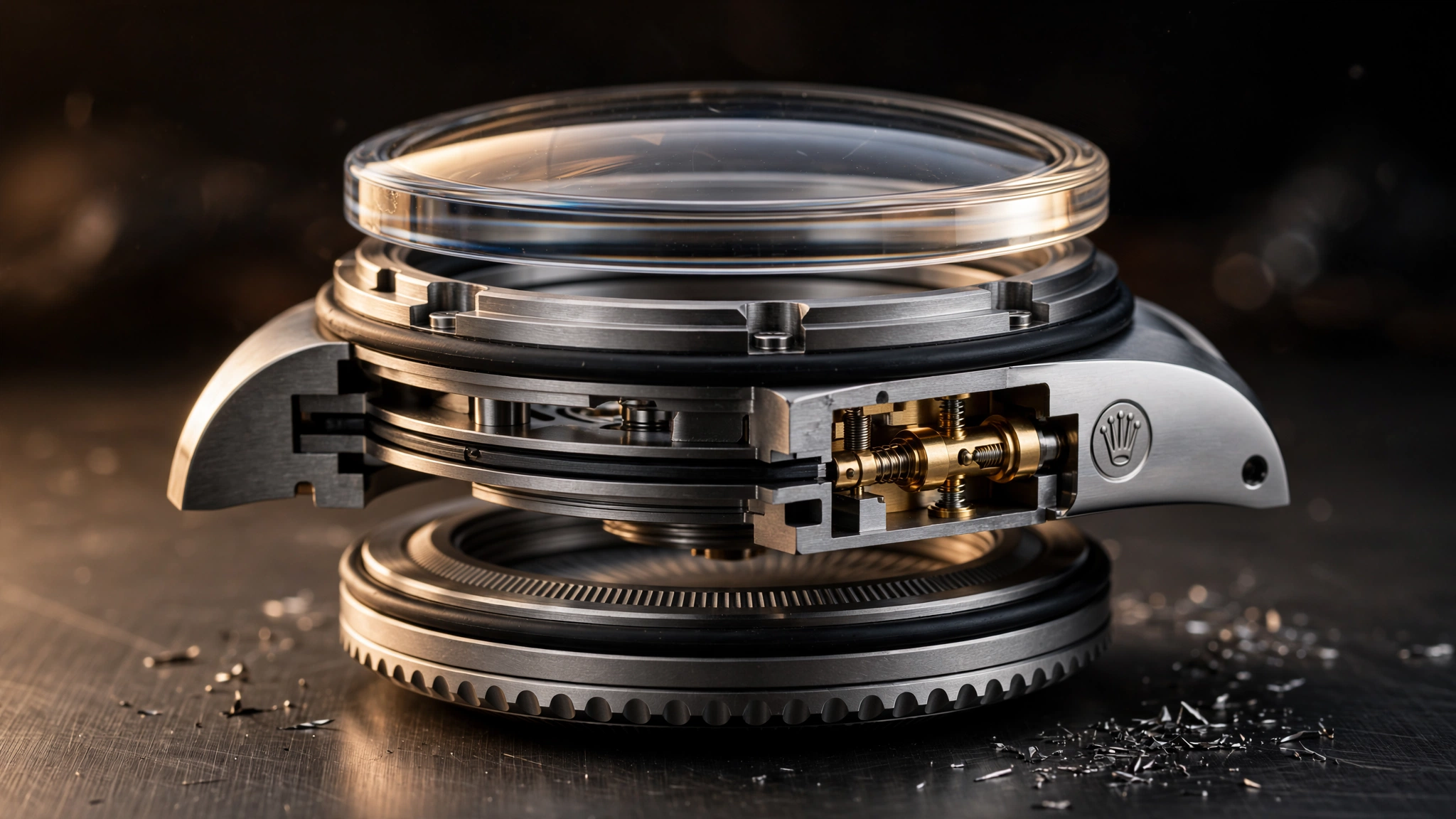
The Thickness Problem
Building a watch that survives at depth has always meant building a thicker watch. Arithmetic drives the constraint: at 300 metres, ambient pressure reaches 31 bar, climbing to 101 bar at 1,000 metres. At the Rolex Deepsea's rated depth of 3,900 metres, approximately 391 bar of hydrostatic pressure acts on every exposed surface, translating to roughly three tonnes bearing down on the sapphire crystal alone. A conventional Oyster case, the kind that equips the Submariner and Sea-Dweller, responds to this problem with the only tool it has: thicker walls, thicker crystal, thicker caseback, every dimension scaling upward until you are wearing something closer to a bathysphere than a wristwatch.
Rolex hit this wall decades ago. The Deep Sea Special, an experimental watch bolted to the hull of the bathyscaphe Trieste when Jacques Piccard and Don Walsh descended 10,916 metres to the Mariana Trench floor on 23 January 1960, was a crystal dome over a movement with no pretence of being wearable. It proved Rolex could build a case to survive the deepest point on Earth. It did not prove anyone could put that case on a human wrist.
Forty-eight years of incremental improvement produced the Submariner at 300 metres and the Sea-Dweller at 1,220 metres, but each step demanded a larger, heavier case with diminishing returns on the wearability curve. Quadrupling the Sea-Dweller's depth rating using the same case philosophy would have produced something absurd. So in 2008, Rolex did something different. They stopped trying to make a stronger case and started building a pressure capsule inside one.
A Case Within a Case
The Ringlock system is, conceptually, a Russian nesting doll. Its outer structure is a standard 44mm Oyster case in Oystersteel, machined and finished to the same standard as every other Oyster case in the catalogue. It screws together, takes the same bracelet lugs, and looks, externally, like a large diver's watch. But this outer case does almost nothing to resist depth pressure; it is a container, a housing, a shell.
Inside it sits the actual pressure-resistant structure, and that structure consists of exactly three components stacked vertically: a thick domed sapphire crystal on top, a nitrogen-alloyed steel compression ring in the middle, and a domed RLX titanium caseback on the bottom. Together, these three parts form a sealed capsule that holds the movement, dial, and hands. Crucially, the compression ring also serves as the movement holder, because in the Ringlock architecture every component does double duty or it does not exist.
Here is where the engineering gets genuinely interesting. In a normal dive watch, polymer gaskets sit between the crystal and the case, and between the caseback and the case, creating sealed interfaces at both surfaces. Those gaskets carry dual responsibility: they must seal against water ingress and they must absorb compressive force, which works at shallow depth and still works at 300 metres. At 3,900 metres, the compressive force would crush or extrude the gaskets, destroying the seal from the inside.
Rolex separated the two jobs entirely. In the Ringlock system, the sapphire crystal sits directly on the compression ring, metal on sapphire with no gasket between them. On the underside, the titanium caseback sits directly against the same ring, metal on metal, no gasket there either. Sealing is handled by a tubular sleeve gasket that wraps around the outside of the crystal-ring junction, encircling both components without sitting between them. A second gasket seals the titanium caseback against the inner wall of the outer Oyster case.
What follows is counterintuitive and elegant: as the watch descends and pressure increases, the sapphire crystal is compressed downward against the steel ring, and the titanium caseback is compressed upward against the same ring, so both interfaces get tighter. Meanwhile, the sleeve gasket, wrapped around the perimeter rather than sandwiched between compression surfaces, experiences lateral force but not the crushing axial load that would destroy a conventional gasket. Depth pressure does not attack the seal; it reinforces it.
Three Materials, Three Jobs
Each component of the Ringlock system exploits a specific material property, and none of the three could substitute for another.
For the crystal, synthetic sapphire: aluminium oxide grown by the Verneuil flame-fusion process and ground to a thickness of 5.5 millimetres with a slight dome. Sapphire has a compressive strength exceeding 2,000 MPa, roughly five times stronger than the 904L Oystersteel that forms the outer case, and it is virtually scratchproof at 9 on the Mohs hardness scale. Sapphire has zero flexibility and does not bend under pressure, but it compresses fractionally and transmits force directly into whatever sits beneath it. In the Ringlock architecture, "whatever sits beneath it" is the compression ring, and that directness is the entire point, because no energy is wasted deforming a gasket and every newton of force acts to seat the crystal more firmly against the ring.
Biodur 108, a nitrogen-alloyed austenitic stainless steel identified in Rolex's Ringlock patent (EP1916576A1), forms the compression ring. Originally developed by Carpenter Technology for orthopaedic implants, hip and knee replacements, spinal hardware, Biodur 108 replaces carbon with nitrogen as the primary interstitial strengthener. Nitrogen atoms occupy octahedral interstices in the face-centred cubic lattice more uniformly than carbon, which tends to precipitate as chromium carbides at grain boundaries during welding or heat treatment, and the result is an alloy with greater tensile strength, superior fatigue resistance, and better corrosion performance than 316L or 904L, while remaining fully non-magnetic. It does not buck under three tonnes of compressive load distributed across a 44mm ring, and it does not corrode when immersed in warm chloride-rich seawater for extended periods.
RLX titanium, Rolex's designation for Grade 5 (Ti-6Al-4V) titanium alloy, forms the caseback. Two properties matter here: density and flexibility. First, density: at 4.43 g/cm³, titanium is roughly half the weight of steel, which partially offsets the heft added by the 5.5mm sapphire crystal and the Biodur ring. Second, and more critically, flexibility: Grade 5 titanium has a modulus of elasticity around 114 GPa, versus 200 GPa for steel, meaning it deforms elastically under load rather than fracturing. Slightly domed, the caseback flattens toward the compression ring as pressure increases at depth, compressing the seal tighter with every additional bar of ambient pressure. Titanium springs back when the watch returns to the surface. This elastic deformation is not a weakness but a design feature.
Patent EP1916576A1 includes a material comparison table showing compressive limits: sapphire crystal at over 2,000 MPa, nitrogen-alloyed steel at roughly 1,000 MPa, and RLX titanium at approximately 830 MPa. Compare those to Oystersteel at around 515 MPa and 18-karat gold at a feeble 180 MPa, and the rationale for building a separate internal capsule becomes obvious: the outer case simply cannot take the load.
The Gold Edition Problem
In 2024, Rolex released the Deepsea in 18-karat yellow gold with a D-Blue dial, and the compression ring changed from Biodur 108 to blue ceramic, a substitution that is not a downgrade. High-tech ceramic, specifically zirconia-based ceramic (ZrO₂ stabilised with yttria), has compressive strength exceeding 2,000 MPa, actually outperforming the nitrogen-alloyed steel. Ceramics are brittle under tension but superb under pure compression, which is exactly the loading mode the Ringlock ring experiences. Blue colouring is aesthetic, matching the graduated D-Blue dial, but the material substitution is structurally sound. With gold, the outer case is even weaker than Oystersteel in compression, making the internal capsule architecture more necessary, not less.
Scaling to 11,000 Metres
The Deepsea Challenge, launched as a production watch in 2022 after an experimental version rode James Cameron's submersible to the Mariana Trench floor a decade earlier, proves the Ringlock concept scales. Consider the numbers: case diameter goes from 44mm to 50mm, crystal thickness from 5.5mm to 9.5mm, and depth rating from 3,900 metres to 11,000 metres. That is a 2.82-fold increase in depth capacity achieved with a 1.14-fold increase in diameter and a 1.73-fold increase in crystal thickness. A conventional case architecture would have required a proportional increase across every dimension. Non-linear scaling becomes possible because the compression ring absorbs most of the additional load.
For the Deepsea Challenge, the entire case is RLX titanium rather than Oystersteel, dropping total weight despite the larger dimensions. Each watch is tested in an ultra-high-pressure tank developed with Comex to the equivalent of 13,750 metres, a 25 percent safety margin above the rated 11,000 metres. At that simulated depth, the sapphire crystal endures a force equivalent to roughly ten tonnes. It does not crack, because sapphire under axial compression behaves more like a bearing surface than a window, transmitting force without absorbing it.
The Crown and the Valve
Ringlock handles the crystal and caseback, but two other points of ingress exist in any dive watch case: the crown and, on saturation-rated models, the helium escape valve.
Rolex's Triplock crown system on the Deepsea involves three distinct sealed zones rather than three gaskets. Its crown cap screws down onto the winding tube, compressing a gasket between them. Inside, the stem passes through the tube with its own set of gaskets that compress when the crown is tightened, and the tube itself is threaded into the outer Oyster case with its own peripheral seal. A mechanical clutch decouples the crown cap from the stem during the screw-down motion so that the act of sealing does not transmit torque into the movement. Because the crown is small relative to the case, it limits the surface area exposed to pressure, and its geometry means ambient water pressure actually helps keep it seated rather than trying to push it out.
At nine o'clock on the case flank, the helium escape valve is automatic and self-actuating, a one-way release that opens when internal gas pressure exceeds ambient. It exists for an edge case that most owners will never encounter: saturation diving, where divers breathe helium-rich gas mixtures in hyperbaric chambers for extended periods. Helium atoms, at 260 picometres in diameter, are small enough to permeate through the gaskets and accumulate inside the watch case over days or weeks. During decompression, the ambient pressure drops faster than the trapped helium can escape, creating an internal overpressure that can blow the crystal off the case. Once pressure reaches destructive levels, the valve vents it. Comex divers during the Hydra VIII expedition in 1988 wore Sea-Dweller watches to 520 metres on an offshore saturation dive, the deepest ever performed at the time, and the valve performed exactly as designed.
What You Actually See
Most of the Ringlock system is invisible, with the titanium caseback hidden against the wrist, the sleeve gasket sitting inside the case, and the Biodur 108 ring buried between crystal and caseback. But one element is visible and, to anyone who knows where to look, unmistakable: the raised, concentrically brushed ring around the dial periphery is the top surface of the compression ring, visible right through the sapphire crystal. On every other Rolex, the dial extends to the crystal edge. On the Deepsea, that ring of brushed steel interrupts the dial, a visible reminder that this is not a normal Oyster case. It is the only structural component of the Ringlock system that the wearer can see, and Rolex made no effort to hide it. Engraved text on the ring reads ROLEX on one side and the depth rating on the other. It is simultaneously a design element and a structural member, which is about as efficient as design gets.
What the Patent Quietly Proves
Buried in the data tables of patent EP1916576A1 is a comparison that Rolex marketing never emphasises. A Ringlock-equipped case at 3,900 metres depth rating is approximately 10 percent thinner than a conventional monocoque Oyster case engineered to the same pressure specification. Ten percent does not sound dramatic until you remember that the Deepsea is already 17.7mm thick, making it one of the thickest watches Rolex sells. Without Ringlock, it would be closer to 20mm, a dimension that crosses the line from large into unwearable for many wrists. What Ringlock really contributes is not the extreme depth rating itself, but the ability to achieve that depth rating in a case that a human being can still reasonably wear.
That is the real engineering achievement, and it gets lost in the marketing noise about trench expeditions and submersible partnerships. Rolex solved a materials science problem, the nonlinear relationship between pressure resistance and case thickness, by building a compound structure that exploits the specific compressive properties of three different materials in a geometry where the operating environment actively improves the seal. Every other watchmaker who wants to play in deep water still builds a bigger, thicker conventional case and accepts the weight penalty. Rolex built a capsule that recruits the ocean.
| Rolex Oyster Perpetual Deepsea (ref. 136660) | |
|---|---|
| Case material | Oystersteel (904L), 44 mm diameter, 17.7 mm thickness |
| Crystal | Sapphire, 5.5 mm thick, domed, AR coating on inner surface |
| Ringlock compression ring | Biodur 108 nitrogen-alloyed steel (blue ceramic on 18k gold ref. 136668LB) |
| Caseback | RLX titanium (Grade 5, Ti-6Al-4V), domed, screw-down via Oystersteel ring |
| Water resistance | 3,900 m (12,800 ft), tested to 4,875 m (25% margin) via Comex hyperbaric tank |
| Crown | Triplock triple-sealed screw-down with crown guard |
| Helium escape valve | Automatic at 9 o'clock, self-actuating unidirectional |
| Movement | Calibre 3235, automatic, 70-hour power reserve, 28,800 vph (4 Hz) |
| Bezel | Unidirectional rotatable, 60-minute Cerachrom insert |
| Display | Chromalight (blue luminescence), hour markers and hands in 18k white gold |
| Bracelet | Oyster, Oystersteel, Oysterlock folding clasp with Rolex Glidelock extension |
| Patent | EP1916576A1 / US7901129B2 |
| Rolex Oyster Perpetual Deepsea Challenge (ref. 126067) | |
|---|---|
| Case material | RLX titanium, 50 mm diameter |
| Crystal | Sapphire, 9.5 mm thick, domed |
| Compression ring | Nitrogen-alloyed steel |
| Caseback | RLX titanium, domed |
| Water resistance | 11,000 m (36,090 ft), tested to 13,750 m |
| Movement | Calibre 3230, automatic, 70-hour power reserve |