The Second Shift Is the Product: Rivian's R2 Ramp at Normal
Three months after the first customer R2s left Illinois, Rivian is doubling the line. Cars are the easy part. What counts is the ramp: 150,000 units a year, hundreds of suppliers, one tornado, and an engineering story nobody photographs.
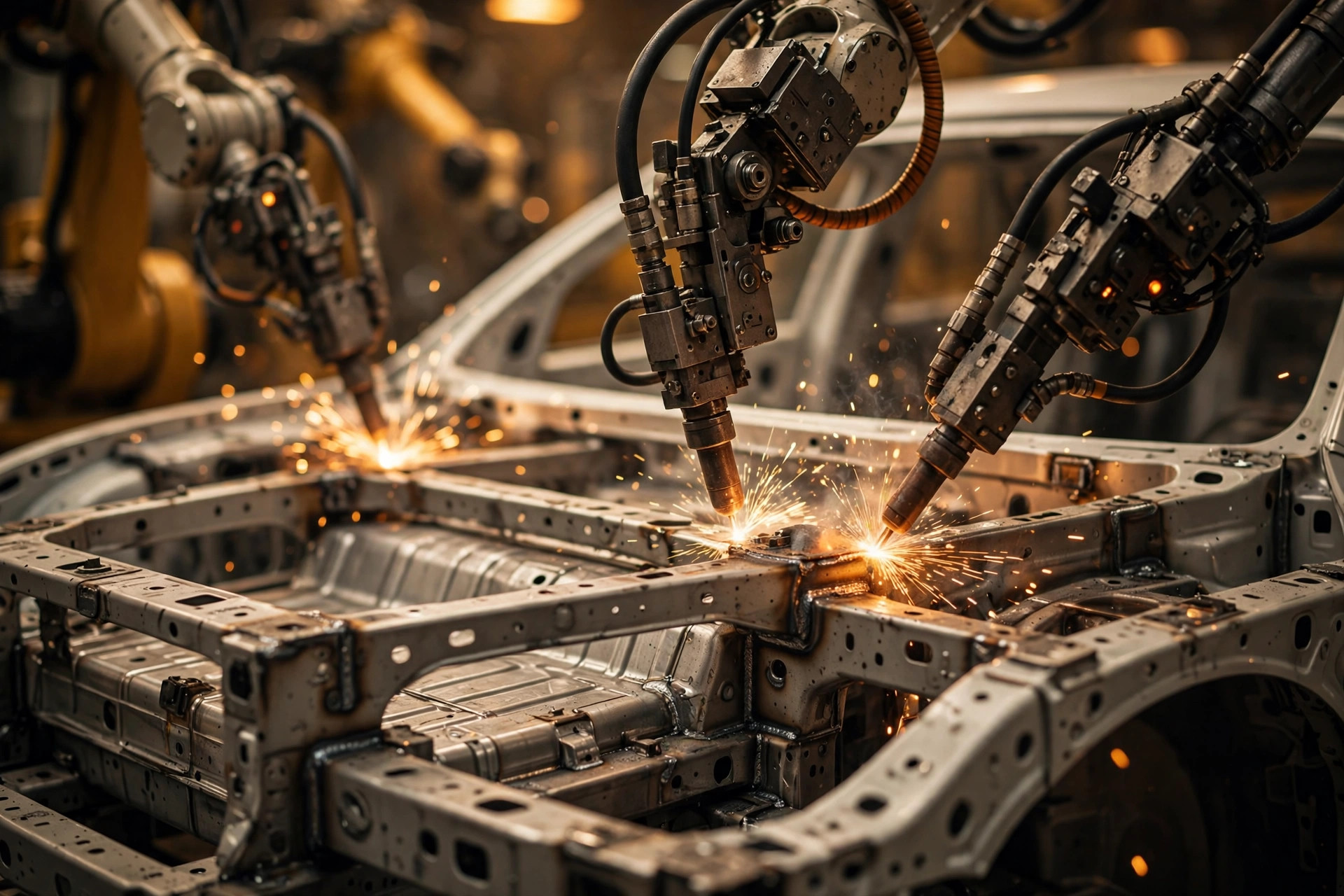
Three months after the first customer R2s rolled out of Normal, Illinois, Rivian is already staffing a second shift. Read that again. Automotive production ramps are measured in years of bruising iteration, and startups do not double-shift a brand-new line ninety days after first customer delivery unless the line is giving them every reason to believe. Something in that building is working, and it is worth asking what.
Rivian founder RJ Scaringe told investors the second shift lands by the end of the third quarter. By year-end the company expects to deliver 20,000 to 25,000 R2s, a pace that would put this launch among the fastest-scaling EV ramps in American history. More striking is the long-term target: over 150,000 R2s a year from the Normal plant alone, before a second factory in Georgia comes online in late 2028. Every one of those numbers is a bet placed on an industrial system, not a vehicle design. That system is the interesting object here.
The Ramp Is the Exam
Any competent automaker can build a hero car. Prototypes lie. A single hand-assembled vehicle tells you almost nothing about whether a company can build the ten-thousandth one at 7 a.m. on a Tuesday in February with the same panel gaps, the same software load, the same torque values. Tesla's Model 3 ramp in 2017 and 2018, "production hell" in Elon Musk's own words, is the canonical demonstration that the factory is the harder engineering problem. You review the car. What decides the company's fate is the line.
Rivian seems to have internalized this in the right order. Consider the timeline, because timelines are where ramps confess. Rivian unveiled the R2 in March 2024; manufacturing validation builds started rolling off the Normal line in January 2026; employee deliveries began in April; public customer deliveries started June 9; and now a second shift lands by September 30, roughly one fiscal quarter from first delivery to doubled capacity, about two and a half years from unveiled concept to a line running twice as hot. That is aggressive by any measure, and it did not happen by accident. It happened because the car was designed to be built, which is a different discipline than designing a car.
Slab to Second Shift
A little more than a year ago, the R2 expansion at Normal was, in the words of industry coverage at the time, a concrete slab. Rivian completed a 1.1-million-square-foot expansion and had manufacturing validation builds running by January. MVB vehicles are the unsung heroes of every ramp: pre-production cars built on the actual line to find certification issues, registration problems, and the factory's own snags before any customer touches one. Getting MVBs off the line in January and customer cars off it in June, inside a building that was barely a building a year earlier, is the kind of schedule that implies the process engineering ran ahead of the marketing, not behind it.
That sequencing matters more than it looks, because the usual startup failure mode is designing the car first and discovering the factory later, at which point every bracket, every harness, and every fastener becomes a negotiation with the line. Rivian's gen-2 architecture reads like the opposite approach: the factory constraints were in the CAD models from the start. This column covered the details in March, but they bear repeating in miniature, because each one is a ramp story wearing a design story's clothes.
Designed to Be Built
Rivian's second-generation platform deleted 1.6 miles of wiring from the vehicle and cut the ECU count from 17 to 7. New Maximus drive units use 91 percent fewer stator welds: 240 of them, gone. Battery duty moved to 4695-format cells in a structural pack. Every one of those decisions is simultaneously a weight story, a cost story, and, most importantly for this article, a line story: fewer wires means fewer harness operations and fewer stations; fewer computers means fewer integration points and fewer software flash steps; 240 fewer welds per motor means 240 fewer defect opportunities per motor, times two motors per car, times 150,000 cars a year. Do that arithmetic once and the second shift starts to look less like optimism and more like the consequence of decisions made years earlier in the design office.
This is the unglamorous heart of design for manufacturing. Nobody photographs a deleted harness clip. Nobody puts a spec sheet line on a reduced ECU count. But the ramp is where those decisions pay out or default, and a second shift three months after launch is the closest thing to a verdict the factory has offered. Rivian designed a car with fewer failure modes per unit, and now the line is confirming it can exploit that headroom. I have not toured the Normal plant, and Rivian no longer discloses headcount there, so I cannot tell you the takt time or the station count. I can tell you the direction the evidence points.
The Building Fought Back
Then there is the tornado. On the night of April 17, an EF-1 tornado tore through McLean County and struck the Normal factory directly, collapsing a section of roof in Building 2, the area dedicated to R2 operations. No employees were injured. R2 operations paused for several days while the building was repaired. Production started days later, on schedule, as if the roof had not just been redesigned by the weather.
Most launch schedules would have slipped a quarter on that. Rivian lost days. There is a tendency to file this under luck, and luck played its part, the storm hit at night, the damage was contained. But schedule resilience is also an engineering property. A ramp with slack in the right places, validation builds already banked, suppliers already staged, can absorb a building-level disruption the way a suspension absorbs a pothole. A ramp running on the ragged edge cannot. That storm did not test the R2's design. It tested the ramp's design. It passed, and I do not think that is a coincidence.
The Synchronization Problem
A ramp's hardest part is not inside the building. Scaringe's comment on the investor call deserves a second reading: "hundreds of suppliers are coordinating to bring up their own production," in an organized fashion, to keep things smooth. That is the entire problem stated in one sentence. A line that can build 150,000 cars a year is useless if a seat supplier, a harness supplier, a casting supplier is still ramping at 60,000. Underneath, the R2 ramp is really several hundred smaller ramps synchronized to the same takt, and every one of them is a company with its own constraints, its own labor, its own weather.
Demand is not the constraint here, at least not yet. Rivian has reportedly taken more than 200,000 R2 reservations and 57,000 demo drives, and a significant share of buyers are first-time EV owners, people who wanted this exact shape of vehicle and had no option until now. Orchestration is the constraint: converting reservation intent into sheet metal at a rate the suppliers can sustain. A second shift is the signal that the orchestration is holding. You do not add a shift because the press release calendar says so. You add it because the bottleneck analysis says the line can take it.
Where It Lands
Here is my verdict, and it will annoy the spec-sheet crowd: the most interesting engineering deliverable Rivian has produced this year is not the 656-horsepower Performance trim, not the 330 miles of EPA range, not the NACS port or the semi-active suspension. All of that is good engineering, and some of it is excellent. But cars are the part Rivian already knew how to do. R1 proved that. What Rivian had never done, the thing that kills startups, is the ramp. That second shift is demand made physical and capability made audible. It is the sound of a company discovering it can build cars the way Toyota builds cars: as a process, not an event.
Watch the next two milestones and you will know whether this column ages well. First, the Georgia factory in late 2028, because copying a ramp to a second site is a harder exam than the first one, and every lesson from Normal either transfers or it was luck. Second, the affordable trims arriving through 2027, because a simplified architecture either sustains its cost advantage at real volume or the simplifications turn out to have been the easy ones. R2's story is not finished. But the second shift is the first chapter of evidence, and it is the right kind of evidence: industrial, boring, and decisive.
| Model | Rivian R2 Performance (Launch Edition) |
|---|---|
| Plant | Normal, Illinois; 1.1M sq ft expansion |
| Output | 656 hp, dual-motor all-wheel drive |
| Range | 330 miles EPA-estimated |
| Battery | 4695-format cells, structural pack |
| Architecture | Gen-2: 1.6 mi less wiring, 17 to 7 ECUs, Maximus motors with 91% fewer stator welds |
| Ramp | Deliveries from June 9, 2026; second shift by Sept 30, 2026; 20,000–25,000 target by year-end; 150,000+/yr target |
| Disruption | EF-1 tornado, April 17: roof section collapsed on Building 2; operations paused days, production started on schedule |
| Next plant | Georgia factory online late 2028 |