1,200 Pounds of Second Life: Inside the Rivian R2's Materials Playbook
Rivian just published its circularity report, and the numbers are unusually specific: 550 kilograms of the R2 is recycled or bio-based, the model hit its 2030 carbon goal four years early, and the whole thing is filed under a new SAE disclosure standard. Read past the headline and the interesting part is the metallurgy nobody is marketing.
The Headline, and Why the Method Deserves It
Lifecycle emissions claims from automakers are usually press-release mulch. Rivian's R2 Circularity, Energy & Carbon Footprint Report, released this month alongside the company's 2025 Impact Report, is something else: a full cradle-to-grave accounting of the R2 Performance with Launch Package, evaluated at 200,000 miles and ten years of use, a baseline that reflects how long vehicles actually survive on American roads.
Against that measure, the R2 comes in at 211 grams of CO2 equivalent per mile, a 50 percent reduction from the R1S Launch Edition. That matters because the original goal was to halve the R1's lifecycle carbon by 2030, and the R2 did it four years early. Read that again.
The dual baseline is what convinced me to take the document seriously. Rivian also ran the math against the original R1 benchmark of 155,000 miles, which produces a less flattering 242 grams per mile, still a 43 percent improvement, and published both figures anyway. An industry that specializes in favorable denominators chose to print the unfavorable one too, and that is not nothing. Fairness demands the footnote: the celebrated four-years-early halving exists only at the new 200,000-mile functional unit; under the original 155,000-mile benchmark it is 43 percent, not 50. Victories ride denominators, and printing both of them is what makes this report worth reading.
Set against combustion, the comparison gets dramatic in a way the raw numbers almost undersell. Rivian puts the R2's lifetime emissions 58 percent below what it calls a comparable gasoline SUV, a comparator whose definition is not detailed in the available coverage, with carbon parity against an average 2023 gas vehicle arriving after just 20,000 to 25,000 miles. The payback number has been the favorite weapon of EV skeptics, the claim that battery production emissions erase the advantage. If Rivian's accounting holds, that payback lands inside the first two years of ownership, which is where the argument dies. Dead on arrival.
Where the Carbon Actually Lives
The report's most honest table is the footprint breakdown, and it refuses to flatter the car. Of the roughly 42.2 metric tons of lifetime CO2 equivalent, the largest share is charging electricity: 21.2 tons, half the total, and that is a function of the grid, not the vehicle. The car is half the story. The plug is the other half. Non-battery materials contribute 9.2 tons, battery cells 5.2, factory assembly 3.0, and logistics plus maintenance cover the remainder.
That 21.2-ton line is worth sitting with, because it redraws where the car's cleanliness actually comes from. It means the cleanest engineering in Normal, Illinois, can only do so much; the dirtiest electrons in the R2's life come from wherever the owner plugs in. Rivian's own modeling says a lifetime of exclusively renewable charging would drag the figure to 111 grams per mile, roughly half the reported number. The company currently matches the factory charge, the first 10,000 miles, and all Rivian Adventure Network charging Renewable certificate accounting is standard and standardly debatable, which is to say the certificates do not guarantee the actual electrons came from a wind farm, only that an equivalent amount of renewable generation was purchased on the grid, and they say nothing about whether that purchase caused any new generation to be built; the coverage states that distinction plainly, which deserves credit.
But if charging is the part Rivian cannot control, materials are the part it can, and that is where the report turns into an engineering document instead of a sustainability one.
550 Kilograms of Second Chances
By Rivian's accounting, roughly 25 percent of the R2's total mass, more than 550 kilograms or about 1,200 pounds, is now recycled or bio-based content. Not offset, not promised, but in the vehicle.
Steel makes up 42 percent of the car's mass and carries 36 percent recycled content. Aluminum is 12 percent of mass at 44 percent recycled. Both feed into a 2030 target of 70 percent recycled steel and aluminum, which is ambitious to the point of being a supply-chain bet, since recycled-metal markets remain immature compared to virgin ore channels. Polymers are 20 percent of mass at 21 percent recycled or bio-based content today, heading for 40 percent by 2030.
| Material | Share of R2 mass | Recycled/bio-based content | 2030 target |
|---|---|---|---|
| Steel | 42% | 36% | 70% |
| Aluminum | 12% | 44% | 70% |
| Polymers | 20% | 21% | 40% |
| Total recycled/bio-based | ~25% of mass, >550 kg (~1,200 lb) | n/a | |
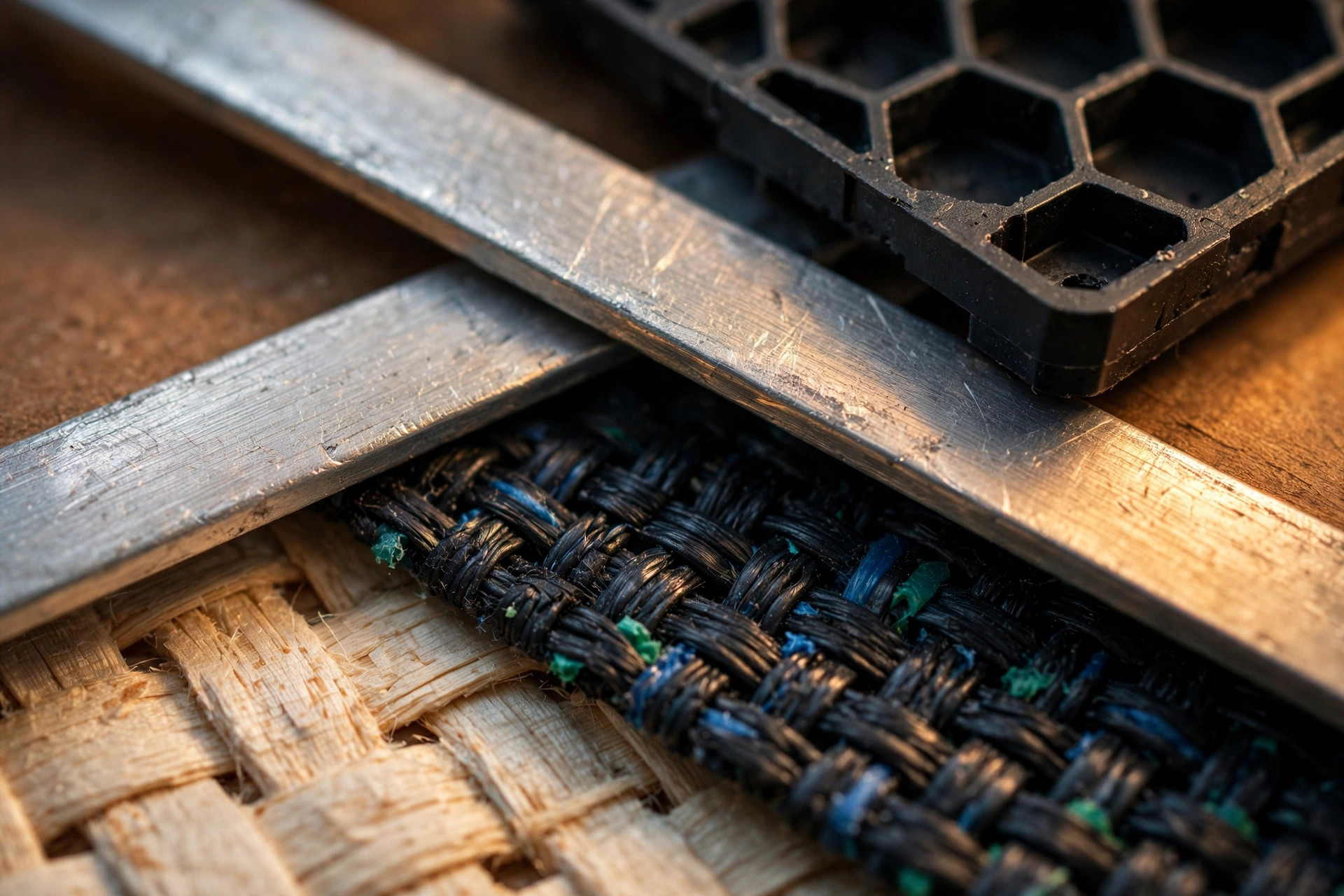
The component list reads like a sourcing map. Seating wears a second-generation Adventex, a synthetic derived from wood pulp, produced from paper waste out of Nordic mills, quietly turning one industry's waste stream into another industry's seating surfaces without a single passenger noticing the difference, which is how circularity wins: not as a compromise, but as a supply chain. The front trunk and select trim assemblies use plastic at 85 percent post-consumer recycled content, which is a second life for packaging waste that would otherwise have gone straight to landfill. Floor mats push further, 99 percent reclaimed ocean plastic waste. And the resin trays that house the battery cells, the structural cradle of the most expensive component in the car, are molded entirely from recycled resin.
That last item is the one I keep coming back to. Battery trays are not where automakers experiment lightly. They carry crash loads, manage thermal events, and seal out the elements. Building them from 100 percent recycled resin means Rivian's materials team trusts the recycled feedstock with a safety-critical structural part, which says more about the maturity of the recycled-polymer supply chain than any percentage ever could. Not a trim piece. A crash structure.
The Part Nobody Markets: Tramp Elements
Now the unglamorous half, which is where my opinion lives. Publishing a recycled percentage is procurement; making it work in a stamped body panel is metallurgy, and recycled aluminum is metallurgically difficult in ways the press releases skip.
Scrap aluminum carries tramp elements, chiefly iron and silicon picked up from mixed scrap streams, and tramp content is the enemy of ductility, which is why every automaker chasing recycled content is quietly fighting the same metallurgical battle Rivian just put numbers on. A 6000-series body alloy that absorbs too much iron loses the elongation it needs for deep stamping and the crash performance it needs in a body-in-white. Holding 44 percent recycled content in aluminum while keeping mechanical properties inside spec means the scrap sorting, chemistry control, and supplier qualification had to get dramatically better, or the alloys had to be redesigned around a dirtier feedstock. That is my inference from standard metallurgical practice, not a Rivian disclosure. Either way, that is real engineering, and it is the part of this report I wish were a white paper instead of a bullet point. The percentage is the headline that will travel through every news writeup; the alloy control underneath it is the achievement that determines whether the 2030 target survives contact with a stamping press. Headlines don't stamp sheet metal.
Steel is a different animal but the same story. Thirty-six percent recycled content in automotive sheet means the electric-arc-furnace and direct-reduced-iron supply chains are being pulled into a stamping ecosystem that historically ran on blast-furnace virgin steel for surface quality. Getting automotive-grade surface finish out of higher-scrap melts is a process-engineering problem, full stop. When Rivian says 70 percent by 2030, it is not announcing a goal so much as booking a decade of furnace and sorting capacity that is not yet committed at scale, which turns a sustainability pledge into a capital-expenditure commitment that hits somebody's balance sheet years before it reaches a window sticker.
The Porsche Counterpoint
Porsche, in a pilot project whose latest phase was announced this month, is attacking the chemistry itself, and the contrast is instructive.
Porsche partnered with the German recycler cylib on a project that takes end-of-life high-voltage batteries from Porsche's own vehicles, recovers the raw materials, and processes them into new cathode active material: lithium, nickel, cobalt, and manganese. In the current phase, the recycled active materials fully replace conventionally sourced primary raw materials in battery cells that are now undergoing operational testing. Not blended in as a fraction, but replaced.
The loop is already partially operational: batteries have been arriving from German Porsche Centers and running through the water-based process since May 2026, with the recovered material tracked in a dedicated material account for cell production starting in 2028. "cylib closes the battery recycling loop, from end-of-life batteries to recovered raw materials," says Dr. Lilian Schwich, the company's co-CEO and co-founder. Further test results are expected in the second half of this year.
My read on the pair: Rivian's circularity is horizontal, recycled mass spread across the whole vehicle, from floor mats to battery trays, with the hard problems in alloy and process control. Porsche's is vertical: closed-loop chemistry at the cathode, where the hard problem is purity, proving recycled lithium and cobalt perform identically to mined material under automotive qualification. Rivian's hard problem is metallurgical bookkeeping at industrial scale, and it is shipping in cars today. Porsche's is chemical purity at the atomic level, and it is still in testing. Score the pair accordingly.
The Quiet Standard That Could Outlast Both Reports
The most consequential line in Rivian's report might be a technical footnote. The company says the R2 assessment is the first automotive lifecycle analysis structured under SAE J3341, the disclosure standard for carbon footprint reporting.
Lifecycle claims have been incomparable across manufacturers precisely because everyone chose their own denominators, baselines, and boundary conditions, which is why the 200k-versus-155k dual baseline above matters. A common disclosure standard turns "we cut carbon" from a marketing assertion into a checkable filing. If J3341 gains traction, Rivian's report stops being a one-off marketing document and starts being the template competitors get pressured to follow, which is how a disclosure rule written by an engineering society ends up doing more climate work than a decade of sustainability pledges. Standards are boring, but they are also how industries stop lying to each other.
What I Cannot Verify
Honesty requires the caveat. I have not torn down an R2, handled its Adventex, or weighed its floor mats. Every number in this piece comes from Rivian's own report and the coverage around it, and a company-authored lifecycle assessment is still a company-authored document, however unusually transparent the dual-baseline methodology is. Renewable certificate accounting is standard and standardly debatable. That 111-gram all-renewable scenario is a model, not a measurement.
What I can say is this: 550 kilograms of recycled and bio-based material, specified to component level, with the recycled-content hard part buried in the metallurgy rather than the marketing, is a serious piece of engineering disclosure. The percentage deserves less attention than it will get. The alloy control deserves more.
References
- Rivian R2 Circularity, Energy & Carbon Footprint Report, via Auto Connected Car, September 2026. All lifecycle figures, material percentages, and component applications sourced to this coverage: autoconnectedcar.com. Published both the 200,000-mile (211 g/mi) and 155,000-mile (242 g/mi) baselines. No stable public URL for the primary report was available at time of writing; internal arithmetic (42.2 t / 200,000 mi = 211 g/mi) was checked against the coverage.
- Porsche battery recycling pilot with cylib, via Interesting Engineering, September 2026: recycled cathode active materials (lithium, nickel, cobalt, manganese) fully replacing primary raw materials in pilot cells; water-based recycling since May 2026; material account with cell-production availability beginning 2028; series production a potential future application, not dated. interestingengineering.com
- Limitation: no independent teardown or handling of the R2; all figures are Rivian's as reported. Tramp-element and EAF/DRI analysis is the author's inference from standard metallurgical practice, not a Rivian disclosure.