Six Columns, Two Hands, One Tenth of a Second — The Split-Seconds Machine in Sand Quartz TPT
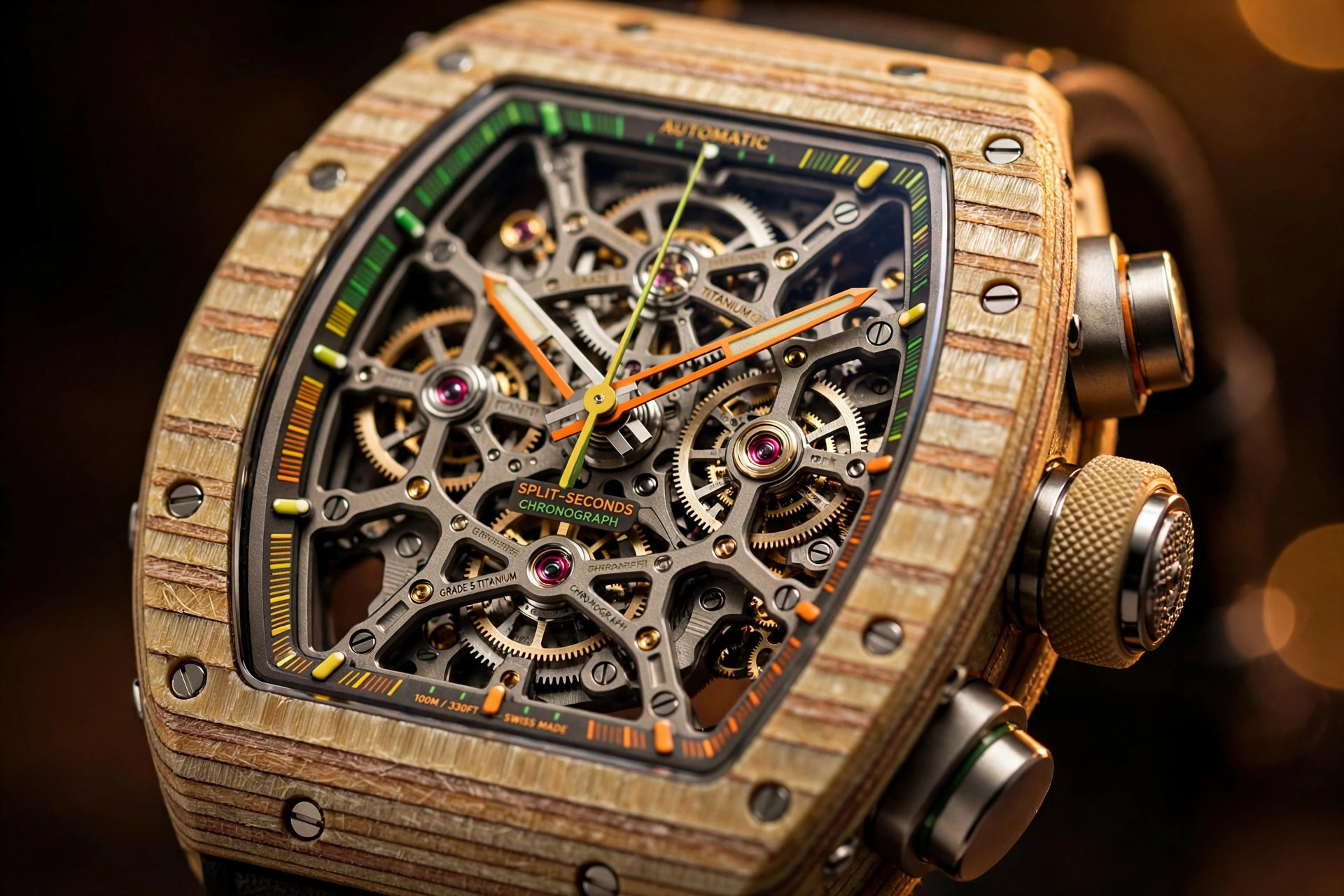
Ahead of the Singapore Grand Prix, Richard Mille dressed the RM 65-01 in a new golden-beige Sand Quartz TPT. Treat the colorway as the invitation and the RMAC4 calibre as the reason to accept: an automatic split-seconds chronograph running at 36,000 vibrations per hour, governed by six column wheels, built on a grade 5 titanium baseplate. More than 600 parts to time laps to a tenth of a second.
What Was Actually Announced
A new colorway, not a new movement. Richard Mille presented the RM 65-01 in Sand Quartz TPT ahead of the Formula 1 Singapore Airlines Singapore Grand Prix, scheduled October 9 to 11, 2026 at Marina Bay. Golden beige replaces the earlier yellow, blue, grey, and dark yellow Quartz TPT variants. Bright green, yellow, and orange coding marks the densely packed dial, which helps, because the dial needs it.
Underneath the new case color sits the calibre RMAC4, unchanged. Developed with Vaucher Manufacture Fleurier over five years, it is Richard Mille's most complicated automatic movement in a series-production model: more than 600 parts, 51 jewels, an automatic split-seconds chronograph with a 30-minute counter at 3 o'clock, a 12-hour counter at 9, small seconds at 6, and a vertical date aperture at 11. Case dimensions stay at 44.50 by 49.94 millimeters, 16.10 millimeters thick, with 50 meters of water resistance. For a watch built to time motorsport, the case reads like a roll cage: oversized, layered, and visibly structural.
Richard Mille has not published edition size or pricing for the Sand colorway as of this writing. Previous Quartz TPT references of the RM 65-01 were listed around $353,000, with the 120-piece yellow edition at $380,000. This site does not cover pricing as a story, so take those numbers as context, not commentary.
The Rattrapante Is the Hard Complication
Every chronograph measures elapsed time. A split-seconds chronograph, or rattrapante, measures two elapsed times that start together. Two hands stack on the central chronograph arbor and run superimposed. Press the split pusher and a clamp grabs the upper hand, the split-seconds hand, freezing it so an intermediate time can be read, while the lower hand keeps sweeping with the running event. Press again and the frozen hand snaps forward to rejoin its twin. Rattrapante means "catch up," and the whole complication is named for that reunion.
Why this is genuinely hard: the split hand must stop instantly, hold without creeping, and then accelerate back into exact alignment with a hand that never stopped moving, all without stealing enough energy to disturb the oscillator. Stopping a moving train element means introducing a clutch, and clutches mean friction. Friction means lost amplitude and lost accuracy. In a 600-part movement, the rattrapante mechanism is the part where everything can go slightly wrong at once, which is why most maisons treat it as a flagship-level complication and why some automatic split-seconds chronographs simply do not exist.
Automatic winding adds a second layer of difficulty. A manual-wind split-seconds chronograph, Patek Philippe's 5370P or the Lange Double Split, asks nothing of the movement's winding system. An automatic one must keep the rotor feeding the barrel while the chronograph and its split mechanism draw heavily on the same energy store. RM's answer is a variable-geometry rotor that adjusts its winding efficiency, a detail borrowed from the world of automotive turbochargers in spirit, if not in hardware: change the geometry, change the response.
Five Hertz Is Not a Spec, It Is the Resolution
Thirty-six thousand vibrations per hour means the balance completes five full oscillations per second. Each half-oscillation is one counted beat, ten beats per second, which gives the chronograph a native resolution of one tenth of a second. That is the point of the frequency. A 4 Hz movement divides time into eighths, a 3 Hz movement into sixths, and neither can honestly claim tenth-of-a-second measurement. RM wanted tenth-of-a-second measurement, so it built at 5 Hz.
High frequency is expensive in the thermodynamic sense. Every extra beat costs energy. Friction in the gear train scales with speed, the escapement works harder, and the power reserve shrinks unless the energy store grows or the losses fall. RMAC4 delivers around 60 hours of reserve with the chronograph disengaged, which is respectable for a 5 Hz automatic chronograph and frankly surprising for one carrying a split-seconds mechanism. Compare Zenith's original El Primero from 1969, the first 5 Hz automatic chronograph, which managed closer to 50 hours, and the RMAC4's energy bookkeeping looks like the mature version of the same idea.
There is a lineage point worth making. High-frequency chronographs have been the motorsport timing instrument since the El Primero, and every serious racing chronograph since has wrestled with the same tradeoff between resolution and reserve. RMAC4 does not escape the physics. It budgets better.
Six Column Wheels: The Control Logic
Column wheels are the control logic of a mechanical chronograph. Each is a small toothed wheel with alternating tall pillars and gaps around its circumference; levers ride up and down the pillars as the wheel rotates, and their positions sequence the start, stop, and reset operations in the correct order. A conventional chronograph uses one column wheel. High-end chronographs sometimes use two, one for the main chronograph and one for the split-seconds. RMAC4 uses six.
Richard Mille does not publish a function-by-function map of the six wheels, so treat the following as informed architecture, not a teardown. With a split-seconds chronograph, the mechanism must independently sequence the main chronograph's start, stop, and reset, the split-seconds hand's clamp and release, and the engagement of the vertical coupling that connects the chronograph train to the going train. Six column wheels suggest the sequencing is distributed across dedicated wheels rather than multiplexed through cams, which means each operation gets crisp, positive control with minimal mechanical interference between functions.
Why column wheels instead of cam levers: cams actuate through sliding contact, which wears and produces inconsistent feel over time. Column wheels actuate through levers dropping into defined detents, which gives the sharp, machined click that chronograph enthusiasts pay for. At the price tier this movement occupies, the column wheel is partly theater and partly engineering. The engineering part is real: six wheels sequencing a split-seconds chronograph at 5 Hz is a control problem that cam systems would struggle to keep crisp.
Vertical coupling deserves its own note. When a chronograph starts, its seconds hand must engage with the already-running gear train, and lateral couplings, the traditional method, cause the hand to jump or stutter as the gears mesh. A vertical coupling engages through a friction disc pressed axially, like a clutch plate, so engagement is smooth. On a tenth-of-a-second chronograph, a stutter at engagement is not a cosmetic flaw. It is a measurement error.
Sand Quartz TPT: Color Is a Materials Problem
Quartz TPT is a silica-based composite. Hundreds of ultra-thin layers of quartz fibers, impregnated with resin, are stacked and pressed, then machined into the case shape. The machining exposes the layer structure as fine striations, so every case carries a unique grain pattern. Structurally it behaves like carbon fiber's mineral cousin: light, stiff, and impact-resistant, with the layered architecture doing the energy absorption.
Here is the part that makes the Sand colorway an actual materials story rather than a fashion decision. The tint is added to the resin at the first stage of manufacturing, before the layers are stacked. Any coloring chemistry must coexist with the resin cure and the fiber impregnation without compromising the composite's strength. A pigment that interferes with the resin cross-linking weakens every layer boundary. A dye that migrates during curing produces uneven color. Each new colorway is therefore a materials qualification program disguised as a design choice, which is why new Quartz TPT colors arrive years apart rather than seasonally.
Sand is a golden beige, and it joins a palette that already included yellow, blue, grey, and dark yellow. Achieving a stable, uniform beige through hundreds of translucent silica layers is nontrivial: the color has to read consistently across striations that vary in depth and density, since the machining exposes different layer thicknesses across the case. Richard Mille's press materials treat this as routine. The chemistry says otherwise.
Inside the case, the movement's structural parts go the opposite direction from the decorative composite. Baseplate and bridges are grade 5 titanium, a material chosen for stiffness-to-weight ratio and dimensional stability under shock. The baseplate carries a grey electroplasma treatment and the bridges a black PVD finish. And the movement does not sit in a conventional casing ring at all. It mounts on chassis-mounting rubbers, ISO SW shock absorbers fixed by grade 5 titanium screws, which is engine-mount logic applied to a watch. A watch that spends its life at the track had better not flex its baseplate at the first kerb strike, and it had better not rattle it loose either.
The Pusher at Eight and the Selector in the Crown
Two details round out the machine, and both are about the interface between wrist and mechanism. At 8 o'clock sits a patented rapid-winding pusher. One hundred twenty-five presses fully winds the barrel. When a 5 Hz automatic with a split-seconds chronograph runs its reserve down, the rotor alone would take its time rebuilding it, and spinning the crown by hand on a 16-millimeter-thick case is ergonomically dubious. The pusher turns winding into a tactile ritual. It is also, quietly, an admission that this movement's appetite exceeds what a rotor can casually satisfy.
More elegant is the function selector. Pull the crown through its positions and a small hand at 4 o'clock indicates the selected mode: winding, date setting, or hand setting. This is a solution to a real packaging problem. A movement with a chronograph, a split-seconds mechanism, a date, and a function display has more crown functions than a crown has comfortable positions. Rather than stacking everything onto the crown stem and hoping the wearer memorizes the sequence, RM added a visible indicator. It is the horological equivalent of a gear position display: a small piece of feedback that prevents a large piece of confusion.
The Full Spec Sheet
| Detail | Specification |
|---|---|
| Model | RM 65-01 Automatic Split-Seconds Chronograph, Sand Quartz TPT (new colorway, unveiled ahead of the October 2026 Singapore Grand Prix) |
| Case | Quartz TPT composite (layered silica fiber in tinted resin); 44.50 x 49.94 mm; 16.10 mm thick; 50 m water resistance |
| Movement | Calibre RMAC4, skeletonized automatic; developed with Vaucher Manufacture Fleurier over five years |
| Dimensions | 31.78 x 29.98 mm movement; 8.69 mm thick; more than 600 parts; 51 jewels |
| Frequency | 36,000 vph (5 Hz), giving native 1/10-second chronograph resolution |
| Power reserve | Around 60 hours (plus or minus 10 percent) with chronograph disengaged |
| Chronograph | Split-seconds (rattrapante); six column wheels; vertical coupling; 30-minute counter at 3, 12-hour counter at 9, small seconds at 6 |
| Date | Vertical aperture at 11 o'clock |
| Baseplate/bridges | Grade 5 titanium; grey electroplasma treatment on baseplate, black PVD on bridges |
| Winding | Automatic with variable-geometry rotor; patented rapid-winding pusher at 8 (125 presses for full wind) |
| Function selector | Crown-operated: winding, date setting, hand setting; indicator hand at 4 o'clock |
| Dial | Openworked with tachymeter scale; green, yellow, and orange color coding; luminescent hands and indices |
| Edition/pricing | Sand colorway edition size and pricing not yet published; prior Quartz TPT references listed around $353,000 |
Racing Is the Honest Use Case
Most luxury chronographs are timing devices in the way a showroom Ferrari is a race car. The RM 65-01 earns its motorsport framing more honestly than most. A split-seconds chronograph at 5 Hz is the correct instrument for timing intermediate laps, which is exactly what a pit wall does. The six column wheels are the correct control architecture for a mechanism that must start, split, release, stop, and reset without cross-talk between functions. The rapid-winding pusher is the correct answer to a movement whose energy budget the rotor cannot refill quickly.
Whether the watch needs to exist at this price is a separate question, and this site is not in the business of answering it. What matters here is internal coherence: every exotic detail of the RMAC4 traces back to the same design brief, which is measuring short intervals accurately, repeatedly, under mechanical stress. The Sand Quartz TPT colorway is new paint on an old brief. But the brief was sound, and the paint required real chemistry. That is enough to justify the article.
One caveat, stated plainly: the six-column-wheel count is confirmed by two independent sources, but Richard Mille has not published a function-by-function map of the wheels, and I have not handled the watch. The allocation analysis above is presented as informed architecture, not a teardown claim. If RM opens the movement's technical papers, this piece gets updated.
Sources
- PEAK Singapore, "9 new motorsport watches to get you into the F1 Singapore Grand Prix spirit," October 2026. Sand Quartz TPT colorway unveiling; five-year RMAC4 development with Vaucher Manufacture Fleurier; 125-press rapid winding; most complicated automatic in series production; 5 Hz timing; green, yellow, orange dial coding.
- Hodinkee, "Introducing the RM 65-01 in yellow and blue Quartz TPT," 2023. Resin-stage color chemistry of Quartz TPT; RMAC4 full specifications (31.78 x 29.98 mm, 8.69 mm thick, 51 jewels, 5 Hz, 60 hours plus or minus 10 percent, variable-geometry rotor); yellow edition 120 pieces at $380,000.
- K2 Luxury (via lislux), "RM65-01 Automatic Split-Seconds Chronograph Dark Yellow Quartz TPT," 2026. Six column wheels; grade 5 titanium baseplate and bridges; function selector with 4 o'clock indicator; dial layout (30-minute at 3, 12-hour at 9, seconds at 6, date at 11).
- YourWatchHub, "Richard Mille RM 65-01 Automatic Winding Split-seconds Chronograph Blue and Yellow." More than 600 parts; 51 jewels; rattrapante 1/10th-second chronograph; 44 x 49.9 mm case; 16.1 mm thick; 5 ATM.
- Luxuryes, "Richard Mille RM 65-01 Split-Seconds Chronograph in Grey Quartz TPT," 2023. Grey reference at $353,000; dial layout confirmation; 60-hour reserve.
- SwissWatches Magazine, "Richard Mille RM 65-01 McLaren W1." Grey electroplasma treatment of titanium baseplate; black PVD bridges; McLaren W1 reference context.
- Revolution Watch, "The Richard Mille RM 65-01 in Blue and Yellow Quartz TPT," 2024. Six column wheels confirmed by a second independent source; chassis-mounting rubbers (ISO SW) replacing the casing ring; grade 5 titanium baseplate and bridges; variable-geometry rotor; rapid winding mechanism.
- Disclosure: the author has not handled the RM 65-01. All specifications compiled from the manufacturer's published materials and the independent sources above. Where Richard Mille publishes no internal documentation, the mechanism analysis is presented as informed architecture, not a teardown claim.