Thinner Than a Time-Only: How Rexhep Rexhepi Engineered the RRCHF Flyback
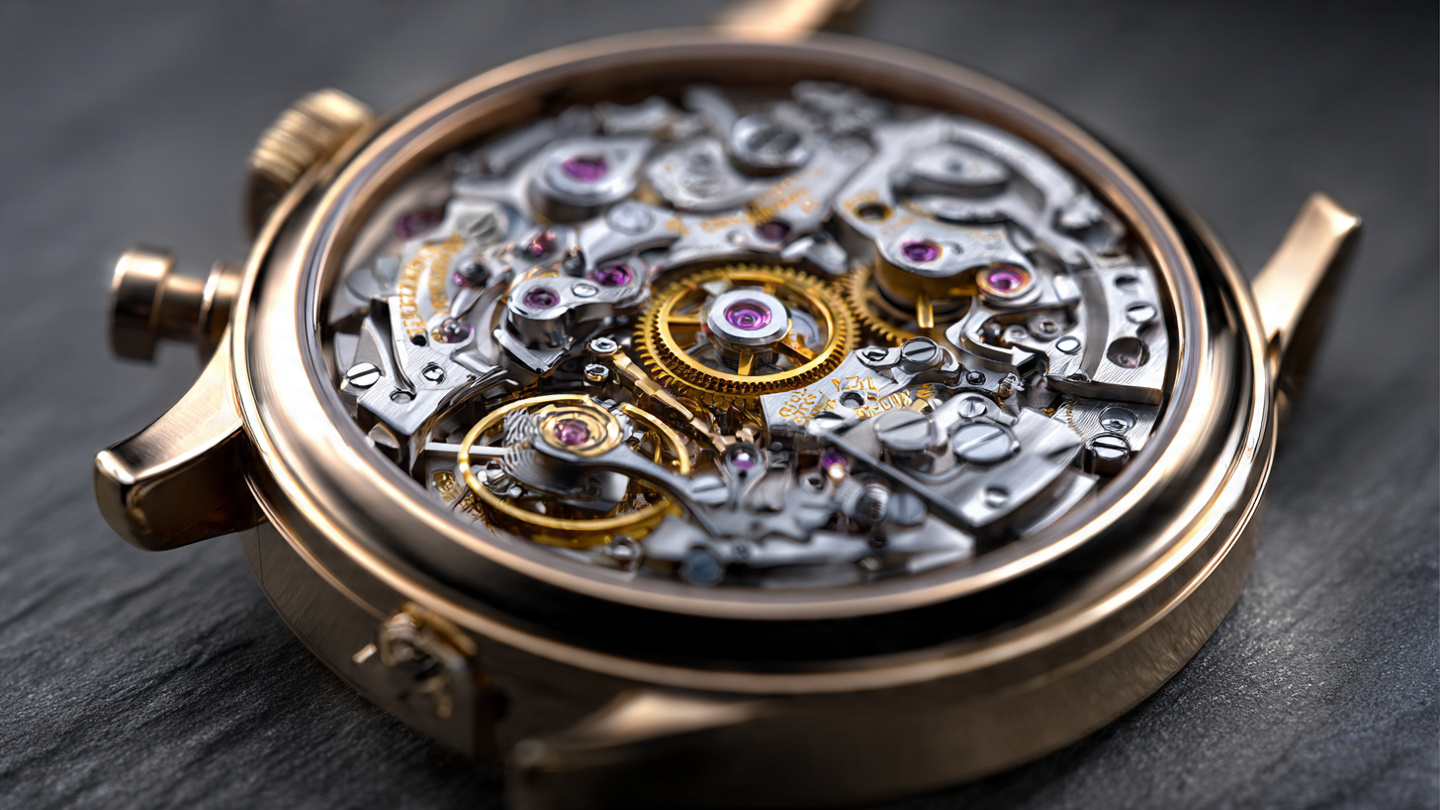
Most flyback chronographs are built in layers. A base movement handles timekeeping. A chronograph module bolts on top, adding its own bridges, levers, and wheels in a separate plane. Every additional layer adds height. A Patek Philippe 5170, one of the benchmark manually wound chronographs, stands 11.3 mm tall. A Lange Datograph, perhaps the most admired flyback ever produced, reaches 13.1 mm. Rexhep Rexhepi looked at those numbers and decided to work the other way around.
His new watch, the RRCHF (Rexhep Rexhepi Chronograph Flyback), measures 38.8 mm across and 9.7 mm tall. It contains a fully integrated flyback chronograph with a column wheel, horizontal clutch, instantaneous minute counter, and 72-hour power reserve. It is thinner than his own Chronomètre Antimagnétique, a time-only watch that stands at 9.9 mm. A flyback chronograph with no complication height penalty. That result required rethinking how a chronograph movement gets designed.
Designing in Reverse
Rexhepi describes his earlier approach as movement-first: start with the caliber architecture, then build a case and dial around it. For the RRCHF, he inverted the process. He designed the dial layout, the hand geometry, and the case proportions before touching the movement. Crown and pusher positions were fixed by the desired case silhouette, not dictated by where the winding stem and chronograph levers happened to land.
This is a practical distinction, not a philosophical one. Modular chronographs frequently show misaligned pushers and crowns because the chronograph plate was designed independently of the case. One pusher sits too high, the crown too low, because the movement architecture forced those positions. Rexhepi wanted the pushers and crown to sit in visual balance on the case band. Achieving that required integrating every chronograph component directly into the mainplate rather than stacking them on a secondary plate.
Integration explains the height reduction. In a modular construction, the chronograph plate sits above the base movement, separated by its own bridge layer. Levers and wheels occupy their own vertical zone. In the RRCHF, chronograph components share the same plane as the going train. Column wheel, clutch, and coupling levers are recessed into the mainplate architecture alongside the barrel, gear train, and escapement. Nothing stacks. Everything cohabits.
From the Antimagnétique to the RRCHF
Rexhepi did not start from scratch. He started from the RRCA, the Chronomètre Antimagnétique he built as a unique piece for Only Watch in 2023, which sold for CHF 2.1 million at auction. That movement already contained structural decisions that anticipated a chronograph. Its fourth wheel sits at 4 o'clock rather than the conventional 6 o'clock position. To achieve center seconds from that offset fourth wheel, Rexhepi designed an auxiliary train of three additional wheels, arranged above the plane of the gear train, routing the motion back to the dial center.
That auxiliary train has the character of a chronograph coupling train. It already carried rotational energy from an offset position to the center of the dial through an intermediate gear path. Adding a clutch mechanism to control when that energy flows was a logical extension, not a reinvention.
Similarly, the RRCA included a hacking, zero-reset function. A bridge at 8 o'clock supports a reset lever acting on a heart cam mounted to the center seconds wheel. That same bridge position naturally accommodates a minute recording wheel. When Rexhepi placed the chronograph counters at 4 and 8 o'clock on the RRCHF dial, he was following the geometry his earlier movement had already established. Running seconds at 4, elapsed minutes at 8. No forced symmetry, no arbitrary sub-dial placement. Each counter sits where the mechanical architecture puts it.
Column Wheel and Horizontal Clutch
Chronograph movements use two basic coupling systems: vertical clutch or horizontal clutch. A vertical clutch presses two friction discs together like a car's clutch plates. It allows the chronograph seconds hand to start without a visible stutter because the coupling is already spinning. Most modern chronographs use vertical clutches for this reason. Rexhepi chose a horizontal clutch instead.
A horizontal clutch engages a pivoting lever that swings a wheel into mesh with the chronograph train. Because the coupling wheel starts from rest, there can be a brief hesitation when the chronograph starts. Rexhepi accepts that trade-off for what the horizontal clutch offers visually: its engagement is mechanical and visible through the movement. He has described horizontal clutches as "more romantic," meaning you can watch the parts move and understand what they do.
Governing the clutch is a column wheel, the traditional control mechanism for high-end chronographs. When a pusher is pressed, the column wheel rotates by one position, raising or lowering its columns to activate or release the various chronograph levers. Column wheels require tighter manufacturing tolerances than cam-actuated systems, but they produce a smoother, more defined pusher feel. Rexhepi specifically wanted that tactile quality. He has said he wants the pushers to feel "smooth but still strong," with the mechanical action perceptible in the fingertips.
Instantaneous Minute Counter
Most chronograph minute counters are dragging or semi-instantaneous. A dragging counter creeps forward continuously as the seconds hand rotates. A semi-instantaneous counter advances in uneven increments, drifting between minute markers before snapping into approximate position. Neither produces a clean, readable minute indication during timing.
Rexhepi built a true instantaneous minute counter. A ratchet-toothed wheel is indexed by a lever carrying a pawl on one end and a feeler on the other. As the chronograph seconds wheel rotates, a snail cam on its arbor gradually lifts the feeler. Once per minute, the feeler drops from the cam's peak to its base. That drop pulls the pawl forward, advancing the minute ratchet by exactly one tooth. A jumper, pivoting in a jewel, locks the wheel in its new position. The minute hand snaps to the next marker with no drift, no creep, and no ambiguity.
Building an instantaneous jump mechanism adds complexity because the switching forces must be precisely calibrated. If the pawl spring is too weak, the minute hand fails to advance. Too strong, and the sudden energy draw from the chronograph train causes the seconds hand to stutter at the 60-second mark. Rexhepi tuned the spring tension so the advance is invisible in the seconds hand's sweep.
The Flyback Sequence
A standard chronograph reset is a three-step operation: press once to stop, press again to reset, press a third time to restart. A flyback chronograph compresses all three into a single pusher press while the chronograph is running. The column wheel must orchestrate a precise sequence within milliseconds. First, the coupling disengages to release the chronograph train from the going train. Simultaneously, a flyback lever retracts the minute recording mechanism from its indexing position. Then the hammers fall on the heart cams of both the seconds and minutes wheels, snapping them to zero. Finally, the coupling re-engages and the chronograph restarts from zero without ever fully stopping.
Flyback is inherently difficult because operations that are normally kept separate must happen in overlapping sequence. If the hammers act before the coupling fully disengages, torque from the going train resists the reset. If the coupling re-engages before the hammers release, the heart cams can jam. Lever geometry, spring forces, and cam profiles must be calculated so each action completes within its window and hands off cleanly to the next. Rexhepi spent years developing the tolerances. "A few years ago, this watch couldn't exist," he told Revolution Watch. "I didn't have the knowledge. Not the small touches."
Dial Architecture: Controlled Transparency
All three sub-dials on the RRCHF are cut from grey-tinted fumé sapphire crystal. Rather than opaque metal registers that hide the movement, each counter functions as a semi-transparent window. You see the lever geometry and wheel teeth beneath the tinted surface, filtered through a grey veil that modulates visibility without full exposure.
At 12 o'clock, a combined hour-and-minute register uses a sector layout recalling the Art Deco character of the Chronomètre Contemporain II but condensed into a smaller format. At 4 and 8, the chronograph sub-dials reveal different depths of the movement depending on the viewing angle. Tilting the wrist shifts the visible layer. Convention places the running seconds at 6 and the minute counter at 3 or 9. Rexhepi rejected that for the same reason he rejected a modular movement: because convention serves the mechanism, not the design.
Two dial variants exist. Platinum cases receive a stormy blue grand feu enamel dial, built through repeated kiln firings with manual control over material behavior. Rose gold cases carry a black dial. Both share the same fumé sapphire sub-dials and hand geometry. A new inscription on the dial reads "Hgers à Genève," a compressed declaration of origin that embeds Geneva provenance directly into the composition.
Finishing as Engineering
Hand-finishing in high horology gets discussed as decoration. For Rexhepi, it functions as quality control. Bevels on the RRCHF bridges are wide and rounded, executed entirely by hand with files and burnishers. Each bevel requires consistent pressure across the full length of the surface. Inconsistency produces visible ripples under magnification. Consistent pressure across varying geometries, where a bridge narrows or curves, demands skill that cannot be automated.
Côtes de Genève (Geneva stripes) are hand-applied, not machine-cut. Black-polished steel components achieve a mirror finish through successive abrasive stages, ending with a tin block and diamond paste. Poli-bercé surfaces, a cradled polishing technique, produce a subtly curved reflective plane. Graining on flat surfaces provides contrast against the polished elements. None of this changes the movement's accuracy. All of it demonstrates the maker's control over material and geometry at a resolution where errors are measured in microns.
Rexhepi employs 54 people across seven ateliers within four blocks in Old Town Geneva. Micro-mechanics, case making, strap production, enamel work, decoration, assembly, and apprenticeship training all happen within walking distance. Even the straps are produced in-house, finished with a Norwegian center stitch. Annual output is 50 to 60 watches. For context, Rolex produces roughly 1.2 million per year.
What the Numbers Say
Case diameter is 38.8 mm. Height is 9.7 mm. Movement frequency is 21,600 vibrations per hour (3 Hz). Power reserve is 72 hours from a single barrel. Chronograph type is flyback with column wheel and horizontal clutch. Minute counter type is instantaneous. Case materials are 950 platinum or 18-karat rose gold, with soldered lugs and a double-stepped bezel carried over from the RRCA. Water resistance is unspecified but expected to be modest given the pusher construction.
Retail price is CHF 150,000 with limited production. For comparison, a Patek Philippe 5170J (manually wound chronograph, no flyback, no instantaneous minutes) retails for approximately CHF 90,000. A Lange Datograph Up/Down (flyback, big date, power reserve indicator) lists at approximately CHF 115,000. Neither integrates the chronograph into the mainplate architecture. Neither achieves 9.7 mm case height with a flyback mechanism. Rexhepi charges more because the integration costs more to build, but the engineering justification is measurable in millimeters.
Independence as a Design Constraint
Large manufacturers can distribute chronograph development across dozens of engineers, prototype rapidly, and absorb failed iterations as overhead. Rexhepi works with a team of 54 building everything from movement blanks to enamel dials to calfskin straps. Independence constrains throughput but eliminates compromise. No supplier dictates component dimensions. No ébauche manufacturer's plate geometry forces dial layout. When Rexhepi wanted the fourth wheel at 4 o'clock, he put it at 4 o'clock. When he wanted fumé sapphire sub-dials, his own enameling atelier, Emailleurs de la Cité, produced them.
That control extends to the case. Jean-Pierre Hagmann, widely considered the finest living case maker, came out of retirement in his mid-70s to work with Rexhepi. Hagmann's cases feature individually soldered lugs, meaning each lug is attached to the case body as a separate component rather than machined from a single block. Soldered construction allows tighter curves and thinner profiles than monobloc machining, which is part of how the RRCHF maintains classical proportions at 38.8 mm despite housing a flyback movement.
Annual production of 50 to 60 watches across all references means the RRCHF will exist in very small numbers. Rexhepi does not disclose exact allocation, but given the breadth of his current catalog, single-digit annual production per reference is likely. Scarcity is not the point. Capacity is the constraint, and capacity is a function of the handwork that makes each watch what it is.
Sources
- Hodinkee, "In-Depth: The Rexhep Rexhepi Chronograph Flyback (RRCHF)," April 2026, covering the brand history, Akrivia ateliers in Old Town Geneva, movement heritage from the RRCA and LVRR-01, fumé sapphire dial construction, and the RRCCII lineage.
- Revolution Watch, "Rexhep Rexhepi on Building the RRCHF, His First In-House Flyback Chronograph," April 2026, featuring direct quotes from Rexhepi on reverse-design methodology, horizontal clutch selection, instantaneous minute counter mechanism (snail cam, pawl, ratchet), RRCA movement heritage, and finishing philosophy.
- Watchonista, "Rexhep Rexhepi RRCHF Flyback Chronograph In-Depth: A New Chapter in Geneva Watchmaking," April 2026, covering integrated movement architecture, 72-hour power reserve, 38.8 mm case dimensions, fumé sapphire counter construction, hand geometry, double-stepped bezel, and CHF 150,000 pricing.