Two Hands, One Axis: Engineering the Rattrapante Split-Seconds Chronograph
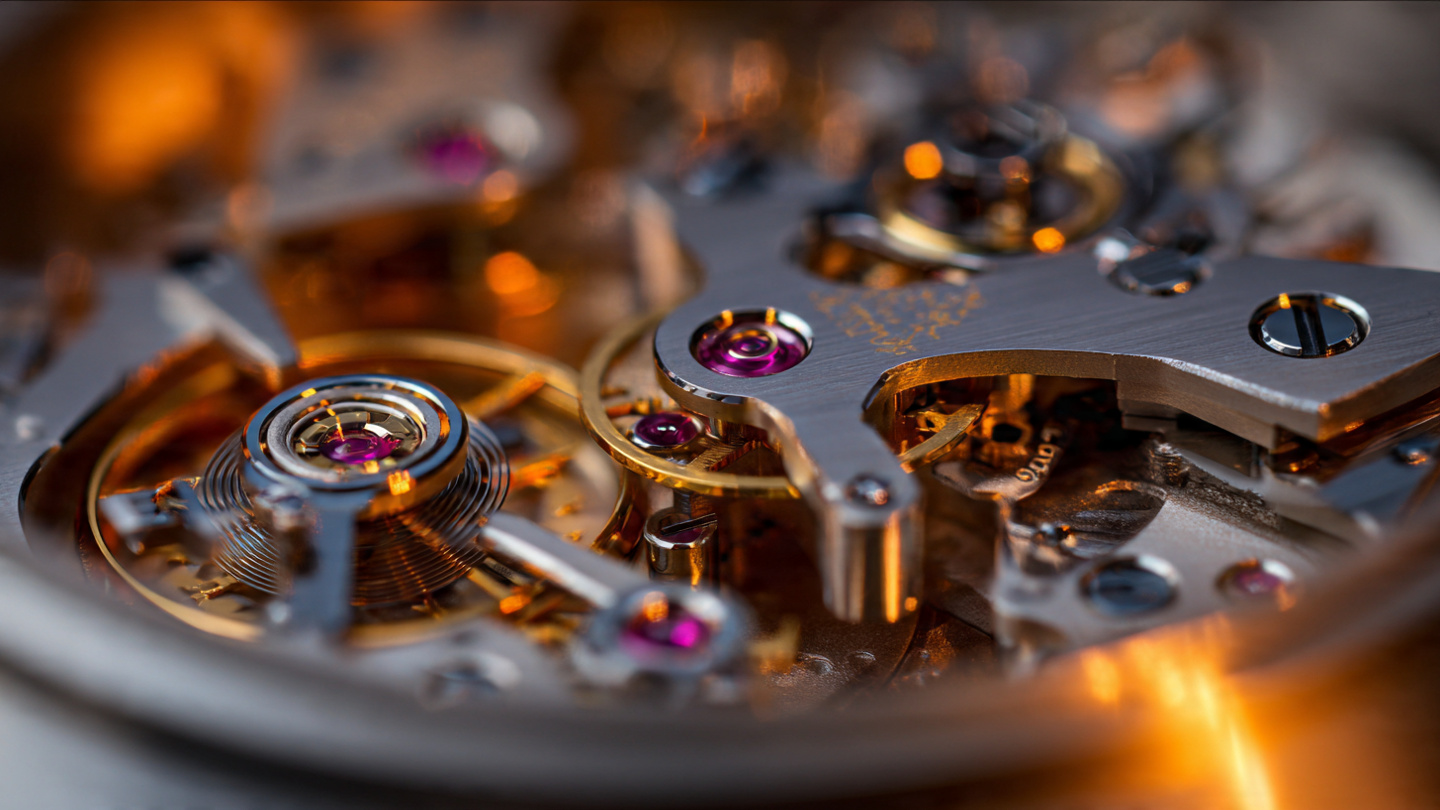
A standard chronograph is already one of the most component-dense complications in mechanical watchmaking. A column-wheel chronograph with flyback function typically contains 250 to 350 parts, roughly double the count of a simple time-only movement. Every one of those parts must engage and disengage cleanly across three states: start, stop, and reset. Now add a second set of timing hands that ride on a concentric shaft inside the chronograph arbor, can be stopped independently while the primary hands keep running, and must snap back to perfect synchronization on command. That is a rattrapante. It adds another 100 to 200 parts to the already crowded chronograph architecture, introduces tolerances measured in microns on the concentric shaft assembly, and demands a clamp mechanism precise enough to arrest a spinning hand instantly without transmitting vibration to the running geartrain. In watchmaking, few complications pack more mechanical ingenuity per cubic millimeter.
Naming a Mechanism: Rattrapante vs. Split-Seconds
Both names describe the same complication, but from different perspectives. "Split-seconds" is the English term, referencing the ability to split a timing measurement into intermediate intervals. "Rattrapante" comes from the French rattraper, meaning to catch up, describing the moment when the stopped hand is released and snaps forward to rejoin the running hand. In German watchmaking, Lange uses Doppelzeiger (double hand). All three names point to the same engineering challenge: two coaxially mounted hands that can be independently controlled yet must resynchronize perfectly on demand.
Adolphe Nicole and the 1862 Patent
Joseph Thaddaeus Winnerl built what is generally considered the first split-seconds pocket watch mechanism in the 1830s in Paris. His design used a single pusher to alternately stop and release a second timing hand. Charles Victor Adolphe Nicole refined and patented a more practical version in 1862 that established the architectural template still used today: two superimposed seconds hands on concentric arbors, a dedicated control mechanism to arrest one hand while the other runs, and a heart-cam system to resynchronize the pair. Nicole’s key insight was that the split hand needed its own braking system entirely separate from the chronograph start/stop mechanism. Combining both functions into a single control path created unpredictable timing errors. Separating them produced repeatable results.
Nicole worked in London but maintained deep ties to Swiss suppliers, and his patent circulated quickly through the Vallée de Joux workshops that supplied chronograph blanks to the London trade. Within two decades, split-seconds pocket chronographs appeared from multiple Swiss makers. By the early twentieth century, Vénus, Valjoux, and Lemania all produced split-seconds chronograph calibers for the pocket watch market. Miniaturizing the mechanism for wristwatches proved far harder and took another half century.
Anatomy of the Standard Chronograph
Understanding the rattrapante requires understanding what it builds upon. A column-wheel chronograph is a binary-state machine. A column wheel is a steel cylinder with raised pillars and recessed slots arranged around its circumference. When the start pusher is pressed, the column wheel advances one step, and levers fall into the slots or ride up onto the pillars. This controls three functions simultaneously: the coupling clutch engages the chronograph geartrain to the movement, the blocking lever releases the chronograph wheel so it can spin, and the reset hammer lifts away from the heart cams.
Energy flows from the mainspring barrel through the going train to the fourth wheel, which rotates once per minute. A friction-fit driving wheel on the fourth wheel arbor transmits torque to the chronograph train when the clutch is engaged. Horizontal-clutch designs slide a toothed coupling wheel into mesh with the chronograph runner. Vertical-clutch designs use a disc pressed against the driving wheel by spring tension, releasing it when the chronograph starts. Both approaches lose some amplitude from the balance wheel because the chronograph train draws power from the same mainspring.
Reset uses heart cams: cam-shaped profiles attached to the chronograph wheels. When the reset hammer drops onto the heart cam, the cam’s geometry forces the wheel to rotate to the zero position regardless of its current angle. It is an elegant mechanical solution to a problem that digital systems solve with a single register clear.
Adding the Second Layer: Concentric Arbors
A rattrapante chronograph places a second hand directly on top of the primary chronograph seconds hand. Both hands share the same center point on the dial and appear as a single hand when running together. Mechanically, this requires concentric arbors: a hollow outer tube carrying one hand, with a solid inner shaft running through it carrying the other. Both must rotate independently with minimal friction between their contact surfaces.
Manufacturing these arbors demands extreme precision. Typical clearance between the inner shaft and outer tube is 5 to 15 microns, roughly one-fifth the diameter of a human hair. Too tight and friction causes the hands to drag on each other, transferring torque between the two timing systems and corrupting the measurement. Too loose and the hands wobble visibly on the dial. Lange, Patek Philippe, and other manufacturers producing rattrapante movements maintain dedicated tooling for these arbor assemblies because standard watchmaking lathes cannot hold the required tolerances across the full arbor length.
At the bottom of the rattrapante arbor assembly sits the rattrapante wheel, which connects to a heart cam and a disengagement wheel. At the top sits the hand. Between them, the arbor passes through the chronograph arbor without touching it except through precisely lapped bearing surfaces. When both hands run together, a spring-loaded heart lever pressed against the rattrapante heart cam locks the two arbors into synchronous rotation. When the rattrapante pusher is pressed, a clamp arrests the rattrapante wheel, stopping the split hand while the chronograph hand continues unimpeded beneath it.
Clamp and Column Wheel: Stopping One Hand Without Disturbing the Other
Arresting a spinning hand sounds straightforward. In practice, it is one of the hardest problems in the rattrapante mechanism. A clamp must halt the rattrapante wheel instantly, because any delay translates directly into timing error. At 4 Hz (28,800 vibrations per hour), the chronograph seconds hand advances one degree every 1/12 of a second. A 50-millisecond delay in clamping produces a 0.6-degree error, visible on the dial as a misalignment between the split hand and the printed scale.
Most modern rattrapante movements use a dedicated second column wheel to control the split function. Pressing the rattrapante pusher advances this column wheel by one step. Levers riding the column wheel’s pillars and slots actuate the clamp mechanism, which physically grips the rattrapante wheel. Clamp designs vary by manufacturer. Some use a forked lever that pinches the rim of the rattrapante wheel between two hardened steel jaws. Others use a flat spring that presses against a brake surface on the wheel. Lange’s 1815 Rattrapante uses a precisely shaped clamp that closes around the rattrapante center wheel, locking it in place through friction.
Releasing the clamp requires equal precision. When the rattrapante pusher is pressed a second time, the column wheel advances again, the clamp opens, and the spring-loaded heart lever forces the rattrapante arbor back into synchronization with the chronograph arbor. The heart cam on the chronograph center wheel serves as the target: the rattrapante heart lever follows the cam’s profile until the two hands align, then locks into the flat of the heart shape, holding both hands in register. This catch-up action is where the name rattrapante originates. Done well, the split hand appears to teleport from its stopped position to the running hand’s current position. Done poorly, it visibly stutters or overshoots.
Isolator Mechanisms: Protecting Amplitude
When a rattrapante chronograph is running with the split function engaged, meaning one hand is stopped while the other continues, a friction problem emerges. The chronograph heart cam continues to rotate, and the spring-loaded rattrapante heart lever rides over its surface with every revolution. This constant rubbing drains energy from the movement. Each revolution of the chronograph seconds hand loses a small amount of torque to the friction between the heart lever and the heart cam. Over time, this reduces the balance wheel’s amplitude, degrading timekeeping accuracy.
Early rattrapante movements simply accepted this loss. In a pocket watch with a large mainspring barrel, the amplitude reduction was tolerable. Wristwatch mainsprings have far less energy reserve, and the amplitude loss became a measurable problem. Lange solved it with a disengagement mechanism. When the rattrapante clamp engages, a second lever lifts the heart lever away from the heart cam entirely. The heart lever hovers above the cam surface without contact, eliminating friction. When the clamp releases, the disengagement lever drops the heart lever back onto the cam for resynchronization. Patek Philippe’s Caliber CHR 29-535 PS uses a similar isolator system, where activating the split function simultaneously lifts the rattrapante heart lever clear of the running heart cam.
These isolator mechanisms add yet more components to an already dense movement. Lange’s Double Split, which extends the rattrapante function to the minute counter as well as the seconds, includes separate disengagement systems for both arbor pairs. Every additional pair of hands requires its own concentric arbor assembly, its own clamp, its own heart cam, and its own isolator lever.
Patek Philippe CHR 29-535 PS: 362 Parts in 29.6 Millimeters
Patek Philippe’s Ref. 5370P is a pure split-seconds chronograph without perpetual calendar or other complications. It houses the CHR 29-535 PS caliber, a hand-wound movement measuring 29.6 mm in diameter and 6.85 mm thick, containing 362 parts. Patek developed the movement entirely in-house with seven patented innovations specific to the split-seconds mechanism.
One of those patents addresses the clamp design. Traditional rattrapante clamps apply force at a single point on the rattrapante wheel’s rim, creating asymmetric stress that can cause the wheel to deflect slightly before stopping. Patek’s design distributes clamping force more evenly, reducing deflection and improving stopping accuracy. Another patent covers the isolator geometry, optimizing the lever’s lift arc to minimize the energy required to raise and lower it. In a movement where every micro-newton of torque matters, reducing the isolator’s energy consumption preserves power reserve and amplitude.
In the 5370P, the split-seconds mechanism sits visibly under the dial, with the second column wheel and clamp lever partially exposed through the openworked dial at six o’clock. A sapphire caseback reveals the Gyromax balance, Breguet overcoil hairspring, and the characteristic striping of Patek’s Geneva finishing. Rated at 55 to 65 hours of power reserve, the CHR 29-535 PS maintains stable amplitude even with the chronograph running and the split function engaged. This is a direct result of the isolator design.
A. Lange & Söhne: From Datograph to Triple Split
Lange’s chronograph lineage began with the Datograph in 1999, a flyback chronograph that reset expectations for German watchmaking. The Datograph’s L951.1 caliber was not a rattrapante, but it established the architectural language, a column-wheel flyback with precisely jumping minute counter, that Lange would later extend into split-seconds territory.
In 2004, Lange introduced the Double Split, powered by caliber L001.1. It was the world’s first chronograph with a double-rattrapante function: split-seconds capability on both the central seconds hands and the minute counter. Previous rattrapante movements split only the seconds. Extending the function to minutes required a second pair of concentric arbors at the minute counter position, a second clamp mechanism, a second isolator, and a precisely jumping minute rattrapante hand that advanced in one-minute increments synchronized with the running minute counter. At 465 parts, the L001.1 was among the most complex chronograph movements in series production.
Lange pushed further in 2018 with the Triple Split. Caliber L132.1 adds a rattrapante function to the hour counter as well. Three pairs of concentric arbors, three clamp mechanisms, three isolator levers, and three heart-cam resynchronization systems operate in concert. Pressing the rattrapante pusher at ten o’clock simultaneously arrests the seconds, minutes, and hours split hands. Pressing it again releases all three, and they snap back to their running counterparts. A total of 567 parts interact inside a movement that measures 14.6 mm thick, only 0.3 mm more than the Double Split despite the additional hour-counter rattrapante mechanism.
Achieving that dimensional discipline required Lange to redesign the gear train layout from the Double Split. Engineers relocated the power reserve indicator from the three o’clock position to six o’clock, freeing space for the hour-counter rattrapante assembly at twelve. Power reserve increased from 38 hours to 55 hours. Combined with the disengagement mechanisms on all three arbor pairs, the Triple Split maintains adequate amplitude even during extended split-function measurements lasting hours, something no other mechanical chronograph can accomplish.
Venus 185 and the Affordable Rattrapante That Was
Not every split-seconds movement has been an exclusive manufacture exercise. Vénus, the Swiss movement maker based in Moutier, produced the caliber 185 from the 1940s through the 1960s. It was a hand-wound column-wheel split-seconds chronograph available as an ébauche to any brand willing to case it. Breitling, Tourneau, and smaller brands used the Vénus 185 in production models that sold for a fraction of what comparable complications cost today.
By modern standards, the Vénus 185 is crude. Its clamp mechanism is a simple lever pressing a flat spring against the rattrapante wheel rim. No isolator system lifts the heart lever during split operation. Amplitude drops measurably when the split function is engaged. Finishing ranges from workmanlike to plain. Yet the Vénus 185 demonstrated that a rattrapante mechanism could be produced industrially, not just hand-assembled in small batches by master watchmakers. Vintage examples with original cases and intact mechanisms now sell for $5,000 to $15,000, making them the most accessible entry point into mechanical split-seconds chronograph ownership.
Why So Few Brands Produce Rattrapantes Today
Among active manufacturers, the list of brands producing rattrapante wristwatches in 2026 is short: Patek Philippe, A. Lange & Söhne, F.P. Journe, and TAG Heuer constitute the core group. IWC previously offered the Doppelchronograph using a Habring-designed module on the Valjoux 7750 base, but that model has been discontinued. Other brands produce occasional limited editions or one-off pièces uniques, but sustained series production of rattrapante movements requires tooling, expertise, and quality control infrastructure that most manufacturers cannot justify commercially.
Several factors explain this scarcity. Concentric arbor production requires specialized lathes and grinding equipment that standard chronograph manufacturing lines do not include. Each additional rattrapante arbor pair adds assembly time measured in hours, not minutes, because the concentricity must be verified at multiple stages. Quality-control rejection rates for rattrapante movements exceed those for standard chronographs because a defect in any single clamp spring, heart cam, or arbor surface finish can cause the entire split function to malfunction. All of this increases cost per unit without proportionally increasing the number of customers willing to pay for the complication.
For most collectors, a flyback chronograph provides 90 percent of the practical timing utility at a fraction of the complexity. A flyback resets and restarts the chronograph without stopping, enabling consecutive lap measurements. It does not, however, allow recording a lap time while continuing to measure total elapsed time. That specific capability, freezing one hand to read an intermediate result while the other keeps counting, is what the rattrapante exists to provide. In competitive timing, race timing, or any scenario requiring simultaneous measurement of total and split intervals, no other mechanical solution works.
F.P. Journe and TAG Heuer: Different Philosophies
F.P. Journe’s lineSport Chronographe Rattrapante houses caliber 1518, a hand-wound split-seconds movement with an 80-hour power reserve. Journe uses a lateral clutch for the chronograph and a clamp-based system for the rattrapante, with an emphasis on movement readability. Visible through the sapphire caseback, the movement displays its column wheels, levers, and clamp mechanisms in a layout designed to be understood visually. At 44 mm in titanium, the watch is purposefully oversized to accommodate the movement architecture without stacking components too densely.
TAG Heuer takes a different approach with the Monaco Split-Seconds Chronograph, powered by caliber TH81-00 co-developed with Vaucher Manufacture Fleurier. Running at 5 Hz (36,000 vibrations per hour) rather than the typical 4 Hz, it offers one-tenth-of-a-second precision on the split measurement. Higher frequency means the chronograph hand advances in smaller increments, improving the resolution of each split reading. At 364 parts and 30 grams for the movement alone, the TH81-00 prioritizes performance density in a way that complements the Monaco’s compact square case.
Torque, Friction, and the Limits of Mechanical Splitting
Every additional complication layered onto a chronograph draws energy from the same mainspring. A standard chronograph reduces balance amplitude by roughly 10 to 30 degrees when started, depending on clutch design and movement architecture. A rattrapante with the split engaged reduces amplitude further because the clamp mechanism introduces static friction on the arrested wheel, and the running chronograph must continue to drive the heart cam past the (now inactive but still present) heart lever contact point.
Modern isolator designs have reduced this penalty dramatically. Lange claims the Triple Split maintains adequate amplitude throughout its 55-hour power reserve even with the split function engaged for extended periods. Patek’s CHR 29-535 PS similarly preserves amplitude stability through its patented isolator geometry. But the physical reality remains: any energy spent on friction, clamp tension, or lever actuation is energy not available to sustain the oscillation of the balance wheel. This is why rattrapante movements universally use hand-winding rather than automatic rotors. A rotor adds weight, thickness, and its own friction to the movement, further burdening the energy budget. Hand-winding allows the full mainspring torque to flow directly to the geartrain without rotary-mass losses.
Some manufacturers have experimented with twin barrels to address the energy deficit. Lange’s caliber L132.1 uses paired mainspring barrels connected in series, doubling the available torque delivery curve. Patek’s CHR 29-535 PS uses a single barrel but optimizes the barrel arbor and mainspring alloy (Nivachron-derived) for flat torque output across the full wind. Both approaches aim at the same goal: maintaining enough energy to run the timekeeping train, the chronograph train, and the rattrapante control system simultaneously without amplitude loss compromising accuracy.
Assembly: Hours Measured in Patience
Assembling a rattrapante movement is a task reserved for the most experienced watchmakers in any manufacture. At Lange, a single watchmaker assembles each Triple Split movement twice. First assembly verifies fit, function, and timing performance. The movement is then completely disassembled, each component cleaned and inspected, and final assembly follows. This double-assembly protocol, standard for all Lange calibers, takes on additional significance for a 567-part movement where a single misaligned lever can cause the entire split function to fail.
Concentric arbor installation is the most delicate phase. Both the inner shaft and outer tube must be seated in their jeweled bearings with the correct end-shake (axial play) and side-shake (radial play). Too much end-shake and the hands drift vertically on the dial, creating an uneven visual split. Too little and the arbors bind under thermal expansion as the watch warms on the wrist. Watchmakers verify these clearances under magnification, adjusting bearing surfaces by lapping with diamond paste in increments of a single micron.
After the arbors are set, the clamp mechanism must be timed to the column wheel. When the rattrapante pusher is pressed, the column wheel advances exactly one step, and the clamp must close at precisely the moment the column pillar engages the lever. If the clamp closes early, it catches on the wheel before the lever is fully seated, causing a grinding sensation through the pusher. If it closes late, the split hand drifts past its intended stopping point. Watchmakers adjust this timing by bending the clamp lever’s tail in increments of hundredths of a millimeter, a process that relies entirely on tactile feedback and decades of experience.
The Rattrapante as Engineering Philosophy
Unlike a tourbillon, which exists primarily to improve positional accuracy in pocket watches and persists in wristwatches largely as a demonstration of craftsmanship, the rattrapante serves a genuine functional purpose. It is the only mechanical complication that allows simultaneous recording of total elapsed time and intermediate split intervals. No single-hand chronograph, regardless of frequency or accuracy, can replicate this capability.
From an engineering perspective, the rattrapante is a study in controlled decoupling. Two mechanical systems share a common energy source, a common spatial envelope, and a common display surface. They run in lockstep until commanded to separate, operate independently during the split, and rejoin seamlessly when released. The engineering challenge is not brute force or material science. It is precision control of mechanical interaction at a scale where tolerances are measured in single-digit microns and energy budgets are counted in millinewton-meters.
Fewer than a dozen manufacturers have successfully produced wristwatch-scale rattrapante movements in the 164 years since Nicole’s patent. Lange’s Triple Split remains the only movement to extend the principle to three hand pairs, a record that has stood since 2018 with no competitor attempting to match it. In an industry where complications are regularly replicated and commoditized within a few years of introduction, the rattrapante’s persistent exclusivity says something about its difficulty. Some mechanical problems yield to scale and investment. Others demand a specific kind of patience.
Sources
- A. Lange & Söhne, “Rattrapante Mechanism,” alange-soehne.com.
- A. Lange & Söhne, “Triple Split,” press release, 2018/2021.
- A. Lange & Söhne, “Double and Triple Rattrapante Mechanism,” alange-soehne.com.
- Hodinkee, “Inside An A. Lange & Söhne Split-Seconds Chronograph,” hodinkee.com.
- TAG Heuer Magazine, “How Does a Split-Seconds Chronograph Work?,” magazine.tagheuer.com.
- Fratello Watches, “Understanding The Mechanical Chronograph: A Watchmaker Explains,” Henrik Korpela.
- Langepedia, “A. Lange & Söhne Triple Split,” langepedia.com, 2021.
- Gear Patrol, “What the Hell Is a Rattrapante, and Why Is It So Expensive?,” gearpatrol.com.
- Patek Philippe, “Grand Complications Ref. 5370P/5370R,” patek.com.
- Quill & Pad, “Split Decision: Patek Philippe 5370P vs. A. Lange & Söhne 1815 Rattrapante,” quillandpad.com.