Watches / Materials Engineering
The Gold Bezel That Isn't Gold
Rado's new DiaStar Original Skeleton wears a gold bezel made of Ceramos, a ceramic-metal composite five times harder than steel. Gold is a color here, not a material, and that distinction is the whole story.
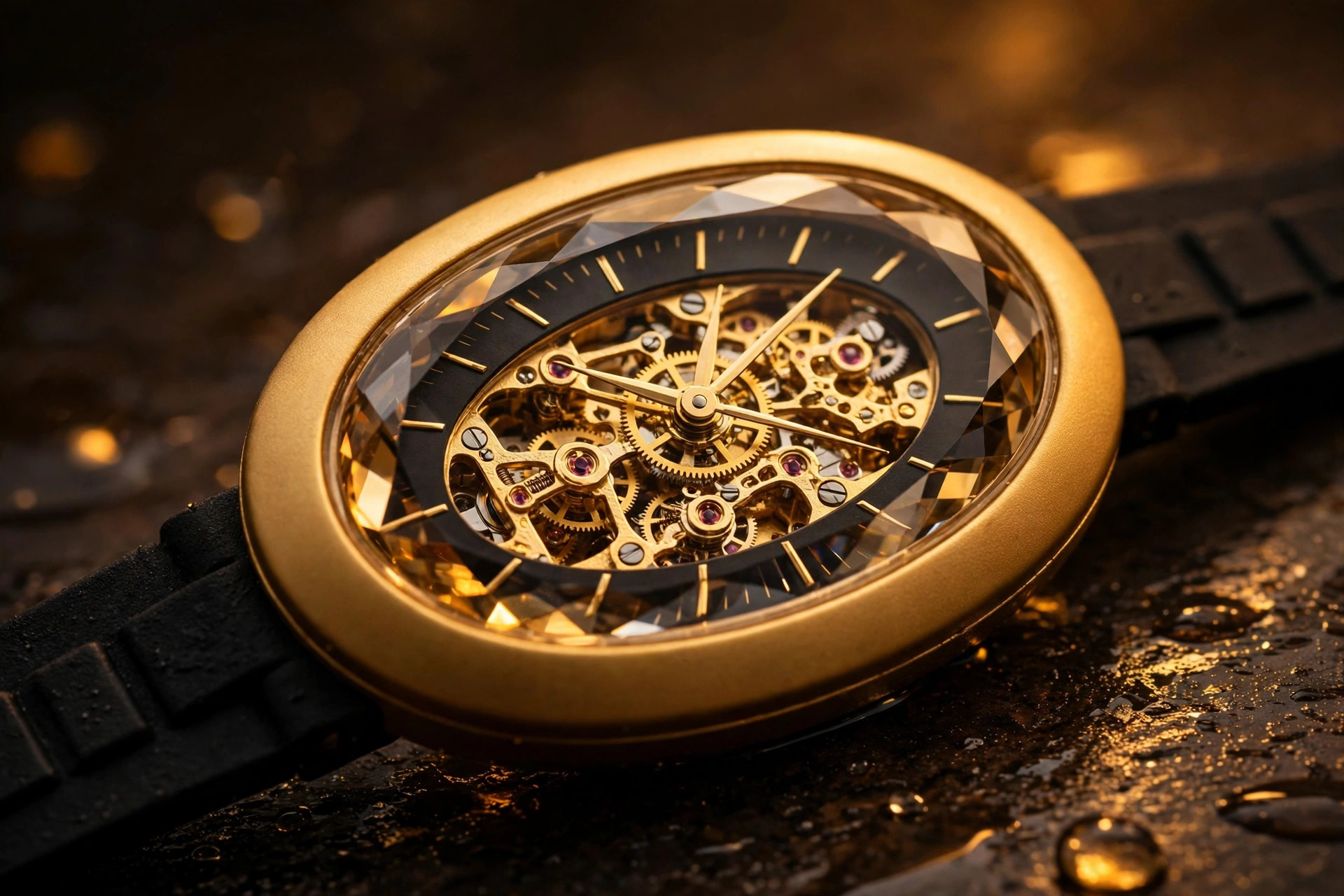
Fratello's reviewer called them UFOs, and the nickname fits. Two gold DiaStar Original Skeletons landed on his desk in November, one yellow gold, one rose, both built around a bezel made of Ceramos, Rado's ceramic-metal composite. Sixty-four years after the first DiaStar promised a scratchproof watch, Rado is still arguing that the case material matters more than the movement inside it.
Rado announced the pair in late October, with Monochrome publishing full specifications on October 26 and WatchTime following on November 5. Fratello went hands-on a few days later. References are R12166159 in yellow gold and R12159309 in rose gold, each priced at $2,700, each running the same skeletonized R808 automatic, each weighing a reported 80 grams.
Ceramos, explained
Ceramos is a cermet, a ceramic-metal composite, and the name says exactly what it is. Roughly 90 percent titanium carbide provides the hardness, while roughly 10 percent metal binder supplies the toughness and the metallic lustre. Reports put Ceramos at 1,750 Vickers, which puts it five to six times harder than the 316L stainless steel most watches are made from, and harder even than the zirconia high-tech ceramic Rado uses elsewhere, which lands around 1,200 to 1,250 Vickers.
Hardness alone would make a brittle bezel. Titanium carbide on its own shatters rather than dents, which is why the binder matters more than the headline number. During sintering, the metallic portion melts and re-alloys itself around the carbide particles, forming a metal matrix that holds the ceramic together. Rado's own materials page describes Ceramos as a further development of hardmetal, with improved scratch resistance at significantly lower specific weight. In plain terms, the ceramic does the resisting and the metal does the surviving.
Rado has been working this material since 1993, when the Sintra became its first watch in a ceramic-metal matrix, pressed into blanks and machined to shape. Injection moulding arrived in 2011, when the injectable version was trademarked Ceramos and first used on the D-Star case. DiaStar Original got the material for its 60th anniversary redesign in 2022, and the Skeleton followed a year later. These two gold editions are the newest colorways on that platform, not a new watch, and Rado is not pretending otherwise.
The gold that can wear off
Now for the awkward part. Gold is a color on this watch, not a material. Monochrome reports that the convex Ceramos bezel is PVD-coated and radially brushed, which means the gold tone sits on top of the composite as a thin vapor-deposited layer. WatchTime and Fratello describe the same bezel as gold-colored Ceramos, and the distinction matters, because a coating can wear even when the substrate underneath cannot scratch.
Rado's own history makes the point for it. Revolution's Ceramos explainer notes that galvanic gold coatings are soft and thin, 10 to 20 microns, and that PVD layers run 0.8 to 3 microns, hard but finite, and will eventually wear off. Ceramos itself will never wear off, because it is a bulk material. Put those two sentences together and the verdict writes itself: this bezel cannot be scratched, but its gold can fade at the edges, over years of wear, exactly where a watch meets the world.
None of this is a defect. It is a trade-off, and Rado chose it openly. Solid gold at this hardness does not exist, and a Ceramos bezel in its natural color would be dark grey, not gold. PVD is how the watch gets its autumn colorway. Buyers should simply know what they are buying: a scratchproof bezel wearing a gold coat, not a gold bezel. For $2,700, that is a fair deal, as long as nobody mistakes the coat for the structure.
Hublot's Magic Gold makes the comparison instructive. Magic Gold fuses 24-karat gold with boron carbide ceramic into a bulk material, so its gold color runs all the way through, and it measures around 1,000 Vickers. Ceramos is harder at 1,750 Vickers and lighter, but its gold is a surface treatment. Each material solves a different problem. Hublot wanted gold that could not scratch. Rado wanted ceramic that could look like gold.
An 80-hour skeleton
Inside, the R808 is a skeletonized version of the ETA C07.901+, the Powermatic 80 family movement Swatch Group builds in huge numbers. Twenty-five jewels, 21,600 vibrations per hour, an 80-hour power reserve, a Nivachron hairspring for magnetic resistance, adjustment in five positions. Skeletonizing a movement usually means cutting away bridge material to show the gear train, and Rado did exactly that, then coated the remaining bridges gold and brushed them horizontally to match the bezel.
Eighty hours from a 3 Hz movement is the Powermatic family's party trick, and it survives skeletonization because the trick lives in the barrel and the escapement, not in the bridges. A lower beat rate burns less energy per hour, and the barrel holds enough mainspring to keep going for more than three days. Removing metal from the bridges changes nothing about that arithmetic, which is why the reserve figure matches the standard Powermatic 80. What changes is the risk: every gram removed from a bridge is a gram that no longer stiffens it, so the remaining structure has to be engineered, not just decorated.
Through the exhibition caseback, the anchor-shaped rotor carries Geneva stripes, a small joke Rado has been telling for years, since the anchor is the brand's logo and also the name of the part that regulates the escapement. On the dial side, a pivoting anchor sits at 9 o'clock, floating above the movement against a black or brown chapter ring. Hands and indices carry white Super-LumiNova. Legibility was clearly not the priority, and Rado knows it: this is a watch for looking at the movement, not for glancing at the time.
Eighty grams and eight facets
Fratello put the watch on a scale and found 80 grams, which is strikingly light for a 38 by 45 millimeter watch rated to 100 meters. Ceramic does most of that work, since the composite weighs far less than steel, and the rubber strap does the rest. A steel watch of these dimensions usually weighs noticeably more. Weight is the Ceramos advantage nobody photographs, and it is the one owners will notice first.
Over the dial sits the DiaStar's signature faceted sapphire crystal, eight sloped facets cut into a single piece of sapphire, with an internal anti-reflective coating. Sapphire rates 9 on the Mohs scale, second only to diamond, which makes it the only crystal material hard enough to deserve a place on a scratchproof watch. Each facet is a separate polishing operation on a material that resists polishing, and the facets are a deliberate callback: the 1962 DiaStar wore a faceted sapphire crystal too, because Rado understood even then that a scratchproof case deserved a scratchproof window.
Case dimensions are 38 millimeters wide, 45 long, 11.9 thick. Water resistance is 100 meters, which is generous for a skeletonized watch and speaks to the case construction: a gold PVD-coated stainless steel mid-case, crown, and caseback, sealed around the Ceramos bezel. Straps are rubber, black for the yellow gold reference, brown for rose gold, both on Rado's EasyClip system for tool-free changes.
Sixty-four years of scratchproof
DiaStar launched in 1962, billed as the first scratchproof watch, a tungsten carbide case with a sapphire crystal, shaped like nothing else on the market. Rado reimagined it for the 60th anniversary in 2022, in Ceramos, and the Skeleton arrived in 2023. Summer editions in bright colors came earlier in 2026, and these two gold versions close the year as the autumn colorway. Nothing about the movement or the case changed. Rado changed the color, and the color is the news.
That restraint is worth noting. Most brands would have used the anniversary to launch a new caliber or a limited edition with a higher price. Rado kept the platform, kept the price at $2,700, and spent the effort on two new PVD tones. It is a small release, honestly presented, and the engineering is all in the material that was already there.
Limitations, stated plainly: I have not handled either watch, and nobody on this site has. Every measurement here comes from Monochrome, WatchTime, Fratello, and Rado's own materials pages. Two details deserve a flag. Monochrome lists the price at 2,600 euros while Fratello lists 2,650, so the European price is uncertain by 50 euros until Rado's own store confirms it. And the long-term behavior of gold PVD on a radially brushed Ceramos bezel is untested in public: Rado's own explainer says PVD layers eventually wear, and no reviewer has worn one long enough to say when. Buy the watch for the composite underneath the color, not for the color itself. That is where the engineering lives.
DiaStar Original Skeleton: key figures
| References | R12166159 (yellow gold, black dial and strap); R12159309 (rose gold, brown dial and strap) |
|---|---|
| Bezel | Convex Ceramos (90% titanium carbide, 10% metal binder), 1,750 Vickers, PVD-coated, radially brushed |
| Case | 38 mm wide, 45 mm long, 11.9 mm thick; gold PVD-coated stainless steel mid-case; 80 grams total |
| Crystal | Faceted sapphire, eight sloped facets, internal anti-reflective coating; sapphire exhibition caseback |
| Movement | Rado R808, skeletonized ETA C07.901+ (Powermatic 80 family); 25 jewels; 21,600 vph; 80-hour reserve |
| Hairspring | Nivachron, antimagnetic; adjusted in five positions |
| Water resistance | 100 meters |
| Strap | Rubber, EasyClip tool-free system; black or brown to match the reference |
| Price | $2,700; 2,600-2,650 euros (sources disagree); 5-year warranty |
| Lineage | DiaStar 1962; Ceramos redesign 2022; Skeleton 2023; autumn gold editions 2026 |
Sources: Monochrome Watches, "Warm Autumnal Colours for the Rado DiaStar Original Skeleton," Oct 26, 2026; WatchTime, "Rado DiaStar Original Skeleton Debuts Two Autumn Colorways," Nov 5, 2026; Fratello Watches, "Hands-On: Two Rado DiaStar Original Skeleton Watches," Nov 2026; Revolution Watch, "Getting to Know Rado's Ceramos"; Rado, "Master of Materials" (Ceramos); Rado, "High Tech Ceramic"; Efficient Design, "Hublot Magic Gold: Boron Carbide Cermet Engineering" (Magic Gold, approx. 1,000 Vickers).