Four Thousandths of an Inch
How Plasma-Sprayed Bore Coating Killed the Cast Iron Cylinder Liner
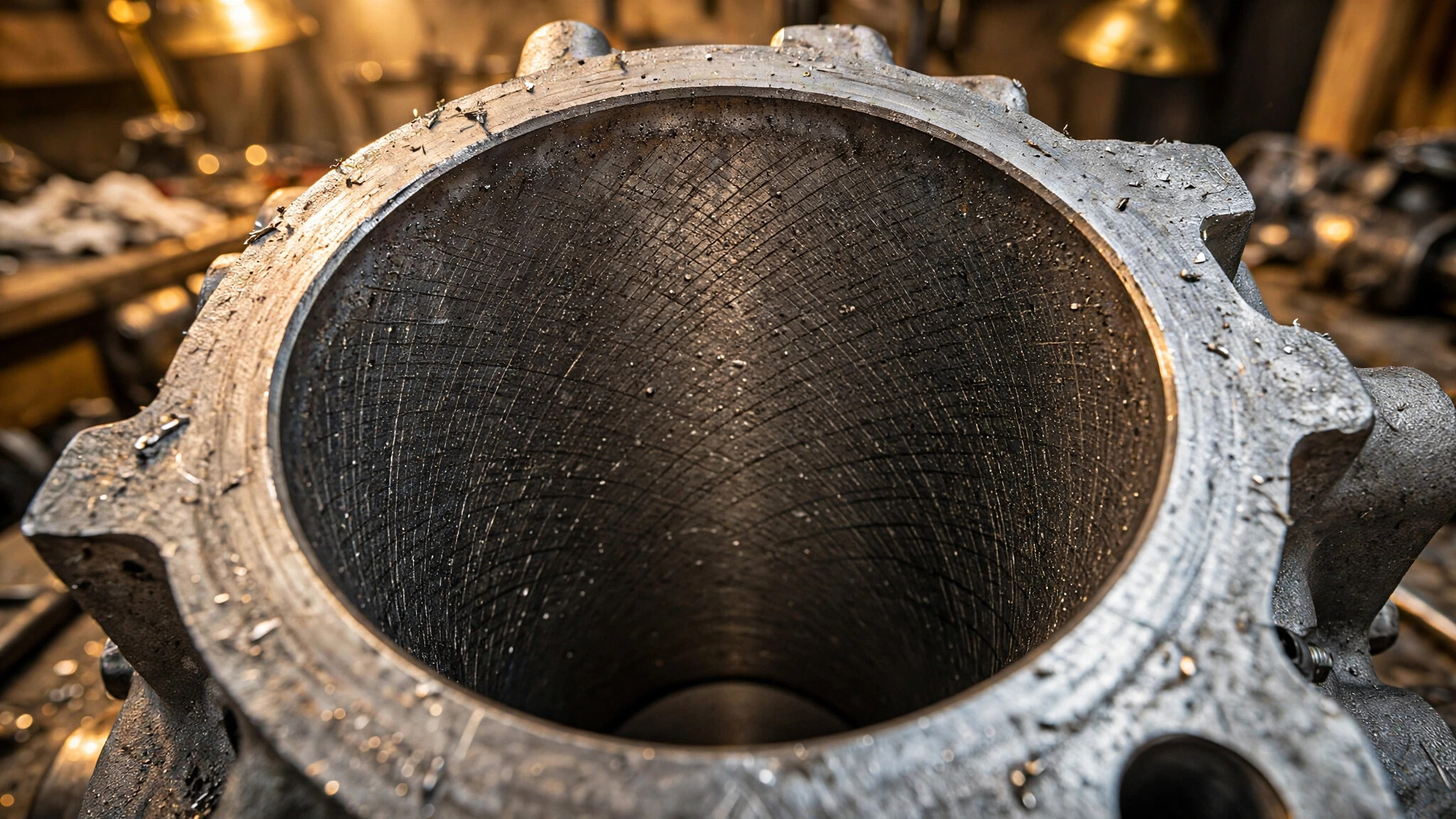
Cast iron cylinder liners weigh roughly six pounds in a V6, conduct heat poorly across the interference fit where iron meets aluminum, and force engineers to leave extra material between cylinder bores for structural support, which limits bore diameter, which caps displacement. For decades, every aluminum engine block carried these penalties because the alternative was aluminum-on-steel piston rings scraping against bare aluminum walls, a situation that ends badly and quickly and leaves you staring at a cylinder wall that looks like it lost a fight with a cheese grater.
Ford figured out how to end it differently: spray iron onto the aluminum, not thick and not heavy, just a coating thinner than two sheets of copy paper applied by a plasma torch spinning inside the bore at 400 revolutions per minute, fed by a continuous wire of iron at 252 feet per minute. Two minutes per cylinder. Finished thickness after honing: 0.004 inches, which is one hundred microns, which is the width of a human hair, which is doing the job that two millimeters of cast iron used to do.
How a Plasma Torch Replaces a Foundry
PTWA stands for Plasma Transferred Wire Arc. Ford developed the automotive application at the Essex Engine Plant in Windsor, Ontario, and first deployed it in the 5.2-liter Voodoo flat-plane V8 that powered the 2016 Shelby GT350 Mustang.
Before any spraying happens, the raw aluminum bore gets mechanically roughened on a CNC machine, a step that sounds simple but determines whether the coating survives the first thousand hours of engine operation or peels off in flakes that destroy the piston rings and score the bore beyond recovery. Parallel grooves are cut into the bore wall, then the tops of those grooves are deformed sideways to create undercut profiles, forming a microscopic dovetail joint running in circles around the cylinder interior that gives the sprayed iron something to grip in three dimensions, not just two. Without this mechanical interlocking, the sprayed iron would eventually delaminate under the thermal cycling and piston-ring scrubbing that define an engine bore's life. Tim Beyer, Ford's technical specialist in advanced manufacturing engineering, described it as a two-step process done on conventional CNC equipment, nothing exotic, just precise enough that a half-millimeter error in groove depth changes the coating's adhesion strength by double-digit percentages.
Once roughened, the block moves to the PTWA station, where a robotic arm guides a spray torch into each cylinder bore with the kind of positional accuracy that would make a watchmaker nod approvingly. Inside the torch, a hydrogen-argon plasma arc melts the tip of a 0.0625-inch-diameter iron wire that feeds continuously at 252 feet per minute, creating a stream of superheated metal that exists in the fourth state of matter for a fraction of a second before becoming a solid coating on an aluminum wall. Forced air through the nozzle atomizes the molten iron into microscopic droplets and accelerates them toward the bore surface, where each droplet flattens on impact, transfers its heat to the aluminum substrate, and solidifies in microseconds. Layer builds on layer. In roughly two minutes, the bore has a uniform iron coating several tenths of a millimeter thick, and the cylinder that started as naked aluminum is now ready to survive a hundred million piston strokes.
After cooling, the coated bore is honed using conventional cross-hatch techniques that cut oil-retaining grooves into the iron surface and seat the piston rings, the same basic finishing operation that engine builders have performed for decades, just applied to a substrate that arrived by plasma torch rather than by press fit. Final wall thickness: approximately 0.10 mm, compared to 2.0 mm for a pressed-in iron liner, a twenty-to-one ratio that captures the entire engineering argument in a single number. Ford's production engineers at Essex treated two blocks simultaneously, outputting six to eight finished blocks per hour, about 48 per day, small numbers because the Voodoo was never a high-volume engine. But the process scales, and Ford subsequently applied PTWA to the 5.2-liter Predator supercharged V8 in the GT500 and across the 3.5-liter EcoBoost family, where annual volumes run into the hundreds of thousands and the cost-per-bore amortization starts looking competitive with iron liner installation.
What Disappears When the Liner Goes Away
Weight is the headline, but not the most interesting advantage. Ford claims approximately six pounds saved per V6, somewhat more for a V8 depending on liner dimensions, which is meaningful in a performance context though not transformative on its own, roughly equivalent to deleting a few accessories from the engine.
Friction is better. A cast iron liner presents a rougher, less uniform surface to the piston rings than a precision-honed plasma coating, because the liner's surface finish depends on both the liner manufacturing process and the interference-fit installation, whereas PTWA applies the wearing surface and finishes it in place, eliminating one entire layer of dimensional tolerance stack-up. Mike Palazzolo, Ford's V8 engine programs manager during the Voodoo's development, noted measurable friction reduction from the PTWA surface, lower friction that means less parasitic loss, more power reaching the wheels for the same combustion event, and reduced wear on piston rings over the engine's life. Ford reported that honing cross-hatch marks remained visible after 200,000 miles of durability testing on PTWA-coated bores, which is remarkable durability for a bore surface that started as droplets of molten metal splattered onto aluminum at supersonic velocity.
Heat transfer is where the physics gets genuinely clever. A cast iron liner sits inside its aluminum bore with an interference fit, meaning the iron is slightly oversized and pressed into place, creating a thermal boundary where heat from combustion passes through the iron, hits the iron-aluminum interface, and slows down because microscopic surface irregularities on both mating surfaces trap thin layers of air that act as insulation. With PTWA, the sprayed iron bonds directly to the roughened aluminum substrate with no air gap and no interference boundary, so heat conducts straight from the combustion-facing iron surface into the aluminum block and out to the coolant jacket in a continuous thermal path that would make a heat exchanger designer smile. In a turbocharged engine running sustained high loads, that difference determines whether the bore wall stays below the temperature where aluminum softens and begins to creep, or crosses it.
Bore spacing is the one that really opened doors for the Voodoo. Without liners, Ford had only 6 mm of material between adjacent cylinder bores, down from 7.8 mm with liners in place, and that 1.8 mm difference per interbore bridge is what allowed the Voodoo to run a bigger bore diameter in the same block casting footprint, which is how you get a 5.2-liter flat-plane V8 out of a block that started as a 5.0-liter Coyote casting. Palazzolo was explicit about this: the Voodoo team optimized their cooling passages and casting cores around the tighter bore spacing that PTWA enabled, building what was fundamentally a different engine that could not have existed with iron liners.
Not Just Ford
BMW calls their version LDS, short for Lichtbogen-Draht-Spritzen, which translates to arc-wire-spraying and is exactly as literal as German engineering vocabulary tends to be. Same principle, slightly different equipment: an electric arc melts a conductive iron wire while high-pressure gas atomizes the melt and blows it onto the aluminum bore wall at velocities that turn liquid iron into a perfectly adhered solid in less time than it takes to blink. BMW specifies a coating thickness of roughly 0.3 mm on their B58 inline-six, thicker than Ford's finished dimension but still a fraction of an iron liner's bulk, and the extra thickness gives BMW more material to work with during the honing process that follows. LDS appears across nearly every modern BMW engine: the B58 powering the M340i and Supra, the S58 in the M3 and M4, the B48 four-cylinder, and their diesel equivalents, making it one of the most widely deployed thermal spray bore coating implementations in the industry. BMW's technical training documents are blunt about one consequence: subsequent machining of the cylinder barrels is not possible, meaning you cannot overbore a BMW engine with LDS coating, because boring through the iron exposes bare aluminum, and bare aluminum against piston rings is the end of the block.
Mercedes-AMG uses a proprietary variant they brand NANOSLIDE, a twin-wire arc spray process applied to their M178 4.0-liter V8 in the AMG GT family and the M139 2.0-liter four-cylinder in the A45, an engine that produces 416 horsepower from two liters and would melt its own bore walls in minutes without the coating that Mercedes claims is harder and more uniform than competing thermal spray processes due to the twin-wire feed geometry creating a more stable arc and finer droplet distribution. Whether that claim holds under independent testing is unclear, but the fact that the M139 passes durability requirements at specific outputs exceeding 200 horsepower per liter while running on pump fuel suggests the bore coating is at least as robust as its marketing.
Nissan adopted PTWA for the VR38DETT twin-turbo V6 in the GT-R, another engine where tight bore spacing and extreme thermal loads made liner elimination attractive, and Volkswagen Group uses a related atmospheric plasma spray process called SUMEbore on select EA888 and EA839 engines, feeding powder rather than wire into the plasma stream, which is a different feedstock delivering the same fundamental result: melt metal, atomize it, splat it onto aluminum, hone it flat, run the engine for a quarter of a million miles.
The Cautionary Tale That Shaped Everything
Porsche tried removing iron liners long before Ford built the Voodoo, using an approach called Nikasil, a portmanteau of nickel and silicon carbide, which instead of thermally spraying iron electroplates a thin layer of nickel embedded with silicon carbide particles onto the aluminum bore. Worked brilliantly. Air-cooled 911s ran Nikasil from the 1970s onward, enjoying a hard, low-friction surface without the weight and heat-transfer penalties of iron liners, and Porsche engineers probably thought they had solved the cylinder bore problem permanently.
Then it destroyed engines across two continents.
In the mid-1990s, BMW used Nikasil in their M60 and M62 V8 engines sold in the United States and United Kingdom, markets where gasoline contained higher sulfur concentrations than European fuel. Sulfuric acid formed during combustion attacked the nickel matrix, dissolving it grain by grain over tens of thousands of miles. Bore surfaces became pitted. Compression dropped. Oil consumption climbed. Engines that should have lasted 200,000 miles were failing at 60,000 with bore wear patterns that looked like chemical etching, because that is exactly what they were. BMW faced class-action lawsuits and eventually switched affected engines to steel liners under warranty, while Porsche experienced similar failures in their 993 and early 996 models sold in high-sulfur markets.
Nikasil did not fail because electroplating was a bad idea; it failed because its chemistry was intolerant of a real-world variable that the engineers either underestimated or did not test for, specifically that sulfur content in retail gasoline varied by country, by state, by season, and by refinery. A bore coating technology that works perfectly with 50 ppm sulfur and corrodes at 500 ppm is a technology that works perfectly in a laboratory and catastrophically in a gas station parking lot in Leeds.
PTWA and its thermal spray relatives avoid this trap by using iron-based coatings, because iron corrodes in acid at rates orders of magnitude lower than nickel's susceptibility to sulfuric acid attack, and because thermal spray coatings have a porous microstructure that retains oil and resists the kind of progressive dissolution that destroyed Nikasil bores. Ford's 200,000-mile durability results were achieved on pump gasoline, not lab-grade fuel, which is exactly the kind of validation that matters when you are replacing a century-old manufacturing process with a coating thinner than a fingernail.
What You Give Up
Rebuild culture built the American V8 into an institution. Bore it thirty over, fit new pistons, run it another hundred thousand miles. Guys have been doing this since the 1960s, and the expectation that an engine block should be rebuildable is baked into the culture as deeply as the cross-hatch marks are baked into the bore surface. Thermal spray coatings break that tradition completely.
A PTWA coating is 0.10 mm thick, and a standard overbore removes 0.25 mm per side, which means one pass of the boring bar takes you through the coating and into bare aluminum. BMW's training documents say it plainly: not possible. Rebuilding a thermally sprayed engine requires stripping the old coating, re-roughening the substrate, and reapplying the spray process on specialized equipment that no independent machine shop owns, a sequence that takes the entire concept of a weekend engine rebuild and turns it into a factory-return proposition. Ford initially developed PTWA partly as a remanufacturing technology, recognizing that worn blocks could be recoated instead of scrapped, but that recoating happens at Ford facilities with million-dollar plasma spray equipment, not at a corner engine rebuilder with a Sunnen hone and forty years of experience boring iron-lined blocks.
Production cost is the other penalty. Ford's PTWA line at Essex produced 48 blocks per day, while a conventional iron-liner installation runs in the hundreds, and the logistics chain that the Voodoo block followed tells the story of that cost in geographic terms. Comtech Manufacturing in Guelph, Ontario, cast the Voodoo blocks and partially machined them before shipping to Essex for PTWA coating, after which the blocks went back to Comtech for final honing, and then on to the Romeo engine plant in Michigan for assembly, a journey through three facilities in two countries with multiple shipping legs for a single engine block. When volume justifies it, the economics work, and Ford clearly decided the Voodoo and EcoBoost programs cleared that bar, but it remains a more complex and capital-intensive manufacturing path than heating an iron sleeve and pressing it into a bore.
Chevrolet took a different approach with their flat-plane V8s, and it is worth pausing on because GM had every reason to follow Ford's lead and chose not to. Both the LT6 in the Z06 and the LT7 in the ZR1 use A319 cast aluminum blocks with traditional cast-in iron cylinder liners, assembled by hand at the Performance Build Center in Bowling Green, Kentucky, where about 70 master engine builders produce roughly 90 engines per day. Iron liners added weight and limited bore spacing options, but GM accepted those trade-offs for reasons that are not public, and whether that reflects a philosophical choice about rebuild serviceability, a cost decision given the PBC's low volumes, or simply the engineering timeline of the Gemini engine program's development is a question that no GM spokesperson has answered directly. What it means in practice is that the most powerful production V8 in America, a 1,064-horsepower twin-turbo flat-plane engine, carries iron cylinder liners that Ford abandoned a decade earlier in a car with less than half the horsepower.
0.10 Millimeters of Opinion
Thermal spray bore coating is one of those technologies that sounds exotic until you understand the physics, and then it sounds obvious, because of course you should spray the bore surface directly onto the block instead of pressing in a separate iron cylinder, and of course the coating should be as thin as the tribology allows, and of course eliminating the thermal boundary between liner and block improves heat rejection, which makes you wonder why it took until 2016 for an American automaker to put it into a production engine when the underlying thermal spray science has been used in aerospace since the 1950s. The answer, as with most manufacturing questions, is that the idea was never the hard part; making the process reliable, repeatable, and cheap enough to justify the complexity across hundreds of thousands of engine blocks per year was the hard part.
Ford proved it could, at least at Voodoo and EcoBoost volumes. BMW proved it scales to their entire engine lineup. Mercedes proved it survives 208 horsepower per liter in the M139. Porsche, decades earlier, proved that getting the chemistry wrong is catastrophic.
GM still runs iron liners in their most advanced flat-plane V8. Maybe that changes with the next generation. Maybe it does not. Either way, the Voodoo's bore walls told the story first: four thousandths of an inch of sprayed iron, doing work that two millimeters of cast iron used to do, and doing it better in every measurable dimension except the one that matters to a guy with a boring bar in his garage and a belief that an engine block should outlast the civilization that built it.