Adjustable Vanes at 1,050°C: Inside Porsche's Twenty-Year Gasoline VTG Monopoly
Every turbocharged engine faces the same fundamental tradeoff. A small turbocharger spools quickly at low RPM but chokes at high RPM when the engine demands more air than the small compressor can deliver. A large turbocharger flows freely at the top of the rev range but takes an eternity to build boost from idle. Engineers have spent decades trying to build a turbo that acts small when you need response and large when you need power.
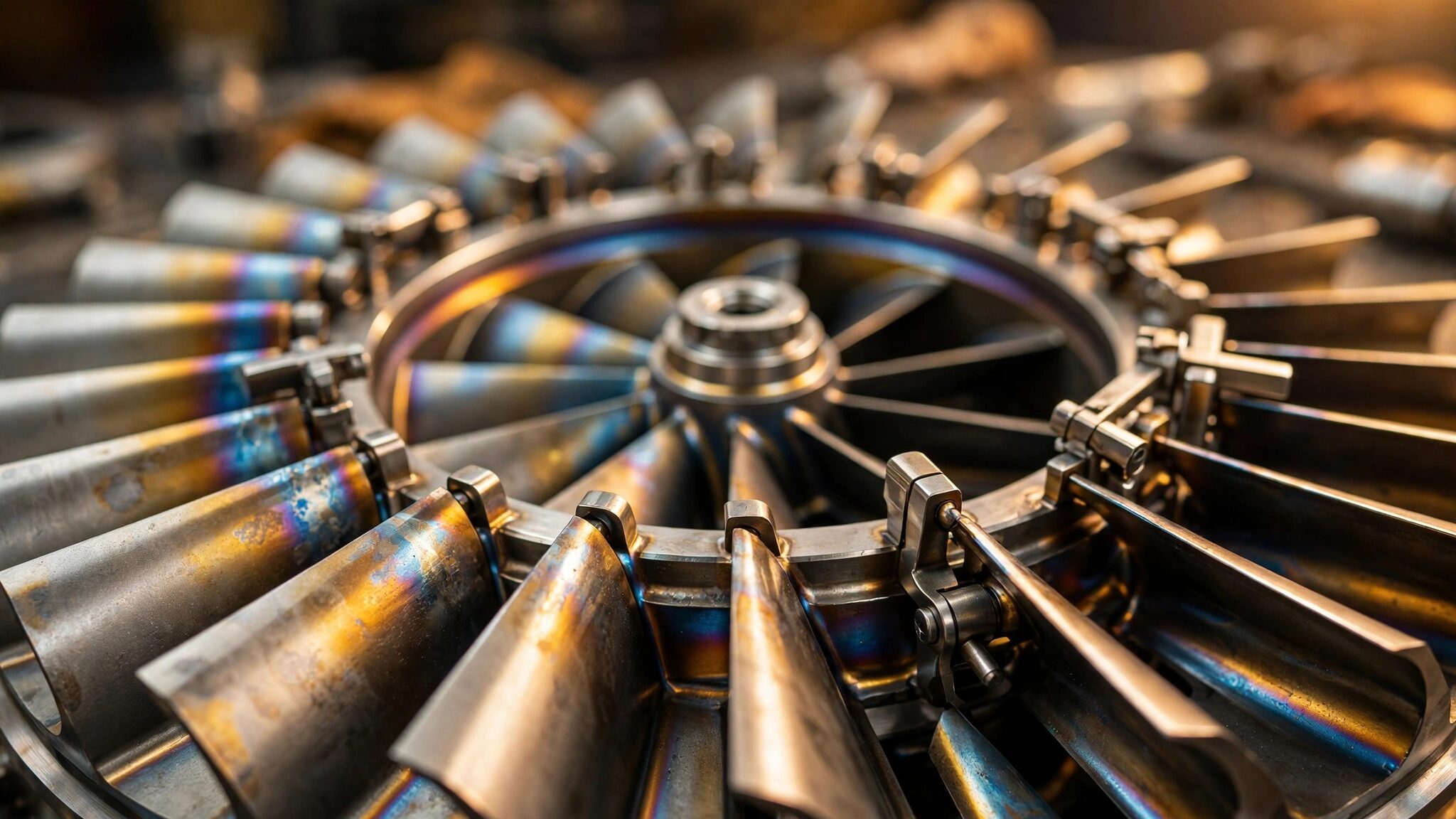
Variable turbine geometry solves this problem with adjustable guide vanes positioned in a ring around the turbine wheel inlet. Close them and the exhaust passage narrows, accelerating the gas stream so the turbine spins faster with less exhaust volume. Open them and the passage widens, allowing high-volume exhaust to flow without choking. One turbocharger, continuously adjustable, behaving like a different size at every engine speed.
Diesel engines have used VTG since the early 1990s. Garrett and BorgWarner supplied variable-nozzle turbos to Volkswagen, BMW, and Mercedes for millions of diesel passenger cars. It was proven technology. It was everywhere. And in 2006, when Porsche debuted the first production gasoline VTG in the 997-generation 911 Turbo, the rest of the industry watched from the sidelines. Twenty years later, they are still watching.
Why Heat Changes Everything
A variable-nozzle turbine is, mechanically, a collection of small moving parts living inside the hottest region of the engine. Each guide vane pivots on its own pin, synchronized to the others by a unison ring that rotates when an external actuator changes the vane angle. The vanes sit directly in the exhaust stream, millimeters from the turbine wheel. They must move freely, seal tightly, and hold their shape under thermal stress.
Diesel exhaust peaks around 800 degrees Celsius. At that temperature, well-chosen stainless steels keep their mechanical properties, resist oxidation, and maintain dimensional stability through millions of thermal cycles. Austenitic stainless alloys like HK30 work reliably for diesel VTG applications at reasonable cost. The engineering is solved. That is why every turbo diesel sedan on the road can have variable geometry for a few hundred dollars in added component cost.
Gasoline engines produce exhaust gas above 1,000 degrees Celsius. Under sustained load, the 911 Turbo's flat-six pushes temperatures to 1,050 degrees at the turbine inlet. At that temperature, HK30 stainless steel begins to lose creep strength. Its grain boundaries weaken. Thermal cycling causes cumulative distortion, microns per cycle, that eventually jams the vane mechanism or opens gaps that leak exhaust around the vanes instead of through the flow channels. A sticking vane at 145,000 RPM is not a warranty claim. It is a catastrophic failure.
That 250-degree gap between diesel and gasoline exhaust temperatures is the barrier that kept everyone else out. It is not a tuning problem or a packaging problem. It is a materials problem, and materials problems are the most expensive kind to solve in production engineering.
How the Mechanism Works
A ring of guide vanes sits in a nozzle assembly surrounding the turbine wheel inlet. Each vane is a small airfoil, roughly 20 millimeters long, pinned to the nozzle ring at one end and connected to a unison ring through a lever arm at the other. When the actuator rotates the unison ring, all the vanes pivot simultaneously, changing the angle of attack and the width of the flow channels between them.
At low engine speeds, the actuator closes the vanes toward their minimum-area position. Exhaust gas entering the nozzle ring is forced through narrow channels, accelerating to a higher velocity before striking the turbine blades. Faster gas means more kinetic energy transferred to the turbine, which spins up quickly even with modest exhaust volume. Boost pressure builds from as low as 1,500 RPM.
As engine speed climbs and exhaust volume increases, the actuator progressively opens the vanes. The flow channels widen, reducing exhaust velocity but allowing a much larger mass of gas to pass through without creating excessive back pressure. Back pressure is a turbocharger's hidden tax: it opposes the exhaust stroke, reducing engine efficiency and costing power. By opening the vanes at high RPM, VTG keeps back pressure low while still driving the turbine at full speed.
The result is a torque curve that looks like a mesa instead of a mountain. In the current 992-generation 911 Turbo S, peak torque of 590 lb-ft arrives at 2,500 RPM and holds flat through 4,000 RPM. Peak power of 640 horsepower comes at 6,750 RPM from a 3,745 cc engine that, without VTG, would need either a much larger turbocharger or a pair of sequentially staged units to cover the same operating range.
Aerospace on a Turbine Ring
Understanding the mechanism makes the materials challenge obvious. Every one of those vanes must pivot freely, seal tightly, and hold its shape while sitting directly in exhaust gas above 1,000 degrees Celsius. Porsche's solution came from the same place jet turbine blades do: nickel-chromium superalloys. The guide vanes in the 997 Turbo's VTG system were manufactured from alloys whose compositions overlap with materials used in gas turbine engines and, according to Porsche powertrain engineer Thomas Krickelberg, the Space Shuttle's main engines. These are alloys engineered to maintain yield strength, oxidation resistance, and dimensional stability above 1,000 degrees Celsius for thousands of hours.
Typical nickel-based superalloys for this application contain 20 to 35 percent chromium for oxidation resistance, 10 to 15 percent cobalt for high-temperature strength, and smaller additions of molybdenum, niobium, and carbon to stabilize the grain structure and form strengthening carbides at the grain boundaries. For context, a stainless steel watch case contains roughly 8 to 10 percent nickel. These turbocharger vanes carry nearly double that, plus cobalt, in an environment that would destroy the watch case in seconds. The resulting material holds its shape and surface finish at temperatures where conventional stainless steel would distort, oxidize, and eventually weld itself to adjacent surfaces.
Cost is the obvious penalty. Nickel superalloys can run ten to twenty times the material cost of HK30 stainless per kilogram. Manufacturing is harder too. These alloys resist conventional machining and must be produced through investment casting or metal injection molding with tighter tolerances. Every vane must meet dimensional specifications measured in hundredths of a millimeter because the clearance between vane edge and housing wall determines both sealing efficiency and freedom of movement.
Too tight and thermal expansion jams the vanes at operating temperature. Too loose and exhaust leaks around the vane edges, reducing the turbine's ability to accelerate at low RPM. Porsche and BorgWarner spent years calibrating these clearances to a window narrow enough for effective sealing yet wide enough for reliable operation across the full temperature range from cold start to sustained track use.
Why a Wastegate Becomes Optional
Conventional turbochargers use a wastegate to prevent overboosting. When boost pressure exceeds the target, the wastegate valve opens and diverts exhaust gas around the turbine, reducing turbine speed. It works, but it wastes energy. Every molecule of exhaust bypassing the turbine is energy that could have been extracted for useful work.
A VTG turbocharger can regulate boost by adjusting vane angle alone. If boost pressure rises too high, the vanes open wider, reducing the exhaust velocity at the turbine and slowing the compressor without wasting any gas. All exhaust energy passes through the turbine at all times. The 997 Turbo eliminated the wastegate entirely using this approach.
Later 911 Turbo generations reintroduced electronic wastegates alongside VTG, not because the variable vanes could not control boost on their own, but because electronic wastegates offered additional tuning flexibility for emissions compliance and transient response calibration. The combination of VTG and electronic wastegates gives Porsche's engine management two independent control surfaces for boost regulation, a level of precision that a wastegate-only or VTG-only system cannot match.
BorgWarner's Exclusive Partnership
Porsche did not build these turbochargers alone. BorgWarner, the turbocharger supplier based in Auburn Hills, Michigan, has manufactured every VTG unit fitted to a 911 Turbo since the technology's debut. Their expertise in variable-nozzle turbines for diesel applications provided the foundation, but adapting the design for gasoline temperatures required a joint engineering program that ran for years before the 997 launched.
BorgWarner's contribution was not limited to materials. Their computational fluid dynamics team optimized the vane profiles specifically for gasoline exhaust conditions, where the gas composition, density, and velocity differ meaningfully from diesel exhaust. Gasoline exhaust carries more water vapor, higher concentrations of carbon monoxide, and different particulate characteristics. Each of these factors affects how the gas interacts with the vane surfaces, influencing both aerodynamic efficiency and long-term material degradation.
The current 992 Turbo S uses a pair of BorgWarner 61-millimeter VTG turbochargers with 55-millimeter turbine wheels. Compared to the previous generation, compressor diameter grew by 3 millimeters and turbine diameter by 5 millimeters. These are incremental changes measured in single-digit millimeters, but in a turbine housing where flow dynamics are governed by cross-sectional areas measured in square centimeters, each millimeter shifts the efficiency curve.
Twenty Years of Iteration
Porsche introduced VTG in the 2006 model-year 997 Turbo with a 3.6-liter flat-six producing 480 PS (roughly 473 SAE horsepower) and 620 Nm of torque. Boost pressure peaked at 1.0 bar. No wastegate. The entire boost control strategy relied on vane position and fuel trim.
By 2009, the 997.2 Turbo added direct fuel injection alongside VTG and climbed to 500 horsepower. Direct injection cooled the combustion chamber, allowing higher compression ratios and more aggressive boost targets without risking detonation. The VTG mechanism itself did not change substantially, but the engine around it evolved to exploit VTG's capabilities more aggressively.
The 991-generation Turbo (2013) grew to 3.8 liters and adopted a new charge-air cooling layout. Turbo output reached 520 horsepower, and the Turbo S pushed to 560. Porsche refined the vane actuation speed and added more sophisticated engine management software to coordinate vane position with direct injection timing, reducing the transient response window to near-imperceptible levels.
With the 992 generation (2019), the Turbo S reached 640 horsepower from the same displacement. BorgWarner enlarged both turbine and compressor wheels while maintaining VTG compatibility. Porsche added electronic wastegates for the first time, creating a dual-control boost management system. Torque spread widened further, with 590 lb-ft available from 2,500 RPM. The turbochargers themselves grew only slightly in physical size, but the vane profiles were redesigned using updated CFD models that accounted for transient thermal loads during track driving.
Why Nobody Followed
Twenty years is a long time for a useful technology to remain exclusive to one manufacturer. The explanation is not a single factor but a stack of them.
Material cost is the floor. Nickel superalloy vanes cost significantly more than the stainless steel components used in diesel VTG or the aluminum housings used in wastegate turbos. For a manufacturer selling millions of turbocharged gasoline cars at mainstream price points, the per-unit cost increase is difficult to justify against cheaper alternatives like twin-scroll housings or sequential turbo arrangements.
Validation time adds to the expense. The vane mechanism must survive hundreds of thousands of thermal cycles without degradation, which means accelerated durability testing under extreme conditions over months of development time. Porsche amortizes this investment across a low-volume, high-price model line where customers expect cutting-edge powertrain technology. A mass-market manufacturer would need to spread the same validation cost across a much larger number of units, reducing the cost per car but requiring a much longer commitment before the first production unit ships.
Packaging matters too. A VTG turbocharger is physically larger and more complex than a wastegate turbo of equivalent flow capacity, because the nozzle ring, unison ring, vane levers, and actuator linkage all occupy space that a simple wastegate valve does not. In engine bays already crowded with emissions equipment, cooling lines, and wiring harnesses, the additional volume is a genuine constraint.
And then there is the alternative. Electric turbocharger assist, which Porsche itself adopted for the 992.2 Carrera GTS, achieves similar anti-lag benefits through a different mechanism entirely. Instead of reshaping exhaust flow with adjustable vanes, an electric motor on the turbo shaft spins the compressor to operating speed before exhaust energy builds. Mercedes-AMG uses electric turbo assist in the C63 S E Performance. The technology is spreading because it sidesteps the entire materials problem that makes gasoline VTG so expensive. An electric motor does not care about exhaust temperature because it sits between the compressor and turbine, upstream of the hottest zone.
The Succession Question
Porsche now runs two different anti-lag strategies simultaneously across the 911 range. The Carrera GTS uses a single electrically assisted turbocharger with no variable geometry. The Turbo S retains twin VTG turbochargers without electric assist. Two approaches to the same problem, sold in the same showroom, sharing the same platform.
Whether the next-generation 911 Turbo will keep VTG, adopt electric turbo assist, or combine both remains undisclosed. The 992.2 Turbo S already pairs VTG with electronic wastegates. Adding an electric motor to that assembly would create a turbocharger with three independent boost control mechanisms, which is either the ultimate expression of redundant precision or an engineering excess that electric assist alone renders unnecessary. VTG still holds one measurable advantage: at sustained high RPM, adjustable vanes manage exhaust back pressure more efficiently than an electric motor can, because VTG controls flow geometry directly rather than adding rotational energy to the shaft. The Turbo S holds peak torque across a 1,500-RPM band partly because VTG optimizes the turbine's operating point continuously, not just at spool-up.
For twenty years, variable turbine geometry on a gasoline engine has been Porsche's calling card. A ring of superalloy vanes, pivoting in exhaust gas hot enough to soften structural steel, held in place by metallurgy borrowed from jet engines. The technology works because Porsche and BorgWarner solved a materials problem that nobody else found worth solving at the volumes they produce.
Whether VTG survives the electric turbo era may depend less on engineering and more on identity. Porsche built the 911 Turbo's reputation on the idea that every molecule of exhaust does useful work. If an electric motor can deliver the same result without aerospace vanes and nickel superalloys, the rational choice is clear. But rationality has never been the only currency in Zuffenhausen.
Sources & Further Reading
- Porsche Newsroom, "Staying Power: the Porsche 911 drive technology," 2024.
- Porsche Christophorus Magazine, "Under Pressure," Issue 394, 2020.
- BorgWarner product specifications: 53049980334 VTG Turbocharger for 911 Turbo S 3.8L.
- BorgWarner patent WO2013106503A1, "Turbocharger with variable turbine geometry having grooved guide vanes," 2013.
- BorgWarner patent US20170248070A1, "Turbocharger with integrated actuator," 2017.
- BorgWarner patent US10844465B2, "Stainless steel alloys and turbocharger kinematic components," 2020.
- BorgWarner patent US10927698B2, "Turbocharger with variable-nozzle cartridge," 2021.
- Porsche Newsroom AU, "T-Hybrid for significantly enhanced performance," 2024.
- Engine Labs, "Porsche's Latest Variable Geometry Turbocharger Explained," 2025.
- CarBuzz, "The Porsche 911 Turbo's Variable Turbine Geometry Was A Gamechanger," 2025.