The Clutch Pedal With Nothing Behind It: Porsche Patents the Manual's Afterlife
On September 20, the German Patent and Trade Mark Office (DPMA) published a Porsche filing that reads like a confession, because buried in its dry apparatus claims is an admission no car company has stated this plainly before: that the feeling of driving matters enough to patent. Patent DE102025109563A1 describes a dual-clutch automatic transmission with a clutch pedal, which sounds like a contradiction in terms until you grasp that the pedal is the entire point and the transmission itself is almost incidental. Not a paddle-shifted automatic with a sport mode. A third pedal. On the floor, in front of the driver's left foot, connected to absolutely nothing mechanical, which is the sentence this entire article is about, so it bears repeating in full.
Porsche filed a patent for the feeling of a manual transmission, minus the transmission, which is either the most honest thing a car company has done this decade or the most cynical, and I have not decided.
CarBuzz surfaced the filing first, and the details have been picked over by the enthusiast press in the days since: three selectable driving modes, a gear lever that physically changes its behavior between modes, and a clutch pedal whose only job is to send electrical signals. It is the most elaborate piece of transmission theater ever committed to patent paperwork, and the theater is worth taking seriously, because the engineering underneath it is solving a problem that nostalgia alone could never justify. Underneath the theater, a genuinely hard engineering problem. Nothing to do with nostalgia.
One Gearbox, Three Personalities
Mode one is a conventional automatic. In this mode the lever becomes a direction switch, drive, reverse, neutral, and nothing about the interaction asks anything of the driver beyond choosing a direction and pressing the accelerator. Nothing about it asks anything of the driver beyond the accelerator, except that the third pedal is still there, and it still does something. Press it past a defined threshold and the drivetrain disengages, letting the car roll free, which is the closest thing to dipping a real clutch without anything mechanical actually dipping. Lift off and it re-engages, with the take-up behavior of a conventional clutch, which means the muscle memory in your left foot transfers over intact even though nothing mechanical is listening to it. Even in full automatic mode, Porsche wants your left foot employed.
Mode two is sequential: paddles behind the wheel, or the lever shuttled fore and aft through a single gate, with every gear change executed as a request the electronics carry out. Tug a paddle while cruising in automatic. The car drops into sequential operation for a defined interval, holds your chosen gear while you are clearly driving with intent, and reverts on its own when you stop. Thoughtful interface design. The car assumes that if you reached for a paddle, you wanted authority, which is a generous reading of human behavior and, for once, the correct one. It grants a lease, not a lifetime. That open/close function of the third pedal carries over into sequential mode too, so even when the paddles are doing the shifting, the left foot retains its one job: deciding when the drivetrain is connected and when it is not.
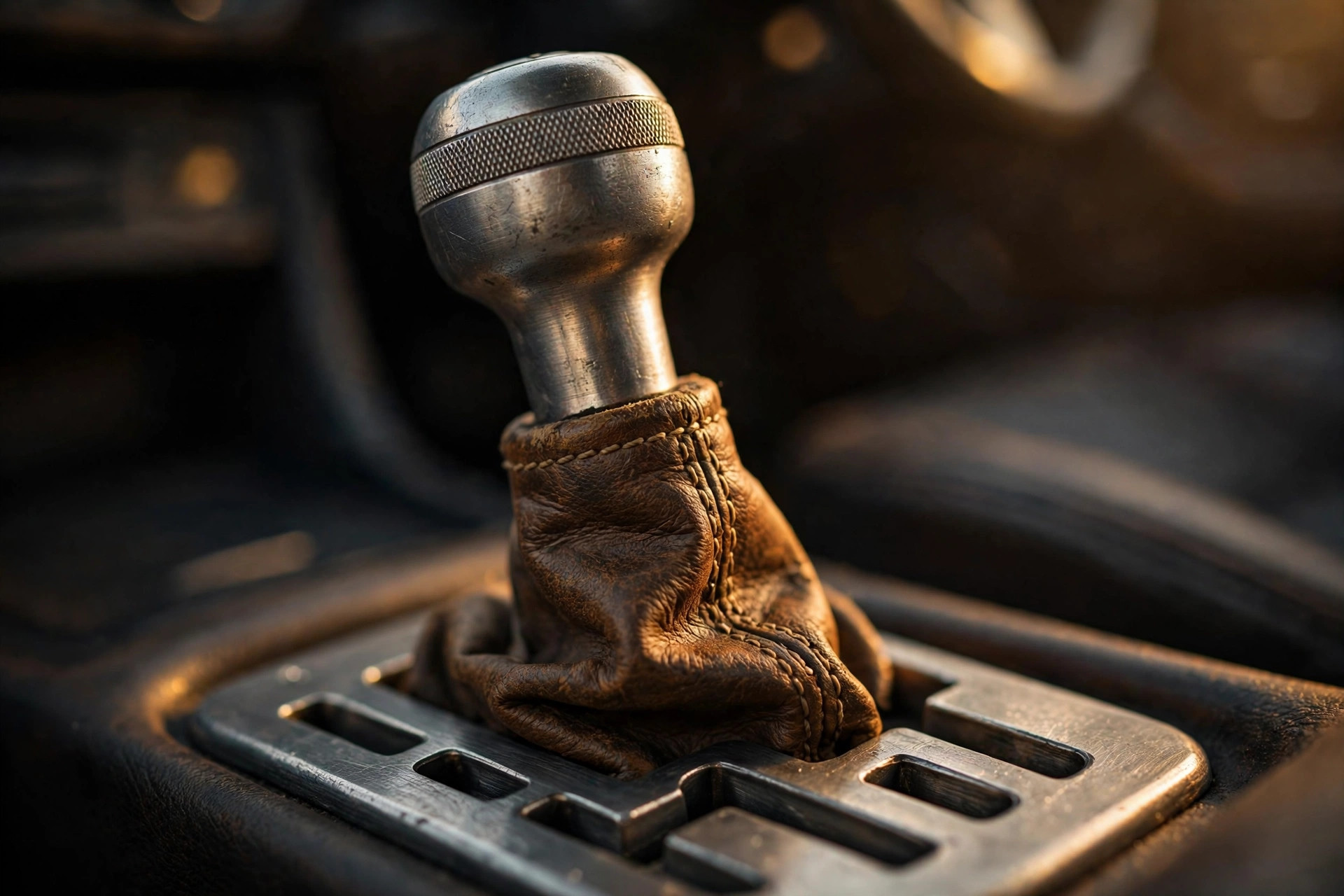
Mode three is the one that matters: engage it and the third pedal wakes up as a clutch in the full sense, with bite point and slip rendered in software rather than enforced by physics. Gone is the monostable switch that springs back to center. In its place: a multi-stable lever that stays where the driver puts it, and a shift pattern that becomes a genuine H-gate, which means the lever now has a memory of where it is, the one thing a monostable switch can never have. Motors and springs would simulate the effort of moving the lever through the gates, and the detents that tell your hand where each gear lives, which means the entire tactile vocabulary of the manual transmission, learned over decades of machined metal and spring steel, would be re-created as a software output. Row through the pattern and the car behaves, from the driver's seat, like a three-pedal manual, which is precisely the trick: the driver's seat is the only place where any of this is true.
From the gearbox's perspective, nothing has changed. Same dual clutches, same gear trains, same hardware, all of it running under a control layer the driver never sees, which is why the patent can promise three transmissions while developing zero.
The Lever That Changes Its Mind
That lever deserves a closer look, because it is the hardest part of the whole scheme to execute convincingly. A conventional PDK selector is monostable: you nudge it and it returns to center, because its position carries no information, the transmission's state living entirely in software, which is why the lever can afford to forget where it has been. It already knows what gear it is in. A manual shifter works the opposite way: its position is the information, which is why you can feel third gear without looking, and why mis-shifts happen when tired hands misread the gate.
Porsche's filing proposes a selector that switches between these two philosophies on command, a lever that is a forgetful switch in one mode and a positional instrument in another. In automatic and sequential modes it behaves like today's lever, springing back to center and carrying no positional information, but in manual-simulation mode it becomes multi-stable, holding its position in the gate like a proper shifter. A companion filing at the German patent office describes a two-zone selector, splitting the lever's job into two distinct regions with two distinct jobs, because a lever that must be both a direction switch and a gear shifter needs, essentially, two personalities and two places to keep them. One zone handles the D, N, and R positions, while the other repeats an H-gate for the numbered gears, giving the driver a dedicated region for choosing modes and a dedicated region for driving. Think of it as two shifters sharing one stalk. Software decides which one you are holding. Then comes the haptics problem.
A real H-gate has detents machined into metal. Springs and interlock pins create the resistance profile your hand learns over thousands of shifts, the little wall between second and third that keeps you honest, the spring-loading that centers the lever in the 3-4 plane. Porsche's patent proposes faking all of it with motors and springs under software control, which turns the shift lever into a haptic display, a device whose feel is rendered rather than machined, and the quality of that rendering, the resolution of the force feedback, the latency between hand and response, is the entire difference between a convincing illusion and an expensive joke.
This is force feedback, the same engineering discipline as a sim-racing wheel or a fly-by-wire sidestick: done well, it is convincing, and done cheaply, it is the uncanny valley with a shift knob. Nobody outside Weissach knows which of those two outcomes Porsche can actually build, because nobody outside Weissach has touched the hardware, and the patent is silent on the only variables that determine feel: actuator bandwidth, force resolution, and latency.
The Hybrid Problem Is the Real Story
Strip away the theater and the patent is solving a packaging problem, not a philosophical one. In the 911's T-Hybrid system, the electric motor integrates directly into the dual-clutch transmission housing, an elegant piece of packaging that puts torque-adding hardware exactly where it can do the most good with the least additional mass, cooling, or structure. That integration is elegant engineering. The motor sits where it can add torque without a separate housing, cooling circuit, or mounting structure, which is the kind of packaging win that engineers frame and hang on walls. It is also fatal to any conventional manual, because a manual needs a flywheel and clutch assembly in exactly the space the motor now occupies, plus a mechanical linkage path from the cabin to the gearbox that the hybrid architecture never provided.
There is no room. Not in the "it would be expensive" sense or the "take rate is too low" sense, though both are true, and no amount of wishing changes the geometry. There is physically no room. Physics does not negotiate.
Last month, Porsche Cars North America CEO Timo Resch said the quiet part out loud, in an interview, on the record, which is why this filing reads less like idle speculation, even if a patent is still a long way from a plan. The current hybrid setup cannot be paired with a manual gearbox, though he added that he hopes the engineers will find a way around the problem, which is exactly the kind of executive wish that becomes a patent filing six months later. This patent appears to be that way around. If the pedal and lever are input devices rather than linkages, the packaging constraint evaporates, because input devices can live anywhere and need only wires, while linkages need a physical path through a crowded machine. Drivers get their three pedals, the hybrid keeps its motor, and nobody has to redesign the transmission housing, which is the single most expensive component decision in the whole vehicle. Nothing else has to change.
That last point is the economic engine of the entire filing, and it is worth stating plainly: no new transmission gets developed here, which means no new transmission gets homologated, tooled, or crash-tested either, which is where the real money goes in any transmission program and the reason this patent might actually become hardware while a hundred cleverer gearboxes never left the drafting table. Developing a true manual rated for modern torque figures, then homologating it for emissions and crash across every market, for production volumes in the low thousands, is the kind of math that kills gearboxes. Porsche's approach keeps one transmission family and changes what the driver touches, which is the cheapest possible place to innovate, because sheet metal and software cost nothing next to a new gearbox program, which routinely runs into the hundreds of millions once you count tooling, validation, durability testing, and the emissions certification that follows every hardware change. Hardware stays exactly as it is; only the interface multiplies, which is the oldest trick in the platform playbook: one expensive thing underneath, many different feelings on top.
A Patent That Admits Feelings
Patent background sections are usually dry recitations of prior art, but this one's problem statement is startlingly human. Drivers who grew up with manual gearboxes, according to reporting on the filing, rate any two-pedal vehicle as less sporty and less emotional regardless of shift mode, which is an extraordinary sentence to find in a patent background section, where the usual language concerns prior art and technical deficiencies rather than the inner life of the driver. Read that again. Porsche's engineers wrote, in a legal document, that the problem they are solving is emotional, and once you have admitted that the design constraint is a feeling, the entire engineering trade space reorganizes itself around a question no dynamometer can answer.
It is worth sitting with how unusual that is. Dual-clutch history is a story of measurable superiority. Faster shifts than any human, no torque interruption, better fuel economy, launch control, and every instrumented test ever run agrees, which is why the manual's survival cannot be explained by engineering and has to be explained by people. Every objective metric says the PDK won a decade ago. And yet the take rate on real manuals, where Porsche still offers them, refuses to die, which tells you everything about what customers actually buy when they buy a sports car. Feelings are a design constraint now. Porsche just spent patent attorney hours proving it.
They are right to treat it as one. Nobody ever loved a car because its shift times were optimal.
The Precedents, Ranked by Honesty
Porsche is not the first to this idea, and the company knows it. Ferrari's 12 Cilindri Manuale, which we covered in detail, grafts a by-wire shifter and clutch pedal onto the existing eight-speed dual-clutch: no mechanical connection between the driver's inputs and the gearbox, sensors and software doing all the work. Ferrari charges supercar money for 1,499 cars and calls it a manual, which is real engineering wrapped around an imaginary linkage, and the people who bought them seem delighted anyway.
Koenigsegg got there with more ambition: its CC850 runs nine automatic ratios or six "manual" gears within the same Light Speed Transmission architecture, rowed via paddles. We have been through that gearbox's internals before. It is the closest thing on sale to what Porsche is patenting, except Koenigsegg never pretended the clutch pedal was doing anything, because there isn't one.
Even the mainstream is circling, with Hyundai's Ioniq 5 N simulating gearshifts and rev-matching in an EV that has a single-speed reduction gear and nothing to shift, and reviewers keep admitting it is fun. Across the industry, a quiet consensus has formed: the sensation of shifting is separable from the mechanism of shifting, and customers will pay for the sensation.
What distinguishes Porsche's filing from all three is scope: Ferrari built one mode, Koenigsegg built a party trick for a hypercar, and Hyundai built a toy, while Porsche is patenting a universal interface, one unchanged gearbox with three personalities, designed to span combustion and hybrid powertrains across an entire product line. If it ever ships, it would be the first by-wire manual designed as a platform rather than a novelty, which is the difference between a curiosity for 1,499 collectors and a transmission strategy for the next decade of Porsche sports cars.
What the Simulation Cannot Do
Now the part the patent will never address, because patents describe mechanisms and this is about meaning. In mode three, your left foot makes requests, not commands, and that single distinction, request versus command, is the entire philosophical content of the patent. Sensors read the pedal, the transmission control unit interprets the request, and software decides the timing of the clutch engagement, which means the most analog-feeling part of the car is now a digital negotiation. Your foot is advisory; the computer, authoritative.
Follow that to its conclusion and the picture gets uncomfortable. A real manual can be stalled. It can be money-shifted from fourth to first at redline, with mechanical consequences the driver pays for, which is precisely what makes the real thing thrilling and the simulation safe. Those failure modes are not bugs in the manual transmission experience; they are the experience, the part of driving a manual that makes it a skill rather than a gesture. A perfect heel-and-toe downshift pleases precisely because getting it wrong has a cost, and a system that cannot let you get it wrong cannot let you get it right either, not in the way that matters. Remove the cost and you have removed something load-bearing, which is why every safety system ever designed eventually has this same argument with its users.
Porsche would never ship a system that lets software pass through a driver's catastrophic error, because the warranty claims alone would end the program before the first review was published. That protection is the arbitration layer's whole point, the computer standing between the driver's intentions and the hardware's survival, which is exactly what makes the system safe and exactly what makes it something other than a manual. So the simulation is, by design, a manual transmission from which all danger has been removed, which makes it safer than the original in exactly the way a photograph of a mountain is safer than the mountain. Whether the ritual survives the removal of the risk is not an engineering question, and it is the reason this patent will be argued about in forums long after the hardware details are forgotten. It is the only question that matters, and no patent can answer it.
There is a narrower, more technical version of the same doubt, and it concerns what happens to driver skill when the filing assigns rev-matching, clutch timing, and the entire choreography of the downshift to software. Rev-matching, clutch timing, the choreography of a downshift: the filing says software handles all of it, which leaves the driver as the conductor of an orchestra that is playing itself. At that point the driver's skill contribution is reduced to choosing when, which is still a skill, just a much smaller one than it used to be. The machine handles how. That is already true of every modern rev-matched manual, and enthusiasts made their peace with it years ago, which suggests the ghost clutch is not a rupture but the next step in a surrender that began the day computers learned to blip the throttle. In the end, the ghost clutch just completes the journey the rev-match started, the slow migration of driving skill from the driver's hands into the car's software, one actuator at a time.
My read: this is the right engineering answer to the wrong era's question, because the era that wanted manuals is ending for reasons no interface, however clever, can reverse. Manuals died the day the electric motor moved into the gearbox housing; everything since has been grief management. Porsche's grief management is more sophisticated than most, because it preserves the choreography, the third pedal, the H-gate, and the left-foot muscle memory built over decades of driving, while quietly accepting that the one thing it cannot preserve is the consequence. It cannot preserve the stakes, and nothing by-wire ever will.
Whether that is enough depends on what you thought the manual was for, and if your answer is the feeling of mastery, the ghost clutch might be enough, but if your answer is the mastery itself, it never will be.
Limitations Worth Stating
A patent is not a product. DE102025109563A1 names no model, no timeline, and no production intent, and the enthusiast press has been careful to say so, because a patent is a legal claim about an idea, not a product announcement, and the distance between those two things is where most automotive patents go to die. Everything about the haptic quality, the thing the entire concept stands or falls on, is undescribed in the public reporting: motors and springs can mean anything from exquisite to awful. I have not seen the filing's full text beyond the reported summaries, have not touched the hardware, and neither has anyone outside Porsche. Both the T-Hybrid packaging conflict and Resch's August remarks are documented. Everything else here is informed reading of a clever document.
Sources
- German Patent and Trade Mark Office (DPMA), publication DE102025109563A1 (September 20, 2026): dual-clutch transmission with three selectable operating modes, shift-by-wire control layer, monostable-to-multi-stable selector conversion, clutch-pedal sensor input with software-arbitrated clutch timing, lever effort and detents simulated by motors and springs, applicability to combustion and hybrid powertrains. First surfaced by CarBuzz; mode details via Hypebeast and AutoGuide reporting.
- Car Revs Daily (September 22, 2026): two-zone selector concept from a companion German patent office filing (separate D/N/R zone and H-gate zone for numbered gears); no production model or timeline disclosed in the filing.
- Carscoops (September 2026): T-Hybrid incompatibility rationale, electric motor integrated directly into the dual-clutch unit; Porsche Cars North America CEO Timo Resch's August 2026 remarks that the current hybrid cannot pair with a manual while expressing hope engineers would find a solution.
- AutoGuide (September 2026): patent status disclaimer; sequential-mode behavior including paddle-initiated temporary sequential operation.
- Efficient Design, "No Clutch Plate, No Synchros, No Mechanical Link: How Ferrari Engineers Haptic Deception into a Dual-Clutch Gearbox": the 12 Cilindri Manuale precedent, 1,499-unit run, by-wire shifter and clutch on the existing eight-speed DCT.
- Efficient Design, Koenigsegg Light Speed Transmission coverage: CC850's nine-automatic / six-manual architecture as the closest existing implementation of a multi-personality gearbox.