Above the 911: Porsche's Flat-Eight Gets a Second Chance
Porsche confirmed a mid-engine halo supercar above the 911, previewed by the Mission S concept on October 15. Handelsblatt reports a twin-turbo flat-eight under the skin, which would be the first production Porsche road car with eight cylinders in a boxer layout. The engine won Porsche's only Formula 1 race in 1962, then spent sixty years waiting for a chassis wide enough to hold it.
A rumor with a pedigree
October 7, at the Weissach Capital Markets Day, Porsche CEO Michael Leiters confirmed what the rumor mill had been chewing on for a year: the company is developing a mid-engined super sports car platform, positioned clearly above the 911, and will preview it with the Mission S concept on October 15 in New York. It would be the first range-topping halo since the 918 Spyder, and the first time Porsche has ever announced a flagship explicitly meant to outrank the 911.
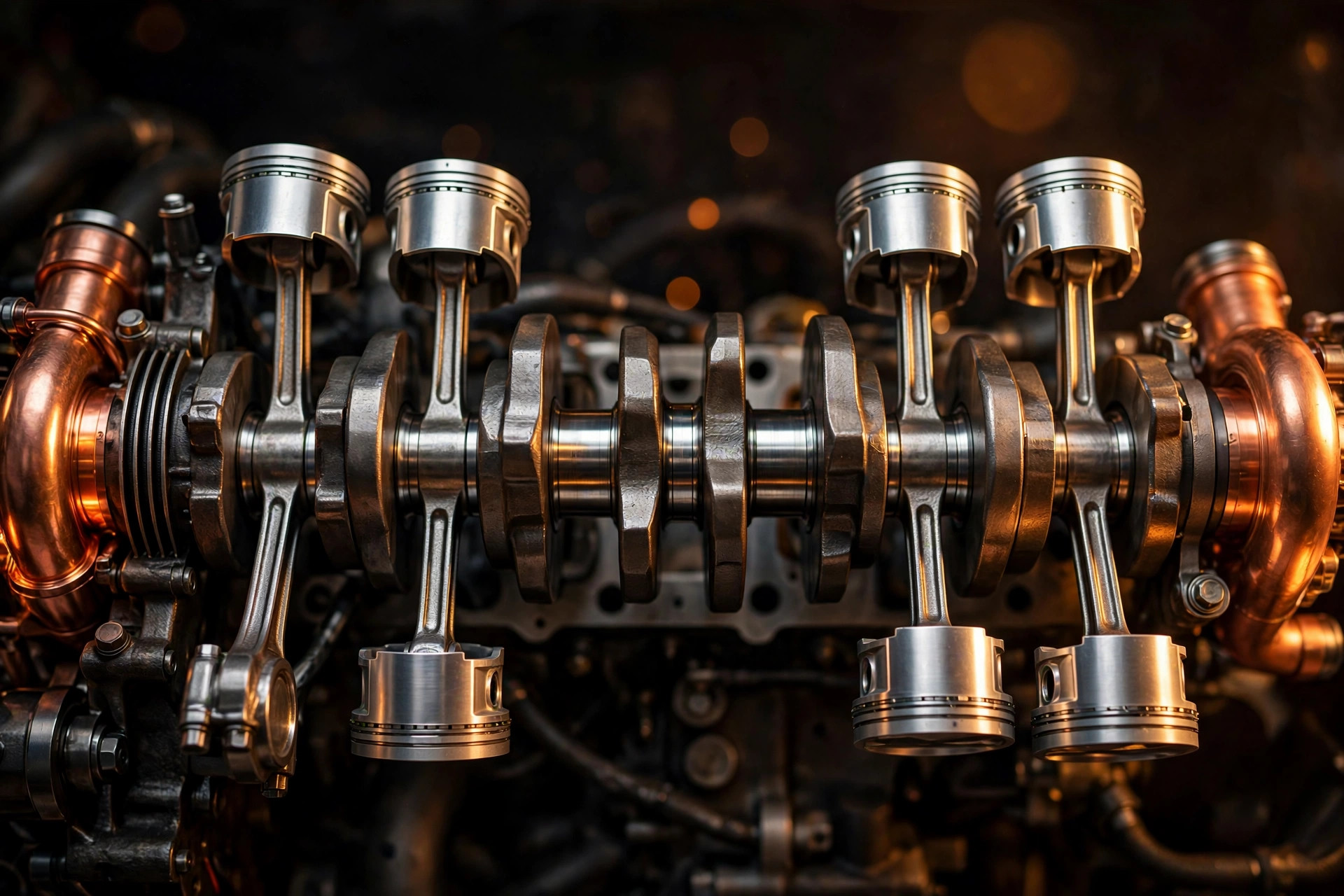
What engine goes in it is unconfirmed, which is where the story gets good. In September, the German business daily Handelsblatt reported that the car, codenamed S1, will use a twin-turbo flat-eight. A boxer with eight cylinders. If accurate, it ends a drought that has lasted the entire history of the company: Porsche has built flat-eight engines for Formula 1 cars, sports racers, and one-off experiments, but never for a production road car.
One competing report says Leiters favors a V8, possibly the flat-plane crank unit from the Lamborghini Temerario, Porsche's corporate cousin. That rumor has the smell of platform economics, since VW Group parts sharing is an explicit pillar of the new strategy. Both stories cannot be true, and I know which one I want to be true, because only one of them makes the car a Porsche rather than a very expensive Audi parts bin.
The engine that won once, then vanished
Hans Mezger designed the Type 753 in 1960 for the 1.5-liter Formula 1 formula: 1,494 cc, four camshafts, two valves per cylinder, air-cooled in an era when everyone else had given up on air. It made 180 horsepower at 9,200 rpm from a package that weighed 341 pounds with exhaust and clutch, riding in a magnesium crankcase with a one-piece crankshaft running in nine main bearings and titanium connecting rods.
Building one took between 100 and 220 hours of hand-fitting. On its debut at Zandvoort in May 1962 it was already down on power against the Coventry-Climax and BRM V8s, which is the polite way of saying it was outgunned from the first green flag. Then Dan Gurney won the French Grand Prix at Rouen in July, Porsche's only victory as a Formula 1 constructor, and the company withdrew from F1 at the end of the season anyway. Ferry Porsche decided the money was better spent on sports cars.
It refused to die quietly. A 2.0-liter derivative, the Type 771, made 240 horsepower and powered the 904, 906, 910, 907, and the featherweight 909 Bergspyder through the late sixties. Two experimental 914/8 road cars got detuned versions, one of them built as Ferry Porsche's 60th birthday present, which remains the closest any flat-eight has come to a license plate. More recently, Porsche built a 5.0-liter twin-turbo flat-eight making around 750 horsepower and 738 lb-ft, revving to 9,000 rpm, and tested it in a Cayman-based mule with rear-wheel drive and a manual gearbox. That project never reached production.
Why the chassis matters more than the cylinders
A boxer engine is wide and short, and that geometry has been the flat-eight's enemy for six decades. In a rear-engine 911 the width hangs behind the rear axle, exactly where you least want mass. A former VW Group powertrain chief once said the 5.0-liter prototype was probably too big for the 911, which reads as a packaging verdict: the engine fits fine, the car does not.
A dedicated mid-engine platform inverts the problem. Width sits between the axles, where the body is already wide for the cabin, and the short crankshaft keeps the mass concentrated near the yaw axis. That low profile, the whole reason Porsche clings to the boxer layout, drops the center of gravity below what any V8 of equal displacement can manage. None of this works in a 911. All of it works in a car drawn around the engine from a blank sheet.
Balance is the other half of the argument, and it is the part the V8 rumor gets wrong. In a boxer, each piston's twin reaches top dead center at the same instant on the opposite bank, so primary forces cancel without balance shafts or counterweight theater. A flat-plane V8, the Temerario unit included, shakes at twice crankshaft speed by geometry, and manages it with stiff mounts and engine calibration rather than symmetry. Porsche has spent seventy years arguing that the boxer's smoothness is worth its width. Abandoning that argument for the company's flagship would be a strange way to celebrate it.
The turbochargers already exist
Here is the part of the rumor that makes me take it seriously: Porsche already knows how to turbocharge a flat engine better than anyone alive. The 992.2 911 Turbo S runs twin electric turbochargers, motors on the shafts spinning the compressors to 145,000 rpm before exhaust gas arrives, erasing the lag that defined turbocharged engines for forty years. Port that hardware to a flat-eight and the packaging writes itself, with turbos mounted low and outboard on short exhaust primaries, each feeding four cylinders with almost no plumbing between the ports and the turbine.
Heat is the tax on that layout. A wide engine in a mid-engine bay concentrates exhaust temperature exactly where the bodywork is thinnest, and a halo car cannot afford the heat soak that melts a track day. But the electric turbo solves half the thermal problem by harvesting exhaust energy into the hybrid system instead of dumping it as backpressure, and the reported 1.9 kWh battery architecture from the Turbo S program scales directly. French reporting already expects electric assistance on the S1 to match hybrid rivals. Every piece is already on Porsche's shelf.
That shelf is the real story. A twin-turbo flat-eight hybrid does not require Porsche to invent anything. It requires the company to assemble technologies it already ships: the boxer layout, the eTurbo hardware, the compact hybrid battery, the PDK. With the 918 Spyder, Porsche already proved it can build a halo car from its own parts. Now the Mission S gets to prove the company can build the engine it has been rehearsing for sixty years.
What we do not know, stated plainly
Everything about the powertrain is rumor until October 15 at the earliest, and possibly for months after. Porsche's official language says "potential" platform, not confirmed production car. No displacement, no output figure, no gearbox, no weight, no price, no date. Maybe the flat-eight is a beautiful fiction planted to keep the V8 story interesting. Maybe the V8 is the fiction. I have handled neither, driven neither, and seen nothing beyond a blurred teaser.
What is confirmed is the strategy around it. Sportwagenschmiede '35, the sports car forge, commits Porsche to fewer, more expensive cars: break-even below 200,000 units a year against 279,449 delivered in 2025, top-model prices up around 20 percent, a fifth fewer variants, and at least one brand-defining product every year through 2030. The 718 goes electric-only in 2028, the 911 will never be electric according to Leiters, and the combustion flagship sits at the top of a lineup with a mid-engine car at each end. Ferrari is the named reference point in the presentation, which tells you exactly who this car is aimed at.
My read: the flat-eight is the only choice that justifies the platform. A shared VW Group V8 would make the S1 a faster, prettier parts-bin special, and Porsche does not need a new platform to build that. The flat-eight gives the car an engineering story no rival can copy, because no rival has sixty years of flat-eight drawings in the vault. Porsche tried the sensible engine in 1962 and won once. Time to try the romantic one.
| Engine | Displacement | Output | Application |
|---|---|---|---|
| Type 753 | 1.5 L flat-eight | 180 hp @ 9,200 rpm | 804 F1, 1962; Porsche's only F1 win (Gurney, French GP) |
| Type 771 | 2.0 L flat-eight | 240 hp | 904, 906, 910, 907, 909 Bergspyder, 1962-68 |
| 914/8 (experimental) | 2.6-3.0 L flat-eight | ~260-300 hp | Two road cars, one a gift to Ferry Porsche |
| 5.0 L twin-turbo prototype | 5.0 L flat-eight | ~750 hp, 738 lb-ft @ 9,000 rpm | Cayman-based mule, RWD + manual; never produced |
| S1 (reported) | Undisclosed | Undisclosed | Mission S concept, October 15, 2026; twin-turbo per Handelsblatt |
Sources: Traction, Mission S preview (October 2026); Auto Express, Mission S confirmation (October 7, 2026); Porsche flat-eight engines, specifications and history; Porsche Newsroom, Typ 804 specifications; WhichCar, Sportwagenschmiede strategy.