The Cathode Is the Whole Bet: Porsche's 100 Percent Recycled Battery Cells
Recycling an EV battery is the easy part. Grinding it up, extracting the metals, selling them on: that is the business almost everyone is in. What Porsche and cylib announced on September 17 is the hard part, turning recovered lithium, nickel, cobalt, and manganese back into cathode active material pure enough to build a new cell around, with no virgin material in the mix at all.
What Was Actually Announced
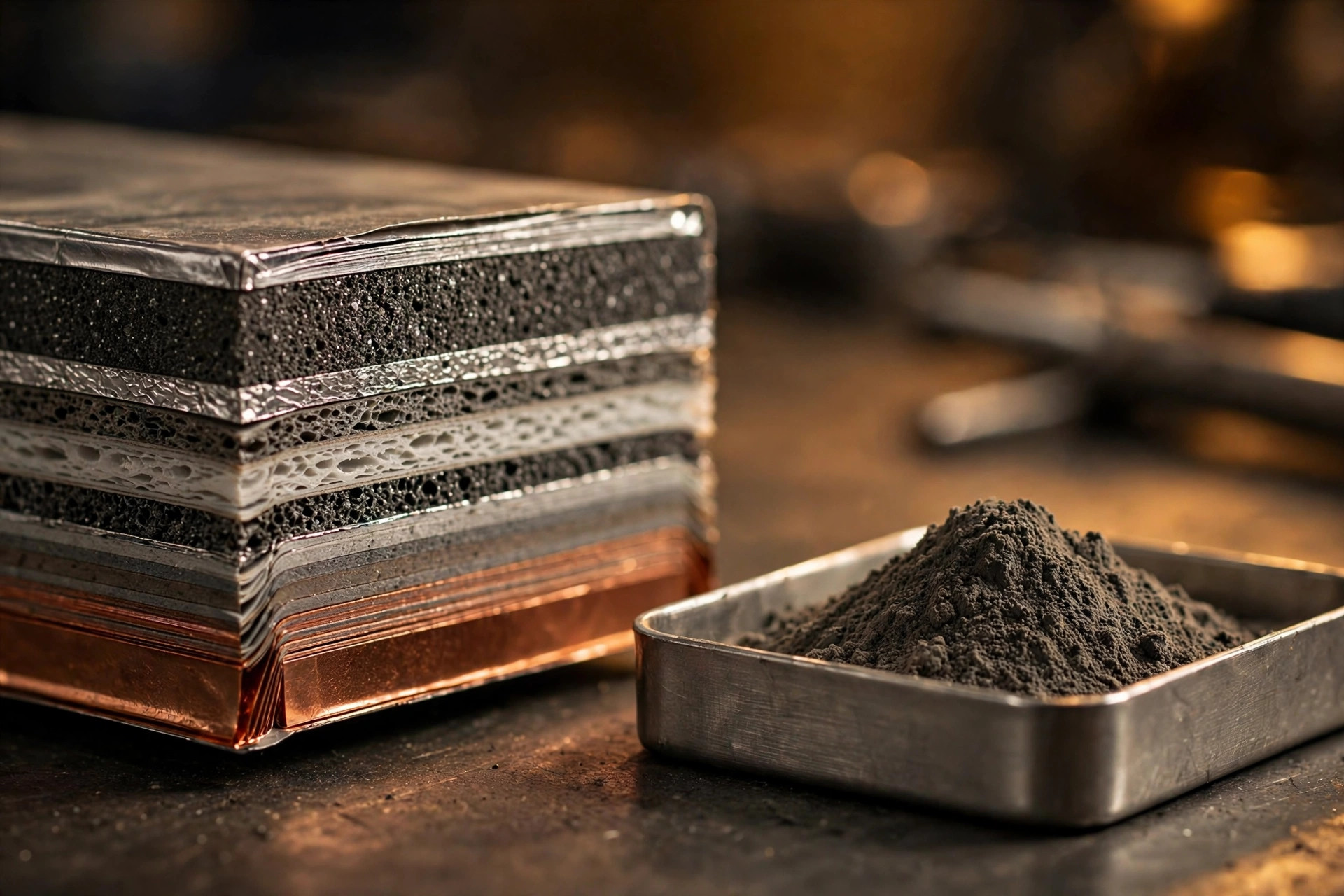
Strip the announcement down to its load-bearing sentence and it reads like this: for the first time, battery cells have been produced whose cathode active material comes entirely from recycled raw materials recovered from Porsche's own high-voltage batteries. Not from a blend, and not from recycled metals topped up with virgin feedstock: entirely.
That is the milestone, and it is worth being precise about its boundaries, because "100 percent recycled battery" would be a much bigger claim than what Porsche made, and confusing the two is exactly what most coverage will do. Here is the honest reading: the cathode active material, one component of the cell, now fully replaces primary raw materials within the pilot. Everything else in the cell, anode, separator, electrolyte, housing, is not part of the claim. Cells built around this recycled cathode are now undergoing extensive operational testing in Porsche test vehicles, which is the correct thing to do before anyone talks about production.
Context helps. Porsche and cylib launched the high-voltage battery recycling pilot last year, collecting end-of-life packs from Porsche Centres across Germany. Since May 2026 the packs have been processed through what Porsche calls an innovative water-based process. Recovered raw materials are tracked in a dedicated material account managed by cylib, covering lithium, nickel, cobalt, and manganese separately, and Porsche says the material stream will be available for new cell production from 2028 onward. Joachim Scharnagl, Porsche's board member for procurement, called the recycled-cathode cells "an important technological milestone." Dr. Lilian Schwich, cylib's co-CEO and co-founder, framed it as proof that the loop "from end-of-life batteries to recovered raw materials" can close in practice.
One sentence of limitation, stated early because it matters: no performance data accompanied the announcement. No capacity retention figures, no fast-charge curves, no cycle-life counts, no cold-weather behavior, no cost. Initial tests have "indicated the technical feasibility," with further results expected in the second half of 2026. Pilot scale, single recycler, 2028 as target rather than commitment. I will come back to what is still missing. First, why the cathode is the prize.
Why the Cathode, Not the Pack
Inside a lithium-ion cell, the cathode is where the money lives. Cathode active material typically accounts for roughly half the cell's cost and almost all of its strategic vulnerability: it contains the lithium, nickel, cobalt, and manganese whose mining and refining concentrate in a handful of politically complicated regions. Anode graphite has its own supply concerns, but graphite does not set the cell's energy capacity the way the cathode's chemistry does. Change the nickel fraction in an NMC cathode and you change how far the car goes. That leverage is the whole game.
Which makes the cathode the correct place to close the loop. A recycler can extract metals from black mass all day and sell them into the open commodity market; that is open-loop recycling, and it is commercially proven but strategically thin. Every recovered kilogram that leaves for the spot market is a kilogram Porsche still has to buy back somewhere else, along with the price volatility and the geopolitics. A closed loop, Porsche batteries in, Porsche battery material out, is fundamentally a supply-chain resilience play wearing a sustainability costume. Both motives are real. Resilience is the more interesting one.
None of this is controversial, which is why the announcement deserves a sharper reading than the congratulatory one it will mostly get. If the cathode is the most valuable part of the cell and the most exposed part of the supply chain, then producing new cathode material entirely from recycled metals is not a side project. It is the exact step an automaker serious about controlling its mineral future has to take.
Purity Is the Milestone, Not Recovery
Here is where the engineering story actually sits, and where the announcement says just enough to let a careful reader reconstruct it. Extracting metals from dead batteries is not the hard part. Mechanical shredding produces black mass, a dark powder rich in everything you want, and hydrometallurgical leaching has been pulling metals out of it for years. Hardest is what comes after: producing battery-grade cathode precursor from the recovered metals, with impurity levels low enough that the finished cathode behaves like one made from virgin material.
That is a purity bar measured in parts per million. NMC cathode precursors are made by co-precipitation, where nickel, manganese, and cobalt are crystallized together in tightly controlled ratios, and the process is brutally unforgiving of contamination. Iron, copper, aluminum, silicon, even traces of elements that ride along from the shredding and dismantling stages will embed themselves in the crystal structure and degrade the cathode's capacity, cycle life, or safety. Battery-grade specifications for lithium salts run to impurity limits that look absurd until you remember that one bad element distributes itself across millions of cells. Porsche's language gives this away quietly: "placing a strong emphasis on the quality of the recycled materials" and "ensuring that the recycled raw materials meet Porsche's high standards for value, quality and performance." That is the voice of a company whose real fear is a cathode that passes a chemical assay and fails a cycle-life test.
So the milestone that matters is not "recycled lithium exists." It is that the recovered metals were refined, presumably through cylib's hydrometallurgical process, to a purity where they could be synthesized into cathode active material with zero virgin content, and the resulting cells were judged good enough to put into test vehicles. That is the first time anyone has cleared that specific bar in this loop, and it is a genuinely hard piece of chemical engineering. Shredding was never the question; crystal chemistry was.
One related note, because the press materials invite it: cylib emphasizes a water-based process. Without published process parameters I will not speculate on what "water-based" excludes or how it compares to acid-intensive conventional hydrometallurgy, except to say the direction is sensible, since the acid loads of traditional leaching are the environmental weak point of the whole recycling chain. A label remains just a label. What counts is whether the output meets battery-grade spec, and that judgment belongs to the test results Porsche says are coming in the second half of 2026.
The Material Account, Quietly the Most Interesting Part
Buried in the announcement is a mechanism that deserves more attention than the headline: cylib manages the recovered materials through a dedicated material account, with lithium, nickel, cobalt, and manganese tracked separately, and the recovered stream earmarked for cell production from 2028. Think of it as a bank account for atoms. Material goes in with a provenance record, sits in an account, and gets drawn down when it enters new production, and the chain of custody is auditable end to end.
Why does that matter? Because closed-loop claims are only as credible as their bookkeeping. Industry-standard practice, mass-balance accounting across a pooled commodity stream, lets a producer claim recycled content while the actual recycled atoms may never touch their products. A dedicated material account with per-element tracking is the stronger design: it says these specific grams of nickel came out of Porsche packs and went into Porsche cathode material, not merely that an equivalent tonnage was recycled somewhere. Against the European Union's battery-passport requirements, which arrive ahead of the 2028 target and will demand exactly this kind of documented provenance, the material account looks less like a nice extra and more like the load-bearing infrastructure for operating in Europe at all.
There is a fair objection. Dedicated accounting is more expensive than pooled accounting, and the industry's history with "traceable" supply chains, conflict minerals in electronics being the cautionary exhibit, suggests that paperwork and physical reality diverge under cost pressure. That defense is narrower: the loop is small, geographically concentrated, and physically auditable in a way that global mineral chains are not. Germany in, Germany out. That is the advantage of the pilot's modesty, and it is worth more than the announcement's ambition.
What the Announcement Does Not Tell You
Scholarly honesty demands the gap list, and it is a real one. Nothing was disclosed about which cathode chemistries were reproduced: the NMC ratios, whether the recycled material matched virgin-material spec on capacity and voltage curves, whether fast charging stresses it differently. Nothing about cycle life, calendar aging, or cold-weather behavior. Nothing about cost, which is the number that decides whether closed-loop cathode material survives contact with series production. And nothing about scale: a pilot line in Aachen producing test cells is not a supply chain, and 2028 is a stated target for material availability, not a production commitment.
Also unstated is the feedstock question that determines whether any of this scales. End-of-life Porsche packs arrive in modest numbers today, because the Taycan and its siblings are young and EVs mostly die old or by accident. A recycling loop fed by warranty returns and early retirements has a thin input stream. Industry-wide, the feedstock wave from the first mass-market EV generation reaching end of life is still years out. Porsche knows this. This pilot builds capability ahead of the wave, which is the correct sequence, but judging the project by today's throughput misses the point. Capability first, volume later.
So: treat the announcement as a chemistry milestone with an auditable bookkeeping design, not as a production plan. If the test results in the second half of 2026 show the recycled-cathode cells holding their capacity curves, that will be the real news. Everything before that is a down payment.
Why This One Matters More Than the Recycling Headlines Usually Do
Most battery-recycling announcements are recovery stories: tons processed, recovery rates, new plants. They answer the question "where do dead batteries go?" Porsche and cylib are answering a different question: "can a dead battery become a new battery, with no new minerals, at battery-grade quality?" That is the difference between waste management and materials science, and it is the difference this site exists to cover.
Verdict, stated outright: the technical achievement is real and correctly scoped, the bookkeeping design is the part the industry should copy, and the supply-chain logic is sound. Missing performance data is the only thing standing between this and a genuine breakthrough, and Porsche has promised it within months. I will be watching for the cycle-life numbers, because that is where recycled cathodes have historically failed. If the cathode holds its curve, this stops being a pilot and starts being a template.
| Specification | Porsche x cylib Closed-Loop Cathode Pilot |
|---|---|
| Announcement | September 17, 2026 (Porsche Newsroom) |
| Milestone | First battery cells with cathode active material from 100% recycled raw materials |
| Recovered metals | Lithium, nickel, cobalt, manganese (from Porsche HV batteries) |
| Feedstock | End-of-life HV batteries from Porsche Centres across Germany |
| Process | Water-based recycling in operation since May 2026; cylib hydrometallurgical refining |
| Traceability | Dedicated material account, per-element tracking (Li, Ni, Co, Mn) |
| Current status | Cells in extensive operational testing; further results expected H2 2026 |
| Scale target | Recovered materials available for cell production from 2028 |
| Recycling partner | cylib (Aachen, founded 2022; dismantling Wernberg-Koeblitz, hydrometallurgical processing in Dormagen under development) |
Battery recycling has had a decade of recovery headlines. This is the first closed-loop headline that is actually about the battery, not the trash. The cathode was always the whole bet, and for the first time, the bet is placed with recycled metal. Now we find out whether the crystal chemistry agrees.
Sources: Porsche Newsroom, "From Porsche to Porsche: Next Milestone in Battery Recycling" (17/09/2026, via newsroom.porsche.com); Autoblog, "Porsche Has Found a Way to Turn Dead EV Batteries Into New Battery Cells"; Primary Ignition, "Porsche cylib Battery Recycling Loop Closes With 100% Recovered Cathode" (Sep 19, 2026); Electric Hunter, "Porsche Turns Old EV Batteries Into New Battery Cells". No performance data (capacity, cycle life, fast charge, cost) disclosed in the announcement. Cells not handled; chemistry details from manufacturer materials only.