Twice-Mined: Porsche's 100%-Recycled Cathode
On September 17, 2026, Porsche announced something the industry has been promising for a decade: battery cells whose cathode active material is made entirely from recycled raw materials. No newly mined lithium, nickel, cobalt, or manganese. Porsche says the chemistry works. Now comes the harder question, whether it works at scale, for thousands of cycles, through a winter.
What the Announcement Actually Claims
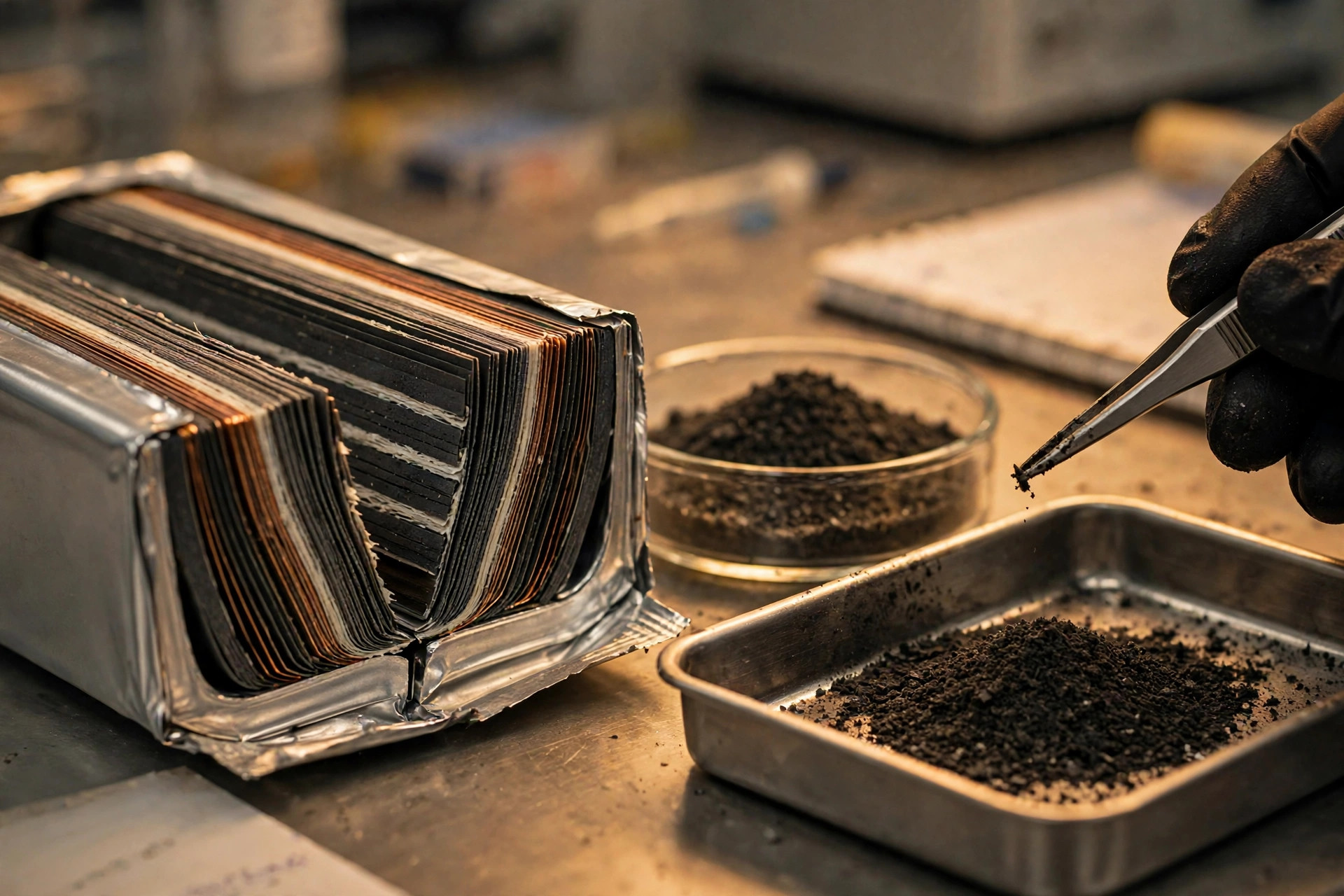
Precision matters here, because the press release is easy to misread, and the misreading is the flattering one. Read the claim, not the headline: Porsche did not announce a battery pack made wholly from old packs. It announced cells whose cathode active material, the positive-electrode powder that largely determines a cell's energy capacity, power behavior, and cost, was produced from 100% recycled raw materials, lithium, nickel, cobalt, and manganese recovered from Porsche's own end-of-life high-voltage batteries. The remaining cell components, anode, separator, electrolyte, housing, stay resolutely conventional, which is exactly the point: the cathode was always the hardest part, so that is where the recycled claim has to live if it is going to mean anything. That narrower claim still counts, because in a nickel-manganese-cobalt lithium-ion cell the cathode is the most chemically demanding component to manufacture and the one where recycled feedstock has historically failed. Smelt an old pack and you recover most of the metals, but the output is a mixed alloy that still has to be refined again before it qualifies as cathode feedstock, and the lithium slags off and is effectively lost. That is the crude end of the business, and it cannot recover the full cathode bill of materials.
Dissolve it, separate the metals, purify them to battery grade, re-precipitate them into precursor, and you are doing real chemistry rather than scrap dealing. Crossing that line with zero primary extraction inputs is the milestone. One caveat rides with it: no independent assay data or third-party verification of the 100%-recycled claim has been published. The claim rests on Porsche's own reporting and the bookkeeping of its dedicated material account. It deserves to be stated, not assumed.
The cells are currently undergoing extensive operational testing, and Porsche has not released capacity retention curves, fast-charging behavior, cycle-life figures, cold-weather performance, or cost data. Making one good batch proves chemistry. Making thousands of consistent batches at a competitive cost, with every batch clearing the same impurity spec as the last, is what proves a business. That missing data is the entire difference between an encouraging lab result and a bankable production process, and any honest writeup of this story has to say so up front, which is why the absence of numbers in the announcement is itself the most important number.
Why Cathode Purity Is the Bottleneck
Recycling a battery is easy. Recycling it into a battery is a different discipline entirely, closer to pharmaceutical synthesis than to scrap dealing. Inside a modern EV cell, the cathode is a layered oxide, typically a nickel-manganese-cobalt compound, whose crystal structure must hold lithium ions in precise lattice positions through thousands of charge cycles. Contamination that a steel mill would never notice, the kind of trace impurity that disappears into a furnace charge without a second thought, kills a cathode outright. Parts per million of copper or iron in the precursor will seed defects, drive voltage fade, and produce gas that swells pouch cells, which is why cathode plants treat their precursor like a drug substance.
Fresh cathodes get their purity from mined feedstock that arrives at the refinery already characterized, already consistent, and already free of the binders and electrolytes that turn end-of-life packs into chemical soup. Recycled cathodes have to reach the same bar starting from chaos, packs of different ages, states of health, and chemistries arriving mixed on the same dock, with no birth certificates and no material data sheets attached.
Before co-precipitation (crystallizing the dissolved metals back out together in precise ratios) can rebuild the precursor with the right stoichiometry, the purification train must strip out electrolyte residues, binder fragments, aluminum and copper current-collector carryover, and trace transition-metal cross-contamination, and every one of those separation steps is a yield loss and a cost. Where operators blend recycled metal with virgin metal downstream, diluting impurities back under spec, it clears compliance but tells you nothing about the recycling itself. Porsche says its pilot eliminated the virgin metal entirely, which would mean the separation train held at every stage, from leachate through solvent extraction to the final co-precipitation, with no dilution step to hide behind. The company has published no independent assay to prove that, and the article's own standard applies: audits beat adjectives.
Lithium recovery from pyrometallurgical smelting ends up in slag, effectively lost, and the nickel and cobalt that do survive come back as alloy that needs a full refining pass before it qualifies as cathode feedstock. The cathode is where recycling either closes the loop or does not. Everything else is bookkeeping.
Water Instead of Fire
Porsche's partner is cylib, a German recycling firm founded in 2022 with the explicit goal of closing battery-material loops, and the process detail Porsche disclosed is the interesting part of the whole announcement. Since May 2026, end-of-life high-voltage batteries collected through Porsche Centres across Germany have been processed using cylib's water-based method instead of being stored or shipped for basic material recovery.
Water-based means hydrometallurgical. The shredded battery mass, called black mass, is leached in aqueous solution, and the metals are recovered through solvent extraction and precipitation in a sequence tuned, step by step, for the purity cathode synthesis demands rather than for maximum metal throughput. Compared with the older pyrometallurgical route, which is essentially smelting at 1,400°C or higher, the advantages compound: lithium survives in the leachate instead of vanishing into slag, recovery rates for nickel and cobalt can run higher under tuned conditions, energy input can be a fraction of a furnace's, though nobody outside cylib has published the number, and the process can be tuned for the purity levels cathode synthesis demands. None of which means water is free. The hydrometallurgical trade is real: acid leaching reagents, solvent extraction, wastewater treatment, drying energy. Treating water as settled virtue is lazier than the engineering deserves.
Fire is faster and cheaper at crude recovery; water is slower and more precise. For closing the loop rather than just stripping value, precision is the whole game, which is why the process choice tells you more about the project's real ambition than any of the press-release adjectives. Dr. Lilian Schwich, cylib's co-CEO and co-founder, has described the partnership as closing the loop from end-of-life batteries back to recovered raw materials. Porsche procurement board member Joachim Scharnagl called the result an important technological milestone and pointed at two goals at once, circular economy principles and raw material resilience, which is the kind of paired framing that only a procurement executive would volunteer, because nobody in procurement has ever been able to afford the luxury of caring about only one of those two things.
That second goal deserves emphasis, because the first one gets all the marketing and the second one gets all the budget. Cobalt travels through one of the most politically concentrated supply chains in industry, and nickel prices have whipsawed automakers for three years running, which is why any car company with a long memory treats cathode feedstock as a strategic asset rather than a commodity. A closed loop that sources cathode metals from the company's own installed fleet is, before it is anything green, a hedge against mineral geopolitics. When your vehicles depend on minerals mined in difficult corners of the world, recycling is supply-chain strategy wearing a sustainability costume. Porsche's wording says as much: resilient supply of critical raw materials is not environmental language; it is procurement language. Follow the org chart.
The Material Account
One disclosed detail has the unmistakable ring of real operational thinking, the kind of unglamorous infrastructure detail that press releases usually bury. Every gram of recovered material is processed through what Porsche calls a dedicated material account, a tracking system that segregates and inventories recovered lithium, nickel, cobalt, and manganese separately from any other streams.
That sounds bureaucratic, but it is the thing that makes the whole claim auditable. Mass-balance accounting is how industries prove chain-of-custody when physical segregation is impractical: you measure what enters the loop, what leaves it, and you certify that recycled outputs never exceed recycled inputs. The European Union's battery regulation is moving toward exactly this kind of verified recycled-content accounting, with mandatory recycled-content targets for cobalt, lithium, nickel, and lead phasing in from 2031: 16, 6, 6, and 85 percent respectively, rising to 26, 12, 15, and 85 percent in 2036. Manganese, conspicuously, is not on the recycled-content target list at all, which is worth getting exactly right, because the metal list is easy to garble. A dedicated material account is the infrastructure that lets a manufacturer point at a regulatory target and produce receipts, which is precisely what the coming decade of European battery rules will demand. Audits beat adjectives.
Per Porsche, recovered materials tracked this way will be made available to Porsche and selected partner companies for battery cell production starting in 2028, which means the recycled metal stops being a press-release asset and starts being an inventory line item. That is a two-year runway from pilot chemistry to production-relevant volume, which in battery-industry time is practically tomorrow. Two years is not a distant ambition when the collection network already exists: Porsche Centres across Germany have been feeding end-of-life packs into the process since May, so the feedstock side of the equation is already operational. What the two years buy is statistical confidence: cycle life, consistency batch to batch, cost.
What We Still Don't Know
Enthusiasm should be rationed here, and not because the chemistry is suspect: three facts keep the announcement in the pilot column where it belongs, and none of them are about the chemistry at all.
First, the performance data is missing. Porsche says the cells are in extensive operational testing and that early results support technical feasibility, but the numbers that would let anyone evaluate the cells, capacity fade per thousand cycles, DC fast-charge degradation, low-temperature capacity, have not been published, and the absence is conspicuous, because cycle-life curves are the first thing any cell maker shows a customer.
Which means either the testing is genuinely early or the numbers are not yet flattering, and neither reading would surprise anyone who has watched battery announcements for more than a year. Nobody buys a battery on a press release. Press releases don't cycle.
Second, scale. A pilot line proving that recycled cathode active material can be synthesized at 100% recycled content says nothing about throughput, yield at volume, or whether the process economics survive when the collection stream includes packs from every Porsche EV ever sold rather than the pilot's current feedstock. Uniform feedstock is a luxury production never gets. Pilots get the clean stuff.
And the current feedstock is about as clean as it gets. Porsche's announcement describes end-of-life batteries collected through Porsche Centres in Germany since May, with test vehicles in the mix. The Taycan has been on sale since 2019, and end-of-life volumes from the earliest cars are still tiny, which means the pilot has never had to cope with the full chaos of a decade of pack variants, degradation states, and chemistry changes. The same scarcity logic applies to the money. Recycled cathode active material has historically cost more than virgin feedstock, purification trains, yield losses, and small, irregular collection volumes will do that, and the supply-chain-resilience hedge only matters if it does not require a permanent cost premium. Porsche has published no cost data. Zero.
Third, cars. Porsche has not committed a model, a year, or even a firm production date for cells using recycled cathode material, which is the difference between a technology demonstration and a product plan. The 2028 date covers availability of recovered material for cell production, which is one step upstream of a pack, which is one step upstream of a car. Read the calendar accordingly.
And then there is the question nobody in the announcement wants to ask: what fleet is this loop being built for. Since September 2025 Porsche has been unwinding its EV ambitions in public, writing down its Cellforce battery-cell unit, pushing its next dedicated electric platform into the 2030s, and extending combustion and hybrid Cayenne and Panamera production well into the next decade. Battery-electric models made up 19.4 percent of first-half 2026 deliveries, down from 23.5 percent a year earlier, and the old 80-percent-by-2030 electric target is dead. Battery-electric cars currently earn significantly lower margins than combustion cars, the company says. Against that backdrop, a closed-loop cathode program is either a long-horizon hedge built for the EV fleet Porsche still plans to sell, or a green headline that costs very little while the real money goes the other way. The honest reading has to hold both.
None of this diminishes the result; it locates it. This is a chemistry milestone with a supply-chain horizon, and Porsche deserves credit for publishing it with the testing caveat attached rather than letting the headline do all the work. The industry standard for battery announcements is vaporware wrapped in renders, shipped with a CGI video and a reservation page. Porsche shipped cells and admitted they are still in testing, which by the standards of battery press announcements is practically radical transparency.
A Pairing Worth Watching
Two days ago, this site covered Rivian's circularity push, 550 kilograms of recycled or bio-based material per R2, and argued that the hard part of automotive recycling is not the percentages but the alloy control. Porsche's announcement is the same thesis from the hardest possible angle: Rivian is closing loops on steel, aluminum, resins, and textiles, which are solved recycling industries with established scrap streams, while Porsche is trying to close the loop on the single component where chemistry, not metallurgy, sets the purity bar, where the recycled product has to outperform nothing and match everything, and where the industry has been failing in public for a decade.
Watch the 2028 material-account numbers when they arrive, because volumes will tell you whether this is a boutique compliance exercise or a real feedstock channel. Until then, the honest scorecard is short: cathode from 100% recycled content, cells in testing, no performance data yet. That is a genuine milestone, and the problem it solves is the one the whole industry has been failing at in public for a decade.
- Porsche Newsroom, "From Porsche to Porsche: Next Milestone in Battery Recycling," September 17, 2026.
- Electric Hunter, "Porsche Turns Old EV Batteries Into New Battery Cells," September 18, 2026.
- GlobalData via Electric Motor News, "Porsche's battery recycling signals next phase of EV supply chain localization in Europe," September 26, 2026.
- Autoblog, "Porsche Has Found A Way To Turn Dead EV Batteries Into New Battery Cells," September 18, 2026.
- Carscoops, "Your Next EV From Porsche Might Have A Recycled Battery," September 26, 2026.
- Primary Ignition, "Porsche-Cylib Battery Recycling Loop Closes With 100% Recovered Cathode," September 19, 2026.
- EU Battery Regulation (EU) 2023/1542, Article 8: mandatory recycled-content targets of 16% cobalt, 6% lithium, 6% nickel, and 85% lead from August 2031, rising to 26%, 12%, 15%, and 85% respectively from August 2036. Manganese is not among the mandatory recycled-content targets.
- The Auto Wire, "Volkswagen Profit Warning: The €9 Billion Porsche Rethink" and "Porsche Write-Down: Why the 911 Is the Only Porsche Growing," September 25, 2026.
- Carscoops, "Porsche's EV Gamble Is Going So Well It's Even Closing Its Ebike Arm And 500 Jobs," May 2026.
Disclaimer: this article was written without access to Porsche's pilot facility or test cells. All process and performance claims rest on Porsche's published announcements and secondary reporting. Where data has not been published, the article says so.