1,139 Horsepower, Zero Cylinders: How Porsche Made Its Most Powerful Production Car an SUV
A Cayenne with 1,139 horsepower should be a contradiction. Porsche's answer is a rear motor cooled by oil, brakes that almost never touch their discs, active aerodynamics, and a suspension that cancels the weight it cannot hide.
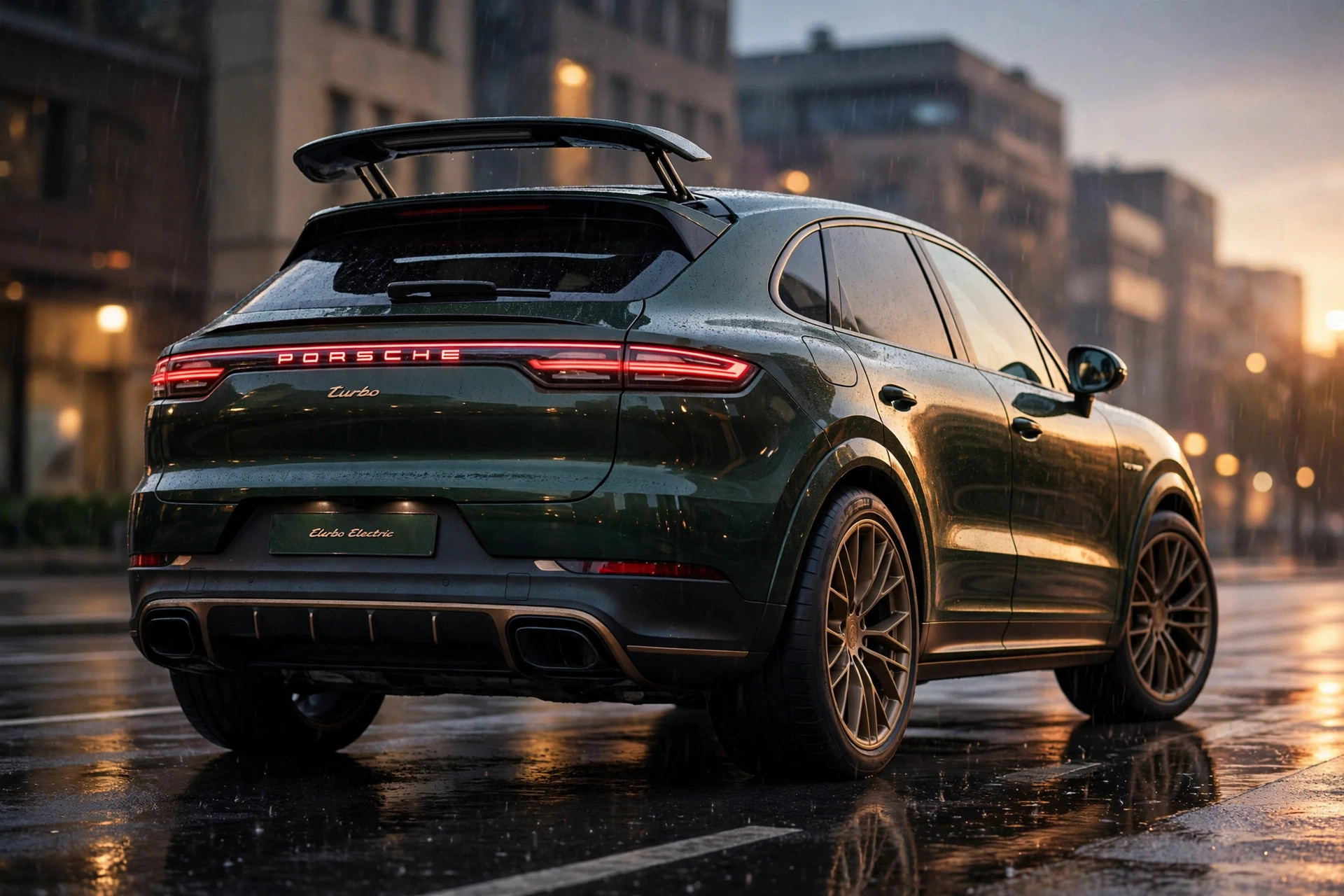
At the Los Angeles Auto Show this month, Porsche gave its all-electric Cayenne a zone of its own, where visitors walking past the Rivian R2 and the Genesis GV90 would have found the Turbo Electric sitting quietly among them. Nothing about its shape announces what it does. It looks like a Cayenne, the company's best seller for two decades, until you read the specification sheet. With Launch Control engaged, it makes 850 kW, quoted as 1,139 horsepower in the United States and 1,156 PS in Europe, which makes it the most powerful production Porsche ever built, gas or electric. It does the job in a vehicle that can tow 7,716 pounds and wade through 19 inches of water.
Four figures of horsepower in a family SUV is a headline, and headlines are cheap. What matters is whether the engineering underneath the number holds up when the number is used more than once. Porsche's case rests on four systems: a rear motor cooled directly by oil, a recuperation system that recovers 600 kW under braking, active aerodynamics that reshape the car at speed, and a suspension borrowed from the company's sports sedans that fights the mass rather than apologizing for it.
Porsche sells three Cayennes at the same time: a combustion-engine car, a plug-in hybrid, and this electric one, all on the same showroom floor. It is the company's stated strategy, a completely flexible choice of powertrains while buyers decide at different speeds. It is therefore not a replacement for the Cayenne you know, but a third Cayenne on a dedicated electric platform, which has to earn its place against two siblings that already do the job well.
Overboost is a loan, not a balance
Start with the number itself, because it needs taking apart to see what is inside. In normal driving, the Turbo Electric makes 630 kW, or 844 horsepower, the power available whenever you ask for it, and already more than any Cayenne V8 ever offered. That 1,139 horsepower figure arrives only with Launch Control engaged, as an overboost, and it arrives with 1,106 pound-feet of torque. A burst, not a state. Press the Push-to-Pass button and you get another 130 kW, 173 horsepower, for ten seconds, and Porsche quotes 0 to 60 mph in 2.4 seconds, a quarter mile in 9.9 seconds, and a top track speed of 162 mph.
Why structure power this way? Because an electric drivetrain's limits are thermal and electrical, not mechanical. A battery can discharge at an enormous rate for a few seconds. So can an inverter. Sustained operation at those levels cooks both. Overboost is the engineering answer to that physics: allow the peak when the driver explicitly asks for it, for a bounded time, and run the rest of the time at a level the cooling system can sustain indefinitely. Framed that way, 844 horsepower is arguably the more important number: the power the car can live with through a mountain pass, a towing run, or a second launch five minutes after the first, which is where a one-shot overboost number would already have gone quiet.
Two permanent magnet synchronous motors do the work, one on each axle, managed by electronic Porsche Traction Management, and permanent magnet motors are efficient at cruise and powerful at full load, which is why they sit at both ends of this car. Their weakness is heat in the rotor, where the magnets live, and that weakness is what the next system addresses. Under partial load the front motor can disengage to save energy, while the rear motor does the heavy lifting and carries the cooling hardware to match.
A rear motor that drinks oil
Cooling an electric motor sounds simple until you look at where the heat actually is. Water jackets cool the stator, the stationary outer part, well enough. But the rotor spins inside it, and the magnets on that rotor are the parts most sensitive to heat. Coolant cannot easily reach a spinning component, so a hot magnet loses strength and the motor loses torque exactly when you want it most. Porsche's answer, carried over from its Formula E program, is direct oil cooling: synthetic oil sprayed directly onto the rotor and windings of the rear motor, pulling heat out of the parts a water jacket cannot touch.
Oil cooling sounds obvious only after someone has made it work. Oil does not conduct electricity, so it can touch live windings without shorting them. It carries heat to a heat exchanger the way coolant does, just from a much more difficult address. In the Turbo Electric, this is what makes the 844 horsepower continuous figure believable. Without it, the rear motor would have to derate, pulling power back after repeated hard use. Overboost would be a one-shot trick instead of a repeatable one.
A companion piece on this site covered the battery side of the same thermal problem: double-sided cooling of the 113 kWh pack, silicon carbide inverters, and 400 kW charging. Two halves of a single idea, since Porsche treats heat as the real currency of electric performance, and spends its engineering budget moving it out of the places where power is made, whether that means cooling a battery from both faces or spraying oil onto a spinning rotor. Both faces of the battery get cooled, and the rear motor gets cooled from the inside, so nothing in the drivetrain becomes the bottleneck the other half just solved.
Six hundred kilowatts of braking
If the headline number is the car's loudest claim, the recuperation figure is its quietest and most revealing. Under braking, the Cayenne Electric recovers up to 600 kW, more power than most public DC fast chargers can deliver to a car at all. Out of its own motion, the Cayenne can pull that much energy back, through the motors running in reverse as generators, and put it into the battery. Porsche says about 97 percent of all braking in everyday driving is handled purely by the motors, with the friction brakes rarely intervening.
That statistic changes what the brake discs are for. In most cars the brakes are the primary slowing device and the wear item to match; here they are a backup system, kept in reserve for the stops that exceed what the motors can absorb. Porsche Ceramic Composite Brakes are optional on the Turbo, for use in the narrow band where recuperation alone is not enough.
There is an efficiency story here too, connecting the 600 kW figure to the range figure. EPA rates the Turbo Electric at 298 miles, against 620 kilometers on the European WLTP cycle. Most of the gap between those two numbers is a difference in test cycles, but the recuperation system is what keeps either number honest in real driving, since every stop in traffic is energy recovered rather than energy thrown away as heat in the discs. On a 2,645-kilogram car, that recovery is not a footnote: mass is the enemy of range, and recuperation is the partial refund.
Air that earns its keep
At 0.25, the Cayenne Electric's drag coefficient is unusually low for an SUV, and it earns that number with moving parts. Porsche Active Aerodynamics manages three elements: cooling air flaps in the nose that open and close with demand, an adaptive roof spoiler, and, on the Turbo only, active aeroblades at the rear. Hidden inside two openings at the back of the car, the blades extend outward at speed, effectively lengthening the body to clean up airflow behind it, then retract to restore the clean shape, small theater with a real aerodynamic job and the most visible difference between the Turbo and the lesser Cayennes from behind.
Drag matters more to an electric SUV than to a combustion one, because there is no cheap energy to waste: an electric Cayenne spends range, and range is the number every buyer reads first. A 0.25 drag coefficient, a flat underbody, and active elements are therefore not styling exercises. They are range engineering, the same way oil cooling is performance engineering, both serving the same goal from opposite directions: spend less, recover more. Wider rear tires than its siblings carry the Turbo, with 315-section rubber at the back on the optional 22-inch wheels, the price of putting 1,106 pound-feet through two axles.
Hiding 2,645 kilograms
Weight is the honest problem with this car, and Porsche does not hide it. At 2,645 kilograms, the Turbo Electric carries roughly the mass of two 911s, and no amount of cleverness makes that disappear, though what cleverness can do is stop the driver from feeling it. Standard adaptive air suspension with Porsche Active Suspension Management handles the everyday work, adjusting damping continuously across Normal, Sport, and Offroad modes, while optional rear-axle steering turns the rear wheels by up to five degrees, tightening the turning circle at low speed and adding stability at high speed.
Above that sits the Turbo's party piece: Porsche Active Ride, available on the Cayenne for the first time, a hydraulically cross-linked active suspension familiar from the Taycan and Panamera that almost completely compensates for body movements. Pitch under braking, roll in corners, dive and squat: the system counters each one by pushing fluid between corners faster than the body can move, the closest thing in production to a car that refuses to lean.
PTV Plus, the limited-slip rear differential with torque vectoring, is standard on the Turbo, sending torque to the outside rear wheel in a corner to rotate the car rather than merely push it. Taken together, the chassis is a deliberate answer to one question: how do you make 2,645 kilograms change direction like a Porsche? Pretending the weight is not there is not the answer. Spend hardware on every axis it moves on, and let software coordinate the spending.
Early reviewers have been candid about the limits. Evo, driving the Coupe Turbo around Munich, called full power borderline unusable in the wet and noted the synthesized V8 sounds and vibrations fed through the pedal in Sport Plus as almost too much. PistonHeads, more forgiving, called the 0 to 62 mph time of 2.5 seconds conservative and praised the car's grip and its handling of the sensible side of the brief. A car this powerful will always have a gap between what it can do and what its driver can use, and the sound synthesis is Porsche admitting that silence is a problem it has not yet solved elegantly. Serious engineering is not in doubt. Theater is still finding its register.
A charger you park on
Charging is where the Cayenne Electric makes its most quietly radical move. Underneath, the 800-volt Premium Platform Electric architecture supports DC fast charging at up to 400 kW, taking the battery from 10 to 80 percent in under 16 minutes under ideal conditions. But the Turbo's second charging trick is the stranger one: it is the first Porsche that can charge without being plugged in at all.
Optional inductive charging works through a floor-mounted plate, delivering up to 11 kW at roughly 90 percent efficiency. Park over the plate and the car lowers itself onto the pad, aligns, and charges. A motion sensor shuts the plate down if a living being or a piece of metal is detected underneath. Eleven kilowatts is slow by fast-charging standards, and nobody would choose it for a road trip. Its job is the garage, where the car sits ten hours a night and the difference between plugging in and not plugging in is the difference between a habit and a chore. Porsche is betting the buyers who can afford this car would rather pay for the plate than remember the cable. Probably right.
Three Cayennes, one showroom
Step back and the strategy comes into focus: Porsche is not asking the Cayenne buyer to choose between the past and the future, but offering both, plus a hybrid in between, and letting the market sort itself out over years rather than a model cycle. Converting anyone is not the electric Cayenne's job. It has to be good enough that the next Cayenne buyer does not rule it out.
Early signs favor it: in mid-November, the Cayenne Turbo Electric was named Best Luxury Vehicle for 2027 in the Buzz Awards, and 2027 model year cars are expected to reach American buyers in the first quarter of 2027, after 2026 deliveries began in the summer. No longer a press release, it is a thing you can sit in, and the sitting-in is going well.
An honest accounting
So what is the Cayenne Turbo Electric, judged as engineering rather than as a headline? A serious answer to a real question: what does a performance SUV look like when the engine is gone and the battery is the constraint? Porsche's answer is not a bigger battery, but a system of small, expensive solutions to specific problems: oil where water cannot reach, recuperation where friction brakes used to be, moving bodywork where a fixed shape would waste range, and a suspension that spends hydraulic energy to hide mass.
Against that, the honest debits. At 2,645 kilograms, the car carries weight no active suspension makes disappear in a collision with physics, only in a corner. A burst is what the 1,139 horsepower figure is, and the car you live with makes 844, still an enormous number but not the one on the poster. By the reviewers' accounts, the synthesized engine sound is an acquired taste. And the range, 298 miles on the EPA cycle, is good for a car this powerful and unremarkable for a car this expensive.
None of those debits is disqualifying, and that is the point. A decade ago, an electric SUV with these numbers would have been a concept car, wheeled onto a stage and wheeled off again. Today it is the most powerful production Porsche ever built, sitting in a showroom next to its combustion siblings, waiting to be chosen for the ordinary reasons people choose a Cayenne: space, comfort, and the feeling that the badge means the engineering was taken seriously. Horsepower is the headline. Underneath it, the engineering is the reason to believe the headline will still be true in five years, when the car is no longer new and the novelty has worn off.
| Specification | Cayenne Turbo Electric |
|---|---|
| Powertrain | Dual permanent magnet synchronous motors, front and rear, ePTM all-wheel drive |
| Peak output (Launch Control) | 850 kW / 1,139 hp (1,156 PS), 1,106 lb-ft |
| Continuous output | 630 kW / 844 hp; Push-to-Pass adds 130 kW / 173 hp for 10 seconds |
| 0-60 mph | 2.4 seconds (manufacturer claim) |
| Quarter mile | 9.9 seconds (manufacturer claim) |
| Top track speed | 162 mph |
| Battery | 113 kWh gross, about 108 kWh usable, 800-volt PPE platform |
| DC fast charging | Up to 400 kW; 10-80% in under 16 minutes |
| Recuperation | Up to 600 kW; about 97% of everyday braking via motors |
| Range | 298 miles EPA; 620 km WLTP |
| Drag coefficient | 0.25 |
| Weight | 2,645 kg (about 5,830 lb) |
| Chassis | Air suspension with PASM standard; PTV Plus; optional rear-axle steering to 5 degrees; Porsche Active Ride available |
| Towing / wading | 7,716 lb / 19 inches |
| Inductive charging | Optional, up to 11 kW, about 90% efficiency |
| Starting MSRP | $163,000, plus $2,350 delivery, processing and handling |
- Sources:
- Porsche Newsroom USA, "New Porsche all-rounder: Cayenne nameplate expands portfolio to include electrification," November 19, 2025. https://newsroom.porsche.com/en_US/2025/products/new-porsche-all-rounder-Cayenne-nameplate-expands-portfolio-to-include-electrification-41132.html
- Porsche Newsroom Europe, Cayenne Electric press release, November 19, 2025. https://newsroom.porsche.eu/dam/jcr:a8c2c037-4646-4b8d-98f9-22a902d34dcd/25_CayenneElectric_final.pdf
- evo, "Porsche Cayenne Coupe Electric review," May 26, 2026. https://www.evo.co.uk/reviews/208771/porsche-cayenne-coupe-electric-review-ferrari-luce-too-pricey-porsche-has-a-solution
- PistonHeads, "2026 Porsche Cayenne Turbo Electric | PH Review," March 28, 2026. https://www.pistonheads.com/gassing/topic.asp?h=0&f=&t=2138953
- TopSpeed, "The Buzz Awards: Porsche Cayenne Turbo Electrified Named Best Luxury Vehicle For 2027." https://www.topspeed.com/buzz-awards-porsche-cayenne-turbo-electrified-best-luxury-vehicle/
- GSM Global News, "Los Angeles Auto Show: About 1,000 Cars in One Hall, and the Ones to See First," November 20, 2026. https://gsmglobalnews.com/article/d20261120-laautofeature1.html
- Porsche West Houston, "2026 Porsche Cayenne Electric SUV." https://westhouston.porsche.com/en/2026-cayenne-electric
- Efficient Design, "One Hundred Refrigerators: How Porsche Engineered 400-Kilowatt Charging Into the Cayenne Electric." https://efficientdesign.net/stories/porsche-cayenne-electric-cooling.html