Nineteen Seconds, Two Cylinders, One Magnesium Ballet — Inside the 992 Targa Roof
Press the button and the whole rear of the car comes apart, on purpose. A wraparound glass panel lifts and swings out past the bumper while a magnesium-framed soft top unlatches, Z-folds, and vanishes behind the rear seats. Nineteen seconds later the glass settles back down and the car is a roadster. Strip the theater away and the mechanism still stands on its own: the entire sequence runs on one hydraulic cylinder per side.
The Absurd Premise, Stated Up Front
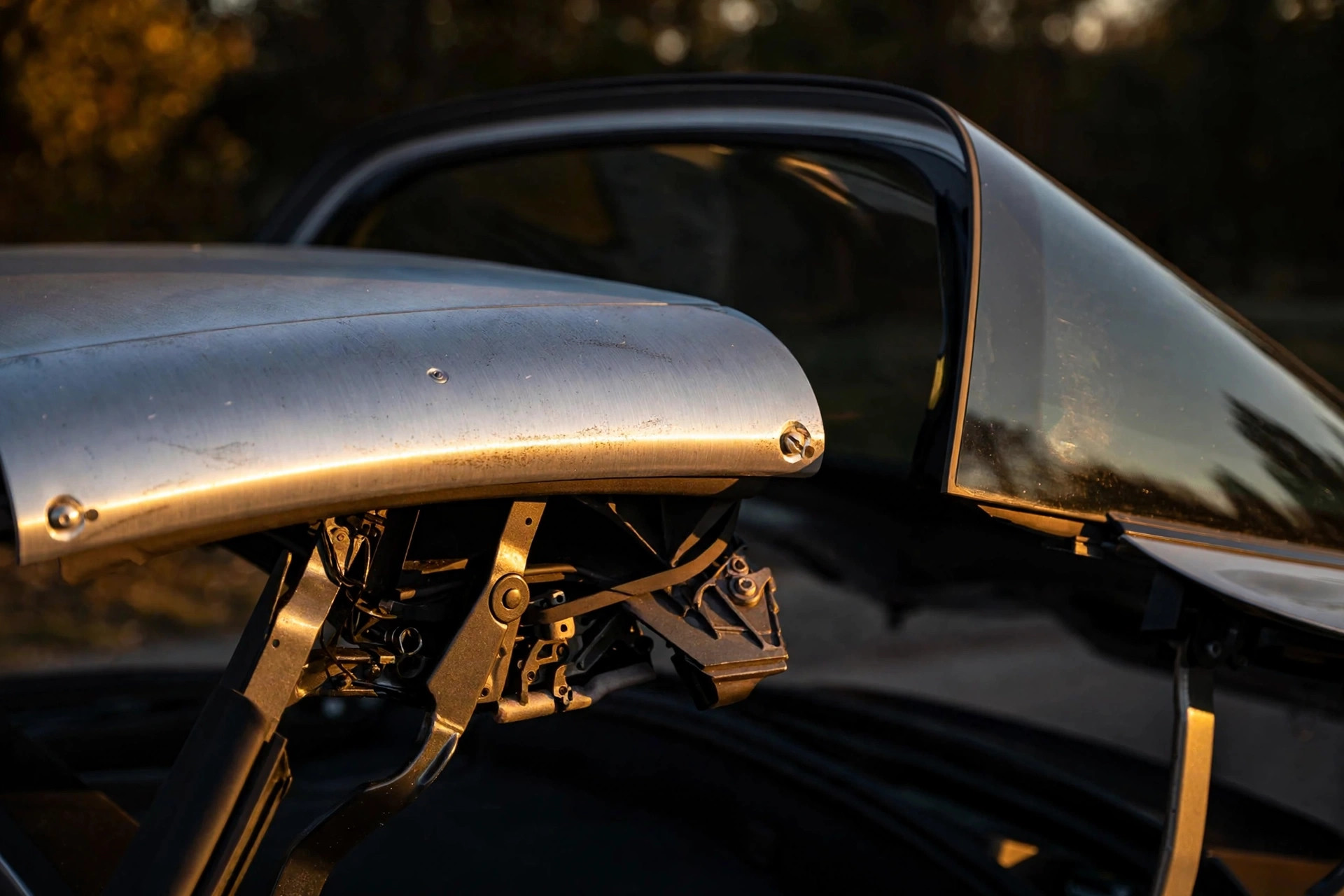
Every convertible has a roof that moves; a Targa has one that performs. Where a Cabriolet's soft top folds itself away in about twelve seconds with minimal drama, the Targa first disassembles the back half of the car: the entire wraparound rear glasshouse rises, pivots rearward until it hangs out past the bumper, and only then does the actual roof begin its exit. Two small flaps integrated into the signature roll bar swing aside to clear the path. Unlatched, the fabric panel folds into a Z, slides beneath the hovering glass, and tucks itself behind the rear seats. Then the flaps close, the glass descends, and the car pretends nothing happened.
Nineteen seconds, and throughout, the car must be completely stationary. Nothing else on sale does anything like it, and nothing needs to, which is exactly why it exists. Porsche could have given the Targa a conventional folding top and saved 187 pounds. Instead it built a machine whose opening sequence is a spectator event. In August 2026, twelve years after the mechanism debuted on the 991 generation, a short video of the roof in motion titled it "the ultimate automotive ballet" and it still drew an audience. That theater is the product, and underneath it sits the engineering, which is the story.
Four Magnesium Segments and Nothing Else Structural
Strip away the choreography and the roof is a panel-bow convertible top, a Porsche development it describes as an in-house design going back to the 992 Cabriolet's 2019 launch. Apart from its side sections, the entire soft top spans a rigid roof surface made of individual segments that sit seamlessly next to one another when closed. Four elements: the front roof frame, two panel bows, and the rear window. Every one of them is magnesium, including the rear window frame.
Magnesium does three jobs here. First, the obvious one: density 1.74 grams per cubic centimeter, roughly two-thirds of aluminum and a quarter of steel, so four structural segments stay light enough to be thrown around by hydraulics nineteen seconds at a time. Second, stiffness per unit mass, which is why each panel bow has to hold the fabric taut enough that the closed roof reads as a coupe silhouette, with no visible bows under the fabric and no sections breaking the 911's flyline, and they have to do it while carrying the insulating mat that lines the whole underside of the fabric. Two integrated magnesium elements double as the structure that keeps the top taut and as noise and thermal insulation carriers, which is how the closed Targa gets within reach of coupe-level climate and noise comfort.
Third, and least appreciated: magnesium die-casts into tight-tolerance pivot hardware. This mechanism lives or dies on the precision of its joints. Segments fold flush over one another in the Z-fold; a few tenths of a millimeter of slop at a pivot multiplies across four segments into a package that does not fit its 23-centimeter-high, 55-centimeter-long stowage envelope. Cast magnesium holds the tolerances and keeps the mass down at the same time. Aluminum could hold the tolerances but not the weight budget, and steel could hold neither.
One Cylinder Per Side: The Logic Is in the Linkage
Here is the detail that separates this mechanism from every powered convertible top built before it. All four magnesium frame segments are connected kinematically, which means a single hydraulic cylinder on each side drives the entire folding sequence. Two actuators, four segments, a dozen-plus pivot joints. Sequencing, phasing, the order in which each bow folds over the last: none of it is programmed into a controller firing a dozen solenoids; it is machined into the linkage geometry.
Consider what that implies: somewhere in Weissach, an engineer solved a four-bar-linkage synthesis problem so that one linear input produces a choreographed multi-stage fold, with each segment arriving at its stowed position in the correct order and orientation, every time, across temperature, wear, and a decade of ownership. One motor per joint with electronic coordination, the alternative, would weigh more, fail more, and need a wiring harness threading through moving magnesium, which is why Porsche chose mechanical logic over electronic control. There is no fixed connection between the panel bows and the soft top fabric, so the segments fold flush over one another while the fabric simply goes along for the ride, which is the kind of design decision that looks obvious only after someone has made it.
Locking is handled the other way: an electric central closure mechanism, proven from the Cabriolet program, supported by side centering pins. Hydraulics do the heavy, continuous work of folding; a compact electric drive does the final precise work of pulling the front frame down and centering it. Split the duties by what each actuator does best. New and lighter for the 992 generation, the hydraulic cylinders are part of why the Cabriolet's own top manages its twelve-second cycle at speeds up to 50 km/h, though the Targa, with its glasshouse gymnastics, demands a full stop.
The Weight Ledger, Accounted Honestly
All of this machinery has a mass, and Porsche does not hide it. Add it up, fabric top, glass panel, bracing, actuators, and the moving roof hardware accounts for 187 pounds. A Targa 4 carries 198 pounds more than a Carrera 4 coupe and 44 pounds more than a Carrera 4 Cabriolet. Center of gravity rises 10 millimeters; weight distribution shifts rearward. On paper, these are the numbers of a car that should feel it.
Consider what 198 pounds and a 10-millimeter CoG rise actually cost. Nobody buys a Targa to chase the coupe's lap time, and Porsche knows its customer: Targa buyers have historically preferred all-wheel drive, and the 992 Targa has been all-wheel-drive-only, which reads less as a limitation and more as an honest engineering call. Put the mass low and aft, drive all four wheels, tune the chassis around the actual car instead of the theoretical one. Autoblog's first drive of the 992 Targa noted it is stiffer than the Cabriolet, though not the coupe, which is the correct ranking for a car whose roof is a removable structural member.
Laminated glass, weight-optimized, deserves a line of its own. Heated laminated safety glass, the rear window is lightened as far as the process allows, because it is the single largest moving panel in the sequence and it travels the farthest, swinging out past the rear bumper on its pivots. Every gram saved in the glass is a gram the hydraulics do not have to swing through a long arc, and a gram less momentum to arrest at the end of travel. Lightweighting the glass is not a comfort feature; it is load-path engineering.
The Parking Sensors Are Load-Bearing
Because the rear glass extends beyond the bodywork while the roof operates, the car borrows its parking sensors for a second job. If they detect anything within about 1.6 feet of the rear bumper, the operation cancels. Up comes the reversing camera on the infotainment screen, a warning flashes on the instrument cluster, and the glass stays put. A mechanism that can swing a heated glass panel into a wall at bumper height gets an interlock, not a warning label.
This is worth pausing on, because Porsche specified that sensor suite for parking. Repurposing it as mechanism protection is the kind of cross-system thinking that separates integrated engineering from a parts bin. Stationary for the full nineteen seconds anyway, the car leaves its sensors idle while the roof needs a proximity guard, and the wiring already exists. Elegant. It also means the Targa's party trick has a failure mode no coupe owner will ever meet: a garage wall two feet behind the bumper, and the roof simply refuses. That is the correct behavior, and it is worth knowing before the first dinner party demonstration.
Why It Still Matters in 2026
Debut came on the 991 Targa at the 2014 Detroit show. Twelve years later, the 992 generation still runs the same fundamental choreography, refined rather than replaced. In a decade that has taught the industry to solve every packaging problem with another motor and another control module, the Targa roof remains a monument to the opposite instinct: solve it in the linkage, actuate it simply, and let the magnesium do the talking.
There is a parallel worth drawing for readers of the watch coverage on this site. A column wheel sequences a chronograph's start, stop, and reset through levers dropping into machined detents, crisp mechanical logic instead of electronic control. At automotive scale, the Targa's kinematic chain does the same job: the order of operations is cut into metal, not coded into a controller. Different industry, same philosophy, and the best mechanisms put their intelligence in the geometry.
Whether the Targa needs to exist is, as with the watches covered here, a separate question this site does not answer. What can be said is that the mechanism is internally coherent. Magnesium segments justify their material, single-cylinder-per-side kinematics justify their complexity, the sensor interlock justifies its paranoia, and the 187-pound penalty is the honest price of a roof that performs. Nineteen seconds of choreography, twice a day, for the life of the car. Some owners will use it daily and every owner will demonstrate it, because that was always the brief.
One caveat, stated plainly: Porsche publishes the architecture but not the linkage synthesis, the hydraulic pressures, or the actuator duty cycles, and I have not operated the mechanism in person. Treat the kinematic analysis above as informed architecture from the manufacturer's published materials, not a teardown claim. If Porsche opens the engineering papers, this piece gets updated.
The Full Spec Sheet
| Detail | Specification |
|---|---|
| Model | Porsche 911 Targa (992 generation); Targa 4 / Targa 4S / Targa 4 GTS; all-wheel drive |
| Roof type | Panel-bow soft top, fully automatic; four magnesium segments (front roof frame, two panel bows, rear window frame) |
| Actuation | One hydraulic cylinder per side driving all segments through kinematic linkage; electric central closure with side centering pins |
| Operation time | 19 seconds, open or close; vehicle must be fully stationary |
| Stowed package | Roof fabric, frame, panel bows, and rear window fold to 23 cm high x 55 cm long behind the rear seats (Z-fold) |
| Rear glass | Weight-optimized heated laminated safety glass; lifts and pivots rearward past the bumper during operation |
| Insulation | Full-surface insulating mat lining the fabric; two integrated magnesium elements keep the top taut and contribute noise/thermal insulation |
| Interlock | Rear parking sensors cancel operation if an obstacle is within ~1.6 ft of the bumper; reversing camera and cluster warning activate |
| Roof hardware mass | 187 lbs (fabric top, glass panel, bracing, actuators) |
| Weight penalty | Targa 4 is 198 lbs heavier than Carrera 4 coupe, 44 lbs heavier than Carrera 4 Cabriolet; CoG raised 10 mm; rearward weight shift |
| Body | Identical to Cabriolet up to the window line; signature fixed roll bar with integrated aerodynamic flaps; manually erected wind deflector |
| Heritage | Targa name from the Targa Florio; original 1965 911 Targa with fixed roll bar; fully automatic mechanism introduced on the 991 generation (2014) |
Sources
- Porsche Newsroom, "Innovative lightweight roof with Coupé characteristics," March 14, 2019. Panel-bow convertible top architecture; four magnesium segments (front roof frame, two panel bows, rear window frame); kinematic connection allowing one hydraulic cylinder per side; electric central closure with side centering pins; Z-fold with no fixed connection between bows and fabric; stowed package 23 cm high x 55 cm long; full-surface insulating mat.
- Autoblog, "2021 Porsche 911 Targa First Drive." 19-second operation; fully stationary requirement; parking-sensor interlock at 1.6 ft; body identical to Cabriolet up to window line; all-wheel-drive-only; 187 lbs of roof hardware; Targa 4 198 lbs heavier than Carrera 4 coupe, 44 lbs heavier than Carrera 4 Cabriolet; magnesium bracing; weight-optimized laminated glass; CoG raised 10 mm; rearward weight shift; stiffer than Cabriolet.
- SlashGear, "The 2021 Porsche 911 Targa Roof Is Basically Engineering Poetry." Two integrated magnesium elements keeping the soft top taut with noise/thermal insulation; heated laminated rear safety glass; reversing camera and cluster warning on interlock; manually erected wind deflector effective 31 to 90 mph.
- Automotive World, "Porsche: Innovative lightweight roof with Coupé characteristics." Panel-bow top press release corroboration: four magnesium segments, single hydraulic cylinder per side, Z-folding mechanism.
- YouTube, "The Ultimate Automotive Ballet: Inside Porsche's Mind-Bending Targa Roof," August 2026. Contemporary documentation of the 19-second sequence: glass lift and rearward pivot, roll-bar flap deployment, Z-fold stowage behind rear seats.
- Autoblog, "Watch the incredibly complicated operation of Porsche's new targa roof," January 2014. 991-generation debut at the Detroit Auto Show; fully automatic mechanism introduction.
- Disclosure: the author has not operated the Targa roof mechanism in person. All specifications compiled from the manufacturer's published materials and the independent sources above. Where Porsche publishes no internal documentation, the mechanism analysis is presented as informed architecture, not a teardown claim.