No Wastegates, No Lag: Inside the 911 Turbo S T-Hybrid's Twin Electric Turbos
When Porsche announced the 992.2 911 Turbo S this October, the headline numbers read like hypercar trivia: 701 horsepower, 590 lb-ft from 2,300 to 6,000 rpm, 0 to 60 mph in 2.4 seconds, a 14-second improvement at the Nürburgring. But the powertrain architecture underneath those numbers is the more consequential story, because it solves the oldest problem in turbocharging without resorting to the heaviest hybrid hardware in the industry.
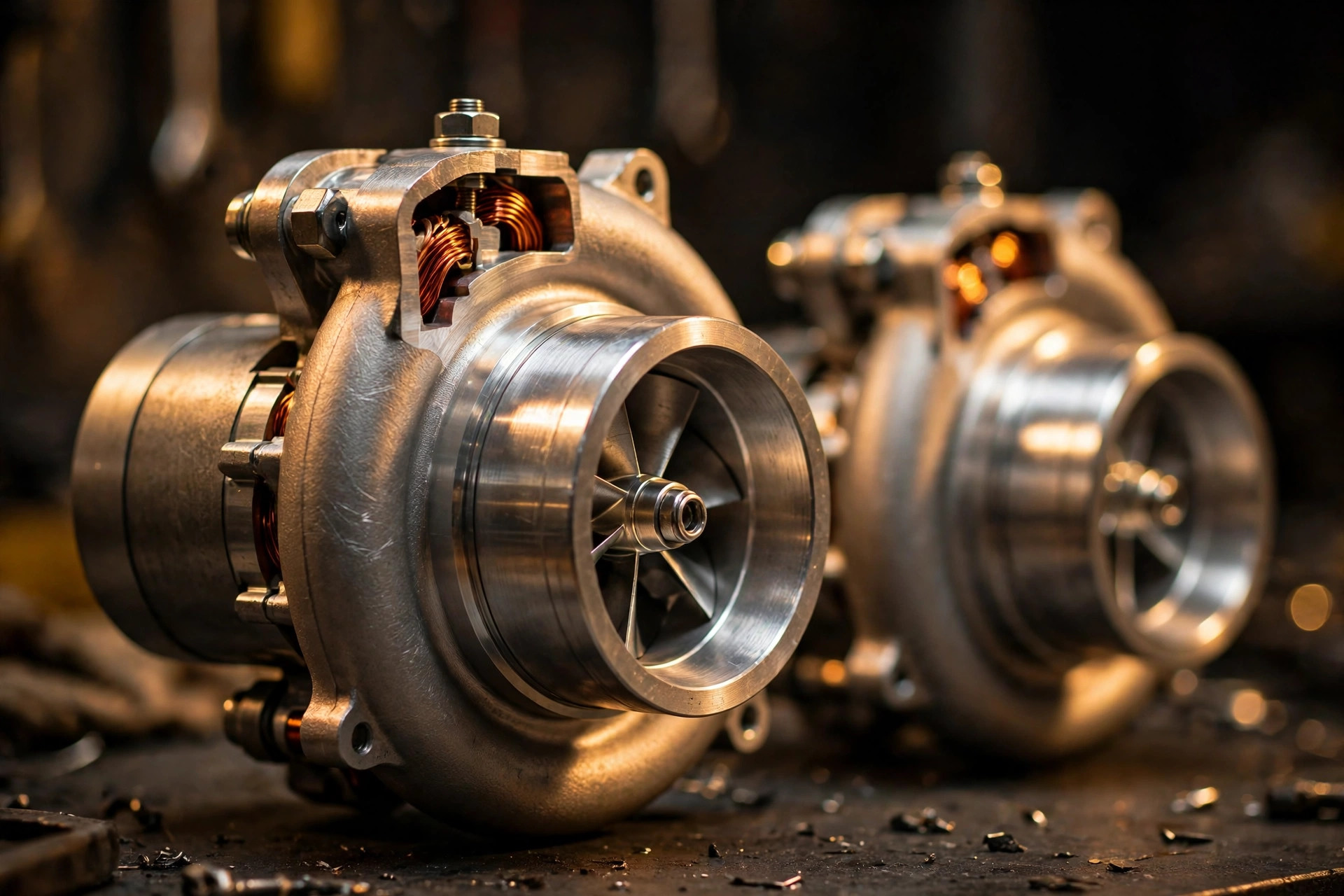
Two years after debuting T-Hybrid on the Carrera GTS, Porsche has escalated the concept for the flagship. A new 3.6-liter flat-six replaces the previous 3.8, and in place of one electrically assisted turbo it carries two. Each turbocharger has a compact electric motor mounted directly on its shaft. Those motors spin the compressors to speed before exhaust gas can do the job, then run in reverse as generators, harvesting energy by braking the turbos when boost would otherwise be thrown away through a wastegate. Which is the neat part: on this car, there are no wastegates at all. Porsche deleted a component that turbocharged cars have carried for a century.
The Turbo That Spins Itself
Conventional turbo lag is a waiting problem, not a power problem. Exhaust gas must travel through the manifold, strike the turbine wheel, and accelerate a shaft spinning on the order of 100,000 rpm before the compressor can deliver boost to the intake. At part throttle and low revs, that sequence takes a noticeable fraction of a second, and the delay is the reason twin-turbo cars have historically used complex strategies like variable-vane turbines and sequential turbocharging to mask it.
Mounting an electric motor on the turbo shaft changes the physics of the wait. An electric motor can add torque to the shaft the instant the throttle opens, driving the compressor toward boost rpm independently of exhaust flow. When exhaust energy is plentiful, the same motor reverses role and becomes a generator, applying electromagnetic braking to the shaft and converting surplus exhaust energy into electricity that charges the battery or feeds the traction motor. Formula 1 engineers will recognize this immediately: it is the MGU-H concept, the motor-generator on the turbo shaft that F1 ran from 2014 through this past season, adapted for a road car with license plates and a warranty.
Porsche's GTS runs a single electric turbo on the same 3.6-liter engine. Stepping to twin units for the Turbo S is a packaging and breathing decision as much as a power decision. Two smaller turbochargers spool faster than one large one at a given motor power, and the flat-six's banked cylinders feed each turbo from its own exhaust manifold, shortening the exhaust path and keeping pulse energy high. Sixty-one horsepower over the outgoing Turbo S sounds like the payoff, but the lap time suggests the real dividend is transient response: boost on demand, at any rpm, with no dead moment between the driver's foot and the compressor's answer.
Braking the Turbo Is the Wastegate's Replacement
Consider what a wastegate actually does. When exhaust energy exceeds what the engine can use at a given operating point, the wastegate opens and dumps that energy straight into the exhaust system, wasted as heat and noise. It is a pressure relief valve: crude, effective, and thermodynamically insulting. Every turbocharged engine on the road carries one, and every one of them throws energy away for as long as you hold the throttle open.
An electric motor on the shaft offers a second path for that surplus. Rather than opening a valve and dumping exhaust gas, the motor increases its generating torque, electromagnetically braking the turbo to hold boost exactly at the target while converting the excess shaft energy into electricity. Boost control becomes an electronic exercise in precision instead of a pneumatic exercise in dumping. This is why the Turbo S can run without wastegates: the motors handle the job with finer resolution and no exhaust-side bypass plumbing.
How much energy are we actually talking about? Porsche has not published the generator capacity of the turbo motors, and back-of-envelope estimates vary with assumptions. But the operating principle matters more than the number: in sustained high-boost driving, where a wastegated turbo would be bypassing a significant fraction of exhaust energy continuously, the electric turbos can sustain generation at a meaningful rate, feeding a system whose entire battery holds only 1.9 kilowatt-hours. A small battery paired with a high-rate energy source is a deliberate design choice, and it reveals how Porsche intends this car to be driven: short, intense bursts of harvesting and assistance, cycling constantly, never storing more than the lap demands.
A Battery That Fits Where the 12-Volt Used to Live
The 1.9 kWh, 400-volt lithium-ion battery sits in the front of the car, in the volume a conventional 12-volt battery would occupy, and that placement is doing more work than it appears. A rear-engined 911 carries a permanent weight-distribution deficit toward the rear axle. Adding hybrid mass anywhere helps balance, but adding it at the extreme front, ahead of the front axle line, maximizes its counterweight effect against the engine hanging behind the rear axle. Porsche chose to bolt its ballast into the one location where a kilogram counts most toward balance.
Then there is the architecture decision: 400 volts, not 800. The Taycan and most flagship EVs run 800-volt architectures for sustained fast charging and continuous high-power output. The T-Hybrid asks neither of its battery. Assistance and harvesting are transient events measured in seconds, and 400 volts is sufficient to move the required power for those bursts while saving the cost, insulation mass, and component expense of an 800-volt system. It is also worth noting that the electric motor sandwiched between the flat-six and the eight-speed PDK serves primarily as a torque-fill and boost device, not as an EV-range motor. There is no plug, no external charging, and no silent electric mode worth mentioning. This is a hybrid tuned for speed, not one tuned for a window sticker.
That distinction deserves emphasis, because the word "hybrid" carries the wrong connotations for this car. Most hybrid architectures store energy to displace fuel consumption. T-Hybrid stores energy to displace waiting. The battery exists to keep the turbochargers spooled, to fill torque gaps during shifts, and to absorb braking energy that would otherwise vanish, and its 1.9 kWh capacity is enough because the energy is always cycling, never accumulating.
One Flat-Six, Seven Cars
Porsche's October 13 announcement, confirming T-Hybrid among the 2026 Wards 10 Best Engines and Propulsion Systems winners, noted that the same 3.6-liter flat-six now powers seven model variants across the 911 GTS and Turbo S ranges. That is the quiet engineering triumph of the program: a single engine architecture, developed once, scaled from the GTS's single-turbo configuration to the Turbo S's twin-electric-turbo flagship by varying the forced-induction hardware around a common block.
Modularity at this level changes the economics of exotic powertrains. Developing a bespoke engine for a flagship is expensive; developing one engine that serves the volume GTS and the halo Turbo S amortizes the cost across both. The Wards judges, who evaluate on horsepower, torque, NVH, observed efficiency, and new technology, recognized the system for precisely this kind of integration: it enhances the driving experience rather than complicating it, and it does so across a product range rather than a single showcase model.
This site examined the T-Hybrid's launch specification in April 2026, before first drives and the Wards award. That analysis focused on spool dynamics and the PDK-integrated motor; the wastegate deletion and the seven-variant modularity described here were not part of the announcement coverage.
180 Pounds of Honesty
Porsche is unusually forthright about the mass penalty. The Turbo S coupe weighs 3,829 pounds, up 180 from its predecessor, and no amount of clever packaging erases that. But the 14-second Nürburgring improvement is the rebuttal Porsche chooses to make, and the chassis hardware backs it up with more than powertrain tricks.
The 400-volt system pays dividends beyond the powertrain. Porsche Dynamic Chassis Control, the active anti-roll system, now draws on the 400-volt bus to drive quicker-acting adjustable stabilizers. An anti-roll bar that reacts faster to load transfer keeps the body flatter through direction changes, and flatter bodywork keeps tire contact patches loaded more evenly, which matters enormously on a car putting 701 horsepower through all four wheels.
Braking hardware reflects the same honesty about mass and speed. Carbon-ceramic discs are standard, 420 mm in front and 410 mm at the rear, with a new pad compound for repeated high-speed stops. Rear tires grew to 325-section rubber from 315, while fronts stay at 255. Active grille shutters, an active front diffuser, a deployable front splitter, and the familiar adaptive rear wing cut drag by roughly ten percent in the car's slipperiest configuration. A titanium muffler on the sports exhaust trims mass from the rear. None of these items is exotic in isolation, but together they describe a program that treated 180 extra pounds as a problem to be solved with engineering rather than a number to be hidden in a brochure.
What the Stopwatch Does Not Separate
Intellectual honesty requires acknowledging what the 7:03.92 lap time does not prove. Fourteen seconds is a large gap, and it comes from the whole car, not from the turbochargers alone. The aerodynamic improvements, wider tires, chassis electronics, and brake upgrades all contribute, and isolating the e-turbos' specific contribution to lap time would require back-to-back testing with a wastegated control car that does not exist.
Attributing the gain entirely to electrification would be the kind of category error this site tries to avoid. Turbo lag matters most at corner exit, and corner-exit response is where the e-turbos should show their advantage, but the lap time also reflects better cornering grip, stronger braking, and reduced drag. Porsche's engineers surely know the decomposition; they have simply chosen, understandably, to publish the composite number and let the mythology write itself.
There is also the question of sustained use. A 1.9 kWh battery cycles aggressively under track conditions, and the e-turbo motors themselves sit on shafts in a brutally hot zone, spinning at six-figure rpm while electronics manage boost in milliseconds. Porsche's validation testing is extensive, but the technology has no decade-long service record. Bearings, insulation, and power electronics in that thermal environment are the components a skeptic watches first, and the first few years of ownership will be the real durability test.
Why This Matters Beyond Stuttgart
Step back from the 911 and the picture gets more interesting. The industry has spent a decade debating two turbocharging futures: bigger electric assistance in full hybrids, or fully electric powertrains that make the debate irrelevant. T-Hybrid proposes a third path. It keeps the combustion engine and its character, electrifies exactly the component with the worst transient behavior, and accepts a battery small enough to fit where the 12-volt lived.
Watchmaking offers an instructive analogy. A traditional chronograph adds complications by stacking modules on a base movement, each adding friction and complexity. The elegant solutions integrate the complication into the architecture from the start, like the column wheel that coordinates the chronograph without extra levers. T-Hybrid integrates electrification into the turbocharger itself rather than bolting a motor onto a conventional drivetrain. It is the difference between a complication module and a movement redesigned around the complication, and it is why the system feels of a piece with the 911 rather than grafted onto it.
Whether the rest of the industry follows depends on cost and durability, and those answers are years away. For now, the Turbo S demonstrates that the wastegate, a component nobody loved and everybody tolerated, is no longer necessary. An electric motor on a turbo shaft does the job better, harvests what the wastegate threw away, and deletes a piece of exhaust plumbing in the bargain. One hundred years of dumping boost pressure into the exhaust is enough.
Sources
- Porsche Cars North America, press release via moto-match.com, "Porsche T-Hybrid Flat-6 Named Among 2026 Wards 10 Best Engines & Propulsion Systems," October 13, 2026, detailing the T-Hybrid architecture, single vs. twin electric turbo configurations, and the seven GTS/Turbo S variants sharing the 3.6-liter flat-six.
- Automotive Addicts, Darryl Taylor Dowe, "New Car Preview: 2026 Porsche 911 Turbo S Sets a New Power Record," October 2026, reporting 701 hp output, 590 lb-ft torque band, 2.4-second 0-60 mph, 7:03.92 Nürburgring lap, 3,829-pound curb weight, PDCC on the 400-volt system, brake and tire specifications, and aerodynamic details.
- YallaMotor, "2026 Porsche 911 Turbo S Hybrid: 701 HP Revealed," October 2026, corroborating twin electrically assisted turbochargers, 1.9 kWh 400-volt battery placement, generator-mode turbo braking in place of wastegates, and the 14-second Nürburgring improvement.
- Times of India / Trends Glance, "Porsche 911 Turbo S Arrives In India," October 2026, confirming 420 mm front and 410 mm rear carbon-ceramic brakes, 325-section rear tires, and titanium sports exhaust.
- Tork.buzz, "I Got a Porsche 911 Turbo S (992.2), and It Feels Almost Too Fast for the Road," October 10, 2026, early first-drive impressions confirming hybrid-assisted responsiveness and the performance-first tuning of the T-Hybrid system.
- Russpain, "Porsche 911 Turbo S 2026 Sets New Benchmark with T-Hybrid Power," October 2026, detailing the 400-volt architecture, compact 1.9 kWh battery, and eTurbo compressor behavior described by reviewers.