More Than 700 Horsepower From a 3.6: How Porsche's GT2 RS Hybrid Borrows From Le Mans
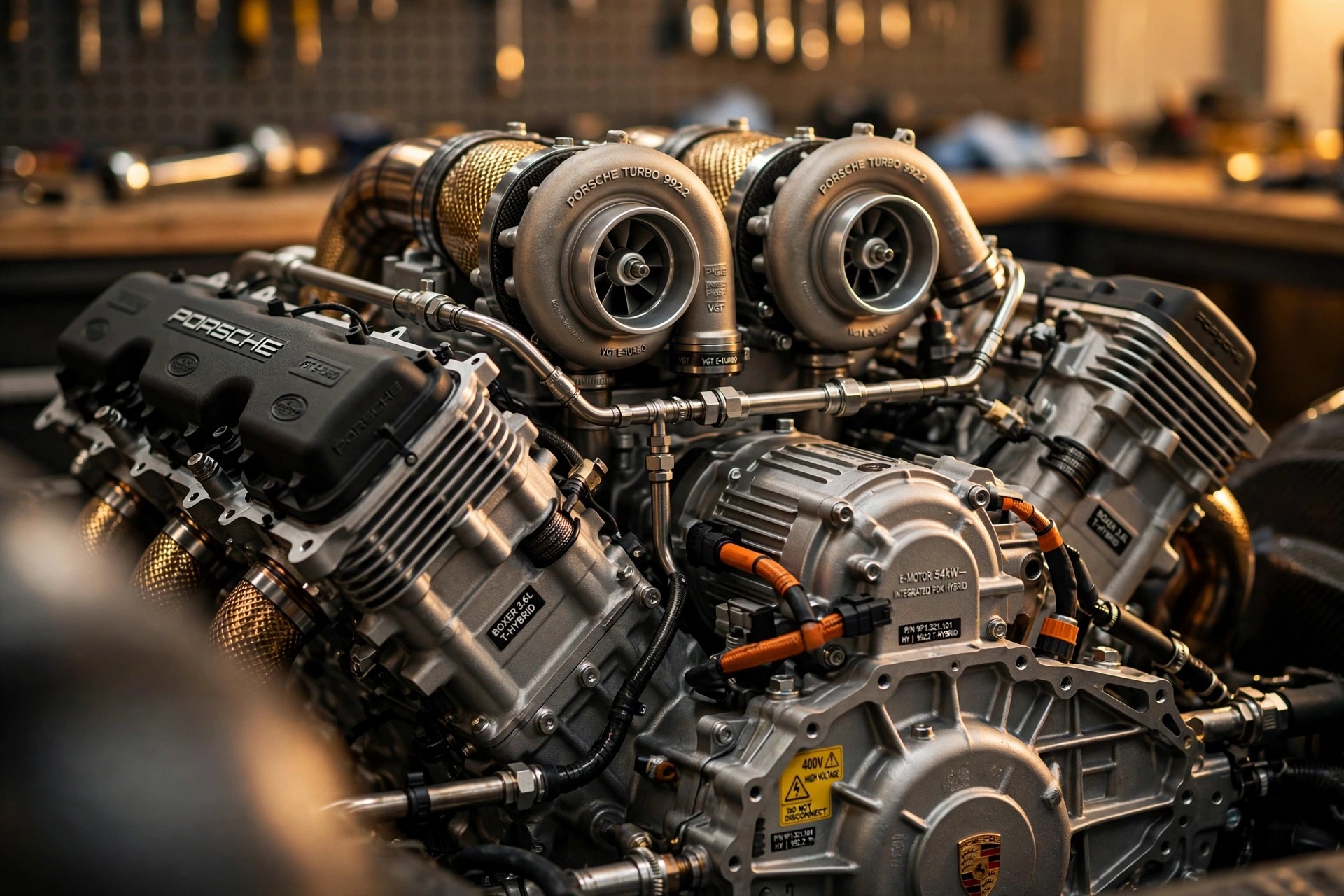
GT2 RS has always meant GT3 RS aero plus Turbo power minus all-wheel drive, and for the 992.2 generation that formula gains a third term because electrification was engineered into the platform from the beginning rather than retrofitted onto it.
When Porsche unveiled the 992.2 Carrera GTS with its T-Hybrid system in 2024, the 3.6-liter flat-six with a 53-hp electric motor integrated into the 8-speed PDK housing looked like a modest step, 534 hp total, 400-volt architecture, single e-turbo, capable of generating its own energy three ways by using the engine as a generator, through brake recuperation, and through exhaust gas recuperation via a turbine in the exhaust stream, but inside Weissach the GTS was never the endpoint.
Prototypes spotted at the Nurburgring since early 2025 carry the same rear quarter-panel air scoops that define the Turbo, side-offset tailpipes at the diffuser edge rather than the central pipes of naturally aspirated GT cars, a more aggressive front spoiler with a lower diffuser, and a rear wing so large it dwarfs the GT3 RS swan-neck that already produces 1,895 pounds of downforce at 177 mph, and Porsche says the new package will generate more than that, with active elements capable of DRS-style stalling to shed drag on straights.
From 919 to 963 to 911
Autocar first reported in 2023 that the next GT2 RS would use tech originally developed for the Le Mans 24 Hours-winning 919 Hybrid and further developed for its successor, the 963 LMDh racer, and subsequent spy shots and insider briefings have confirmed the lineage while revealing how Porsche adapted racing logic for a road car that cannot use spec components.
LMDh regulations mandate a common hybrid system, 630-bhp turbocharged 4.6-liter V8 based on the 918 Spyder and RS Spyder, itself derived from a normally aspirated LMP2 unit, paired with a 67-bhp Bosch motor activated above 80 mph, with Bosch, Williams Advanced Engineering and Xtrac supplying the standardized parts on a Multimatic LMP2 chassis that has now accumulated more than 15,000 miles of testing, and Porsche vice president of motorsport Thomas Laudenbach told MotorTrend in April 2025 that the future of racing tech transfer is no longer hard parts like engines or aerodynamics, which are mature technologies where each incremental step grows increasingly difficult, but software, tools, and control strategies where the development curve remains steep and fast-changing.
GT2 RS does not use the spec system, because a road car does not have to, and Porsche describes its road-going mild-hybrid as even more advanced than the LMDh setup precisely because it avoids the compromises that spec hardware imposes, using a 400-volt architecture instead of 800-volt for weight saving and compactness compared to the 800-volt system coming for electrified 718 Cayman and Boxster, retaining a lightweight air-cooled lithium-ion battery similar to that used by the 919 Hybrid rather than a liquid-cooled pack, and integrating the electric motor directly into the transmission housing where it can add up to 184 lb-ft of torque without requiring a separate e-axle or plug-in charging.
Early prototypes mounted that battery low behind the front seats, a position that lowered center of gravity and helped offset the flat-six hanging behind the rear axle, but production intent moves it behind the rear seats for a 39:61 weight balance, a subtle shift that trades a few millimeters of center-of-gravity height for a more balanced polar moment of inertia and more predictable rotation at the limit, which matters when you are aiming to beat a car with a Formula One power unit.
Why 3.6 Liters and Why Two E-Turbos
Outgoing 991.2 GT2 RS made 691 horsepower from a 3.8-liter twin-turbo flat-six, enough to secure the title of fastest rear-engine production car around the Nurburgring at the time, and the 992.2 Turbo S is predicted to make around 710 horsepower from its revised 3.7-liter unit, so the GT2 RS needed a different displacement story to justify its position at the top of the hierarchy.
Porsche chose the 3.6-liter from the GTS T-Hybrid as its base rather than the 3.8, because the 3.6 was designed from the start for hybridization, with a bore and stroke, crankcase architecture, and oiling system that accommodate an electric motor between engine and gearbox without requiring a longer bellhousing that would push the engine even further rearward, and because starting from a smaller displacement leaves more headroom for boost while staying within thermal limits that already challenge flat-sixes when turbochargers sit inches from exhaust valves.
Then comes the second electronic turbo, a detail first reported by HotCars in late 2024, which transforms the single e-turbo setup from the GTS into a twin-e-turbo configuration where one turbo can provide boost while the other recovers exhaust energy to charge the battery, or both can spool simultaneously for maximum mass flow, and the electric motor in the PDK adds its torque instantly, filling the gap that conventional turbo lag creates between throttle application and boost pressure arrival.
Official targets sit north of 750 hp, with insiders telling Autocar that more than 700 hp is the baseline and telling HotCars that over 800 hp is possible, while Autoblog notes some reports point to 850 hp, and torque expected to top the 590 lb-ft mark of today's 911 Turbo S becomes almost academic when the electric motor can contribute 184 lb-ft from zero rpm, which is why Porsche can keep the car rear-wheel drive only, preserving the GT2 RS purist credential that has always distinguished it from the all-wheel-drive Turbo while still delivering acceleration that challenges what you thought possible from a rear-engine layout.
Three Ways to Make Electricity Without Plugging In
Contrary to earlier speculation that the 911 would get a plug-in hybrid system similar to Cayenne and Panamera, Autocar confirmed the GT2 RS uses a mild-hybrid approach that keeps additional weight to a minimum while still maximizing performance, and the T-Hybrid's three-path energy generation strategy explains how Porsche avoids the weight and complexity of external charging.
First path uses the engine as a generator during cruising and overrun, where the electric motor in the PDK reverses into generator mode and converts mechanical energy into electrical energy stored in the 1.9-kWh-class battery, second path uses brake recuperation where deceleration torque that would otherwise become heat in the carbon-ceramic rotors becomes current instead, and third path uses exhaust gas recuperation where a turbine in the exhaust stream, separate from the main turbochargers, spins a generator under acceleration, a concept Porsche first explored for the 919 Hybrid's thermal energy recovery and now miniaturized for road use.
Recharging the battery through regenerative braking as well as a newly developed turbine in the exhaust system to generate electricity under acceleration means the GT2 RS never needs to be plugged in, and the system operates at 400 volts for weight saving and compactness instead of 800 volts, which reduces insulation mass, allows smaller power electronics, and keeps the battery pack air-cooled rather than requiring a dedicated liquid cooling circuit that would add pumps, radiators, and plumbing.
Weight remains the enemy, and the T-Hybrid adds 110 pounds to the GTS, but GT2 RS models do away with the Turbo's all-wheel drive, which saves roughly 180 pounds, so net gain ends up around 130 pounds more than the last GT2 RS even with obsessive carbon fiber use, thinner glass, and stripped-down sound insulation, a trade Porsche considers acceptable when the power gain exceeds 100 horsepower and the electric torque arrives instantly.
Aero That Thinks
Visually the car blends GT3 RS and Turbo DNA, with air scoops on the rear quarter-panels that feed the intercoolers, a signature Turbo trait absent from naturally aspirated GT cars, and an exhaust setup that mirrors the Turbo's corner-mounted tailpipes, while prototypes show centrally positioned pipes that are reportedly dummies used to confuse photographers.
Massive active rear wing capable of DRS-style stalling forms the centerpiece, a concept borrowed from Formula One where the drag reduction system opens a slot gap in the rear wing to reduce downforce and drag on straights, increasing top speed, and Porsche's implementation uses moving elements to shift between drag reduction and maximum downforce depending on driving conditions, a balancing act that Laudenbach's team learned from managing the 963's energy deployment strategies across 24-hour races where every watt matters.
Lower front diffuser works in concert with multiple air channels for high-speed stability, while wider tracks, stiffer anti-roll bars, and reworked rear-wheel steering aim to keep the extra power in check, and suspension upgrades address a fundamental problem that more power creates, which is that a rear-engine car with 800 horsepower and rear-wheel drive only has a very small window between maximum acceleration and terminal oversteer unless the chassis can manage weight transfer with extreme precision.
Porsche says the aero package will generate more downforce than the already outrageous GT3 RS, and for reference that car produces 1,895 pounds at 177 mph, so exceeding it means the GT2 RS must produce well over a ton of aerodynamic load while still slipping through the air efficiently enough to exceed 200 mph, a contradiction that only active elements can resolve by changing the car's aerodynamic signature in real time.
What It Takes Away to Add More
Lightweight construction follows the Weissach Package playbook from the 991.2 GT2 RS, with carbon-fiber-reinforced plastic for bonnet, roof and mirror housings, polycarbonate windows replacing glass where regulations allow, magnesium wheels that reduce unsprung mass and rotational inertia, and carbon-fiber-reinforced plastic anti-roll bars and drop links that return from the previous model, each component saving grams that accumulate into kilograms.
992.2 GT2 RS will not offer a manual transmission, despite Porsche not officially ruling one out, because whether a traditional manual gearbox can handle 184 lb-ft of electric torque plus 550 lb-ft from the flat-six without damage remains doubtful, and the automatic remains the rational choice when lap times are the primary metric, which they are for a car whose stated goal is to obliterate the AMG One's lap time according to HotCars.
Prototypes fitted with the mild-hybrid drivetrain received a gearbox-mounted electric motor and air-cooled lithium-ion battery positioned low down behind the front seats, a layout that prioritized center-of-gravity height over weight distribution, while production moves the battery behind the rear seats for a 39:61 balance that Porsche engineers consider optimal for a rear-engine car that must put 800 horsepower through only two contact patches without all-wheel drive to distribute the load.
992.1 lineup did not feature hybrid models, but Porsche had built the platform with electrification in mind, which is why it was so easy to put the new powertrain in the 992.2 models, and the Turbo and Turbo S will feature a more powerful variant of the T-Hybrid system, with the GT2 RS receiving an even more potent variant of the same mill, creating a hierarchy where each step up the range adds electrical assistance without diluting the combustion engine's character.
Why This Matters Beyond One Car
Laudenbach told MotorTrend that motorsport is part of Porsche's DNA and they do not do it for its own sake, they do it to give a contribution to the company, and the GT2 RS hybrid represents that contribution in its purest form, where software and control strategies developed for 24-hour endurance racing, managing energy deployment, thermal limits, and driver-adjustable boost strategies, migrate into a road car that must survive warranty periods and cold starts.
Hard parts like engines, suspension, and aerodynamics are fairly mature technologies where development is slower because it is more difficult to make the next step, while software, not only software itself but how engineers approach it and the tools they use, still sits on a very steep curve where change happens fast, and the GT2 RS demonstrates that curve because its most advanced component is not the 3.6-liter flat-six or the carbon wing but the code that decides when to deploy electric torque, when to harvest exhaust energy, and when to stall the wing.
GT2 RS has always been the 911 that pushes boundaries of track-based performance and speed, and the hybrid version continues that tradition by becoming the most powerful and fastest-accelerating road-going 911 yet, according to company insiders, while remaining rear-wheel drive, PDK only, and focused on lap times rather than electric range, which is why Porsche can claim it will be very distinctive from other 992-based models and still be believed.
For a company that sells more Cayennes than 911s, building a 750-plus horsepower hybrid halo that cannot be plugged in, cannot drive silently through a city center, and cannot be ordered with a manual gearbox looks like an odd decision until you remember that GT2 RS has never been about rational product planning, it has always been about taking the Turbo's engine, the GT3 RS's aero philosophy, and removing the all-wheel drive to see what happens when you give a rear-engine car more power than its chassis should be able to handle and then engineering the chassis until it can.
Sources
- Autocar, "Porsche 911 GT2 RS to return as 700bhp hybrid halo," 2023, reporting GT2 RS due 2026 as most powerful and fastest-accelerating road-going 911 yet, more than 700 bhp target, tech from Le Mans-winning 919 Hybrid and 963 LMDh successor, mild-hybrid not plug-in, 400V not 800V for weight saving and compactness, 911 Turbo as basis with twin-turbo 3.8-litre flat-six supplemented by battery like 919 Hybrid, gearbox-mounted motor and air-cooled lithium-ion battery low behind front seats in prototypes, production battery behind rear seats for 39:61 balance.
- HotCars, "Porsche 911 GT2 RS Aims To Obliterate The AMG One's Lap Time," 2025, covering official debut later 2025 ahead of 2026 production, most powerful 911 ever, hybrid powertrain inspired by Le Mans racers, 3.6-liter flat-six borrowed from GTS T-Hybrid pushing 534 hp, second electronic turbo and beefier motor, official targets north of 750 hp with insiders hinting over 800 hp possible, power exclusively to rear wheels via 8-speed dual-clutch, torque expected to top 590 lb-ft of Turbo S, 130 lbs weight gain even with carbon fiber and thinner glass, massive active rear wing with DRS-style stalling, lower front diffuser, multiple air channels, more downforce than GT3 RS which produces 1,895 lbs at 177 mph, wider tracks, stiffer anti-roll bars, reworked rear-wheel steering.
- HotCars, "Wider, Wilder, Faster: New Porsche 911 GT2 RS Caught Testing at Nurburgring," 2025, detailing Porsche's balance of moving parts shifting between drag reduction and maximum downforce, electrified 4.0-liter flat-six with brutal power speculation, hybrid based on GTS setup with 53-hp motor, twin-turbo flat-six likely 4.0-liter, hybrid-electric assist, 8-speed PDK rear-wheel drive, emissions targets, no manual expected, lap time focus.
- Drive.com.au, "SNAPPED: Porsche's hottest-ever 911 will be a hybrid," 2025, confirming electrified 992-generation GT2 RS spied ahead of expected debut 2026, global launch 2027, 3.8-litre twin-turbo flat-six from 991 with 400-volt hybrid technology, motorsport-derived hybrid tech from Le Mans-winning race cars, gearbox-mounted motor and 1.9kWh lithium-ion high-voltage battery, lighter 12-volt LFP starter battery, targeting more than 520kW significant torque increase over 515kW 750Nm outgoing, lightweight construction Weissach Package carbon-fibre-reinforced plastic bonnet roof mirror housings, polycarbonate windows, magnesium wheels, carbon-fibre anti-roll bars and drop links.
- MotorTrend, "The Future Of Porsche's Racing Tech Transfer to Street Cars? Software," April 12, 2025, covering Porsche's triple win same day 2025 with three different powertrains 963 hybrid LMDh IMSA Long Beach, 911 GT3 R GTD Pro pure combustion, 99X Electric Formula E, Laudenbach philosophy motorsport contribution to company not for its own sake, hard parts mature technologies slower development, software steep curve fast changing tools and approach, 963 LMDh spec hybrid 630bhp turbo 4.6-litre V8 plus 67bhp Bosch motor activated above 80 mph, Multimatic LMP2 chassis, Bosch Williams Xtrac standard components, engine based on 918 Spyder and RS Spyder.
- CarBuzz, "Next Porsche 911 GT2 RS To Have Hybrid Engine With Over 700 HP," 2023, reporting 992-generation GT2 RS top of 911 lineup with 700-hp hybrid primed for record-breaking lap times, GT3 RS naturally aspirated record, GT2 RS ethos track-focused, mild-hybrid technology from 963 LMDh racer most powerful fastest 911 ever when arrives 2026, based on 992 Turbo 3.8-liter turbo flat-six boosted by electric motor and mild-hybrid even more advanced than LMDh race car, mild-hybrid not plug-in, 400V electric drivetrain instead of 800V electrified 718 Cayman Boxster, more than 700 hp significant torque increase, old GT2 RS 691 hp 553 lb-ft 2.7 sec 0-60, electric motor 184 lb-ft torque, manual gearbox doubt dual-clutch expected.
- Motorheads, "2026 Porsche 992.2 GT2 RS: Everything We Know So Far," 2024, explaining first hybrid 911 GT2 RS, biggest change 992.2 generation electrification, 3.6-liter T-Hybrid powertrain not all variants but about half including upcoming Turbo Turbo S, GT2 always combined track-focused aerodynamics of GT3 RS with turbo power of Turbo S minus AWD, 992.1 built with electrification in mind easy to add, Turbo S predicted 710 hp, GT2 RS expected close to 800 hp, electrification low for lightweight, T-Hybrid e-motor integrated into PDK housing 400-volt three ways generating energy engine as generator brake recuperation exhaust gas recuperation, T-Hybrid adds 110 pounds GT2 RS does away with AWD expect 180 pounds lighter than Turbo S.
- Autoblog, "SPIED: 2027 Porsche 911 GT2 RS Will Justify Ludicrous Price With More Power Than Ever," 2025, noting tailpipes offset to sides of diffuser unlike central naturally aspirated GT cars front spoiler more aggressive, hybrid power coming, Autocar 2023 report mild-hybrid based on Le Mans-winning 919 Hybrid and 963 LMDh battery behind seats 39:61, Porsche 992.2 Carrera GTS T-Hybrid reasonable assumption GT2 RS will continue based on Turbo currently 3.7-liter twin-turbo formerly 3.8 supplemented with electric motor, last GT2 RS 691 hp rumors as much as 850 hp, some reports 4.0-liter engine speculation cost-effectiveness, leaked €450k pricing 1,000 units limited run previous similar small production expected deliveries June 2026.