One Bolt: How Porsche Hid the Last Analog GTS Inside a Carrera S
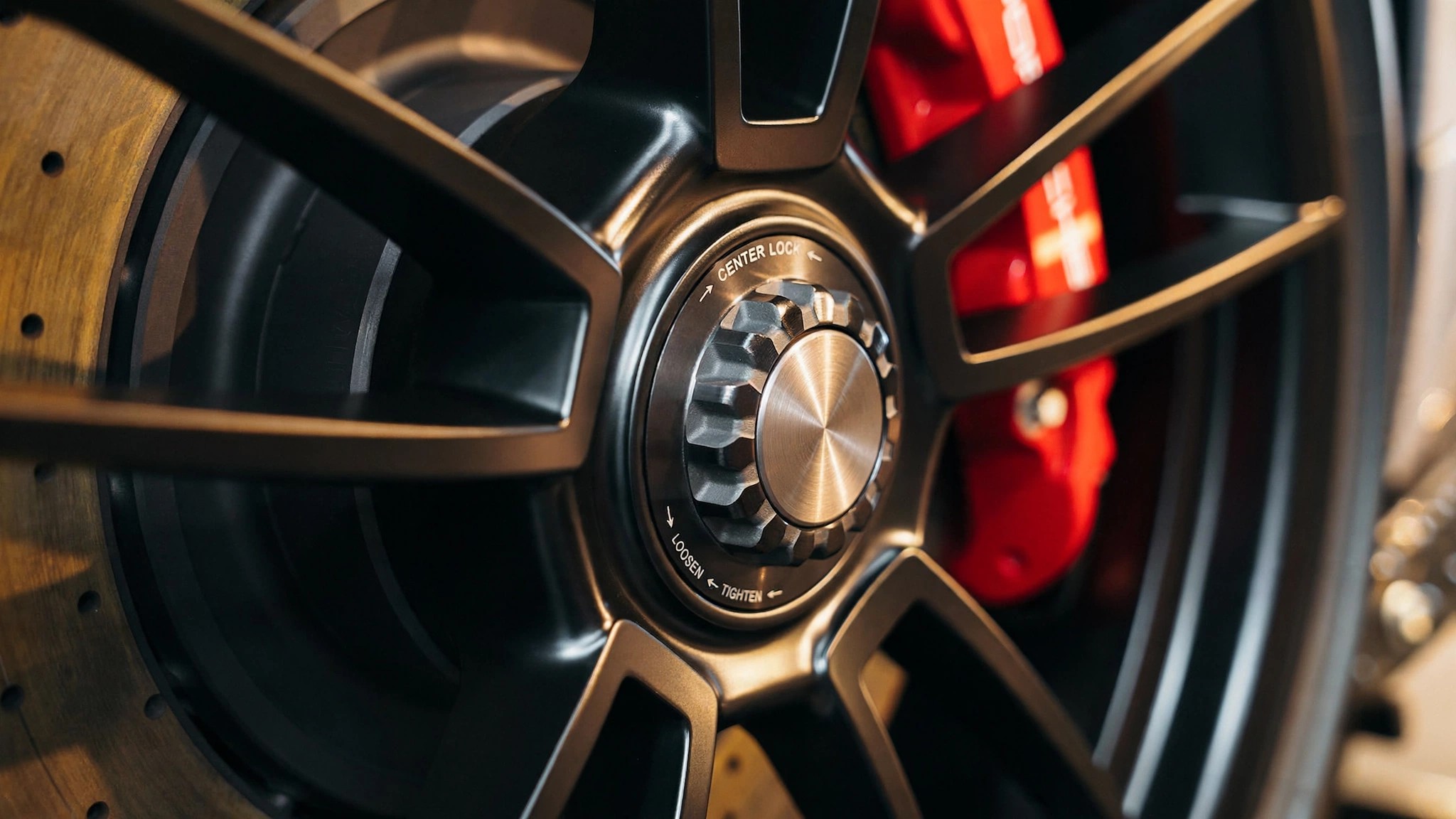
Count the bolts on a Porsche wheel and you know what the car is. Five bolts: street car. One bolt: race car, or something pretending hard enough that Porsche let it through. Since the 959, center-lock wheels have been reserved for the top of the hierarchy, the GT2 RS, the GT3 RS, the Turbo S Exclusive, cars that cost north of $200,000 and come with their own torque wrench because a single-nut retention system requires 442 lb-ft to seat properly. Nobody puts center-lock wheels on a Carrera S.
Porsche just did.
Announced during Monterey Car Week on August 13, the 2027 Porsche 911 Carrera S with MT Package is nominally a transmission option. North America exclusive. Six-speed manual gearbox, rear-wheel drive, the 3.0-liter twin-turbo flat-six making 473 horsepower. But the MT Package is not a gearbox swap with a price adjustment. It is a complete analog chassis specification that includes rear-axle steering, PASM Sport suspension lowered 10 millimeters, Porsche Torque Vectoring with a mechanical limited-slip differential, Sport Chrono, unique exhaust tuning, and those center-lock wheels. Every significant chassis component that defined the previous-generation GTS before that nameplate went hybrid and PDK-only.
Porsche priced it at $167,100 for the coupe. Destination adds $2,350. A 992.2 Carrera GTS T-Hybrid starts at $183,100. For sixteen thousand dollars less, you lose 59 horsepower, an electric motor, and a dual-clutch gearbox. You gain a clutch pedal, a walnut shift knob, 35 kilograms of weight savings from ditching the PDK, and a car that does not need to charge anything.
What the Center Lock Actually Does
Five-bolt wheel mounting is strong, proven, and universally serviceable. Any tire shop with an impact wrench can handle it. A single center-lock nut requires a specific torque wrench, a specific socket, and a specific procedure involving spring-mounted security bolts inside a cartridge built into the wheel hub. Porsche does not include center-lock hardware for aesthetics. It includes it because the engineering math is aggressive.
Porsche's official figure for the MT Package wheels: more than 17 pounds saved over the standard Carrera S five-bolt setup. That translates to roughly 7.7 kilograms spread across four corners, or approximately 1.9 kilograms per wheel. All of it unsprung mass.
Unsprung mass is the weight not supported by the suspension springs: wheels, tires, brake rotors, hubs, and the outboard portion of the control arms. Reduce it, and the suspension can follow road surface irregularities faster because the dampers are controlling less inertia. Steering becomes more immediate because the front tires respond to input with less rotational resistance. Braking improves because the caliper is decelerating a lighter assembly. At 17 pounds total, you could argue the difference is marginal. On track, at the limit, where tenths of a second accumulate over dozens of corners, it is not marginal at all. It is the kind of saving that Porsche's GT division has chased relentlessly for decades.
Center-lock retention uses a single large nut, typically titanium or a high-strength alloy, threaded onto a splined hub. A cartridge assembly inside the wheel ensures the nut cannot back off under load, and the tightening torque sits around 442 lb-ft according to Porsche Club of America documentation on the system. Changing a flat tire roadside is technically possible but involves a procedure most owners will never perform themselves. Porsche accepts that trade-off. So do buyers at this price point.
PTV with a Mechanical Diff
Porsche Torque Vectoring comes in two flavors. PTV pairs with manual transmissions and uses a mechanically regulated limited-slip differential. PTV+ pairs with PDK and substitutes an electronically controlled differential for fully variable torque distribution. Both systems share the same brake-based intervention logic: during cornering, moderate brake pressure is applied to the inside rear wheel, which transfers additional drive force to the outside wheel and creates a yaw moment that sharpens turn-in.
What separates them is the diff itself. A mechanical LSD uses clutch plates loaded by ramp angles on the spider gears. Engine torque pushes the spider gear pins up those ramps, which forces the clutch plates together. More throttle means more lock. On the 718 Spyder RS, Porsche specifies 30 percent locking under traction and 37 percent on overrun. These values are tuned to the chassis: aggressive enough to pull the car out of a corner under power, mild enough on trailing throttle that the rear does not step out unpredictably mid-turn.
An electronic diff can apply any locking percentage at any time, independent of throttle input. It is objectively faster at distributing torque. But it also weighs more, requires software calibration, and introduces a layer of interpretation between the driver's right foot and the rear axle that some people find intrusive. With a mechanical LSD, locking force correlates directly to what you are doing with the throttle. Push harder, lock harder. Lift off, it opens. No software deciding what you meant. For a car that is explicitly about manual engagement, mechanical is the philosophically correct choice.
35 Kilograms at the Rear Axle
Porsche's eight-speed PDK is a dual-clutch transmission with two concentric input shafts, hydraulic actuation, and a mechatronic control unit housing the valve body and electronic brains. It shifts in under 200 milliseconds. It is also heavy. On the previous-generation 992.1 Carrera S, Porsche listed the manual variant at 1,480 kilograms DIN kerb weight and the PDK at 1,515 kilograms, a difference of 35 kilograms concentrated at the rear of the car.
In a mid-engine car, that would matter moderately. In a rear-engine car, it matters enormously. A 911's weight distribution already biases toward the rear axle. Every kilogram added behind the rear wheels amplifies the pendulum effect that has defined the 911's handling character since 1963. Removing 35 kilograms of transmission hardware from that location does not just make the car lighter. It changes the polar moment of inertia, the resistance to rotational acceleration around the car's vertical axis. Lower polar moment means the car rotates more willingly into a corner and recovers more quickly when the rear starts to slide. For a driver managing weight transfer manually through throttle and steering, that difference is felt directly in how the car responds to corrections.
The MT Package coupe lands at 3,327 pounds, 11 pounds more than a Carrera T. But the T makes 388 horsepower. This car makes 473. An extra 85 horsepower for 11 pounds is an absurd power-to-weight trade, and the chassis hardware that accompanies it, rear-axle steering, sport suspension, center-lock wheels, is equipment the T cannot get at any price.
PASM Sport and 10 Millimeters
Porsche Active Suspension Management Sport lowers the ride height by 10 millimeters and recalibrates the adaptive damping for a firmer baseline. Standard PASM offers two modes, Normal and Sport, which adjust damping force continuously based on road conditions and driving inputs. PASM Sport shifts the entire range downward: what counts as "Normal" starts closer to where standard PASM's Sport mode lives.
A 10-millimeter drop does three things. It lowers the center of gravity, reducing body roll for a given lateral acceleration. It reduces suspension travel, which limits weight transfer during cornering and braking. And it brings the aerodynamic surfaces closer to the ground, increasing the floor's contribution to downforce at speed. None of these effects are dramatic individually. Combined with the lower unsprung mass from center-lock wheels, the wider contact patch from the larger-diameter brakes (408 mm front, 380 mm rear), and the rear-axle steering that shortens the car's effective wheelbase at low speeds and lengthens it at high speeds, they add up to a chassis that is fundamentally different from a standard Carrera S on every axis of dynamic performance.
A Flat-Six, Not an Inline-Six
A brief correction that needs stating because at least one major outlet got it wrong in their coverage: the engine in the 2027 Carrera S is a horizontally opposed flat-six, not an inline-six. Porsche has never put an inline-six in a 911 in the model's sixty-three-year production history. A flat-six mounts its cylinders in two banks of three at 180 degrees, keeping the engine low and short, which allows it to sit behind the rear axle without raising the center of gravity to the levels an upright inline layout would demand. CarBuzz's technical explainer on Porsche's flat-six architecture covers the packaging advantages in detail: lower engine height reduces the pendulum effect in the rear-engine layout, a benefit that would evaporate entirely with a taller engine block.
The 992.2 GTS introduced a T-Hybrid powertrain with a different engine architecture, a single turbo and an integrated electric motor adding complexity and roughly 50 kilograms. The Carrera S keeps the pre-hybrid twin-turbo 3.0-liter that has been the backbone of the non-GT 911 lineup since the 991.2 generation. Two turbochargers, no electric motor, no 400-volt battery, no regenerative braking. Just combustion and boost.
What It Costs and What That Price Says
Porsche charges $167,100 for the MT Package coupe before destination. A PDK-equipped Carrera S starts at roughly $155,000. That is a $12,000 premium for a manual transmission and the chassis package that accompanies it. Counterintuitively, MotorTrend notes the MT Package arrives at a "discount of roughly five percent versus the PDK automatic model" once you price the included equipment: rear-axle steering, PASM Sport, Sport Chrono, center-lock wheels, SportDesign fascia, and the upgraded brakes would add far more than $12,000 as individual options on a standard S.
The 992.2 GTS T-Hybrid starts at $183,100. It makes 532 horsepower, has launch control, and will outrun the MT Package car on a straight line without question. But it only comes with PDK, it carries hybrid system weight, and its powertrain includes an electric motor embedded in the transmission that blurs the line between what the engine is doing and what the software is doing. Timo Resch, President and CEO of Porsche Cars North America, put the positioning plainly: "While some brands are abandoning the manual, we are proud to continue offering three pedals in a range of products that speaks to different use cases. Managing a clutch and shift lever isn't for everyone, but for the drivers who want it there really is no substitute."
That quote is corporate marketing language. It is also accurate.
Interior Details That Reveal the Intent
A walnut shift knob is a small thing. It is also a signal. Porsche uses walnut on the Carrera T's shifter, connecting the manual-equipped models to a tradition that predates the current generation by decades. Walnut is warm in the hand, ages with use, and cannot be mistaken for the machined aluminum or leather-wrapped knobs that populate the rest of the lineup. It says: this car is for driving, not for selecting a gear map on a touchscreen.
Optional puddle lights project the six-speed shift pattern onto the ground when you open the door. Plaid Sport-Tex seat centers with Chalk stripes replace the standard leather, a callback to lightweight 911 interiors from the 1970s and the current Carrera T's aesthetic. Ceramica trim replaces the standard brushed aluminum. A white accent ring circles the Sport Chrono clock on the dashboard. None of this adds performance. All of it reinforces what the car is for.
Carbon-fiber folding lightweight bucket seats are optional, and so are Porsche Ceramic Composite Brakes, neither of which is available on the Carrera T. If you want a manual 911 with PCCB and carbon buckets, this is the only path below the GT3 family.
What We Have Not Done
We have not driven this car. Nobody outside Porsche has, as of this writing. Deliveries begin before the end of 2026, and until someone puts the MT Package through a proper road and track evaluation, every claim about how these components interact at the limit is inference based on how they have performed individually in other 911 variants. Rear-axle steering on the GTS is excellent. PASM Sport on the GT3 Touring is excellent. A mechanical LSD on the Spyder RS is excellent. Whether the specific calibration Porsche chose for the MT Package matches the promise of its parts list is a question only seat time can answer.
Porsche also has not published a 0-60 time. Given that the manual-only Carrera T is approximately 0.4 seconds slower to 60 than its PDK-equipped Carrera sibling with the same engine, expect the MT Package to land somewhere around 3.5 to 3.7 seconds. Fast by any normal standard. Slower than a PDK Carrera S by a margin that matters only to people who buy 911s for launch control, and those people are not the audience for a car with a walnut shift knob.
What This Car Actually Is
Strip away the naming and the MT Package is a 992.2 GTS from a timeline where the GTS never went hybrid. Same flat-six, minus the electric motor. Same manual-first philosophy. Same center-lock wheels, same rear-axle steering, same sport suspension. Porsche could not call it a GTS because the GTS is now the T-Hybrid with PDK and 532 horsepower and an entirely different engineering identity. So they called it a Carrera S with an option package, set the price $16,000 below the new GTS, and trusted that the people who care will read the spec sheet and understand what they built.
Seven manual 911 variants will be available in North America when this car reaches dealers. That is a remarkable commitment from a company whose PDK take rate exceeds 70 percent globally. Porsche is not chasing volume with the MT Package. It is preserving an idea of what a 911 should feel like before the electrified era swallows everything, including the GTS badge, that used to protect it.
One bolt per wheel. Six gears. No electric motor. That is the spec sheet. Everything else follows from it.