The Minute That Jumps: Petermann Bédat's 2914 Monopusher Chronograph
Most chronograph minute counters creep. Petermann Bédat's jumps. The Reference 2914 keeps that one trick from its split-seconds predecessor, throws away the rattrapante, and shrinks into a 36.5mm platinum case.
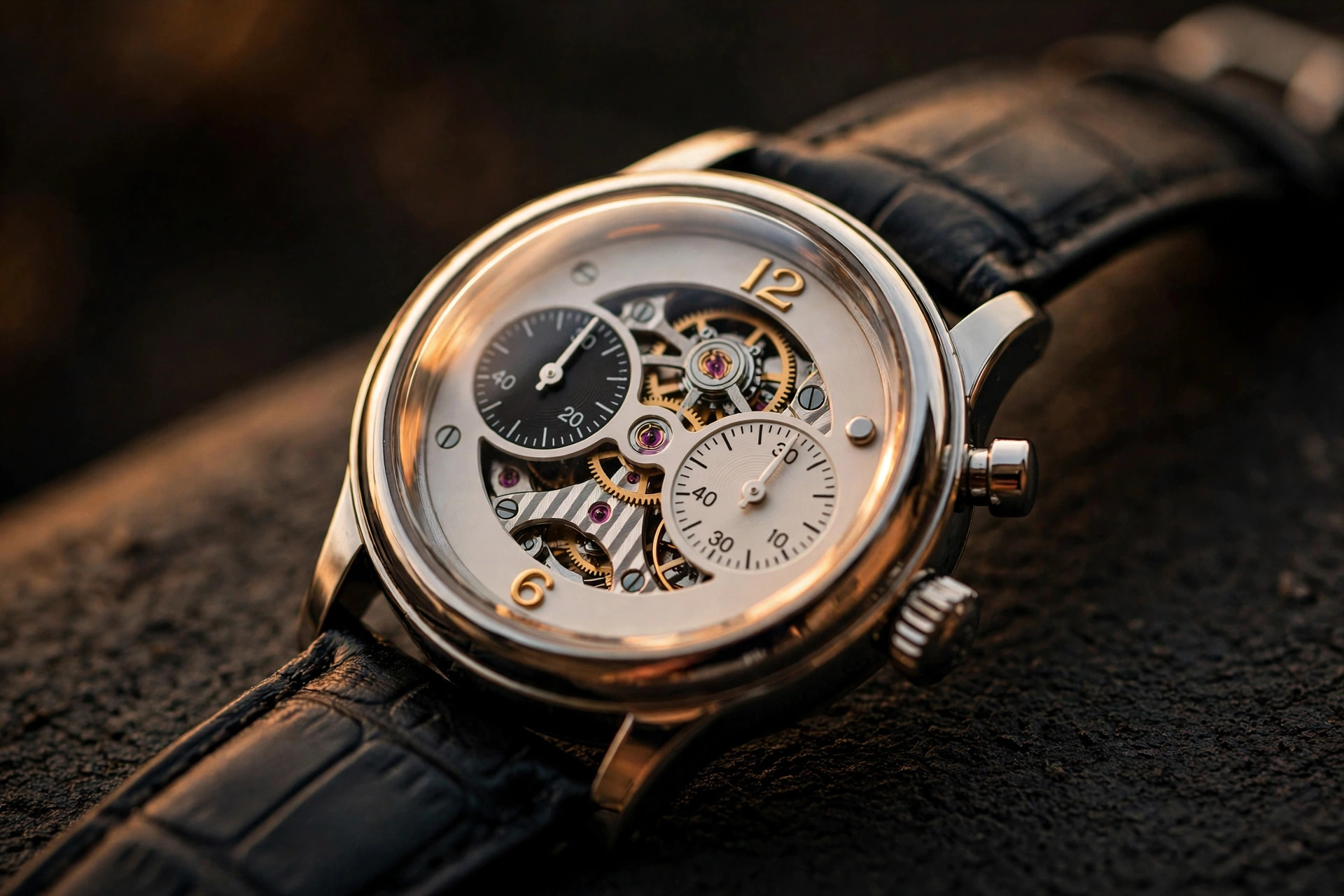
Watch a conventional chronograph minute counter at work and you will see the problem immediately. It drags. It creeps from one mark toward the next over sixty seconds, which means any reading taken mid-minute is an interpolation, a guess dressed up as a measurement. Petermann Bédat's Reference 2914 refuses the guess. Its minute counter sits still, then jumps to the next mark in a single snap at the end of each elapsed minute, and the reading is exact or it is nothing. That one mechanism is the whole watch. Everything else in the 2914 exists to protect it, shrink around it, or get out of its way.
Gaël Petermann and Florian Bédat introduced the 2914 at IAMWATCH in Singapore in mid-November 2026, at an event hosted by The Hour Glass that ran November 12 to 15. It is the two-man Renens workshop's first chronograph-only watch, and it arrives three years after the Reference 2941, the split-seconds monopusher that put the brand on the map. Where the 2941 measured two elapsed times at once through its rattrapante mechanism, the 2914 measures one, and measures it properly. Twenty pieces in platinum, CHF 180,000 excluding taxes, with other metals promised later. Allocation will be harder than payment.
A minute that moves all at once
An instantaneous minute counter sounds simple until you think about what it has to do. A conventional counter is geared directly to the chronograph train, so it inherits the train's motion and moves continuously. A jumping counter has to be decoupled from that motion, held back for fifty-nine seconds, and then released to advance exactly one minute in a fraction of a second, every minute, without disturbing the seconds hand it shares a train with. That takes a snail cam to measure the minute, a jumper spring to hold the counter wheel, and a precisely timed release that dumps stored energy into the counter in one controlled snap. Get the release wrong and the counter overshoots its mark or stutters halfway. Get the energy wrong and the jump steals torque from the going train and the seconds hand hesitates.
Petermann Bédat kept this mechanism from the 2941 and built the 2914 around it. It is a deliberate choice of what to keep. A split-seconds mechanism is spectacular and almost never used, which is the honest description of most rattrapantes outside a racetrack. A jumping minute counter is used every single time the chronograph runs, because every timing ends with someone reading the minutes. Keeping the complication you use and deleting the one you show off is the kind of editorial decision most brands will not make, because the deleted complication is usually the one that justifies the price. Here the price stayed high anyway, which tells you what the brand thinks it is selling.
Slow helps. Calibre 234 beats at 18,000 vibrations per hour, 2.5 Hz, the rhythm of a pocket watch and half the rate of a modern 4 Hz chronograph. At that frequency the seconds hand steps five times per second, in 0.2-second increments, so the minute jump lands on a coarser grid than a fast-beat movement would give it. That is the trade, stated plainly: coarser seconds resolution in exchange for lower wear, lower energy draw, and a gentler life for the gold gear train underneath. A jumping minute counter does not need fine seconds resolution the way a drag counter does, because the minute reading is discrete either way. What it needs is a train that never hesitates when the jumper fires, and a slow beat is one way to buy that steadiness.
Subtraction as engineering
Removing the rattrapante did more than simplify the movement. It shrank the watch. The 2941 measured 38.6mm across; the 2914 cuts that to 36.5mm, and comes in at 9.9mm thick excluding its box-shaped sapphire crystal, 11.6mm including it, which is 1.4mm thinner than the 2941's 13mm on Monochrome's figures. Two point one millimetres of diameter and well over a millimetre of thickness do not sound like much. On a wrist they are the difference between a watch that announces itself and one that disappears under a cuff, and for a chronograph that wants to be read as a 1930s instrument rather than a modern sports watch, the smaller envelope is the entire point.
Calibre 234 is an evolution of the 2941's Calibre 202, with the split-seconds works removed and several pieces rethought. Petermann Bédat modified the reset mechanism and the hook of the column wheel, and redesigned the going train with solid gold wheels whose spokes are bevelled by hand. Gold wheels deserve a pause, because gold is a strange material to build a gear train from. It is soft, it wears faster than brass or steel, and it costs a fortune in a place nobody sees unless the caseback is open. Its virtues are density, stability, and the fact that a hand-bevelled gold wheel is the most honest display of finishing a movement can offer. A maker does not put gold wheels in a calibre to improve timekeeping. A maker puts them there because the movement is meant to be looked at, and because the redesign of the train for what Bersenti describes as long-lasting operation and energy transfer is the engineering answer to gold's softness. SJX notes the calibre is loosely based on the Valjoux 23 architecture, the mid-century chronograph calibre Patek Philippe once used, which makes the 2914 a modern movement with a vintage skeleton and a gold train inside it.
Inside the 30mm movement, a large balance wheel carries a Breguet overcoil hairspring, and Rehaut 1775 describes a free-sprung balance, an upgrade carried over from the brand's Reference 1825. Power reserve is 56 hours, an increase over the 2941. Twenty-one jewels. No date, no twelve-hour counter, nothing that is not the chronograph. What the movement gives up for its classic architecture is the vertical clutch. Calibre 234 uses a horizontal clutch, the visually beautiful and mechanically old-fashioned arrangement, where the chronograph wheel slides sideways into mesh when the pusher is pressed. Horizontal clutches can make the seconds hand jump on starting, because two toothed wheels meeting at speed never mesh perfectly. Vertical clutches, like the one in Seiko's NE86 family, engage without that shudder but hide the engagement from view. Petermann Bédat chose the clutch you can watch. That is a defensible choice in a watch bought to be looked at, and it is worth knowing before the first start.
Gold wheels in a case with no room to spare
A 30mm movement inside a 36.5mm case leaves almost nothing for the case maker. The movement fills 82 percent of the diameter, which is why the lugs are soldered on individually instead of machined as part of the case, a vintage construction that survives here because there is no room for anything else. The case is polished 950 platinum with a concave bezel, and it runs 45.8mm from lug to lug, a long span for a 36.5mm watch that anyone with a small wrist should try on before committing. Water resistance is 30 metres. Nobody buys this watch to swim, but the number belongs in the open anyway, because a tool claim and a 30-metre rating do not sit comfortably together, and the 2914 makes no tool claim. It is a dress chronograph with a stopwatch inside it.
Up top, the dial continues the semi-open construction the brand has used since its first watch. Kari Voutilainen's Comblémine atelier makes the sapphire dial, laser-engraving its centre for a frosted effect over German silver plates, with black-framed subdials and applied gold numerals at 12 and 6. It is a panda dial, white against black subdials, in a sector-style layout, and the transparency is not a gimmick. It lets the owner see the top of the movement through the face, which is the point of a semi-open dial: the watch shows its work from both sides.
The honest ledger
One pusher does everything. Start, stop, and reset run sequentially through a single pusher integrated into the crown, the traditional monopusher arrangement, and it carries a traditional monopusher rule: you cannot reset while the chronograph is running. Press to stop first, then press again to reset. That is not a limitation to apologise for. It is a guard against the most common chronograph accident, resetting mid-timing and losing the measurement, and it is the reason monopushers survived as a form long after two-pusher chronographs took over the practical world.
What the 2914 is not deserves the same space as what it is. It is not a sports watch, at 30 metres and on a black alligator strap with a platinum pin buckle. It is not a value proposition, at CHF 180,000 for a chronograph with no flyback, no rattrapante, and no calendar, when Monochrome's own comparison points to Rexhep Rexhepi's flyback chronograph at CHF 150,000 and the Grönefeld Grönograaf at around EUR 160,000. It is not available, in any practical sense, at twenty pieces in platinum with a ten-row metal bracelet still under development. What it is, at that price, is a watch finished by two people in Renens, in a case size almost nobody else will attempt for a hand-wound chronograph, with a minute counter that jumps instead of creeping. Whether that is worth more than a flyback from a rival independent is a question of what you value: complications, or the discipline to remove them.
Even the name is an act of subtraction. The 2941 took its name from 2941 T.A., the fictional year Smaug met his end in Tolkien's The Hobbit. The 2914 reverses its final two digits, and the founders say the number was inspired by two vintage Patek Philippe chronographs, the same way the movement's architecture reaches back to the Valjoux 23. Petermann and Bédat met while studying watchmaking and worked together at A. Lange and Söhne before founding their own workshop, and the 2914 reads like the work of people who spent their apprenticeships inside other makers' chronographs and came away with a list of what to keep. They kept the column wheel, the horizontal clutch, the slow beat, and the jumping minute. They threw away the split seconds. The result is smaller, simpler, and harder to argue with than the watch it replaces.
A chronograph is a measuring instrument, and every measuring instrument is judged by the same standard: how much of its reading is the thing measured, and how much is the instrument. A dragging minute counter adds the instrument. A jumping one removes it. That is a small idea, executed at a very high price, in a very small case, by two people. It is also, as of November 2026, the most interesting chronograph of the year for anyone who thinks the reading matters more than the mechanism that produces it.
Specifications
| Item | Reference 2914 Monopusher Chronograph |
|---|---|
| Debut | IAMWATCH, Singapore, November 12 to 15, 2026 |
| Case | Polished 950 platinum, concave bezel, individually soldered lugs, box-shaped sapphire crystal, transparent snap-on sapphire caseback |
| Diameter | 36.5 mm |
| Thickness | 9.9 mm excluding crystal; 11.6 mm including box sapphire |
| Lug-to-lug | 45.8 mm |
| Water resistance | 30 m |
| Dial | Semi-open sapphire dial by Comblémine, panda sector layout, frosted laser-engraved centre over German silver plates, applied gold numerals at 12 and 6 |
| Strap | Black alligator leather, platinum pin buckle; ten-row metal bracelet under development |
| Movement | Calibre 234, hand-wound, in-house, 30 mm diameter, 21 jewels |
| Frequency | 18,000 vibrations per hour (2.5 Hz) |
| Power reserve | 56 hours |
| Chronograph | Column wheel, horizontal clutch, single pusher in crown, start-stop-reset sequential |
| Minute counter | Instantaneous jumping minute counter |
| Balance | Large balance wheel, Breguet overcoil hairspring, free-sprung |
| Production | 20 pieces in platinum; other metals later |
| Price | CHF 180,000 excluding taxes |
Limitations
Not handled, not worn, and no independent hands-on coverage exists yet as of November 26, 2026. All technical figures come from the brand and the trade press. The Valjoux 23 lineage is SJX's characterisation, not the brand's. The free-sprung balance is described by Rehaut 1775; the brand's own materials describe a large balance with a Breguet overcoil. No accuracy figure has been published, no lume performance is claimed anywhere, and the metal bracelet is still in development, so its weight, fit, and price are unknown. The jumping minute counter's long-term reliability, and the wear rate of the gold going train, cannot be assessed until watches accumulate years of use.
Sources
- The Hour Glass, "Petermann Bédat Ref. 2914 Chronograph Monopusher Brings Classical Proportions to Contemporary Watchmaking," November 16, 2026, thehourglass.com
- Revolution, "Petermann Bédat Introduces the 2914 Chronograph Monopusher," November 13, 2026, revolutionwatch.com
- Monochrome, "First look: Petermann Bedat Presents The Reference 2914 Monopusher, Their First Chronograph-Only Watch," November 2026, monochrome-watches.com
- Watchonista, "First Impressions: The Petermann Bédat Reference 2914 Monopusher Chronograph," November 25, 2026, watchonista.com
- Waqt, "Petermann Bédat Unveils the Reference 2914 Monopusher Chronograph," November 2026, waqt.com
- Bersenti, "Petermann Bédat Reference 2914: Price and Specifications," November 2026, bersenti.com
- Rehaut 1775, "Petermann Bédat 2914 Monopusher Chronograph (2026)," November 12, 2026, rehaut1775.com