Three Pedals, No Permission: The Manual C8 Corvette GM Refused to Build
GM said the C8 would never have a manual. A Texas race shop disagreed, and the gearbox that made it possible has been sitting in Tremec's catalog for a year.
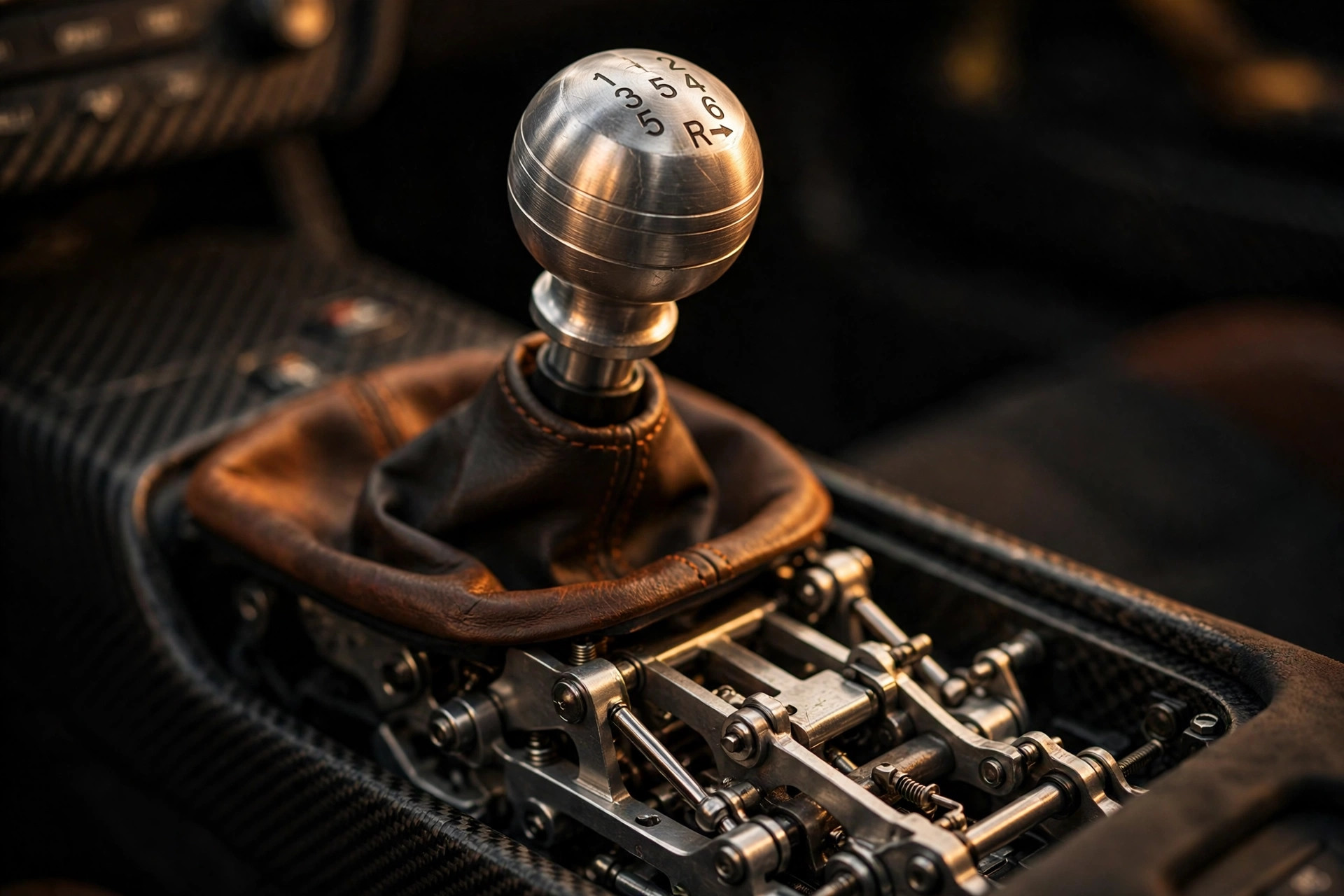
Somebody finally did it. Peitz Performance, a Texas shop that campaigns C8 Corvettes in Gridlife and other track series, has put a six-speed manual transaxle into the mid-engine Corvette, and the car is running, shifting, and lapping. Corvette chief engineer Tony Roma has said repeatedly that GM has no plans to offer a manual C8, and that the factory eight-speed dual-clutch is the faster gearbox. Both statements are true. Neither one stopped anyone.
What makes this conversion interesting is not the existence of a manual C8. Aftermarket shops have been threatening one since the car launched in 2020, and the internet has been demanding one for longer. What makes it interesting is how little fabrication it took, because the hard part was solved a year ago by a supplier, in public, at SEMA. Tremec showed its TR-9060 six-speed manual transaxle at the 2025 SEMA Show, and the headline detail was easy to miss: it shares the packaging envelope and mounting points of the TR-9080, the dual-clutch transaxle Tremec already builds for the factory C8. Same case profile, same hard points, same suspension geometry around it. A gearbox that bolts where the DCT bolts changes the conversion from a fabrication project into an integration project, and integration is a very different kind of hard.
A gearbox built to fit a car it was never sold for
Tremec developed the TR-9080 for GM, so it knows the C8's rear structure intimately, down to the millimeter. When it designed the manual TR-9060 for the aftermarket, it kept that knowledge and reused the DCT's envelope deliberately, so builders could design around a transaxle with known dimensions instead of reverse-engineering a mid-engine chassis from scratch. Six forward gears plus reverse, helical-cut to balance strength against noise, a mechanical limited-slip differential, a cable-shift mechanism, and an aluminum case. Rated for 1,000 horsepower, 800 lb-ft of torque, and input speeds up to 8,600 rpm. Those numbers cover every production C8, including the 1,064-horsepower ZR1, which is not a coincidence. Tremec built a manual that can survive the most violent engine GM will ever bolt in front of it.
One specification deserves a pause. TR-9060 has no park lock. A dual-clutch car parks itself with a pawl inside the transmission, and a manual has no equivalent, so a converted C8 will rely on first gear plus the parking brake, the way every manual car has parked since forever. It is a small detail that reveals how thoroughly the factory car was designed around its DCT. Every assumption downstream of the gearbox, from parking procedure to hill-hold logic, was drawn for a transmission that locks itself. Peitz has to unwind those assumptions one at a time, and the parking question is the most visible of them, not the most difficult.
Everything around the gearbox
Bolting the transaxle in was the easy afternoon. Peitz owner Alex Peitz told Hot Rod that his shop's advantage was unglamorous and decisive: the team had already 3D-scanned the entire car during its earlier race builds, so shifter placement, linkage routing, clutch pedal geometry, and cable lengths were planned in the computer model before anything was cut. That scan is the difference between a conversion that fits and a conversion that fights the car for the rest of its life.
For the shifter itself, Peitz went to the Porsche aftermarket. A Porsche shifter became the starting point for a custom six-speed mechanism, with cable length estimated from the 3D model and refined over a few trial fitments. Under the dash, the team built a bracket mounting a clutch pedal to the brake pedal assembly, starting with a third pedal taken from a Cadillac CT4-V Blackwing and modified with a pedal stop and hydraulic clutch assist. McLeod built the flywheel, incorporating the ring gear and teeth from a C8 flywheel and adding the clutch hardware. Read that parts list again. A Porsche shifter, a Cadillac pedal, a McLeod flywheel, and a Tremec transaxle, assembled by a Texas race shop, in a car whose manufacturer insists a manual is impossible. GM's own parts bin supplied one of the three pedals. That is the kind of irony you cannot manufacture.
None of this is exotic technology. Cable shifters, hydraulic clutch assist, and pedal brackets are old, solved problems. What is hard is packaging them in a cockpit that was drawn with two pedals and a center tunnel shaped around a DCT selector. Every millimeter of pedal travel and every degree of cable bend had to be earned against a dashboard that never expected a clutch master cylinder behind it. Peitz solved it with scanning, trial fitting, and patience, which is the honest answer to most packaging problems and the one nobody wants to hear.
Convincing the car its gearbox never left
Mechanical fitment was only half the job. A C8's factory electronics assume a dual-clutch transaxle is attached at all times, and they talk to it constantly: shift logic, torque management, traction control, stability control, and the instrument cluster all expect answers from a gearbox that is no longer there. Peitz replaced the factory electronics with a MoTeC plug-and-play system it designed for the C8, and the architecture is worth understanding because it shows where the real engineering lives in a modern conversion.
An M182 controls the engine. A secondary M150 handles transmission functions, and it is the flexible half of the pair: with the factory DCT it manages clutch and shift control, and with the manual box it cuts ignition briefly on upshifts and downshifts, unloading the gears so the driver can shift without lifting or grinding. It runs on the factory C8 wiring harness through custom connectors, and Peitz says the production unit is intended to keep the factory dash, ABS, power steering, and other stock systems working. That last claim is the one to watch. Any standalone engine management system can make a car fast. Keeping the dash, the ABS, and the steering assist happy while the car believes it still has a dual-clutch is the part that separates a race car from a street car, and Peitz is explicitly aiming at street cars.
MoTeC system has a second life beyond this conversion. Peitz will sell it for restomods and kit cars, and a standalone version of the M150 controller can run Tremec's TR-9080 and TR-9070 dual-clutch transmissions on their own, paired with any engine management the builder prefers. That matters more than it sounds. Until now, putting a modern Tremec DCT into a custom build meant solving the transmission control problem yourself, which is why so few people did it. A plug-and-play DCT controller is a door opening for an entire category of builds, and it arrived as a side effect of a manual conversion. Side effects like that are how aftermarket engineering actually moves forward.
What it costs you
Honesty first. Hot Rod's first-drive account praised the shifter's short throws and precise feel, and GM Authority's coverage is equally clear that the dual-clutch car would likely remain quicker in outright acceleration. Nobody involved in this project pretends otherwise, and that is exactly why the conversion is interesting. A DCT shifts in milliseconds and never misses a gear. A manual shifts at the speed of a human hand and misses gears when the human is tired, distracted, or ambitious. Choosing the slower gearbox on purpose is a statement about what a sports car is for, and it is a statement GM's product planners have decided their customers no longer want to make.
There are open questions a buyer should ask before ordering. No price has been published for the conversion package. No independent performance numbers exist yet, and the development car is a track-prepared racer, so its driving impressions may not predict how a stock C8 feels with the same gearbox. Long-term durability of the ignition-cut shift strategy under repeated track abuse is unproven in customer hands. Peitz's stated goal is to sell the conversion as a complete package under one part number, with the MoTeC system available for purchase around now and estimated ship dates in the first quarter of 2027. Until kits are in customers' hands, this is a demonstrated prototype, not a product, and the distinction matters.
I have not driven the car. This analysis rests on Hot Rod and GM Authority coverage plus Tremec's published TR-9060 specifications, and hands-on time would answer the questions paper cannot, starting with the one that matters most: does the shifter feel like it belongs in this car, or does it feel like a clever guest? Short throws and precise gates are encouraging words from a first drive, but a shifter reveals its true character over a thousand shifts, not ten.
Integration is the engineering
Step back and the shape of this story is familiar. Tremec did the packaging work a year ago, designing a manual transaxle that shares the DCT's envelope so that someone, someday, could bolt it into a C8. Peitz did the integration work this year, solving the pedal, the cables, and the electronics that surround any gearbox swap. Neither half of that story is dramatic on its own. Together they produce a car that did not exist last month: a mid-engine Corvette with three pedals, built from a catalog gearbox, a Porsche shifter, a Cadillac pedal, and a computer that lies to the car about what transmission it has.
GM will keep building the faster car. Roma is right that the DCT is quicker, and the sales figures presumably agree with him. But the manual C8 now exists because a supplier designed for a possibility and a race shop refused to accept a no, and that sequence is worth more than the car itself. Factory product planning decides what most people get. Aftermarket engineering decides what the stubborn few can have instead. Sometimes the stubborn few are right, and the rest of us get to watch a three-pedal Corvette lap a circuit that GM said would never see one.
| Specification | Peitz C8 Manual Conversion |
|---|---|
| Base car | Chevrolet C8 Corvette (track-prepared development car) |
| Transaxle | Tremec TR-9060, six-speed manual, cable shift |
| Transaxle rating | 1,000 hp; 800 lb-ft torque; 8,600 rpm maximum input |
| Differential | Mechanical limited-slip |
| Packaging | Shares TR-9080 DCT envelope and mounting points |
| Shifter | Custom six-speed mechanism based on Porsche aftermarket shifter |
| Clutch pedal | Modified Cadillac CT4-V Blackwing pedal, hydraulic assist, pedal stop |
| Flywheel / clutch | McLeod flywheel with C8 ring gear and teeth |
| Engine control | MoTeC M182 |
| Transmission control | MoTeC M150; ignition cuts for manual shifts |
| Wiring | Factory C8 harness with custom connectors |
| Park lock | None (gear plus parking brake) |
| Availability | Conversion as one-part-number package (goal); MoTeC system shipping Q1 2027 |
| Factory position | GM: no plans for a manual C8 (Tony Roma) |
Sources
- Hot Rod, "C8 Corvette TREMEC Manual Transmission Conversion," November 3, 2026; Peitz Performance interview, 3D scanning, Porsche shifter, CT4-V Blackwing pedal, McLeod flywheel, MoTeC M182/M150, first-drive impressions.
- GM Authority, "Peitz Performance Releases C8 Corvette Manual Conversion," November 4, 2026; TR-9060 installation, MoTeC system details, Tony Roma factory-manual statement, one-part-number package goal.
- Tremec blog, "New TREMEC 6-Speed Manual Transaxle Redefines Custom Performance," SEMA 2025 debut; TR-9060 specifications, 1,000 hp, 800 lb-ft, 8,600 rpm, TR-9080 mounting points and packaging envelope, mechanical limited-slip differential.
- Ford Muscle, "SEMA 2025: TREMEC's Manual Transaxle Is An Intriguing Option"; cable-shift mechanism, helical-cut gears, aluminum construction, no park lock.