Flat Torque at Midnight: Patek's Instantaneous Calendar Chronograph
Patek has owned an instantaneous perpetual calendar module since 2008 and its finest chronograph since 2009. At the Milan Grand Exhibition it finally combined them in the platinum 5978P. Worth the wait: a calendar that spreads its midnight work over as many as 24 hours so the torque demand never spikes.
What Was Actually Announced
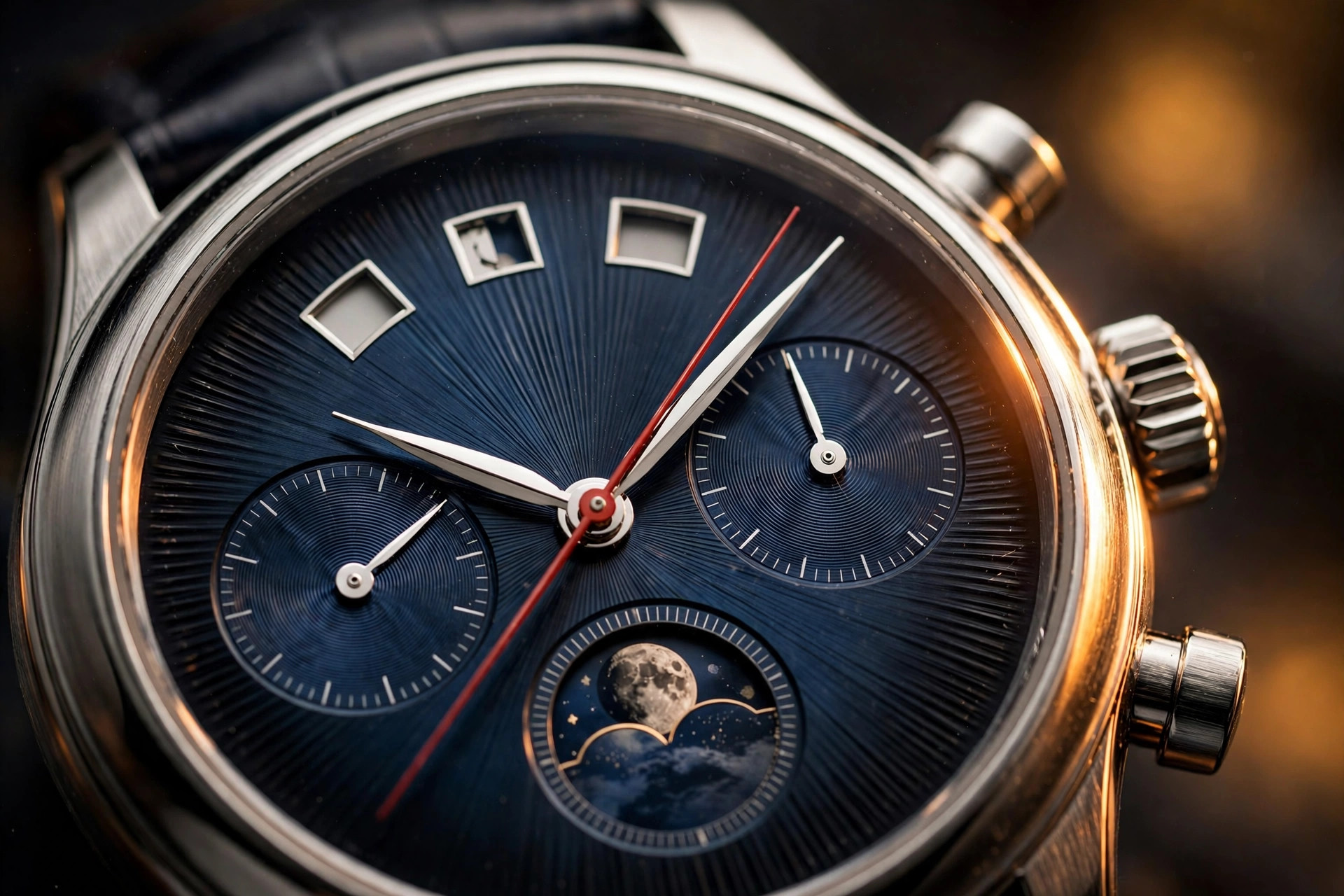
Reference 5978P-010, unveiled at the Watch Art Grand Exhibition in Milan in early October 2026. One hundred twenty pieces, 950 platinum, 42 millimeters across and 14.45 millimeters thick. Inside: the new hand-wound CH 29-535 PS QI, a 500-part caliber that fuses the CH 29-535 PS chronograph of 2009 with an instantaneous perpetual calendar module that first appeared in 2008. Nobody at Patek had ever put the two together before.
Day, date, and month read from apertures along an arc between 10 and 2 o'clock, transfer-printed in blue and framed in applied white gold, and the calendar displays read in Italian. Small seconds sits in an eccentric snailed subdial between 8 and 9; the instantaneous 30-minute counter lives between 3 and 4, red lacquered, with the leap-year aperture with the leap-year aperture tucked beneath its hand, the moonphase at 6, and day/night at 9. Patek lists the price at $337,585 and sells it as an Italian-market allocation, so consider the price stated and set aside; it is not the subject here.
What follows is about two mechanisms most watchmakers treat as incompatible roommates: a chronograph that must never disturb timekeeping, and a calendar that must fire all of its indications at once, on time, without taxing the movement.
Why Instantaneous Calendars Usually Cost the Movement Something
A perpetual calendar has a cruel arithmetic problem. At midnight on February 28, the date must advance four positions, the day and month one each, and the moonphase creeps forward, all in a fraction of a second, and springs do the work. Something has to charge those springs during the day, and in most instantaneous calendars the charging period is fixed: a snail cam winds the calendar spring over a set number of hours regardless of what the calendar is about to do.
That works until February, when four date positions demand more lever travel than one and the spring gets deflected further in the same time window. More deflection in the same time means more torque demanded from the going train, which means the balance wheel sees a load change and amplitude wobbles in the hours before midnight. Some makers accept this. Others hide it behind a big power reserve. Patek declined both options.
Their answer is variable charging duration, and it is the single most interesting idea in this movement. Beyond lever travel, the month cam sets how long the return spring gets charged. In a 31-day month, the drive lever engages the month lever late in the day, so the lift takes about six hours and produces a short travel. In a 28-day February, contact happens almost immediately, so the lift stretches across nearly 24 hours for the longest travel. Same work per unit time, always. Across the month, torque demand on the movement stays flat no matter what the calendar is about to do.
Think about what that buys. Balance amplitude never gets mugged at 11 p.m. in February. To the escapement, there is no February. That is the whole point.
How the Lever Train Actually Works
Strip away the poetry and the architecture is a grand lever, which is standard for perpetual calendars, with a refinement that is not. Once every 24 hours the lever must advance a 31-tooth date wheel, and a month cam encodes the month lengths to govern its travel. On Patek's version, the lever carries three additional pivots: a date pawl, a month lever, and a month finger and day finger sharing the third pivot.
A 24-hour snail cam drives a separate pivoted drive lever cut with four notches, one per possible month length. A smaller month lever rides on the grand lever, reads the month cam, and parks its far end in front of the right notch. The drive lever moves freely at first; when the notch meets the month lever, it begins lifting the grand lever against its spring. Twelve-month cams are used here rather than the 48-month cam of Patek's subdial calendars, with a satellite leap-year cam distinguishing the two Februaries.
At midnight the 24-hour snail cam releases the drive lever, the spring returns the grand lever, and the indications fire. The day finger on the grand lever advances the day star and its attached disc by one position. The date pawl gives the date ring its ordinary advance. Both stay engaged with their teeth afterward to stop overtravel. At month end, a pin on the month finger enters a notch in the date ring just before midnight, and as the lever returns it carries the ring straight to 1: through two positions after a 30-day month, three after February 29, four after February 28. A hook on the same finger advances the month star, disc, and month cam together. A tooth sector on the grand lever meshes with a pinion that acts as a regulator to keep the return from slamming.
One more packaging detail deserves a nod. The date ring is large, which usually means cramped numerals. Patek rested the ring on rollers and recessed its drive teeth into the rear face instead of cutting them through the disc, freeing the front surface for bigger numerals inside the same ring width. Unseen, but you read it every day.
Why This Module Waited Eighteen Years for a Chronograph
Until the 5978P, the instantaneous calendar module had appeared exactly three times: in the Ref. 5207 of 2008, a tourbillon minute repeater; in the Ref. 5208 of 2011, which added a monopusher chronograph; and in the Ref. 5308 of 2023, the quadruple complication built for the Tokyo exhibition. Every prior outing was a minute repeater.
There is a logic to that. A minute repeater's gongs demand enormous energy discipline from the movement; a module that keeps torque demand flat is a natural fit, and putting your bravest calendar inside your most demanding movement is how a manufacture proves it. But it also kept the module rare and stratospheric. The 5978P is its first appearance in a manually wound movement and its first without any chiming complication at all. Bringing the flat-torque calendar down from the repeater stratosphere into a chronograph is not a simplification. It is a statement that the mechanism earned its keep.
Meanwhile the other half of this marriage had its own pedigree problem to solve. The CH 29-535 PS is seventeen years old and still, by most accounts, the finest hand-wound chronograph on the market. Its fame rests partly on fixing two persistent horizontal-clutch headaches: the seconds hand jump when the clutch engages, and uneven power transmission through conventional triangular teeth.
Patek's fix was tooth geometry. The inactive flanks of the clutch and chronograph wheel teeth follow the teeth's path into engagement, so contact is less likely to shove the seconds hand backward, and recoil on disengagement is limited. The convex active flanks transmit power more smoothly once engaged, with less wear and smaller torque fluctuations than the tip-to-flank contact of ordinary triangular teeth. The clutch wheel even meshes at different depths with the drive and chronograph wheels, so its inner and outer portions can each be profiled for the wheel they engage. None of this is visible on the dial. All of it is felt in the smoothness of the seconds hand.
The Curved Slot, or How Not to Break a Reset
The 5978P's chronograph carries an instantaneous jumping minute counter, a refinement that fell out of fashion as makers cut costs and has since been revived at the top end by the likes of Lange and Patek. Most modern chronographs settle for a semi-instantaneous minute counter, where the hand creeps toward the next marker before jumping. A true instantaneous counter snaps the whole advance in one crisp motion, the way high-grade chronograph pocket watches used to.
Mechanism: a snail cam on the chronograph seconds shaft turns once per minute, and its rising profile lifts a spring-loaded lever. At the top of the minute the lever drops from the cam's highest point to its lowest, and a pawl on the lever advances the ratchet-toothed minute wheel exactly one tooth. An eccentric lets watchmakers adjust the cam's angular position so the jump lands precisely as the seconds hand crosses zero.
Elegant, until you reset. Resetting counterclockwise drives the steep face between the cam's highest and lowest points into the nose of the lever. The shaft stops dead, but the hand's momentum flexes it, which can loosen the hand or break it. A clockwise reset meets no such obstruction. Patek's answer is a curved slot cut beneath the outer end of the snail cam. During a counterclockwise reset the lever's nose drops into the slot instead of hitting a wall, so the seconds assembly is free to travel slightly past zero and settle through a few oscillations, exactly as it does on a clockwise reset.
It is a small, honest piece of engineering: the kind of fix that exists because somebody watched a hand break and refused to shrug.
The Bill Comes Due on the Wrist
All of this instantaneous machinery has a volume, and the volume is worn. Day and month discs stacked above the date ring demand height, and the case pays it: 42 millimeters by 14.45, against the 5270's 41 by 12.4. Some reviewers have said the 5270 remains the more persuasive proposition in proportions and classical beauty. They have a point. The 5978P is not a better watch in every respect; it is a more sophisticated calendar in a thicker one, and the instantaneity is most visible in the few seconds around midnight, which is the only window where the mechanism justifies its size.
None of which makes the mechanism less real. Calendar indications in Italian (a nod to the exhibition city), a diamond set into the case at 6 o'clock, a composite navy strap with red stitching and an Italian-flag stopping point: these are Milan-edition trimmings, and they are fine. But the part worth remembering when the exhibition closes is the module, now proven outside the repeater family. If it survives service life gracefully, and that is an if with a decades-long verification cycle, expect to see this calendar again in watches more people can buy.
One limitation, stated plainly: I have not handled the watch. The mechanism description above is built from Patek's published specifications and Revolution's teardown reporting of the module. What is asserted about tooth profiles, charging durations, and notch counts traces to those sources. What is asserted about how it feels on the wrist does not exist in this article, because it does not exist for me yet.
The Full Spec Sheet
| Detail | Specification |
|---|---|
| Reference | 5978P-010, Instantaneous Perpetual Calendar Chronograph, Milano 2026 Limited Edition |
| Case | 950 platinum, 42mm diameter, 14.45mm thick (crystal to crystal 14.24mm); concave bezel, scalloped lugs, diamond at 6 o'clock; sapphire caseback inscribed "Patek Philippe Milano 2026"; 30m water resistance |
| Dial | Navy blue sunburst with black gradient rim, textured concave center; applied white gold hour markers; day-date-month apertures in Italian along an arc 10 to 2; day/night at 9; leap year at 3; moonphase at 6 |
| Chronograph display | Red lacquered arrow-type chronograph hand (Pfinodal) with counterpoise; instantaneous 30-minute counter between 3 and 4; small seconds between 8 and 9; snailed subdials |
| Movement | Calibre CH 29-535 PS QI, hand-wound; 32mm diameter, 8.10mm tall; 500 parts, 33 jewels; 28,800 vph (4 Hz); 55-65 hour power reserve |
| Oscillator | Gyromax balance (4 arms, 4 inertia blocks); Breguet hairspring |
| Calendar module | Instantaneous perpetual calendar on multi-part grand lever; 24-hour snail cam drives four-notch drive lever; month cam + satellite leap-year cam set variable charging duration (approx. 6h in 31-day months, nearly 24h in 28-day February); day, date, month jump simultaneously at midnight |
| Chronograph | Column wheel, horizontal clutch; asymmetric tooth profiles on drive/clutch/seconds wheels (differential mesh depths); instantaneous jumping minute counter via snail cam, spring lever, and ratchet; eccentric zero alignment; curved reset slot for counterclockwise return |
| Strap | Navy blue composite with fabric pattern, red stitching, Italian-flag stopping point; platinum triple-blade fold-over clasp |
| Availability | 120 pieces, Italian market, unveiled October 2026 |
| Price | $337,585 (stated once, set aside) |
Torque Is the Only Luxury That Cannot Be Faked
There is a reason this watch matters more than its 120 owners will. Most complications are sold on what they display. This one is engineered around what the movement never feels: the flat torque curve, the undisturbed amplitude, the midnight that costs nothing at 11 p.m. Variable charging duration is not a complication you can photograph. It is a complication you can measure, in amplitude traces that refuse to dip in February.
Eighteen years between the module and the marriage looks like hesitation. It reads better as discipline: wait until the calendar has proven itself in repeaters, wait until the chronograph has spent seventeen years being the benchmark, then combine them and let the midnight snap do the talking.
Sources
- Patek Philippe official page, Grand Complications 5978P-010 (patek.com). Caliber CH 29-535 PS QI (500 parts), Italian-language calendar apertures, 120-piece limitation, "Patek Philippe Milano 2026" caseback inscription, $337,585.
- Revolution Watch, "Introducing: The Patek Philippe Ref. 5978P Milano 2026 Limited Edition," October 2026. Full module history (5207/2008, 5208/2011, 5308/2023), grand lever architecture (three pivots, date pawl, month lever, shared-pivot fingers), four-notch drive lever, variable charging duration (6h for 31-day months, ~24h for 28-day February), tooth-sector regulator, roller-rested date ring with rear-recessed teeth, instantaneous minute counter mechanism (snail cam, spring lever, ratchet pawl, eccentric zero adjustment), curved reset slot, CH 29-535 PS asymmetric tooth profiles and differential mesh depths, 5270 comparison.
- Revolution Watch, "Last Week in Watches: Patek Philippe Takes Milan," October 2026. Seven Milan editions context, 5978P tech specs (55-65h reserve, 4 Hz, 42 x 14.45mm, navy sunburst dial, red chronograph hands).
- Revolution Watch, "Patek Philippe Releases Seven Limited Editions at Watch Art Grand Exhibition Milan," October 2026. 14.24mm thickness figure, navy composite strap, price-upon-request availability framing.
- Timekeepers Club, "Patek Philippe 5978P-010 Instantaneous Perpetual Calendar Chronograph Limited Edition Milano 2026." Full spec table: 32mm x 8.1mm caliber, 33 jewels, Gyromax 4-arm balance, Breguet hairspring, aperture layout (day/night at 9, leap year at 3), pusher positions.
- mrstateless.com, "Patek Philippe 5978P-010: A New Chronograph Perpetual Calendar For Milano 2026," October 2026. €323,385 pricing, Italian-market exclusivity, CH 29-535 PS QI lineage framing.