Five Hands, One Center Post: How Parmigiani Made a Chronograph Disappear
Most chronographs announce themselves. Subdials break the face into smaller counting zones. Extra pushers punctuate the case band. Tachymeter scales crowd the rehaut. Even when idle, a chronograph carries the visual weight of its complication whether the stopwatch function is running or not.
Parmigiani Fleurier's Tonda PF Chronographe Mystérieux, unveiled at Watches and Wonders 2026, rejects that premise entirely. At rest, it presents a clean three-hand dial with a Mineral Blue grain d'orge guilloché surface, applied gold indices, and skeletonized delta hands. No subdials. No tachymeter. No visible pushers beyond a discreet teardrop button at 7:30 on the left case flank. Only when that button is pressed does the chronograph materialize, and only for as long as it is needed. Release the measurement, and it vanishes again.
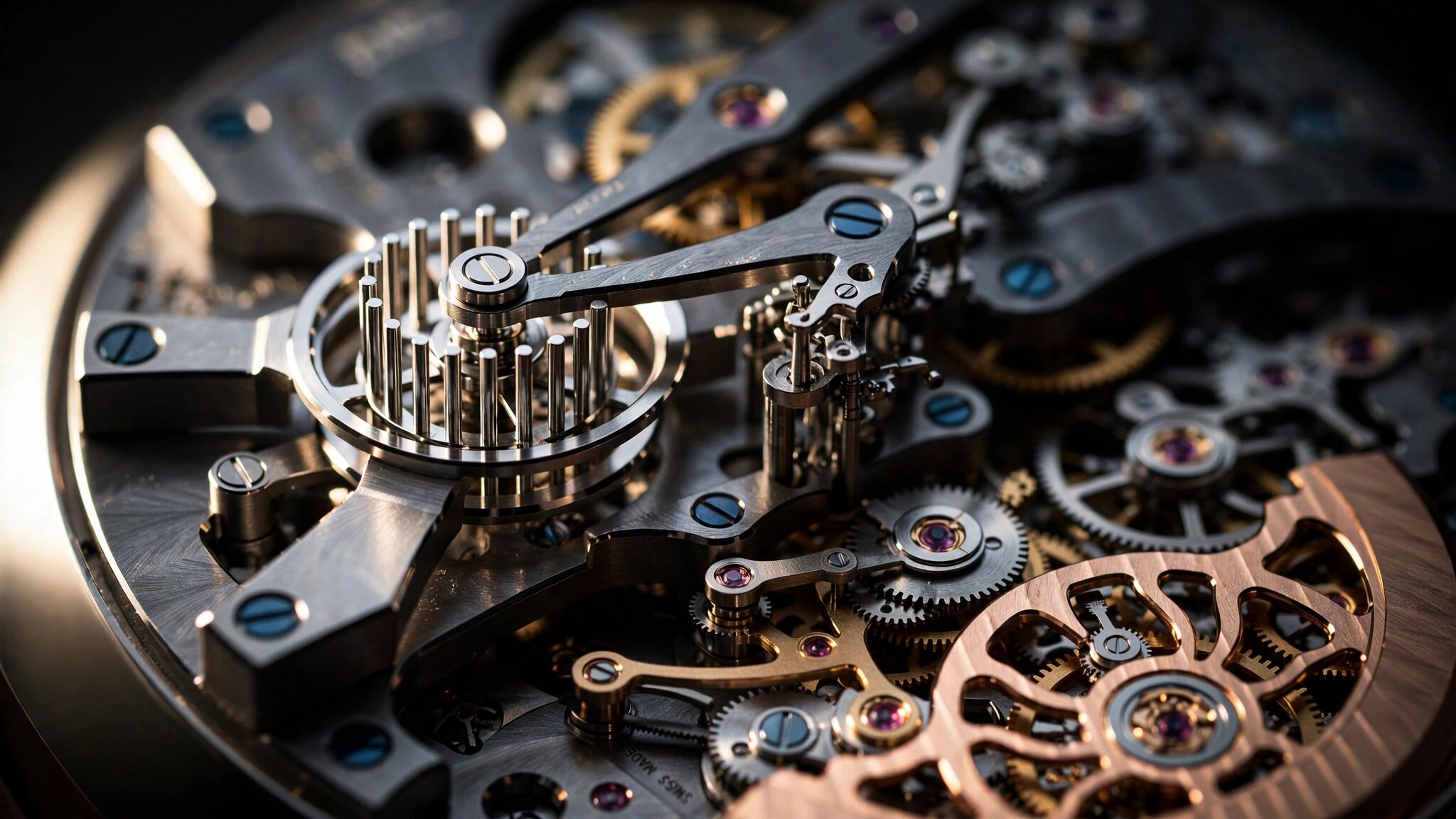
Achieving this required something that had never been built before: a fully integrated column-wheel chronograph with three separate clutch systems coordinating five coaxial hands on a single center post. Calibre PF053 contains 362 components, measures 6.9 mm in height, and represents the kind of engineering effort that hides rather than displays its complexity.
Five Hands on One Arbor
Stack five hands on one center post and you create a set of mechanical problems with no clean precedent in existing chronograph architecture. Two 18-karat rose gold delta-shaped hands track hours and minutes for civil time. Two 18-karat gold rhodium-plated delta hands serve as chronograph counters for hours and minutes. A rhodium-plated steel seconds hand alternates between continuous sweep for normal timekeeping and elapsed-time counting for the chronograph. All five rotate independently around the same vertical axis, separated by fractions of a millimeter.
At rest, the rhodium-plated hour and minute hands display the time, with the rose gold hands riding in their shadow, perfectly superimposed and invisible. Press the monopusher once, and three things happen in concert. First, the rhodium-plated hours, minutes, and seconds hands fly back to twelve o'clock and begin counting elapsed time across the full dial face. Simultaneously, the rose gold hour and minute hands emerge from behind and assume timekeeping duties. Where the dial showed three hands a moment earlier, it now shows five, working independently but sharing the same center axis.
A second press freezes the rhodium-plated hands, displaying the measured interval while the rose gold hands continue their civil time sweep. A third press sends the chronograph hands flying back to realign precisely with the rose gold counterparts, which have been tracking time throughout. Once realigned, the rose gold hands vanish behind the rhodium-plated ones, and the seconds hand resumes its normal sweep. A chronograph that was fully deployed across the entire dial retracts into a simple three-hand watch.
What makes this sequence extraordinary is not the visual effect alone, though that earned Parmigiani one of the strongest reactions at Watches and Wonders. What matters is what the movement must calculate. When the chronograph resets, the rhodium-plated hands must return to wherever the rose gold hands happen to be at that exact instant. Not where they were when the chronograph started. Where they are now. During a ten-minute timing interval, the minute hand has traveled 60 degrees around the dial. During a two-hour interval, the hour hand has swept through a significant arc. Every reset demands that the flyback mechanism send the chronograph hands to a moving target, and the clutch engagement must be instantaneous enough that no visible gap opens between the pairs when they recombine.
Three Clutches, One Column Wheel
Conventional chronographs use either a horizontal clutch or a vertical clutch to engage the timing mechanism with the timekeeping train. Each type handles one coupling event between two gear trains. PF053 requires three separate coupling events, because three pairs of functions must be independently managed.
A vertical clutch handles the primary chronograph engagement. When the monopusher is pressed, a friction disc drops onto the driving surface of the fourth wheel, connecting the chronograph seconds function to the timekeeping gear train. Vertical engagement eliminates the stutter start that plagues horizontal systems, where meshing teeth can produce a momentary jump in the seconds hand before the wheels synchronize. In a watch designed around visual purity, even a fraction-of-a-second hesitation at startup would undermine the disappearing act.
Two horizontal clutches manage the hour and minute hand pairs independently. Each clutch controls the superimposition and separation of one pair. When the chronograph activates, the clutches decouple the rhodium-plated hands from their civil time position and permit the flyback to twelve. When the chronograph resets, the clutches re-engage, forcing the rhodium-plated hands to snap back into alignment with their rose gold counterparts. Managing these transitions through horizontal rather than vertical coupling is a deliberate choice: horizontal clutches allow finer positional control over the exact rotational alignment at which two hands recombine, a property that becomes critical when the goal is pixel-perfect superimposition.
Orchestrating all three clutches through a single monopusher adds another layer of complexity. In a conventional two-pusher chronograph, start/stop and reset functions are mechanically isolated. PF053 routes both through one column wheel operated by one pusher, cycling through three distinct states: start, stop, reset. Each press rotates the column wheel by one position, and each position activates a different combination of clutch engagements. Building a column wheel that sequences three clutch states through a single input is, in mechanical terms, closer to programming a finite state machine than to traditional chronograph construction.
362 Components in 6.9 Millimeters
Calibre PF053 measures 32.4 mm in diameter and 6.9 mm in height. For context, Rolex's 4130 Daytona caliber stands at 6.5 mm with roughly 290 components. Omega's 9900 runs at 7.35 mm with 355 components. Parmigiani packed 362 components and 41 jewels into a profile that sits between the two, while managing a complication neither of those movements attempts.
Running at 28,800 vibrations per hour, the movement delivers a 60-hour power reserve through a single mainspring barrel wound by a skeletonized 22-karat rose gold oscillating weight. At 4 Hz, each tick subdivides a second into eight equal intervals, providing the timing resolution expected of a modern chronograph without the energy demands of higher-frequency alternatives.
Finishing meets Parmigiani's house standards. Open-worked bridges receive satin finishing on their broad surfaces and hand-beveled edges along every visible angle. Sandblasted and polished surfaces alternate across the oscillating weight. None of this decoration is visible from the dial side. It exists entirely for the caseback view, a deliberate inversion of the watch's front-facing philosophy: the dial pretends to be simple, while the movement visible through the sapphire back reveals everything.
Parmigiani's Trilogy of Disappearing Complications
Chronographe Mystérieux did not arrive in isolation. It is the third movement in a series Parmigiani has been building since 2022, each exploring the concept of superimposed hands that reveal complications on demand.
In 2022, the Tonda PF GMT Rattrapante debuted the idea with two superimposed hour hands on the same axis. A rhodium-plated hand tracks local time, advancing in one-hour jumps when traveling. A hidden rose gold hand emerges on demand to display home time. When no longer needed, the gold hand retreats behind the rhodium one. A GMT complication that appears and disappears without leaving visual evidence on the dial.
In 2023, the Tonda PF Minute Rattrapante extended the concept to minute-level countdowns. A hidden minute hand emerges, gets pushed ahead by user-selected increments, and the visible minute hand counts down in real time to meet it. Once the two converge, the hidden hand vanishes again.
Each movement solved a progressively harder version of the same fundamental problem: how to make hands appear, perform a function, and retract without a trace. Going from two superimposed hands in 2022 to five in 2026 required a tripling of the clutch architecture and a ground-up caliber that shares no components with its predecessors. PF053 was designed from a blank sheet for this specific complication.
What 13 Millimeters Contains
Housed in a 40 mm stainless steel case with a knurled platinum 950 bezel, the Chronographe Mystérieux stands 13 mm thick and carries a 100-meter water resistance rating. An integrated stainless steel bracelet with alternating polished and satin-finished surfaces secures it to the wrist. A screw-down crown at 3 o'clock and the teardrop monopusher at 7:30 are the only interruptions along the case band.
At 13 mm, the case is thicker than a typical three-hand Tonda PF. It has to be. Five coaxial hands require taller arbors to maintain clearance between superimposed pairs. Three clutch systems occupy vertical space that a single-clutch chronograph does not need. A column wheel sequencing three states requires a more complex lever and spring arrangement than one sequencing two. Every millimeter of that 13 mm thickness represents a consequence of the disappearing act.
Pricing starts at 36,900 Swiss francs for the steel-and-platinum version, equivalent to roughly $44,600. A full platinum variant costs 99,600 CHF. Both contain the same PF053, the same 362 components, and the same triple-clutch architecture. Platinum adds mass and surface character, but the mechanical choreography is identical. A chronograph that hides itself costs the same to engineer regardless of what surrounds it.
Disappearance as a Design Discipline
In mechanical watchmaking, display is the default. Complications exist to be seen. Tourbillons get their own apertures. Perpetual calendars fill every square millimeter with indicators. Minute repeaters may conceal their hammers but announce themselves audibly. Nearly every complication in the history of horology was designed to add visual information to the dial.
Parmigiani's contribution is subtraction. Instead of adding to what the wearer sees, Calibre PF053 removes information when it is not needed and reconstructs it when it is. Building a mechanism that disappears required solving problems that display-oriented movements never encounter: how to stack five hands with sub-millimeter clearance, how to engage and disengage three clutches simultaneously through a single input, and how to fly back to a target that is itself in motion.
A column wheel that sequences two states through two pushers has been refined over nearly two centuries of chronograph development. A column wheel that sequences three states through one pusher is something new. Not a stopwatch bolted onto a timekeeping movement, but a timekeeping movement that becomes a stopwatch when asked and forgets that it ever was one when dismissed.