744 Hours on a Leash: How Panerai Tamed a Month-Long Power Reserve
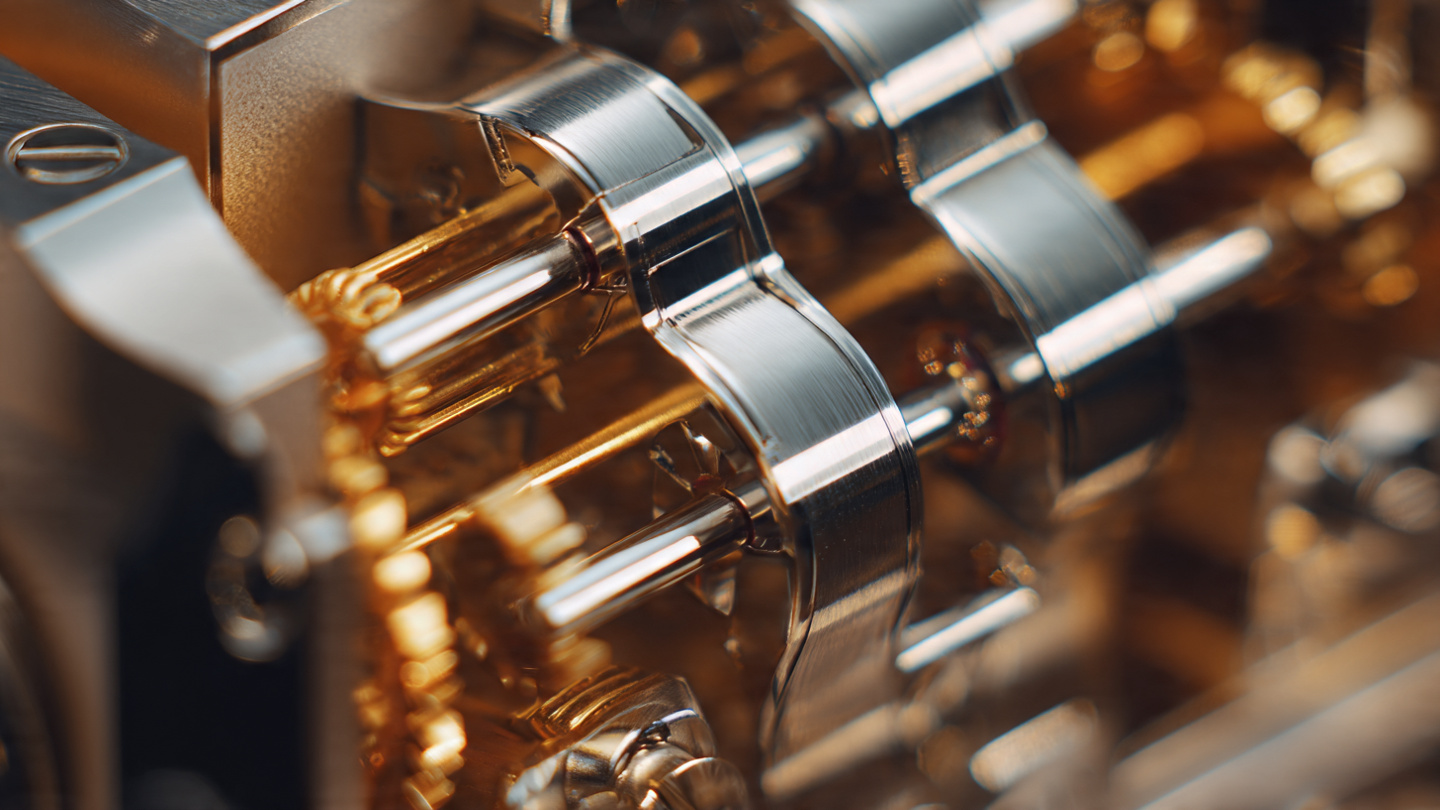
Wind a mechanical watch fully and it runs fast. Let it run down to the last few hours and it runs slow. Every watchmaker since the sixteenth century has known this, because it falls directly out of mainspring physics: a coiled strip of metal exerts maximum torque when tightly wound and minimum torque when nearly flat, and the balance wheel responds to that changing force by oscillating at slightly different amplitudes throughout the power reserve. Most modern calibers solve this by keeping power reserves short enough that the torque variation stays within acceptable bounds, typically 40 to 80 hours, where the difference between fully wound and nearly depleted amplitude is small enough that a well-adjusted escapement can absorb it. Stretch that window to 31 days and the math stops cooperating.
Panerai spent seven years finding a different answer. Instead of fighting the torque curve, they cut it.
Why Long Power Reserves Break Chronometry
A mainspring is a long, thin strip of specially alloyed steel, usually Nivaflex or a proprietary equivalent, coiled inside a cylindrical barrel. When you wind the crown, the inner end of the spring tightens around the barrel arbor, storing elastic potential energy, and as the spring unwinds, it rotates the barrel wall, which drives the gear train, which drives the escapement, which regulates the balance wheel. Every tick of the watch consumes a tiny fraction of that stored energy, and over the course of 744 hours the cumulative drain follows a pattern that has haunted watchmakers since the invention of the mainspring.
Force delivery is not linear. A fully wound mainspring produces its highest torque in the first hours after winding, because the spring is compressed tightly and the elastic restoring force is at its maximum. As it unwinds, torque drops along a curve that approximates an inverse relationship with the number of remaining turns. Plot torque against time on a standard 48-hour movement and you get a gently declining slope; plot it against time on a 744-hour movement and you get something closer to a cliff followed by a long, shallow valley followed by a ditch. Both extremes are problems: at the cliff, excessive torque overdrives the balance wheel, amplitude climbs above optimal range, the balance spring enters its nonlinear regime where isochronism breaks down, and the watch gains time. At the ditch, torque falls below what the escapement needs to maintain stable oscillation. Amplitude drops, the balance wheel cannot complete full rotations, and the watch loses time before eventually stopping, which means that between those two zones sits a band of relatively stable torque where the escapement performs as designed and the watch keeps accurate time.
Conventional movements live almost entirely within that stable band because their power reserves are short, and a 48-hour movement uses roughly the middle third of its mainspring's theoretical energy curve. Extend power reserve to eight days, as Panerai did with the P.2002 caliber in 2005, and you start consuming more of the curve's extremes, requiring careful regulation to maintain accuracy across the full window. Push it to 31 days and the extremes dominate.
Four Barrels, One Argument for Series
Barrel configuration is not a detail but rather the fundamental architecture decision in any long-power-reserve movement, and it determines whether extra barrels buy you more time or more force.
Arrange barrels in parallel and each one drives the gear train simultaneously, so torque doubles with two barrels, triples with three, but running time remains essentially the same as a single barrel because all mainsprings are depleting at the same rate. Parallel arrangements suit heavy complications: tourbillons, perpetual calendars, minute repeaters, anything that demands more driving force than a single barrel can reliably provide.
Arrange them in series and the opposite happens: each barrel's output feeds the next, and the gear train sees the torque of a single barrel while the total running time multiplies. Two barrels in series roughly double power reserve; four, as in the P.2031/S, can quadruple it.
Panerai chose series. Four barrels contain 3.3 meters of combined mainspring, a length that if uncoiled would stretch from floor to ceiling in most rooms and then keep going. Each barrel unwinds at a low torque level, and the series arrangement ensures that the gear train receives steady, modest force rather than a massive pulse that declines rapidly. Low torque means low friction at every pivot in the gear train, which means less wear over 744 hours of continuous operation. High-torque movements chew through lubricants faster and impose greater stress on jewel bearings, so at 21,600 vibrations per hour across 31 days, the balance wheel completes roughly 16.1 million oscillations between windings, and minimizing pivot stress across that many cycles is not an aesthetic preference. It is a survival requirement.
Cutting the Curve
Every previous approach to ultra-long power reserves attacked the torque problem from the escapement side. A. Lange and Söhne built the Lange 31 in 2007 with a remontoire, a secondary spring that sits between the barrel and the escapement, rewinding itself every ten seconds from the main barrel's output. By chopping the enormous power reserve into ten-second segments and letting the balance wheel run off the small, freshly wound remontoire spring each time, Lange isolated the escapement from the barrel's torque variation entirely. Brilliant. Also complex: the Lange 31 required a dedicated winding tool to overcome the barrel's resistance, came in a 46.1-millimeter white gold case, and cost roughly $200,000 at launch.
Hublot went bigger. MP-05 LaFerrari. Eleven barrels arranged vertically in a spinal column, visible through a sapphire case inspired by the Ferrari V12's intake manifold. Fifty days. The standing record for a mechanical wristwatch. No crown at all. Winding required a miniature electric drill that Hublot supplied in a custom case, because 11 barrels worth of mainspring tension exceeded what any human thumb could manage through a standard crown. It was a magnificent piece of horological theater. It was also 51 millimeters by 45.8 millimeters by 15.3 millimeters, required its own power tool, and nobody was wearing it to dinner.
Panerai's Torque Limiter takes the opposite approach: instead of adding mechanical complexity downstream of the barrels, it accepts the full torque curve as a given and simply refuses to use the parts of it that produce inaccurate timekeeping. Four barrels in series produce a theoretical 36 days of power, but a patent-pending mechanism monitors the force state of the barrel train and isolates a 31-day operational window from the middle of the curve, discarding the high-torque surge after full winding and the low-torque fade before depletion. After 31 days, the movement stops. Deliberately. Even though the mainsprings still hold enough energy to run for five more days, that deliberate stop is the detail that reveals the philosophy: Panerai is not trying to set a duration record, because they already have competitors who have done that. What they are doing is setting an accuracy record within a month-long window, a subtler and arguably harder engineering problem, because any watchmaker can add barrels to extend runtime but ensuring that every hour across 744 hours meets chronometric standards requires controlling the energy delivery system with unusual precision.
What 128 Crown Turns Feels Like
Winding a depleted Luminor 31 Giorni from zero to full takes 128 turns of the crown. That sounds like a lot. By ultra-long-power-reserve standards, it is remarkably few. Jacob and Co.'s Quenttin Tourbillon demanded 200 turns of a flip-out lever, not a crown, because the winding torque exceeded what a crown mechanism could handle. Rebellion's T-1000 used an integrated winding lever, and Hublot's MP-05 abandoned manual winding entirely.
Panerai's P.2031/S winds from the crown, period: no special tools, no levers, no drill. Deployant's hands-on review from Watches and Wonders Geneva reported that the winding resistance felt comparable to a standard hand-wound movement, with no unusual stiffness or mechanical protest. That is a direct consequence of the series barrel arrangement: because each barrel operates at low individual torque, the winding mechanism never encounters the concentrated resistance that a single massive barrel would impose. You wind it like any Luminor. It just takes more turns.
128 turns at a comfortable pace takes roughly four minutes, once monthly, and when you compare that with a 48-hour movement that requires winding every other day, the practical convenience argument inverts: over a 31-day month, a conventional hand-wound watch demands 15 winding sessions. This one demands one.
Goldtech and the Polarized Date
Panerai houses the 276-component movement in a 44-millimeter case made from Goldtech, a proprietary alloy that combines 75 percent gold with roughly 24 percent copper and a trace of platinum. Copper gives the alloy its warm, saturated red tone, noticeably deeper than standard 18-karat rose gold, while a trace of platinum improves corrosion resistance, because copper-rich gold alloys are vulnerable to tarnishing if the copper content is not stabilized by a noble metal addition. Goldtech is not merely a color choice; it is a metallurgical solution to the problem of making a high-copper gold alloy that stays beautiful on a wrist exposed to sweat, chlorinated water, and atmospheric sulfur compounds.
Skeletonization exposes the caliber through the dial side, with hour markers cantilevered over the visible movement architecture on a minimal rehaut ring. Super-LumiNova X2 coats the markers, hands, and the arrow at three o'clock that points to a date window using a clever polarization trick: a polarized disc rotates beneath the dial, and the date numeral becomes visible only through the aperture at three, where the polarization angle aligns. Everywhere else, the disc appears opaque, preventing unwanted glimpses of date numerals through the skeletonized dial, a small thing but the kind of detail that separates considered design from showing off.
A curved power reserve indicator traces the dial's perimeter in five-day increments, and at full wind, the indicator sits at 31; after a week, roughly 24; after three weeks, roughly 10. When it reaches zero, the Torque Limiter has already stopped the movement, so the indicator functions as a winding calendar rather than an emergency warning. You check it the way you check a fuel gauge: casually, because you filled the tank last month and you know you have time.
Competitors and Context
Five watches have reached or exceeded 31 days of mechanical power reserve in a wristwatch format. Lange's Lange 31, launched in 2007, pioneered the territory with its remontoire-based approach. Hublot's MP-05 LaFerrari pushed the record to 50 days in 2013, an achievement that remains unmatched, while Jacob and Co.'s Quenttin Tourbillon reached 31 days in 2006 through seven barrels and a separate winding lever. Rebellion proposed several multi-month watches, including the T2M with a claimed 58-day reserve, though industry reporting suggests none of Rebellion's ultra-long-reserve movements functioned reliably. Vacheron Constantin's Twin Beat Concept (2019) claimed a 65-day reserve in low-frequency standby mode, a technically distinct approach that reduces beat rate to 1.2 Hz when the watch is not being worn.
Panerai's entry is neither the longest nor the most mechanically exotic, but what distinguishes it is accessibility. At 44 millimeters in a Luminor case, it wears like a normal Panerai, and it winds from the crown without tools, and its 276-component movement, while sophisticated, is less complex than the Lange 31's 586-component remontoire architecture or the MP-05's 637-component barrel stack. And its Torque Limiter addresses the accuracy problem with elegant simplicity: rather than adding mechanical intermediaries, it redefines the operational window. Less is more, applied to horological engineering.
Limited to 200 pieces at approximately EUR 95,000, it is expensive by any standard other than the ultra-long-reserve watches it competes with. Lange 31 debuted at roughly $200,000, Hublot MP-05 LaFerrari at $300,000 and up, Jacob Quenttin north of $700,000. By the standards of its peer group, the 31 Giorni is the accessible entry point, which tells you something about the rarefied nature of this particular engineering challenge.
What the Torque Limiter Means Beyond Panerai
Most power reserve innovations in watchmaking have been additive: more barrels, more mainspring, more constant-force intermediaries, more components. Panerai's Torque Limiter is subtractive, taking energy that the movement already produces and deliberately discarding the portions that compromise accuracy. In a field obsessed with maximizing every parameter, choosing to use less of what you have is a genuinely unusual design decision.
Its implications extend beyond month-long reserves: any movement with a power reserve longer than about 72 hours begins to encounter meaningful torque variation between fully wound and nearly depleted states. Eight-day movements compensate through careful regulation and generous mainspring sizing, but if the Torque Limiter mechanism, or something derived from it, can be miniaturized and applied to shorter-reserve calibers, it could improve chronometric consistency across a much broader range of movements by standardizing the portion of the torque curve that reaches the escapement.
Whether Panerai pursues that application is unknown, since patents exist to protect inventions, not necessarily to predict product roadmaps. But the concept, that you can improve accuracy by strategically limiting energy delivery rather than adding compensating mechanisms, is sound engineering philosophy regardless of scale, and it applies to domains well beyond horology. Fuel cell engineers trim operating windows to avoid membrane degradation at voltage extremes, battery management systems in electric vehicles restrict state-of-charge ranges to extend cycle life, and Panerai, perhaps without intending the analogy, has built a mainspring management system that follows the same principle.
Wind it. Wait a month. Wind it again. Somewhere inside, 3.3 meters of coiled steel unspools through four barrels at a pace calibrated to deliver 16.1 million oscillations before a deliberate, designed silence. Not because the energy ran out, but because the engineers decided that 31 accurate days matter more than 36 uncertain ones.
Sources
- Panerai, “Luminor 31 Giorni PAM01631,” panerai.com. Caliber P.2031/S specifications: 15¾ lignes, 10.06 mm thick, 276 components, 25 jewels, 21,600 alternations/hour, four barrels, 31-day power reserve.
- R. Naas, “Panerai Pushes Power to 31 Days in Luminor 31 Giorni Tool Watch,” ATimelyPerspective, April 2026. Seven-year R&D timeline, Torque Limiter description, 128-crown-turn winding, Laboratorio di Idee development.
- Deployant, “Review: Panerai Luminor 31 Giorni PAM01631,” deployant.com, April 2026. Hands-on winding assessment, competitive landscape analysis, comparison with Lange 31, Hublot MP-05, Jacob Quenttin.
- K. Khemka, “Panerai unveils the technically impressive Luminor 31 Giorni,” The Cornea Impression, April 2026. Polarized date display, movement dimensions, Goldtech alloy composition.
- WatchTime, “A Month-Long Power Reserve in Panerai's New Luminor 31 Giorni,” watchtime.com, April 2026. 3.3-meter mainspring length, $107,000 pricing, 200-piece limitation.
- Stuff.tv, “Panerai launches five new Luminors at Watches and Wonders 2026,” stuff.tv, April 2026. Torque Limiter operational window description, automatic stopping mechanism.
- Monochrome Watches, “Five Exceptional Watches with Super-Lengthy Power Reserves,” monochrome-watches.com. Competitive context: Lange 31, Haute-Rive Honoris, Hublot MP-05, Rebellion T2M, Vacheron Twin Beat.
- SJX Watches, “Explained: Barrels, Mainsprings, and the Trade-off Between Power Reserve and Energy,” watchesbysjx.com. Series vs. parallel barrel configurations.