From Reactor Core to Watch Case: The Metallurgy of Panerai's Hafnium Submersible
Element 72 spent its entire commercial life controlling fission reactions inside naval submarines and shielding satellites from radiation. Global output measures in tens of tonnes per year. Panerai looked at this and decided to machine it into a wristwatch.
The Chemical Twin Problem
Hafnium was one of the last stable elements ever identified. Dirk Coster and George de Hevesy found it in 1922 at the University of Copenhagen using X-ray spectroscopy on zirconium ore samples, and named it Hafnia after the city's Latin name. It took that long because hafnium does not exist independently in nature. It occurs exclusively inside zirconium minerals, typically constituting 1 to 5 percent of commercial zircon deposits, and the two elements share nearly identical atomic radii, identical oxidation states, and nearly identical chemical behaviour. They are, for most practical analytical purposes, the same thing.
Separating them is where the cost lives. Liquid-liquid extraction using methyl isobutyl ketone (MIBK) or tributyl phosphate (TBP) exploits slight differences in how hafnium and zirconium thiocyanate complexes partition between aqueous and organic phases, and hundreds of extraction stages are necessary to achieve nuclear-grade purity. Why bother? Because their nuclear properties could not be more different: zirconium has a thermal neutron absorption cross-section of roughly 0.18 barns, while hafnium sits at approximately 100 barns, with the isotope ¹⁷⁷Hf reaching 373 barns. That is a 600-fold difference in neutron capture. Leave 100 parts per million of hafnium in your zirconium fuel cladding and the reactor's neutron economy collapses. Remove it, and you get the transparent-to-neutrons zirconium alloy (Zircaloy) that sheathes nearly every commercial reactor fuel rod on Earth. Hafnium becomes the byproduct, and the byproduct goes straight into control rods.
USS Nautilus, the first nuclear submarine, carried hafnium control elements when it reached the North Pole in 1958, and every pressurised water reactor in the U.S. Navy has used hafnium since. It absorbs thermal neutrons without becoming excessively radioactive itself, resists corrosion in hot pressurised water at 300°C and above, and maintains its mechanical integrity across thousands of insertion and withdrawal cycles. No other single element manages all three simultaneously.
Thirteen Grams Per Cubic Centimetre
Pick up the PAM01089 and the first thing that registers is mass. At 200 grams on the wrist, it weighs roughly 40 percent more than an equivalent Submersible in steel, and the density figures explain why: hafnium comes in at 13.31 g/cm³, compared to 7.95 for 316L stainless steel, 4.43 for Grade 5 titanium, and 17.65 for Hublot's 18-karat Magic Gold, which only outweighs it by a third despite containing 75 percent gold by mass. Hafnium achieves its heft through nothing more exotic than atomic number and crystal packing efficiency.
Hafnium sits in Period 6 of the periodic table, which means its electrons fill the 4f subshell before reaching the valence orbitals, and that filled 4f shell creates the lanthanide contraction, pulling the electron cloud inward, increasing effective nuclear charge on the outer electrons, and producing an element that packs more mass into less volume than any Group 4 metal has a right to. Titanium and zirconium, its periodic neighbours above, are featherweights by comparison.
Its melting point of 2,233°C dwarfs stainless steel's approximately 1,500°C, titanium's 1,668°C, and gold's modest 1,064°C, while its boiling point of 4,603°C sits in territory normally reserved for refractory ceramics and rocket nozzle coatings. Hafnium carbide, if anyone ever felt compelled to use it in horology, holds the record for the highest melting point of any binary compound at approximately 3,990°C, and a mixed tungsten-hafnium carbide pushes that to 4,125°C. Academic for watchmaking, certainly, but these numbers illustrate the thermodynamic neighbourhood this element inhabits and the kind of infrastructure required to process it.
Five Axes and a Machinist Who Cannot Leave
Knowing hafnium's properties and actually cutting it into a 47-millimetre dive watch case are separated by an enormous practical gulf, because three characteristics conspire to make the machining process miserable.
First, crystal structure: at room temperature, hafnium adopts a hexagonal close-packed (HCP) lattice, the same structure found in titanium and magnesium, and HCP metals have fewer active slip systems than face-centred cubic (FCC) metals like aluminium or austenitic steel. The material resists deformation, generates higher cutting forces, and produces segmented chips that hammer the tool edge rather than flowing smoothly across it. Titanium machinists already know this pain, but hafnium amplifies it because the material is simultaneously denser and harder.
Second, thermal conductivity sits at just 23.0 W/(m·K), comparable to titanium (21.9 W/(m·K)) and vastly worse than steel (around 50 W/(m·K) for austenitic grades), which means cutting heat concentrates at the tool tip rather than dissipating into the workpiece or chips. Tool coatings degrade faster, carbide inserts thermally crack, and constant tool changes become mandatory rather than optional.
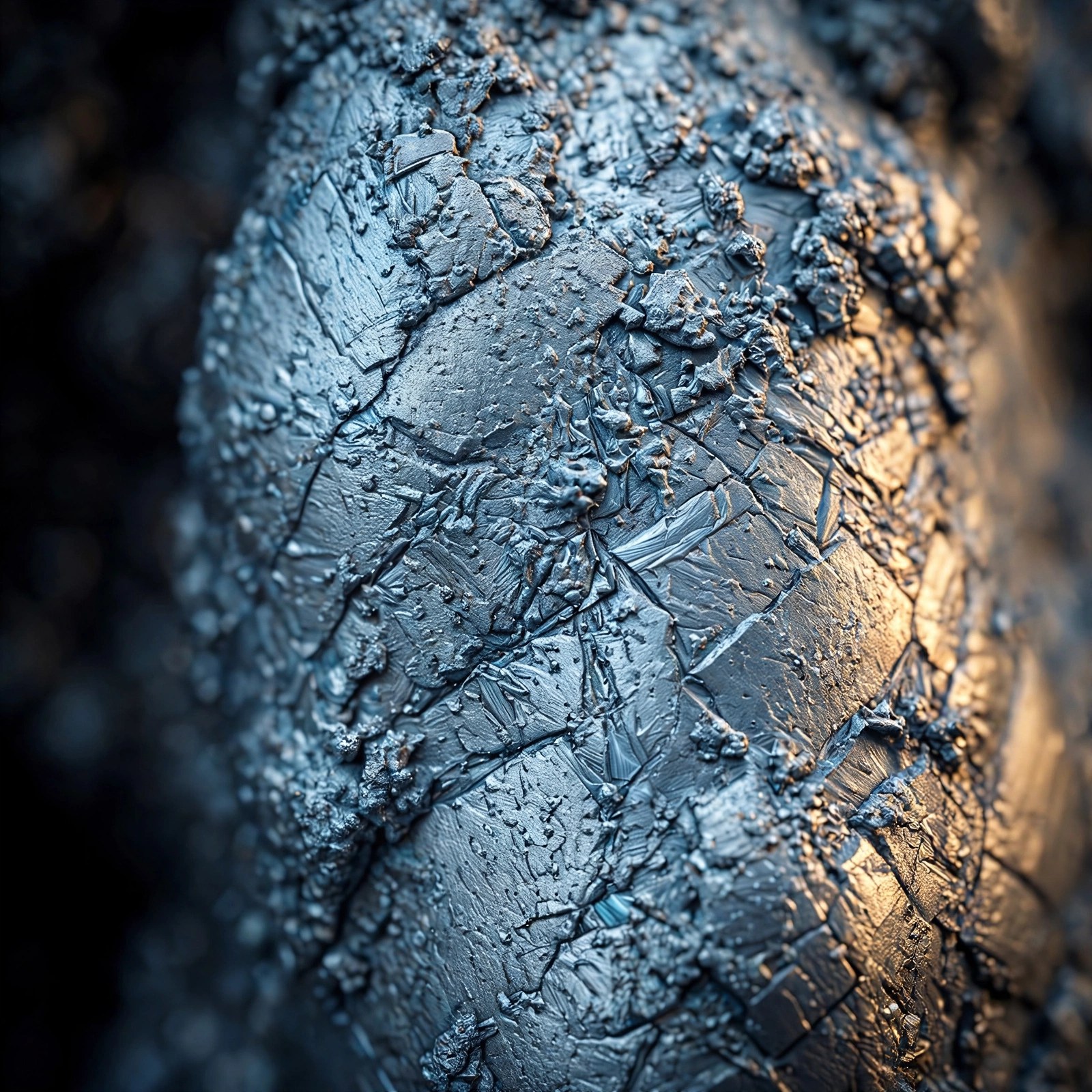
Third, hardness combined with density creates a uniquely hostile cutting environment. At 5.5 on the Mohs scale and Vickers hardness between 1,520 and 2,060 MPa depending on heat treatment, hafnium is harder than most steels used in watchmaking, but unlike a ceramic, which is hard and light, hafnium is hard and heavy, so the cutting tool sees both high mechanical loading and high thermal loading simultaneously with no relief from either axis. Panerai reportedly uses five-axis CNC machining with continuous human oversight throughout the process, a statement that sounds like marketing until you understand that nobody has published feed rates, depth of cut parameters, or tool life data for hafnium case machining because nobody has done it before.
Every piece of the case must be individually supervised. There is no established protocol to optimise, no supplier catalogue listing the correct insert geometry, no decades of accumulated shop floor knowledge the way there is for 316L or Grade 5 Ti. Thirty-five cases in the entire production run. Each one is an experiment, refined incrementally from the last.
Corrosion Resistance and the Saltwater Argument
Panerai positions the PAM01089 as a 1,000-metre dive instrument, and the material actually supports the claim in ways that go beyond density and strength. Hafnium forms a thin, stable oxide layer (HfO₂) on exposure to air, similar to the passive films that protect titanium and zirconium. But hafnium's oxide is more thermodynamically stable. HfO₂ has a dielectric constant of 20 to 25 and a bandgap of 5.7 eV; Intel used it to replace silicon dioxide as the gate dielectric in MOSFET transistors starting at the 45-nanometre node in 2007 because SiO₂ could no longer be made thin enough without quantum tunnelling leakage. That same chemical stability means the passive film resists breakdown in chloride-rich environments, the exact conditions a saltwater dive watch encounters.
Compare this to 316L steel, which relies on a chromium oxide passive layer that pitting corrosion can breach in warm, chloride-laden seawater above approximately 25°C. Titanium performs better, with its TiO₂ film offering excellent marine resistance, but hafnium's HfO₂ layer is arguably more robust because it reforms faster after mechanical damage and resists higher temperatures. Whether any of this matters at recreational diving depths is debatable. At 1,000 metres, in hot brine seeps or volcanic vent proximity, it starts to matter.
Hafnium is also paramagnetic with a molar magnetic susceptibility of +75.0 × 10⁻⁶ cm³/mol at 298 K, effectively non-magnetic. A dive watch case that cannot be magnetised by proximity to speakers, phone magnets, or MRI equipment is not a trivial benefit, although Panerai does not specifically market the PAM01089 on this point.
What Sits Inside the Hafnium Shell
Here is where the story gets ordinary, and intentionally so. Inside the Afniotech case sits the Panerai P.9010/GMT, a 13¾-ligne automatic calibre running at 28,800 alternations per hour with twin barrels delivering 72 hours of power reserve, featuring a Glucydur balance with Incabloc shock protection across 199 components and 31 jewels in a 6.0 mm thickness. It is a thoroughly competent movement, well-finished by Panerai standards, and it does absolutely nothing to justify the €90,000 price tag.
That is not a criticism, because putting an in-house grand complication inside a hafnium case would be engineering schizophrenia: one side screaming operational brutality while the other whispers haute horlogerie. Panerai understood the assignment. A three-day power reserve, a GMT function for timezone tracking, small seconds at nine o'clock, date at three, and enough luminous material to read the dial inside a decompression chamber at midnight: functional, proven, and forgettable in the best sense, letting the case carry the entire story.
The caseback is sandblasted titanium rather than hafnium, engraved with the U.S. Navy SEALs logo, and the material choice is smart: titanium against skin is lighter, hypoallergenic, and thermally comfortable where hafnium would feel noticeably cold due to its higher density and heat capacity. Strap attachment uses a standard 26/22mm taper with sandblasted titanium trapezoidal buckle, supplied on black rubber with an additional anthracite canvas option.
Panerai's Materials Ladder
Afniotech does not arrive in isolation. Panerai has spent two decades building a portfolio of proprietary materials that reads like a research lab's inventory list: Carbotech (forged carbon composite), BMG-Tech (bulk metallic glass based on zirconium), Goldtech (copper-heavy gold alloy resistant to oxidation), Platinumtech (950 platinum with added rhodium), and Ti-Ceramitech (patent-pending surface ceramisation of titanium that creates a blue ceramic layer 44 percent lighter than steel and ten times more fracture-resistant than conventional ceramic). Afniotech extends this library into refractory metals, a category nobody else in watchmaking has touched.
Is there industrial logic here, or is it pure flex? Probably both, because Panerai's manufacturing partner for exotic materials develops transferable expertise with each new alloy: Ti-Ceramitech's ceramisation process borrows from aerospace surface treatments, Carbotech adapted carbon-fibre forging techniques from motorsport, and each material teaches the supply chain something applicable to the next, which is how a brand with annual production under 40,000 pieces justifies R&D spending that would bankrupt a pure horological manufacture. The materials sell watches, but they also build cumulative capability that no competitor can replicate by simply licensing a process.
Should You Care?
At $99,500 for one of 35 pieces, nobody is buying the PAM01089 because they need a dive watch. The value proposition is material novelty and nothing else. Every other specification, the P.9010 movement, the 1,000-metre rating, the GMT function, exists in Panerai's regular catalogue at a tenth of the price. What you are paying for is a case machined from a metal that controls nuclear fission, wrapped around a watch designed for an environment where nuclear submarines operate. There is a certain circularity to that which either appeals to you or it does not.
What is genuinely interesting is the precedent. Hafnium is paramagnetic, extraordinarily corrosion-resistant, dense enough to feel substantial without precious metal pricing structures, and it machines into a surface texture unlike steel or titanium. If Panerai or anyone else can solve the tooling economics at scale, hafnium cases could move from one-off exotica to a legitimate alternative material in the broader luxury watch market. Whether demand exists for a watch case that weighs like lead and costs like a nuclear fuel cycle is another question entirely. But Panerai asked it first, and the answer is at least 35 wrists long.
| Panerai Submersible Navy SEALs Afniotech Experience PAM01089 | |
|---|---|
| Reference | PAM01089 |
| Case material | Sandblasted Afniotech (95% hafnium proprietary alloy) |
| Diameter | 47 mm |
| Thickness | 18.5 mm |
| Weight | 200 g |
| Water resistance | 100 bar (1,000 m), tested to 125% of rated depth |
| Movement | P.9010/GMT, automatic, twin barrels, 28,800 vph (4 Hz) |
| Power reserve | 72 hours |
| Functions | Hours, minutes, small seconds, date, second time zone |
| Dial | Gradient anthracite, Super-LumiNova X2 (green + blue) |
| Caseback | Sandblasted titanium, engraved Navy SEALs logo |
| Strap | Black rubber (26/22 mm) + anthracite canvas, titanium buckle |
| Limitation | 35 pieces |
| Price | €90,000 / $99,500 |