No Valve, No Problem: How Four Patents and a Conical Crystal Sealed Omega to 750 Atmospheres
Every serious dive watch made in the last four decades has a helium escape valve, every single one, from the Rolex Sea-Dweller with its valve at 9 o’clock to every Deepsea ever sold. Omega fitted them to every Planet Ocean Seamaster saturation-rated model from the 2000s onward. Doxa, Sinn, Ball, Panerai, Tudor, Blancpain: all of them acknowledge the same physical reality, which is that helium atoms are small enough (kinetic diameter 2.6 angstroms, roughly one-quarter the diameter of a nitrogen molecule) to migrate through the rubber and silicone gaskets that seal a watch case, and once inside they create a pressure differential during decompression that will blow the crystal clean off the case if you do not give them an exit route.
Omega looked at fifty years of helium valve orthodoxy and asked a different question. What if you built a seal that helium could not penetrate in the first place?
That question produced four patent applications, a watch rated to 6,000 metres, and the elimination of a component that the diving watch industry had treated as structurally mandatory since the 1960s.
Where the Prototypes Went First
In June 2019, Victor Vescovo completed the Five Deeps Expedition aboard DSV Limiting Factor, a Triton 36000/2 full-ocean-depth submersible rated to 14,000 metres. On the manipulator arm of the sub, Omega mounted three prototype Ultra Deep watches. At the bottom of the Mariana Trench, at the Challenger Deep point measuring 10,925 metres below the surface, the watches sat in water at 2°C under approximately 1,100 bar of hydrostatic pressure for a duration measured in hours, not the seconds-long descent that previous record attempts had managed. Omega reported that all three prototypes functioned without fault: no crystal deformation, no case deformation, no water ingress.
Before the dive, Omega had tested the prototypes to 15,000 metres equivalent in a hyperbaric chamber. Fifteen thousand metres does not exist on Earth; the deepest point in any ocean is approximately 11,000 metres. Omega was testing to 136% of the maximum possible natural depth, and the watches held.
What went to the Mariana Trench was not what eventually went to market. Prototypes used Grade 5 titanium throughout and were engineered purely for survival, with no concessions to aesthetics, wearability, or commercial viability. The production Ultra Deep, reference 215.92.46.21.01.001 in titanium, had to do something harder: survive the same physics while remaining a wearable wristwatch weighing 123 grams on its NATO strap.
Patent One: A Crystal That Carries the Load
Conventional dive watch crystals are flat or slightly domed discs of synthetic sapphire (aluminium oxide, Al₂O₃, grown by the EFG method or Verneuil process) seated in a metal gasket channel machined into the case middle. Pressure pushes the crystal inward, and the gasket absorbs the compression while the metal walls of the channel resist lateral deformation. At depth, the crystal is a passive window that transmits light and resists scratching while structural load passes through the case, not through the crystal.
Omega inverted this relationship entirely, making the crystal a primary structural element rather than a passive window.
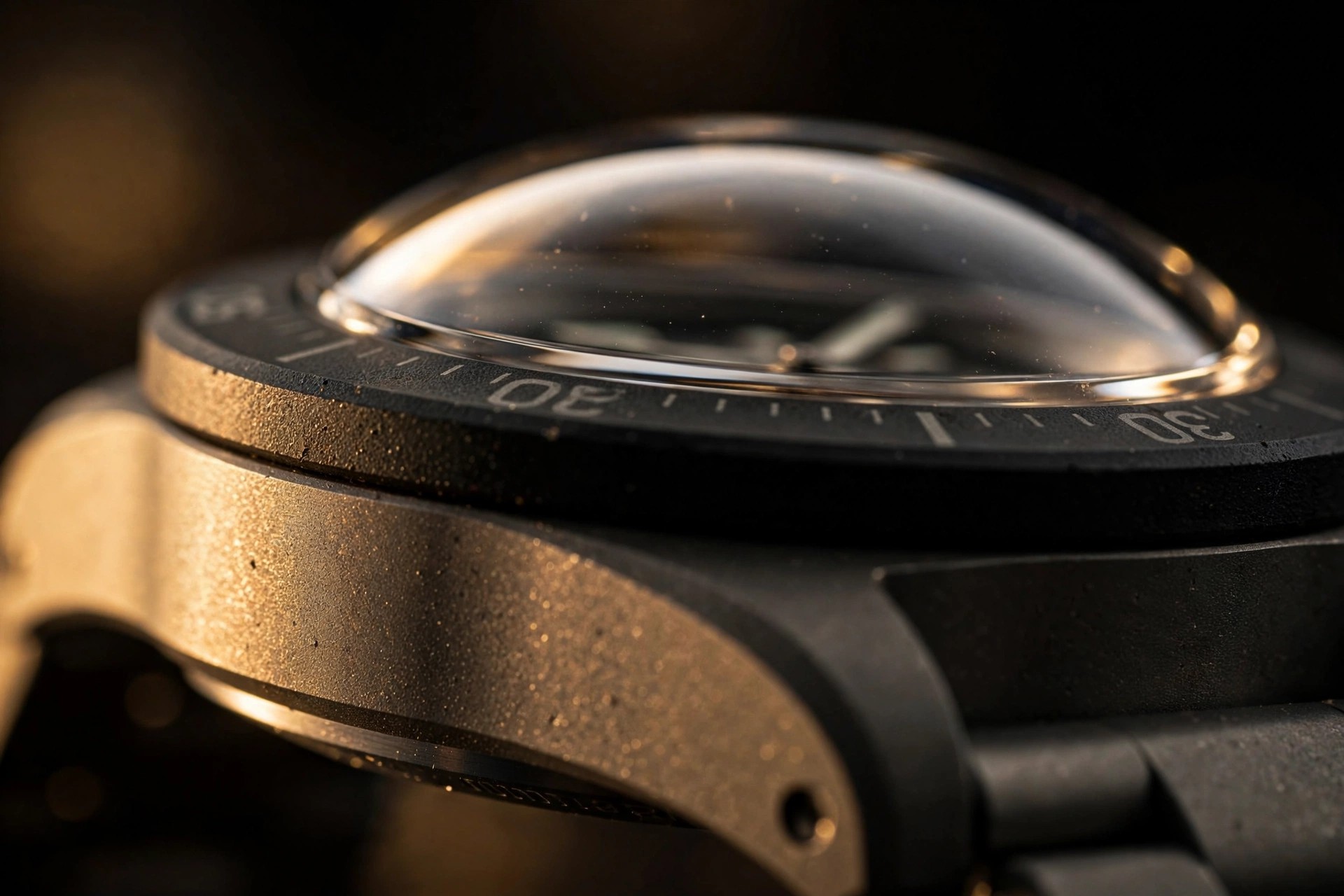
On the Ultra Deep, the crystal is 5.2 millimetres thick and shaped as a semi-cone: the outer surface is a pronounced dome that protrudes above the bezel line, while the inner surface angles inward so that the crystal is thicker at its centre than at its edges. Under hydrostatic pressure, water pushes uniformly on the dome, and the conical geometry converts that distributed load into compressive stress that flows radially inward and downward through the crystal body into the case seat. Sapphire has a compressive strength of approximately 2 GPa, far exceeding its tensile or flexural strength, so a crystal geometry that channels load into pure compression exploits the material at its absolute strongest mode.
Flat crystals fail under pressure because bending stress develops across the unsupported span between the gasket seat and the centre of the disc, and sapphire is brittle in bending. Increase the thickness and you buy more bending resistance, but you also increase weight, and there is a practical limit to how thick you can grind a sapphire blank before the watch becomes unwearable. Omega’s insight was geometric rather than dimensional: do not make the crystal thicker to resist bending. Make bending impossible by shaping the crystal so that load paths are compressive from the start.
Think of a stone arch, because the same structural principle applies. An arch spans an opening not by resisting bending across its length but by converting downward load into lateral thrust that flows through the arch profile into the abutments. A flat beam over the same opening would need to be enormously thick to carry the same load, because beams resist load through bending stiffness while arches resist load through geometry. Omega applied the same principle to a watch crystal, turning a flat window into a load-bearing structural element whose geometry directs force into the case rather than absorbing it internally.
Result: a crystal that gets stronger as pressure increases, because deeper water pushes harder, driving the conical form into tighter compression against its seat. At 750 bar, the crystal is not fighting the pressure; it is cooperating with it.
Patent Two: A Gasket That Does Not Leak Helium
Conventional crystal gaskets are elastomeric rings, typically silicone or fluoroelastomer (FKM/Viton), compressed between the crystal edge and the case channel. They work beautifully against water molecules, which at 2.75 angstroms kinetic diameter are too large to permeate through compressed elastomer at meaningful rates. Helium, at 2.6 angstroms, is fundamentally different in its permeation behaviour. Helium atoms are small enough and mobile enough to diffuse through even a compressed elastomeric gasket given sufficient time and pressure differential, which is exactly the condition that exists inside a saturation diving chamber where divers breathe helium-oxygen mixtures at elevated ambient pressure for days or weeks.
Omega’s patented crystal gasket is not a conventional O-ring. Its exact composition and geometry are proprietary (the patent applications describe the functional principle without fully disclosing the material formulation), but the performance claim is specific and testable: the Ultra Deep was subjected to 40 bar of pure helium for two continuous weeks, and no measurable quantity of helium entered the case. Two weeks under pure helium, not a breathing mixture, with forty atmospheres of it pressing on every seal simultaneously.
For context, the ISO 6425:2018 standard for saturation dive watches does not require a helium test of this duration or severity. ISO 6425 requires resistance to a mixed-gas environment at saturation pressure with a helium escape valve fitted. Omega tested without a valve, under pure helium, for a duration that exceeds any realistic saturation diving scenario, and passed.
How? Permeation through a gasket is governed by three variables: the diffusion coefficient of the gas in the gasket material, the solubility of the gas in the material, and the thickness of the gasket cross-section. Reduce any of these and permeation drops accordingly. Omega appears to have attacked all three: a material with lower helium diffusivity than standard FKM, a geometry that increases the effective seal path length (forcing helium molecules to traverse more material before reaching the case interior), and the compressive preload created by the conical crystal itself, which squeezes the gasket harder as external pressure increases. Compression reduces free volume in the gasket matrix, lowering both solubility and diffusivity.
Eliminate helium ingress and the escape valve becomes vestigial, which is exactly what Omega did when they removed it.
Patent Three: A Crown Built for Compression
Crown tubes are the weakest point on most dive watches. A screw-down crown typically threads onto a tube that is press-fitted or soldered into the case middle at 3 o’clock, and inside the tube sits a winding stem that connects to the movement’s keyless works. Multiple gaskets seal the stem within the tube and the crown against the tube’s outer shoulder. At depth, hydrostatic pressure tries to push the crown inward, loading the threads, deforming the gaskets, and stressing the tube-to-case joint.
On the Ultra Deep, the crown system is a patented architecture that Omega does not describe in full public detail, but the functional intent is documented: the crown, tube, and sealing system are designed so that increasing external pressure improves the seal rather than degrading it. Like the conical crystal, the crown exploits pressure as an ally. Deeper water presses the sealing surfaces together more tightly, increasing gasket compression and reducing any potential leak path.
Most dive watch crowns fight depth, but this one befriends it.
Patent Four: Two Pieces, One Problem
A standard dive watch caseback is a single piece of metal (steel or titanium) that screws or clamps onto the case middle with an O-ring gasket between them. At extreme depth, the caseback deflects inward under hydrostatic load. On the Rolex Deepsea, the caseback is Grade 5 titanium specifically because titanium has a higher strength-to-weight ratio than steel, allowing a thinner back that still resists the deflection forces at 3,900 metres.
Omega’s Ultra Deep uses a two-piece caseback architecture. Limited public documentation exists on the exact mechanical arrangement, but the functional principle is a division of labour between the two components: one piece handles structural load bearing and the other handles sealing. In a single-piece design, the same surface must simultaneously resist deflection and maintain gasket compression, and at extreme pressures these requirements can conflict, because deflection can reduce the contact pressure on the gasket at the very moment the gasket most needs to be compressed. Splitting the caseback into two functionally distinct pieces allows each to be optimised independently, with load-bearing geometry that does not compromise seal geometry and vice versa.
It sounds simple, but it is not. Introducing a second component means introducing a second interface, and every interface is a potential leak path. Omega’s achievement was adding a component while reducing total system vulnerability, which requires the two-piece assembly to seal better than a single piece under the same conditions. At 750 bar, better means better, and there is no margin for “about the same.”
Monocoque Titanium: A Case Without Joints
Conventional watch cases are multi-piece assemblies: a case middle, a bezel, a caseback, a crystal, a crown tube. Each component is manufactured separately and assembled with gaskets, threads, press fits, or friction joints. Each interface is a potential failure point under pressure, and the total number of potential leak paths scales with the number of discrete joints.
Omega’s titanium Ultra Deep (reference 215.92.46.21.01.001) uses a forged Grade 5 titanium (Ti-6Al-4V) monocoque case. A monocoque is a structural skin: a single continuous shell that carries all loads through its surface rather than through an internal frame. Aircraft fuselages are monocoque or semi-monocoque structures, and Formula 1 survival cells are carbon fibre monocoques. In watchmaking, the concept is rare because it demands that the case middle, lug structure, and crown guard be forged or machined from a single billet of titanium, eliminating joints where separate components would traditionally meet.
Grade 5 titanium (Ti-6Al-4V) is the workhorse aerospace alloy: 6% aluminium and 4% vanadium dissolved in a hexagonal close-packed alpha phase matrix with a body-centred cubic beta phase. Yield strength sits around 880 MPa, tensile strength around 950 MPa, and density at 4.43 g/cm³, which is 56% of 316L stainless steel’s 7.98 g/cm³. Forging (as opposed to casting or machining from bar stock) aligns the grain flow along the stress paths of the finished component, producing a part with higher fatigue resistance and more uniform mechanical properties than a casting of identical geometry.
Omega’s forging process produces a near-net-shape case that is then finish-machined and sandblasted to the production surface. Lugs are not bolted on or welded; they emerge from the forging die as integral extensions of the case body, continuous with the case wall, with grain flow wrapping around the lug geometry rather than terminating at a joint. These are what Omega calls Manta lugs, named for their swept profile, and they accept NATO straps only, because the integrated design cannot accommodate spring bars for a bracelet. On the titanium model, there is no bracelet option. Period.
Weight on the NATO strap: 123 grams, which for a 45.5mm dive watch rated to 6,000 metres is absurd. A Rolex Deepsea in Oystersteel (3,900m rating) weighs approximately 220 grams on bracelet. Subtract the bracelet and estimate the head weight alone at roughly 130 grams, which means Omega’s 6,000-metre watch with a 5.2mm sapphire crystal weighs less than a Rolex rated to 35% shallower.
What Lives Inside: Caliber 8912
Under the two-piece caseback sits Caliber 8912, a Co-Axial Master Chronometer movement that represents Omega’s current top-tier automatic architecture. Co-Axial escapement, silicon (Si) balance spring, 60-hour power reserve, free-sprung balance with adjustable regulating screws, and METAS Master Chronometer certification, which means every individual movement (not a sample from the batch, every single one) has been tested to resist magnetic fields exceeding 15,000 gauss while maintaining daily rate accuracy of 0 to +5 seconds per day across multiple positions.
Fifteen thousand gauss is not a number chosen for marketing convenience. It is the field strength generated by medical MRI pre-scan coils at close range, and it is approximately 10 to 15 times the field strength that would stop a conventional mechanical watch dead. A traditional lever escapement with a ferromagnetic hairspring begins to show rate deviation at around 60 gauss. At 200 gauss, most are running significantly fast or have stopped entirely. The silicon balance spring in the 8912 is entirely non-ferromagnetic, and the escapement components are made from materials selected specifically for their diamagnetic or paramagnetic properties, so the movement is not shielded from magnetic fields (there is no soft iron inner case as in the Rolex Milgauss approach). It is transparent to them. Fields pass through without interacting with any component that regulates timekeeping, making antimagnetic performance not a specification sheet decoration but an operational requirement for a watch intended for professional saturation diving, where divers may work near welding equipment, subsea power infrastructure, or electromagnetic survey tools.
O-MEGASTEEL: Harder Than Twice
Omega offers the Ultra Deep in steel as well as titanium, and the steel is not 316L. O-MEGASTEEL is a proprietary alloy that Omega developed in-house, with a hardness of approximately 300 Vickers, roughly double the 150-160 HV typical of 316L austenitic stainless steel used across the Swiss watch industry. Yield strength reaches 560 MPa, compared to 200 MPa for 316L, which is a 2.8x improvement. Scratch resistance is 40-50% higher than 316L by Omega’s testing methodology.
These numbers matter because a dive watch is a tool, and tools get battered. Desks, door frames, concrete, tanks, rocks, regulators, weight belts. A 316L case accumulates hairline scratches within weeks of daily wear. O-MEGASTEEL resists the same abuse for significantly longer, not because it is immune to scratching (nothing wearable is) but because its higher hardness raises the threshold force required to initiate a scratch. Minor contact that would mark 316L slides off O-MEGASTEEL without leaving a trace.
Metallurgically, achieving 300 HV in a fully corrosion-resistant stainless steel is a balancing act. Hardness in steel typically comes from carbon content and martensitic transformation, but carbon in stainless steel promotes chromium carbide precipitation at grain boundaries, which depletes the chromium available for the passive oxide film that provides corrosion resistance. Increase hardness by adding carbon, and you risk sensitisation. Omega’s solution appears to involve nitrogen as a solid-solution strengthener (the “PESR” designation on some documentation suggesting Plasma Enhanced Sintering or Remelting in their production process), but the full alloy composition is proprietary.
Liquidmetal on the Bezel: Amorphous Alloys at the Surface
Around the bezel edge, the diving scale is not painted, printed, or engraved. It is Liquidmetal, a bulk metallic glass (amorphous metal alloy) composed of titanium, zirconium, and copper, with a hardness approximately three times that of conventional stainless steel. Liquidmetal has no crystalline grain structure, and its atoms are arranged in a disordered, glass-like matrix that resists plastic deformation because there are no grain boundaries along which dislocations can propagate, and no slip planes for shear to initiate.
Omega bonds the Liquidmetal diving scale directly into a zirconium dioxide (ZrO₂) ceramic bezel insert. Ceramic provides the scratch resistance and colour stability (black ceramic does not fade under UV exposure, unlike aluminium anodising or lacquer). Liquidmetal provides the scale markings with a level of surface hardness and contrast that printed or engraved indices cannot match, because a painted index wears away and an engraved index fills with grime, while a Liquidmetal inlay is a solid metallic surface flush with the ceramic, equally hard, equally resistant to abrasion.
Two materials that human manufacturing could not combine before the 2000s, joined at the atomic level in a bezel insert on a production dive watch. Nobody talks about it, but it is quietly one of the most sophisticated material interfaces in commercial watchmaking.
A Dial Made of Ceramised Titanium
Pull the crystal off an Ultra Deep (not recommended) and you find a dial made from Grade 5 titanium that has been ceramised, meaning its surface has been thermochemically converted into a ceramic layer through controlled oxidation at elevated temperature. Titanium dioxide (TiO₂) forms on the surface as a coherent, adherent ceramic film that is significantly harder than the underlying metal, providing scratch resistance comparable to sapphire while retaining the ductility and shock resistance of the titanium substrate beneath.
Beneath the centre hole for the hands sits a subtle engraving, almost invisible under the handset: [Ti], the chemical symbol for titanium in the notation style of the periodic table. It is the kind of detail that exists for the person who knows to look, and for nobody else.
ISO 6425:2018, and Then Some
ISO 6425 is the international standard for dive watches, and it specifies a series of tests: water resistance at rated depth plus 25%, thermal shock between 40°C and 5°C water, resistance to salt water corrosion, magnetic resistance, shock resistance, strap attachment strength, luminosity duration, and functional reliability of the time-setting mechanism after pressure testing. Every watch that claims “Diver’s” on its dial must pass every test, not a sample but every individual watch.
Omega certifies the Ultra Deep to ISO 6425:2018, which is unremarkable because so does every legitimate dive watch on the market, but what is remarkable is the overhead: rated depth of 6,000 metres, test pressure of 750 bar equivalent to 7,500 metres. But Omega also subjected prototypes to 15,000-metre equivalent testing, which is 200% of rated depth, or 2.5 times the ISO requirement. And then they sent three of them to the bottom of the Mariana Trench, which is not an ISO test. It is a field trial that no standards body would ask for, because no standards body anticipated that a wristwatch manufacturer would have access to a full-ocean-depth submersible and the inclination to bolt watches to it.
Overengineered? Without question. Nobody will ever wear an Ultra Deep to 6,000 metres. No human can survive at that depth outside a pressure vessel. Saturation divers rarely exceed 300 metres, and most commercial diving happens above 200. Military applications occasionally reach 500-600 metres with experimental equipment. Six thousand metres is for the fish and the geology and the watches that Omega strapped to a submersible because they wanted to know if the math was right.
It was.
What the Ultra Deep Actually Changed
For fifty years, the helium escape valve was a given. You build a saturation dive watch, you put a valve on it, because helium gets in and helium must get out. Rolex patented the HEV in 1967, Doxa adopted it, Omega adopted it. Entire design languages evolved around the valve: the distinctive crown guard at 10 o’clock on the Sea-Dweller, the additional case penetration that must be sealed and tested and serviced. Watchmakers accepted helium ingress as a physical inevitability and engineered around it rather than against it.
Omega proved it was not inevitable. By redesigning the crystal geometry, the gasket material, the crown system, and the caseback architecture, Omega created a sealed volume that helium cannot enter under any realistic (or unrealistic) operating condition. One component eliminated, one failure mode removed, one service point deleted, and one less thing to break, wear out, or leak at depth.
That is what engineering does at its best: it does not add complexity to solve a problem but removes the problem entirely.
| Movement | Caliber 8912, Co-Axial Master Chronometer, automatic |
| Power Reserve | 60 hours |
| Antimagnetic | >15,000 gauss (METAS Master Chronometer) |
| Balance Spring | Silicon (Si) |
| Case Material | Forged Grade 5 Titanium (Ti-6Al-4V), monocoque |
| Case Diameter | 45.5 mm |
| Case Thickness | 18.12 mm |
| Lug-to-Lug | 51.95 mm |
| Weight (on NATO) | 123 g |
| Crystal | 5.2 mm semi-conical sapphire (EFG-grown Al₂O₃) |
| Bezel | ZrO₂ ceramic with Liquidmetal diving scale |
| Dial | Ceramised Grade 5 titanium with [Ti] engraving |
| Water Resistance | 6,000 m (tested to 750 bar / 7,500 m equivalent) |
| Helium Escape Valve | None (patented crystal/gasket seal system) |
| Strap | 100% recycled fishing-net polyamide NATO |
| Standards | ISO 6425:2018 saturation diver |
| Steel Variant | O-MEGASTEEL (300 HV, 560 MPa yield, 2.8x 316L) |
Sources
- Omega SA, “Seamaster Planet Ocean Ultra Deep Professional,” official product documentation and press materials, 2019–2024
- Five Deeps Expedition / Caladan Oceanic, “DSV Limiting Factor dive logs: Challenger Deep, June 2019”
- Omega SA, patent applications (pending): semi-conical crystal geometry, crystal gasket, screw-in crown, two-piece caseback
- METAS (Federal Institute of Metrology, Switzerland), Master Chronometer certification protocol, including magnetic resistance testing at >15,000 gauss
- ISO 6425:2018, “Divers' watches,” International Organization for Standardization
- Boyer, R., Welsch, G., Collings, E.W., “Materials Properties Handbook: Titanium Alloys,” ASM International, 1994 (Grade 5 Ti-6Al-4V properties)
- Johnson, W.L. et al., “Bulk Metallic Glasses,” MRS Bulletin, Vol. 24, No. 10, 1999 (Liquidmetal amorphous alloy fundamentals)
- Omega SA, “O-MEGASTEEL: a new proprietary alloy for Omega,” technical briefing materials