Harder Than the Tools — How Omega Machined a Speedmaster from Zirconium Oxide
Zirconium oxide ceramic resists every cutter in a watchmaker's shop except diamond. Omega spent four years learning to bevel and polish it into a chronograph case thinner than its predecessor by nearly a millimeter.
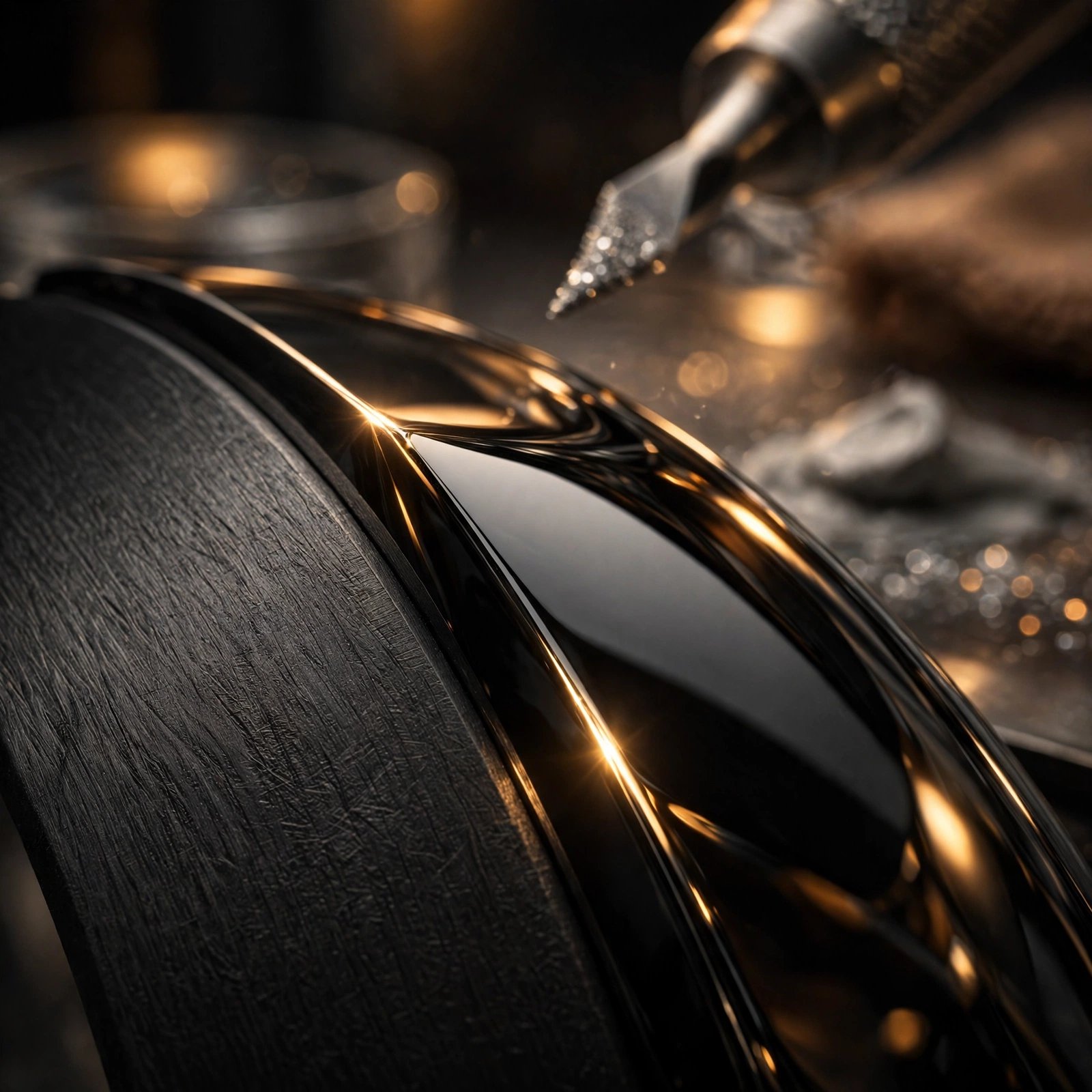
A watchmaker shaping a steel case reaches for carbide cutters, ceramic grinding wheels, and aluminum oxide polishing compounds. Each tool in the chain is harder than the material it works. When the case material is ceramic, that hierarchy collapses. Zirconium oxide measures roughly 1,200 on the Vickers hardness scale, nearly twice the hardness of surgical-grade stainless steel and harder than the tungsten carbide tooling used to machine it in most industrial applications. Only diamond remains reliably above it. Building a watch case from this material means every cut, every chamfer, every polished bevel requires diamond. Nothing else leaves a mark.
Omega introduced the Speedmaster Dark Side of the Moon in 2013 as the first Speedmaster built entirely from ceramic. Not a ceramic bezel insert on a steel case, which the industry had been doing for decades, but a complete case body, bezel, crown, pushers, and dial machined from zirconium oxide. Other brands use ceramic selectively: Hublot's Big Bang Unico uses ceramic bezels and cases but relies on titanium for structural internals, IWC's Ingenieur ceramic is a collaboration with an external case manufacturer, and Rado builds from ceramic but focuses on simpler case geometries without chronograph complications. A ceramic chronograph case with the three-dimensional complexity of a Speedmaster, including angular lug transitions, crown guards, and pusher tubes, occupied a category that Omega created for itself. In late 2025, Omega redesigned the collection with a slimmer profile, sharper bevels, and a new Liquidmetal tachymeter scale after four years of manufacturing research. Understanding what changed requires understanding what zirconium oxide demands of anyone who tries to shape it.
Zirconium Oxide: Properties and Problems
Zirconium dioxide, ZrO2, is an oxide ceramic with a monoclinic crystal structure at room temperature that transforms to tetragonal and then cubic phases at elevated temperatures. Stabilized with small amounts of yttrium oxide (typically 3 mol% Y2O3), it retains the tetragonal phase at room temperature in a metastable state. When a crack propagates through yttria-stabilized zirconia, the stress field at the crack tip triggers a local transformation from the tetragonal to the monoclinic phase. This phase change involves a volume expansion of roughly 4 percent, which places compressive stress on the advancing crack and arrests its growth. Materials scientists call this transformation toughening, and it gives ZrO2 a fracture toughness roughly three to four times that of alumina, the other ceramic commonly used in watchmaking.
For a watch case, this combination matters. Zirconium oxide resists scratching from virtually any material encountered in daily wear, yet survives impacts that would shatter a more brittle ceramic like silicon carbide or boron carbide. It weighs roughly half as much as 316L stainless steel (6.0 g/cm3 versus 8.0 g/cm3). Picking up a 44.25 mm ceramic Speedmaster after handling its steel sibling produces an immediate cognitive dissonance: the watch looks like it should weigh more than it does. On the wrist, the ceramic settles to skin temperature within minutes rather than retaining the cold metallic bite of steel, a consequence of zirconia's low thermal conductivity. And the polished surfaces have a depth that steel cannot replicate. Where polished stainless steel reflects light in a bright, diffuse sheet, polished zirconium oxide produces a darker, almost liquid reflection with sharper boundaries between light and shadow. Collectors who handle both describe the ceramic as looking "wet."
Its natural color, however, is white. Black zirconium oxide does not exist in nature. Achieving the deep, opaque black of the Dark Side of the Moon requires adding transition metal oxide pigments, typically iron oxide or a combination of rare earth oxides, to the raw powder before sintering. Color consistency across an entire watch demands that these pigments disperse uniformly at the particle level, because any variation becomes permanently locked in during the sintering step. A mottled case cannot be corrected after the fact.
From Dust to Disc: Sintering at 1,400 Degrees
Omega's process begins with ultrafine zirconium oxide powder, ground to controlled particle sizes typically below 1 micrometer. Rado's manufacturing partner Comadur, a Swatch Group subsidiary that supplies ceramic components to multiple Swatch Group brands including Omega, handles the raw material processing. For black ceramic, color pigments are blended into the powder along with a polymer binder that allows the mixture to flow under pressure.
Injection molding presses the powder-binder compound into molds shaped roughly like the finished watch component, but significantly oversized. Sintering will shrink the part by approximately 25 percent in every dimension. A case that measures 44.25 mm in diameter at final size starts its life closer to 59 mm across. Mold design must account for this shrinkage with extreme precision, because any inconsistency in powder packing density will cause uneven contraction and warping during sintering.
Before sintering, the polymer binder is removed through a process called debinding, typically thermal decomposition in a controlled atmosphere. If the binder is removed too quickly, gases trapped inside the part create voids or cracks. Too slowly, and production throughput suffers. Omega and Comadur have spent decades calibrating this step for different component geometries.
Sintering itself occurs at approximately 1,400°C in staged heating profiles. At these temperatures, surface diffusion and grain boundary diffusion cause neighboring particles to form solid necks, gradually eliminating the pore space between them. Over the course of several hours, the loose-packed powder compact transforms into a fully dense monolithic solid. Grain growth must be controlled carefully: if grains coarsen excessively, the mechanical properties degrade and the surface finish after polishing will never achieve the depth that fine-grained ceramic can deliver.
After sintering, the part has shrunk to approximately its final dimensions but retains a rough, matte surface with none of the shape detail required for a chronograph case. Lug profiles, crown tubes, pusher holes, case flanks, bezel seats, and the complex three-dimensional geometry of a 44.25 mm Speedmaster case must all be machined from this sintered blank. And every cut requires diamond.
Machining with Diamond
Conventional CNC machining uses carbide or ceramic cutting inserts that are harder than the workpiece. For zirconium oxide, standard carbide tooling (approximately 1,500 Vickers for uncoated WC-Co) barely exceeds the workpiece hardness, resulting in rapid tool wear and poor surface finish. Diamond-tipped tools, either polycrystalline diamond (PCD) or single-crystal natural diamond mounted on metal shanks, provide the hardness differential needed for controlled material removal.
Omega machines sintered ceramic blanks on multi-axis CNC platforms using diamond-tipped tools exclusively. Case details, including the angular lug transitions, crown guard geometry, bezel seat, and case back threads, are all cut from the sintered block. Feed rates and spindle speeds must be managed far more carefully than with metal: ceramics do not deform plastically, so excessive cutting force causes brittle fracture rather than chip formation. A feed rate that works perfectly for steel will shatter a ceramic case blank.
Cooling is critical. Diamond tooling performs best with controlled lubrication to manage heat at the cutting interface, because while diamond is the hardest known material, it begins to graphitize (convert to graphite) at temperatures above approximately 700°C in the presence of oxygen. Dry machining at high speeds risks destroying the very tools that make ceramic machining possible.
Polishing: Where Four Years Went
Metal watch cases achieve their characteristic alternation of brushed and polished surfaces through relatively straightforward abrasive processes. Silicon carbide or aluminum oxide belts create brushed finishes. Buffing wheels loaded with progressively finer polishing compounds produce mirror surfaces. Any competent case finishing shop can execute these operations on steel or gold in minutes per part.
Ceramic refuses these shortcuts. Aluminum oxide, the default polishing compound in metal finishing, measures 9 on the Mohs scale but only about 2,100 Vickers, barely above zirconium oxide's 1,200. It removes material so slowly that achieving a mirror polish on ceramic would take impractically long. Diamond paste, at approximately 10,000 Vickers, must be used for every polishing stage.
Omega's process for the original 2013 Dark Side of the Moon involved tumble polishing with alumina granules followed by diamond paste on polishing wheels. Brushed surfaces were created with diamond-loaded polishing tools run in a linear direction. Mirror-polished surfaces required additional passes with progressively finer diamond suspensions. Even then, achieving the contrast between brushed case flanks and polished bevels demanded careful masking and hand finishing.
When Omega began developing the 2025 redesign, the engineering challenge centered on bevels. Creating a sharp, deeply polished bevel on a ceramic case requires removing material precisely along a narrow edge where two surfaces meet at an angle. In metal, this is routine. In ceramic, the tool must remove material atom by atom through abrasive wear rather than plastic deformation, and any inconsistency in pressure or angle creates a rounded edge rather than a crisp one. Omega spent four years developing a beveled polished ceramic process that achieves what Revolution Watch described as "extraordinary depth and light play across the surfaces." Multiple sources confirmed that this finishing refinement, not the case geometry or movement upgrades, consumed the majority of the development timeline.
Laser Ablation: Sculpting the Moon
With the case manufactured, finished, and polished, Omega turns to the component-level innovations that distinguish each variant. For the Grey Side of the Moon, Omega adds another process layer. Starting from grey ceramic, produced through plasma carburizing where ionized gas energies correspond to equivalent temperatures reaching 20,000°C (a measure of ion kinetic energy in the plasma, not bulk furnace temperature) in a specialized reactor at Comadur, the bridges and plates of the cal. 3869 movement are decorated using laser ablation to reproduce the topography of the lunar surface.
Laser ablation removes material by vaporizing it with focused pulses of light, typically from a nanosecond or picosecond fiber laser. By modulating pulse energy, repetition rate, and scanning patterns, Omega's engineers create three-dimensional relief maps on the movement's bridges that replicate lunar terrain as documented by NASA's Lunar Reconnaissance Orbiter. Diamond engraving adds finer textural detail after the laser pass. Matte screws and satin-finished surfaces complete the illusion of a miniature moonscape visible through the sapphire crystal.
Hodinkee noted that the grey ceramic case of the Grey Side of the Moon measures just 12.97 mm thick, compared to 15.09 mm for the automatic black ceramic variants. This reduction comes partly from the hand-wound cal. 3869, which lacks an automatic rotor, and partly from the thinner case construction enabled by Omega's improved understanding of ceramic structural limits.
Liquidmetal: Another Material That Cannot Be Overheated
Marking a ceramic bezel introduces its own constraint. Conventional approaches involve laser engraving followed by metallization, where metal is deposited into the engraved grooves. Paint fills wear away. PVD coatings chip. Omega's alternative since 2009 is Liquidmetal, a zirconium-based bulk metallic glass in the Zr-Cu-Al-Ni family. Unlike conventional metals, this amorphous alloy has no crystalline grain structure, which allows it to flow at relatively low temperatures (around 400°C for certain compositions) and fill cavities with extraordinary precision before solidifying into a material roughly three times tougher than stainless steel.
Omega secured exclusive watchmaking rights to the technology and uses it for the tachymeter scale on the 2025 Dark Side of the Moon's ceramic bezel. Amorphous alloy is injected into laser-engraved channels under controlled temperature and pressure, filling every cavity completely. When solidified, it bonds mechanically with the ceramic and produces numerals with sharper edges and better contrast than traditional metallized engravings. But the process walks a tightrope: exceeding the alloy's crystallization temperature converts it from an amorphous glass to a conventional crystalline metal, destroying the flow properties that let it fill sub-millimeter channels. Like the diamond tooling that graphitizes above 700°C, the material that makes the process possible is also the material most easily ruined by it.
Two-Plate Dial: Doubling the Tolerance Problem
Previous Dark Side of the Moon models used a single ceramic disc as the dial, mirror-polished to match the case color. For 2025, Omega switched to a two-plate construction that doubles the manufacturing tolerance challenge. A lower ceramic plate provides the base layer, while an upper plate sits above it with laser-brushed surface textures that scatter light differently depending on viewing angle. Sub-dial rings at three and nine o'clock appear to float slightly above the main dial surface, adding dimensional depth that a single flat disc cannot achieve. Functionally, the layered construction also decouples the aesthetic surface from the structural plate, allowing different finishing processes on each layer without risking damage to the other.
Both plates, each less than a millimeter thick, must match in color (requiring identical powder batches and sintering profiles) and must be flat to within microns after sintering and machining. Any bow or warp in either plate produces visible distortion when they are stacked. Applied indices of 18K white gold are attached by hand to the upper plate, and each index cavity is filled with Super-LumiNova using a syringe-like applicator, also by hand. Every stage that makes a single ceramic dial difficult becomes twice as difficult with two.
Twelve Years of Ceramic Chronographs
Since 2013, Omega has produced thousands of ceramic Speedmasters across multiple references, accumulating manufacturing data that informs each subsequent generation. Rejection rates for ceramic cases remain higher than for steel, because ceramic manufacturing is inherently less forgiving: a sintering defect, an uneven shrinkage zone, or a crack initiated during diamond machining cannot be repaired. Steel cases with surface defects can often be re-polished. Ceramic cases with internal defects go to scrap.
Most watch brands that use ceramic confine it to components where its limitations do least harm: bezel inserts that never flex, case backs that never take a sharp impact on their edge, bracelet links shaped as simple rectangles. Even the clasp on the Dark Side of the Moon reveals this boundary. Ceramic's brittleness under bending loads makes it unsuitable for any component that opens and closes daily, so Omega uses ceramised titanium: Grade 5 Ti-6Al-4V surface-treated with a plasma-deposited ceramic layer that matches the case visually while retaining the ductility and fatigue resistance of the metal underneath. Every material in this watch occupies precisely the territory its physics permits and nowhere beyond.
Omega builds complete chronograph cases with the same angular complexity as their steel Speedmasters and finishes them to the same standard. Tighter powder processing yields more consistent sintering. Improved diamond tooling paths reduce machining time and surface stress. Four years of polishing development produced bevels sharp enough to catch light the way polished steel does. And the automatic case, at 15.09 mm thick, is nearly a full millimeter thinner than the 16.14 mm original. Four colorways, three movements, $15,700 to $16,400, no waitlist. Industrial-scale production of a material that punishes every shortcut with a cracked blank headed for scrap. That gap between the material's indifference and the finished product's precision is the engineering story.