Three Scales, One Sweep: How the Chronoscope Puts Three Analog Computers Behind a Column Wheel
Column wheel chronographs are not rare, and vertical clutch chronographs are not rare, but having both in the same movement inside a Speedmaster case while also hand-winding is something that never existed in the original lineup and only became possible when Omega developed the Cal. 9900 family. For over half a century, the Moonwatch has been a cam chronograph, good enough for NASA but not good enough for watchmakers who remember what the pushers felt like before Omega cut costs.
Cal. 9908 fixes that, or at least comes close.
It is Omega's hand-wound derivative of the Cal. 9900 automatic, stripped of its rotor and auto-winding bridge to shed 1.2 mm of thickness and 10 jewels. What remains is a 32.5 mm diameter, 6.4 mm thick, 44-jewel movement running at 4 Hz with 60 hours of power reserve, METAS Master Chronometer certified, built around co-axial escapement geometry with a silicon balance spring, twin DLC-coated barrels, and the column wheel and vertical clutch combination that makes the Chronoscope's pushers feel like they belong on a different watch entirely from the standard Moonwatch. Because mechanically, they do.
Why the Column Wheel Matters
A chronograph needs something to sequence the start, stop, and reset operations. Two competing architectures handle this job, and the difference between them is the difference between a mechanical gate and a spring-loaded suggestion.
A column wheel is a small toothed pillar that sits upright on the movement plate, rotating one increment each time the pusher is pressed. Eight or more columns rise from its perimeter like the turrets of a miniature castle. Levers ride against these columns, and their position is determined by whether they rest in a notch between columns (actuated) or against a column face (retracted). Every state transition is a positive mechanical stop. No ambiguity. No spring tension deciding where a lever sits. Press the pusher, the wheel rotates exactly one tooth pitch, and the levers snap into their new positions with the certainty of a combination lock clicking into place.
Cam actuation works differently and costs a fraction of the price. A shaped metal lobe replaces the column wheel, and lever followers ride against its curved surface, held in contact by spring pressure, making it cheaper to manufacture and more forgiving of sloppy tolerances but also noticeably mushier in operation. A cam-actuated chronograph can have a vague or rubbery feel at the pushers because the lever positions are determined by spring tension rather than positive stops, and springs can bounce, drag, or settle unpredictably as the cam rotates. Omega's Cal. 3861 in the current Moonwatch uses cam actuation. It works. Nobody has ever complained that a Moonwatch chronograph failed to start. But the tactile experience at the pushers is noticeably less precise than what a column wheel delivers, and that tactile difference is the entire reason watchmakers kept making column wheels even after cam systems proved they could do the same job for a fraction of the manufacturing cost.
Cost is the whole story of why column wheels vanished from mid-range chronographs. A column wheel requires tight machining on multiple axes: the tooth profile must be cut with micron-level precision so the rotation increment is exactly uniform, and the column heights must be identical so every lever seats at the same depth in every position. A cam can be stamped from sheet metal. Which one would you choose if you were trying to sell a chronograph for under ten thousand dollars in the 1970s?
Omega chose the cam, and so did nearly everyone else.
Vertical Clutch: No Stutter, No Teeth
Starting a chronograph means connecting the chronograph gear train to the movement's continuously running fourth wheel, and there are two fundamentally different ways to make that connection.
A lateral clutch swings a small gear sideways into mesh with the running gear train, teeth finding teeth in a mechanical collision that can cause a slight stutter or jump of the seconds hand at the instant of engagement because the gear teeth need a fraction of a revolution to settle into their mating positions. Watchmakers call this the "jump start" problem, and while it is cosmetically annoying rather than functionally catastrophic, it signals that the engagement is a mechanical compromise, an impact event rather than a smooth transfer of power.
A vertical clutch eliminates gear engagement entirely. Two friction discs sit coaxially, one driven by the movement and spinning continuously, the other connected to the chronograph train. When the chronograph is stopped, a slight gap separates the discs. Press the start pusher and the column wheel allows a lever to push the driven disc down onto the spinning disc, engaging through surface friction. No teeth. No impact. No stutter. Because the spinning disc was already in motion, the chronograph hand begins sweeping at the exact moment of engagement with zero visible hesitation.
Smooth starts are the obvious benefit, but less obvious is that a vertical clutch cannot damage itself through repeated engagement. Lateral clutch teeth can chip if the engagement is poorly timed, but friction discs cannot chip and instead wear gradually over time, with the service interval for a well-designed vertical clutch exceeding 10 years of normal use before the friction surfaces need attention.
Cal. 9908 pairs both technologies: column wheel for sequencing, vertical clutch for engagement. It is the combination that the Cal. 321 never had, because while the 321 carried a column wheel, it used a lateral clutch, and the 9908 marks the first time any Speedmaster has shipped with both a column wheel and a vertical clutch in the same movement.
Three Analog Computers on One Dial
Most modern chronographs have a tachymeter bezel and nothing else: read the number where the seconds hand points after timing a one-kilometer pass to get speed in km/h, and that is useful for exactly one measurement.
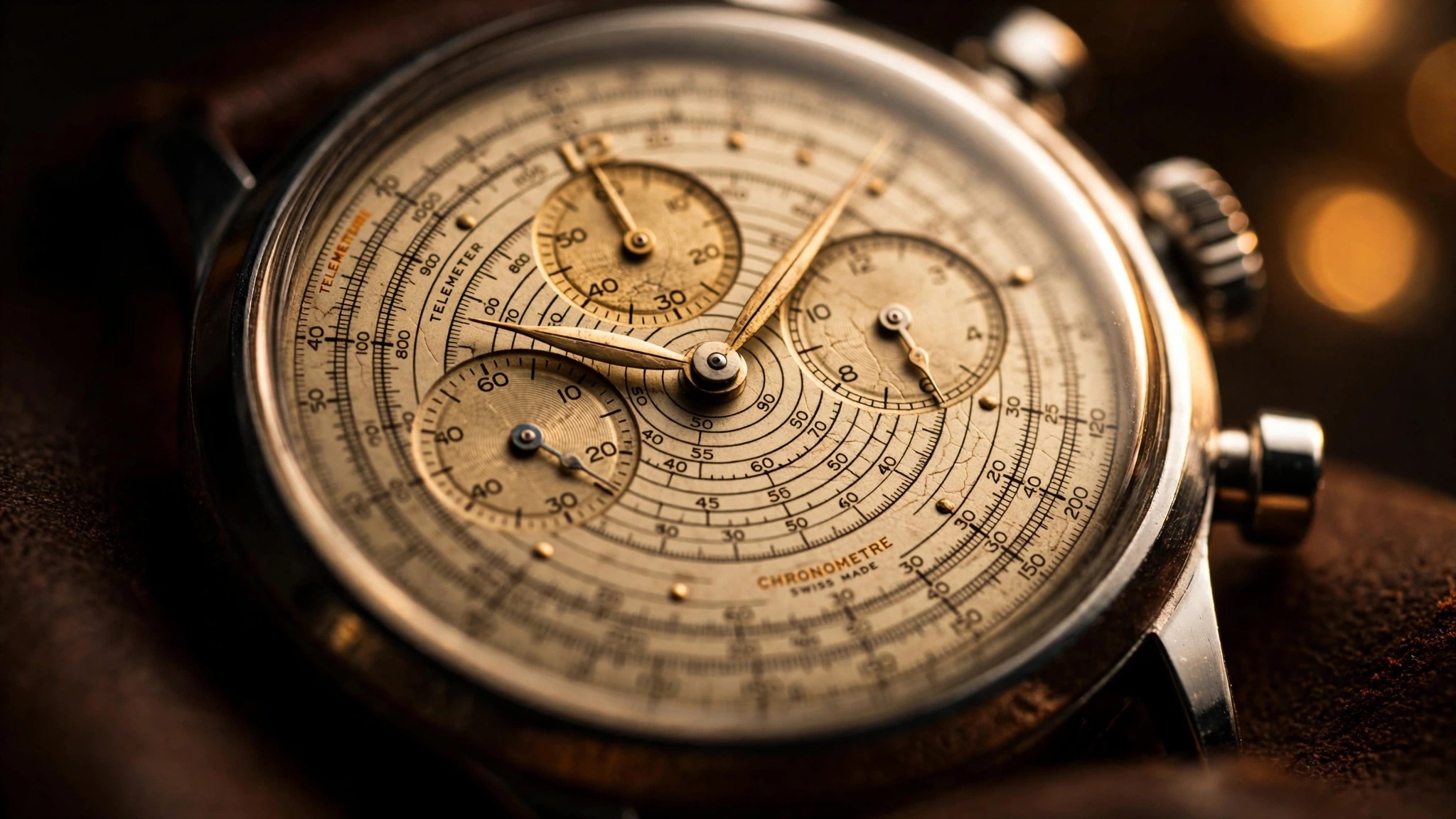
Chronoscope dials carry three scales arranged in concentric rings, a layout borrowed from 1940s-era medical and military chronographs that treated the sweep hand as the input needle of an analog slide rule. Each scale computes a different physical quantity from the same raw input: elapsed time.
Tachymeter (outermost ring). This scale measures speed by timing a known-distance event. Start the chronograph as a vehicle passes a known marker, stop it one unit of distance later. If the unit is one kilometer, the scale reads directly in km/h. If the unit is one mile, it reads mph instead. Mathematically, the computation is speed = 3,600 / elapsed seconds, so a 30-second interval reads 120 on the scale and a 45-second interval reads 80. Nonlinear because speed is the inverse of time. The markings compress toward the higher values, crowding together above 200 and spacing out below 80, which is why most tachymeter scales only go down to 60, because a full minute would put the reading at the starting point where it becomes useless.
Telemeter (middle ring). This scale measures distance using the speed of sound. See a flash of lightning, start the chronograph, stop it when you hear the thunder. Sound travels at roughly 343 meters per second at sea level and 20°C, so each elapsed second corresponds to 343 meters of distance between you and the event. A telemeter scale simply multiplies elapsed seconds by 0.343 and prints the result in kilometers, so five seconds reads 1.715 km and twelve seconds reads approximately 4.1 km. Originally designed for artillery spotting, where knowing how far away a shell landed was operationally critical and pulling out a calculator was not an option.
Pulsometer (innermost ring). This scale measures heart rate by extrapolation. Count 15 pulses (or 30, depending on the scale calibration), and the hand points to the extrapolated beats per minute. A pulsometer calibrated for 15 pulses computes BPM = 15 × 60 / elapsed seconds = 900 / elapsed seconds. Count 15 pulses in 12 seconds and the scale reads 75 BPM; count 15 in 10 seconds and it reads 90. Before digital pulse oximeters, every physician's chronograph had this scale because it was cheaper than a dedicated medical instrument and more reliable than counting silently and multiplying in your head while your patient stares at you.
All three computations happen simultaneously on the same dial, using the same sweep hand, because each scale is just a different mathematical function of elapsed time printed as a curved number line, an analog computer that runs on a coiled steel spring with no electronics, no batteries, and no firmware updates, and will keep computing for 60 hours between windings.
Inside the Barrels
Power delivery matters as much as power storage in a chronograph movement, because the chronograph mechanism draws energy from the mainspring whenever it runs, and uneven power delivery translates directly into amplitude variations that degrade timekeeping accuracy.
Cal. 9908 uses twin barrels connected in series, meaning two mainsprings feed one power train. Series connection means the output torque is the sum of both springs' contributions, smoothing the torque curve compared to a single barrel whose delivery drops off as the mainspring unwinds. Sixty hours of power reserve from two barrels is conservative engineering, not ambitious, because the movement never operates in the bottom third of the mainspring's torque curve where isochronism suffers and the amplitude of the balance wheel begins to decay.
Both barrel interiors are coated with diamond-like carbon, a vapor-deposited amorphous carbon film with a coefficient of friction roughly one-tenth that of polished steel on steel. DLC reduces the friction between the mainspring's outer coils and the barrel wall, a contact zone where conventional lubrication breaks down within a few years as grease migrates and thins under continuous sliding pressure. DLC does not migrate because it is a surface treatment rather than a fluid, and its friction-reducing properties persist for the life of the coating, which in a sealed barrel environment with no abrasive particles exceeds any reasonable service interval.
Omega does not disclose the specific DLC composition, but industrial DLC coatings for low-friction applications typically use hydrogen-free tetrahedral amorphous carbon (ta-C) with hardness values above 50 GPa and surface roughness below 20 nm. Whether Omega's barrel coating reaches those specifications is unknown outside the Biel manufacture. What is measurable is the result: amplitude stability across the power reserve that meets METAS standards of 0 to +5 seconds per day, tighter than COSC's already-demanding -4/+6 window.
Silicon and the 15,000-Gauss Problem
Silicon balance springs do not respond to magnetic fields. At all.
A conventional Nivarox hairspring is a nickel-iron alloy with carefully controlled thermal and elastic coefficients. Excellent metallurgy. Also ferromagnetic. A magnetic field above roughly 60 gauss can magnetize the coils, causing them to stick together or alter the effective spring constant, which shifts the oscillation rate and degrades accuracy by minutes per day rather than seconds. Demagnetizing a hairspring requires professional equipment and a trip to a service center.
Silicon is a semiconductor with no ferromagnetic response whatsoever. Exposing a silicon hairspring to 15,000 gauss, the METAS magnetic resistance standard, produces exactly zero change in its elastic behavior, and the balance wheel keeps oscillating at 4 Hz as though the magnetic field does not exist because from the silicon's perspective it genuinely does not. Cal. 9908's silicon balance spring is fabricated using deep reactive-ion etching (DRIE), the same photolithographic process used to manufacture MEMS devices, which produces a spring geometry with tolerances impossible to achieve through conventional metalworking, sub-micron uniformity across the entire spiral that eliminates the positional errors inherent in mechanically formed metal hairsprings.
Co-axial escapement geometry compounds the advantage because George Daniels invented the co-axial in 1974 as a low-friction alternative to the Swiss lever escapement, reducing the sliding contact between pallet stones and escape wheel teeth by splitting the impulse action between two separate levels of the escape wheel. Less friction means less lubricant dependency, which means longer service intervals and more stable timekeeping as the lubricant ages. Omega has manufactured co-axial escapements at scale since 1999, and the Cal. 9908's implementation represents nearly three decades of production refinement on Daniels' original concept.
Bronze Gold and Controlled Patina
Omega offers the Chronoscope in steel and in 18K Bronze Gold, a proprietary alloy that replaces the silver typically used in yellow gold with copper, palladium, and a small percentage of iron and gallium. Standard 18K gold is 75% gold by weight, alloyed with 25% other metals to achieve the desired color and hardness. Bronze Gold maintains the 75% gold content required for hallmarking but shifts the alloy composition to produce a warm, reddish-brown tone that deliberately evokes aged bronze.
Unlike actual bronze (a copper-tin alloy), Bronze Gold does not develop green patina from copper oxidation because the gold content passivates the surface. Instead, the alloy develops a subtle darkening over years of skin contact, a controlled tonal shift rather than a chemical degradation, because the copper component oxidizes slowly beneath the gold matrix without producing the verdigris that makes untreated bronze unsuitable for jewelry. Palladium in the alloy further stabilizes the color by resisting sulfide tarnishing, the yellowing mechanism that turns standard rose gold brassy over decades. Omega's metallurgy team spent several years on the alloy composition before announcing it, and the patent documentation describes iterative testing of over 40 formulations before settling on the final recipe.
At 43 mm, the Bronze Gold Chronoscope wears large by contemporary standards but appropriate for its 1940s-inspired dial layout, which needs diameter to make three concentric scales legible. Cramming a tachymeter, telemeter, and pulsometer onto a 38 mm dial would render the inner scale's numerals unreadable without magnification, and the entire point of a triple-scale chronograph is instant readability under field conditions.
What the 9908 Is Not
It is not the Cal. 321. Omega reissued the 321 as a historically faithful reproduction in 2019, complete with the original's column wheel and lateral clutch (not vertical clutch, despite the common misconception, because the original Cal. 321 used a lateral clutch while Cal. 9908 uses a vertical clutch). The 9908 is a modern movement that happens to share the column-wheel philosophy with its ancestor while surpassing it in every measurable specification: magnetic resistance, power reserve, amplitude stability, and chronometric accuracy.
It is also not the Cal. 3861 that powers the current Moonwatch Professional, which is a historically informed hand-wound movement with cam actuation and a lateral clutch, evolved from the Lemania 1873 through the 861, 1861, and 1863. Comparing the two movements is comparing engineering philosophies: the 3861 prioritizes historical continuity and proven reliability at a price point roughly half the Chronoscope's, while the 9908 prioritizes technical sophistication and tactile refinement at a cost that puts it closer to competitors from Zenith, Breitling, and IWC.
Honest assessment: I have not handled this watch. Published specifications and movement photography inform every claim above. Omega's Master Chronometer certification provides independent verification of the accuracy and magnetic-resistance claims through METAS testing at the Swiss Federal Institute of Metrology, which is about as authoritative as horological certification gets. Dial-side impressions, pusher feel, and wrist presence remain to be evaluated firsthand.
What is clear from the specifications alone is that Cal. 9908 makes the Moonwatch's 3861 look like a compromise, and it is one, a deliberate, historically motivated compromise that keeps the Moonwatch affordable and connected to its Apollo heritage, but a compromise nonetheless when you stack column wheel versus cam, vertical clutch versus lateral, silicon hairspring versus Nivachron, and DLC-coated twin barrels versus a single barrel with conventional lubricant. On every technical axis the 9908 wins, and whether that matters depends on whether you buy a Speedmaster for what it did in 1969 or for what it can do in 2026.
Sources
- Omega SA, "Speedmaster Chronoscope," official product specifications and Cal. 9908 technical data sheets.
- Hodinkee, "A Week on the Wrist: The Omega Speedmaster Chronoscope," 2022.
- Monochrome Watches, "Omega Speedmaster Chronoscope Co-Axial Master Chronometer Chronograph," Frank Geelen.
- METAS, "Swiss Federal Institute of Metrology Master Chronometer Certification Protocol," testing standards documentation.
- George Daniels, Watchmaking, Philip Wilson Publishers, 2011. Co-axial escapement theory and design.
- Fratello Watches, "Everything You Need To Know About The Omega Speedmaster Chronoscope," Robert-Jan Broer, 2022.
- Caliber Corner, "Omega Caliber 9908," movement specifications database.
- Caliber Corner, "Omega Caliber 321," historical movement specifications.
- WatchBase, "Omega Caliber 9900/9908 Technical Specifications."
- Worn & Wound, "Understanding Chronograph Architectures: Column Wheel vs. Cam, Vertical vs. Lateral Clutch."