Fired Blue: Omega's Ceramic Seamaster Goes Monochrome
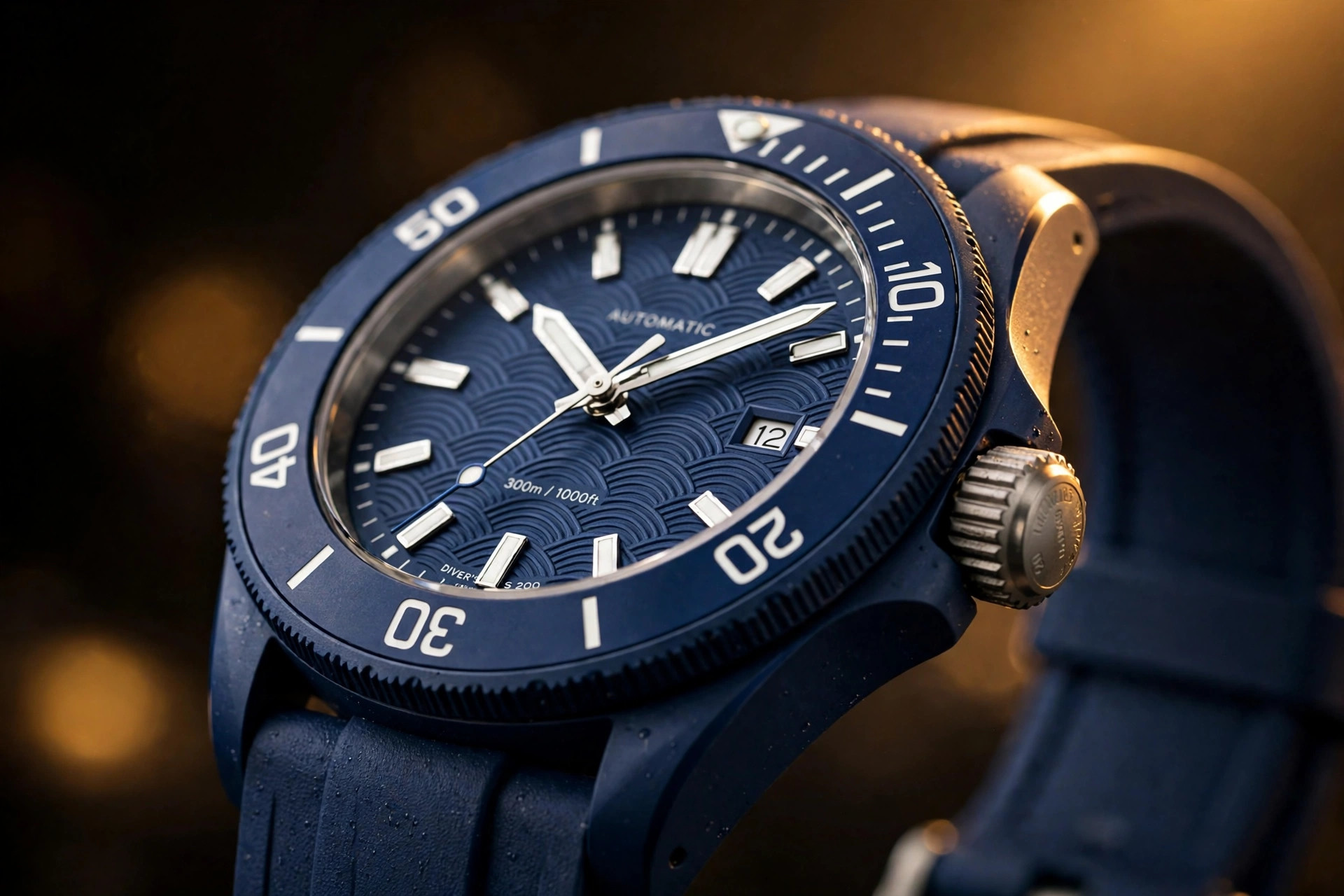
No press release, no teaser, no ambassador on a beach.
Two new Seamaster Diver 300M references simply appeared on Omega's website on November 5, 2026, and the watch press found them the way you find a typo in a book you have already read twice. Gear Patrol called them secret Seamasters, which is generous. Omega has done this before, dropping product onto its own site and letting the internet do the announcement, but this pair deserved a launch event because the blue one is the first Diver 300M ever built in a single color from case to dial to bezel.
Reference 210.92.44.20.03.001 runs blue ceramic through the case, the laser-engraved wave dial, and the polished bezel insert, with Grade 5 titanium handling the crown, caseback, and pin buckle, white enamel filling the 60-minute dive scale, and a color-matched blue rubber strap finishing the run. Its sibling, reference 210.62.44.20.13.001, does the same trick in brown ceramic with 18K Sedna Gold on the bezel and crowns and a Ceragold diving scale. Blue costs $10,000 and brown costs $15,500. Underneath, both are the same watch.
That last sentence is the whole story, really, because when two watches share a movement, a case size, a water rating, and a strap, the only thing left to charge for is material. Omega is betting $5,500 that buyers can feel the difference between titanium hardware and solid gold hardware through a brown ceramic case. They can, but not for the reason the brochure implies.
One Color, Three Parts, One Kiln Problem
Matching blue across a case, a dial, and a bezel sounds like a paint job. It is not. Each part starts life as zirconium oxide powder, yttria-stabilized, pressed or injection-molded into an oversized green body, then fired at 1,400 to 1,520 degrees Celsius until the particles diffusion-bond into a fully dense solid. During that firing the part shrinks 20 to 25 percent, and color shifts with it, because pigment behavior at sintering temperature is not something you can sample from a Pantone book.
So a blue case, a blue dial, and a blue bezel insert are three separate sintering runs that have to land on the same blue, which means the same powder batch, the same furnace profile, and the same cooling curve, or the dial reads lighter than the case and the whole monochrome idea falls apart in daylight. Omega's ceramic dials have been consistently good at this for years, the black ceramic Seamaster from 2022 proved the process at scale, but blue is less forgiving than black. Black hides variation. Blue announces it.
What you get for surviving that process is a material steel cannot match on the wrist. Sintered zirconia runs around 1,200 Vickers, roughly five to six times harder than the 316L steel in a standard Diver 300M, which is why a ceramic Seamaster still looks new after years of desk-diving while a steel one collects the hairline map of its owner's life. Ceramic also weighs less, about a quarter less than steel by volume, which is how the blue model lands at 106 grams complete on its strap, three grams under the steel equivalent despite measuring 43.5mm across against the steel model's 42mm.
There is a trade, and it is the one ceramic always demands. Hardness without ductility means a ceramic case does not dent. It chips, or in a bad drop it cracks, where steel would absorb the impact with a bruise you could polish out. Omega does not publish impact data, and no reviewer is going to drop a $10,000 loaner on concrete to find out, so the honest statement is that ceramic trades repairability for permanence. Buy it for the scratch resistance, not because you think it is indestructible.
The Brown One Is the Interesting Engineering
Most coverage will lead with the blue, and I understand why. It is the prettier watch, the cleaner idea, and the cheaper one. But the brown reference carries the harder manufacturing problem, because its bezel diving scale is Ceragold, Omega's process for inlaying 18K gold into a ceramic bezel, and its crown and bezel hardware are solid Sedna Gold rather than plated or PVD-coated.
Ceragold works by machining the numerals and markers into the fired ceramic bezel, then fusing gold into those recesses so the scale sits flush with the surface instead of printed on top of it. Gold and ceramic expand at different rates when heated, so the inlay has to be engineered to lock mechanically as the parts cool, and the finishing step is diamond polishing because nothing else cuts both materials to the same plane. When it works, the result is a scale that cannot wear off, fade, or flake, because there is no paint layer to lose. Omega has used the process on Seamaster bezels for over a decade, and the brown ceramic model is its latest application.
Sedna Gold deserves a sentence of its own, because it is not a marketing name for rose gold. Omega's proprietary 18K alloy blends gold with copper and palladium, and the palladium is the point: it stabilizes the rose color against the slow fading that conventional rose gold suffers under UV and skin contact over decades. A brown ceramic case with a fading gold bezel would be a slow-motion embarrassment. Sedna Gold exists so that does not happen.
Weight tells the rest of the brown story. At roughly 122 grams it runs seven grams heavier than the steel-and-gold model on a rubber strap, because gold is dense and there is a lot of it here, bezel, crowns, and the ceramic pin buckle is brown ceramic rather than metal. Nobody buys a gold-accented diver for its weight, but the number matters because it punctures the easy story that ceramic always means lighter. Material choice is a system, not a slogan.
Calibre 8806: The Quiet Workhorse
Both watches run Calibre 8806, the no-date sibling of the 8800 that powers most steel Seamaster Divers, and the absence of a date is a feature worth naming because Omega keeps making this choice on its ceramic models. No date window means no disc, no aperture, and no color mismatch in a cutout, which matters enormously when the dial is a single fired color you cannot touch up with paint.
Inside, the 8806 is the movement Omega has spent a decade turning into a default. Co-Axial escapement, the George Daniels design that replaces sliding friction at the pallet with a push, so lubrication lasts longer and service intervals stretch. Free-sprung balance with a silicon hairspring, which shrugs off the magnetic fields from phones, laptops, and airport scanners that used to be a real failure mode for mechanical watches. METAS Master Chronometer certification, which tests the finished watch rather than just the movement, including 15,000 gauss resistance, rate across positions, and power reserve verification, over ten days.
Specs run 25,200 vibrations per hour, 55-hour power reserve, 35 jewels, bidirectional winding, and a rhodium-plated rotor and bridges finished with arabesque Geneva waves, visible through the sapphire caseback on the blue model and through a ceramic caseback with sapphire window on the brown. Nothing here is new. That is the point. Omega put its most proven modern movement inside its most demanding case material and changed nothing else, which is exactly what you want from a watch you might actually dive with.
One honest gap: the 8806 is not Omega's most advanced caliber, and nobody at Omega pretends it is. It is a three-hand, time-only movement in a $10,000 to $15,500 watch, where the same money at other brands buys a chronograph or a GMT. Omega's answer is that the certification and the case are the complication, and for a diver that argument holds. A dive watch with a second time zone is a travel watch wearing a costume. A ceramic case that cannot scratch is a dive watch doing its job.
Where the Pair Sits
Context starts with the steel Diver 300M, reference 210.30.42.20.03.001, at $6,300 on rubber: 42mm, Calibre 8800 with a date at six, same 300-meter rating and helium escape valve. Against that baseline, the ceramics ask a $3,700 premium for the blue and a $9,200 premium for the brown, and what you get is a bigger case, no date, and a material story. That is a lot of money for a color, until you remember that the black ceramic Seamaster from 2022, reference 210.92.44.20.01.003, has held its value on the secondary market precisely because the material is the watch.
Size is the real objection. Both ceramics measure 43.5mm across, 51.5mm lug to lug, and 14.27mm thick, with 21mm between the lugs. Those are big numbers, and the lug-to-lug figure is the one that decides whether the watch wears or perches. Omega's ceramic cases wear smaller than their dimensions suggest because the material is light and the case sides curve, but 51.5mm is still 51.5mm, and wrists under 6.5 inches should try before buying. No bracelet option exists, rubber only, which removes the easiest way to dress the watch up and also removes a $1,000-plus bracelet upcharge Omega could have added.
There is also the question of why Omega released these silently, five weeks after its loud October 5 Bond and Spectre Seamaster collection, six steel references with Calibre 8806 that got a full press push. My read is that the ceramics were not ready for the Bond launch and Omega chose to ship them when the kilns delivered rather than hold them for a marketing moment. That is a manufacturing schedule dictating a release schedule, which is rare in luxury watches and, frankly, admirable. Watch companies usually announce first and manufacture later. Here the watches existed before the announcement did.
Engineering Judgment
Blue is the buy. It is the first Seamaster Diver built in one color from case to dial, it costs $5,500 less than its brown sibling, and the titanium hardware keeps it light enough to wear every day, which is the test a diver has to pass before anything else matters. Brown is the collector's piece, the one where Ceragold and Sedna Gold justify the premium for someone who already owns a steel diver and wants the material story in its most complete form.
Either way, the engineering judgment is the same: Omega took its hardest case material, its most consistent color problem, and its most proven movement, and shipped both watches without a press release, as if the work spoke for itself. It mostly does. Ceramic is not a gimmick on a Seamaster anymore. It is the material the watch was waiting for, ever since the steel original proved in 1993 that a wave dial and a helium valve could carry a whole product line. Thirty-three years later, the wave is fired into the case itself, and the only thing left to scratch is the itch to buy one.
I have not handled either reference. Everything here comes from Omega's published specifications, the November 6 coverage in Fratello, Gear Patrol, HiConsumption, and The Gadgeteer, and the manufacturing literature on zirconia sintering. If the blue reads lighter in person than in Omega's renders, the monochrome argument weakens, and if the brown's Ceragold scale sits proud of the bezel rather than flush, the inlay claim needs revisiting. Both are worth checking at a boutique before spending five figures on a color.
Sources
- Fratello Watches, "New Omega Seamaster Diver 300Ms In Blue/Brown Ceramic," November 6, 2026, reporting references 210.92.44.20.03.001 and 210.62.44.20.13.001, blue ceramic with Grade 5 titanium, brown ceramic with 18K Sedna Gold, Ceragold diving scale on the brown model, Calibre 8806, prices EUR 9,700 and EUR 15,000 including VAT, dimensions 43.5mm by 51.5mm lug-to-lug by 14.27mm thick, 21mm lug width, 55-hour power reserve, 35 jewels, 15,000 gauss resistance.
- Gear Patrol, "Omega Quietly Dropped the Ultimate Blue Seamaster Diver," November 5, 2026, documenting the silent website listing with no press release or social media, blue ceramic case and laser-engraved wave dial, polished ceramic bezel insert, integrated color-matched rubber strap, Calibre 8806 as the no-date variant of the 8800, US prices $10,000 blue and $15,500 brown.
- Sminto, "Omega adds two 43.5mm Seamaster Diver 300M models in blue and brown ceramic," November 6, 2026, providing blue model weight about 106 grams, three grams lighter than the steel equivalent, brown model weight about 122 grams, seven grams heavier than the steel-and-gold model on rubber, white enamel diving scale on blue, skeletonized hands with white Super-LumiNova, domed sapphire crystal with anti-reflective treatment on both sides, helium escape valve, screw-down crown, 300 meters water resistance, and the earlier black ceramic and Sedna Gold reference 210.62.44.20.01.001 with embossed ceramic bezel.
- HiConsumption, "Omega Dunked the Seamaster Diver 300M in Head-to-Toe Bond Blue Ceramic," November 6, 2026, confirming Calibre 8806 as a Co-Axial Master Chronometer, both models live on Omega's site, blue wish-list only online at publication time, prices $10,000 and $15,500.
- The Gadgeteer, "Omega Seamaster Diver 300M in blue ceramic runs case, bezel and dial in one color," November 7, 2026, confirming the single-color construction, steel Diver 300M on rubber at $6,300 with Calibre 8800 and date at six o'clock, and the pricing gap as materials rather than mechanics.
- ProUpcera, "The Complete Guide to ZrO2 Ceramics Manufacturing: From Powder to Precision Parts," covering yttria-stabilized zirconia as the industry standard powder, sintering temperatures of 1,400 to 1,520 degrees Celsius, 20 to 25 percent shrinkage during sintering, cracking risk from fast sintering or uneven heating, and diamond CNC machining as the only viable method for sintered zirconia.
- Omega Watches press release, "OMEGA Introduces The Seamaster Diver 300M James Bond And Spectre Collection," October 5, 2026, documenting six 42mm Seamaster Diver 300M references driven by Calibre 8806, the first Spectre-branded Seamaster, and the October 5 availability date.